INTELLECTUAL DISABILITY
DEFENITION
 According to American Asociation on Mental
Retardation(AAMR);
“Mental retardation refers to significantly sub-
average general intellectual functioning with
concurrent deficits in adaptive behaviour and
manifested during the developmental period”.
INTELLECTUAL DISABILITY
 Refers to Sub average general intellectual
functioning –IQ is less than 75.
 Concurrently with Deficits in adaptive behaviour.
 Adversely affects Educational performance.
 Originate before the age of 18.
IDENTIFICATION OF M.R CHILDREN
 Congenital abnormalities
 Social adjustment is limited .
 Unable to achieve daily routines
(bathing,toileting,eating)
 Physical features- big/small head, slanting eyes..)
 Little or no communication skills
 Slow in learning, difficulty in remembering
information.
 Difficulty in finding soltion to a problem.
 Language development delayed.
 Poor adjustment-lack of motivation,feeling of
insecurity
 Lack in thinking concept formation and process of
generalization
 Short temper
 Lack of coordination,concentration
 Inability to decide,understand,remember
TYPES AND CLASSIFICATION OF MR
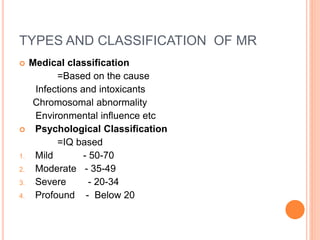
 Medical classification
=Based on the cause
Infections and intoxicants
Chromosomal abnormality
Environmental influence etc
 Psychological Classification
=IQ based
1. Mild - 50-70
2. Moderate - 35-49
3. Severe - 20-34
4. Profound - Below 20
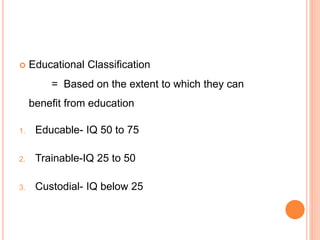
 Educational Classification
= Based on the extent to which they can
benefit from education
1. Educable- IQ 50 to 75
2. Trainable-IQ 25 to 50
3. Custodial- IQ below 25
CAUSES
 1.Genetic /Chromosomal factors
 2.Environmental factors
Genetic and Chromosomal factors
 When child receive defective genes or chromosome from
the parents.
Fragile ‘x’syndrome,Phenylketonuria.
 Defect occur during cell division as Chromosome pair
may not separate and the offspring got Extra
chromosome.
Down’s syndrome
DOWN’S SYNDROME
 John Langdon Down first described the condition in
1866
 Jerome Lejuene in 1959 as genetic condition
Chromosomal abnormality due to problems in cell
division
 Results from failure of separation of 21st pair
chromosome during cell division
 Acquire extra 21st chromosome-Trisomy 21
 47 chromosome in total
 Results in disruption of growth
TYPES
 Regular trisomy
All cell have extra chromosome 21
94% people
 Translocation
Extra chromosome 21 material attached to
another chromosome
4% people
 Mosaic
some body cells have extra chromosome
2%
CHARACTERISTICS
 Flattened face,nasal bridge
 Protruding tongue
 Almond shaped eyes
 Reduced muscle tone
 Broad hands and small fingers
 Congenital heart diseases
 IQ range from 20 to50
2. Environmental factors
External conditions that influence development.
 Illness or infection during pregnancy
 Poor nutrition
 Alcohol/Smoking
 RadiationEmotional stress etc
 Premature delivery
 Birth complications
EDUCATIONAL PROGRAMMES FOR MR
 Early Intervention Services
Early identification,screening, diagnosing with help of
profesionals.
Helps children from further deterioration
 Special schools
Schools where disabled children get education along with
same disability group
Advantage-
Greater degree of supervision and individualised
instruction in teaching and training MR children.
Disadvantage-
The protected environment does not teach how to cope
with the demand of society
 Residential Schools
Special schools with Hostel facility.
 Integrated education
Educational facilities for children with non-disabled
children in regular school.
 Special teacher ‘Resource teacher’
 Mainstreaming
Options in IE
 Education in regular classroom-slightly
intellectually diasabled
 Education in regular classroom with part-time
withdrawel from class for special attention
=Coordination of regular classroom teacher and
resource teacher
 Special class in the regular class
For moderately and severely mentally retarted
children
Educational needs more basic in nature
Integrated them in regular class for cocurricular
activities(art,craft,music,PE)
 Inclusive education
Provide education in regular school and clasroom
along with non-disabled children right from
beginning.
In service training for regular school teacher to
equip them with knowledge and skills to manage
MR children.
 Home based Training and Education
Family members get guidance,training from
professionals regarding how to carry out activities
with child,and do it in home.
Due to lack of resources with the family to enroll
child in school,Distance between school and home
or child’s condition

Intellectual disability

  • 1.
  • 2.
    DEFENITION  According toAmerican Asociation on Mental Retardation(AAMR); “Mental retardation refers to significantly sub- average general intellectual functioning with concurrent deficits in adaptive behaviour and manifested during the developmental period”.
  • 3.
    INTELLECTUAL DISABILITY  Refersto Sub average general intellectual functioning –IQ is less than 75.  Concurrently with Deficits in adaptive behaviour.  Adversely affects Educational performance.  Originate before the age of 18.
  • 4.
    IDENTIFICATION OF M.RCHILDREN  Congenital abnormalities  Social adjustment is limited .  Unable to achieve daily routines (bathing,toileting,eating)  Physical features- big/small head, slanting eyes..)  Little or no communication skills  Slow in learning, difficulty in remembering information.  Difficulty in finding soltion to a problem.  Language development delayed.
  • 5.
     Poor adjustment-lackof motivation,feeling of insecurity  Lack in thinking concept formation and process of generalization  Short temper  Lack of coordination,concentration  Inability to decide,understand,remember
  • 6.
    TYPES AND CLASSIFICATIONOF MR  Medical classification =Based on the cause Infections and intoxicants Chromosomal abnormality Environmental influence etc  Psychological Classification =IQ based 1. Mild - 50-70 2. Moderate - 35-49 3. Severe - 20-34 4. Profound - Below 20
  • 7.
     Educational Classification =Based on the extent to which they can benefit from education 1. Educable- IQ 50 to 75 2. Trainable-IQ 25 to 50 3. Custodial- IQ below 25
  • 8.
    CAUSES  1.Genetic /Chromosomalfactors  2.Environmental factors Genetic and Chromosomal factors  When child receive defective genes or chromosome from the parents. Fragile ‘x’syndrome,Phenylketonuria.  Defect occur during cell division as Chromosome pair may not separate and the offspring got Extra chromosome. Down’s syndrome
  • 9.
    DOWN’S SYNDROME  JohnLangdon Down first described the condition in 1866  Jerome Lejuene in 1959 as genetic condition Chromosomal abnormality due to problems in cell division  Results from failure of separation of 21st pair chromosome during cell division  Acquire extra 21st chromosome-Trisomy 21  47 chromosome in total  Results in disruption of growth
  • 10.
    TYPES  Regular trisomy Allcell have extra chromosome 21 94% people  Translocation Extra chromosome 21 material attached to another chromosome 4% people  Mosaic some body cells have extra chromosome 2%
  • 11.
    CHARACTERISTICS  Flattened face,nasalbridge  Protruding tongue  Almond shaped eyes  Reduced muscle tone  Broad hands and small fingers  Congenital heart diseases  IQ range from 20 to50
  • 12.
    2. Environmental factors Externalconditions that influence development.  Illness or infection during pregnancy  Poor nutrition  Alcohol/Smoking  RadiationEmotional stress etc  Premature delivery  Birth complications
  • 13.
    EDUCATIONAL PROGRAMMES FORMR  Early Intervention Services Early identification,screening, diagnosing with help of profesionals. Helps children from further deterioration  Special schools Schools where disabled children get education along with same disability group Advantage- Greater degree of supervision and individualised instruction in teaching and training MR children. Disadvantage- The protected environment does not teach how to cope with the demand of society  Residential Schools Special schools with Hostel facility.
  • 14.
     Integrated education Educationalfacilities for children with non-disabled children in regular school.  Special teacher ‘Resource teacher’  Mainstreaming Options in IE  Education in regular classroom-slightly intellectually diasabled  Education in regular classroom with part-time withdrawel from class for special attention =Coordination of regular classroom teacher and resource teacher
  • 15.
     Special classin the regular class For moderately and severely mentally retarted children Educational needs more basic in nature Integrated them in regular class for cocurricular activities(art,craft,music,PE)  Inclusive education Provide education in regular school and clasroom along with non-disabled children right from beginning. In service training for regular school teacher to equip them with knowledge and skills to manage MR children.
  • 16.
     Home basedTraining and Education Family members get guidance,training from professionals regarding how to carry out activities with child,and do it in home. Due to lack of resources with the family to enroll child in school,Distance between school and home or child’s condition

Editor's Notes

  • #4 Significantly sub average functioning: A person is described as significantly subaverage if his IQ does not exceed 70 ,characterized by significant limitation in general mental abilities and adaptive functioning. Adaptive behavior: Defined as “the effectiveness or degree with which the individual meets the standards of personal independence and social responsibility expected of his age and cultural group”.
  • #5 Difficulty in behaving ,carrying out tasks. Academic performance is below average. Physical features- narrow forehead, protruding tonge Congenital abnormalities Delayed all areas of development