INTEGRATING PARAPHRASES
    INTO YOUR WRITING
SIGNAL PHRASES

• You always want to introduce your paraphrase with
  a signal phrase by mentioning the author’s name
  AND include a page reference (in parentheses) at
  the end of the borrowed passage. This type of
  bookending of a paraphrase signals to your reader
  that these are not your own words or ideas and tells
  them where source material ends and your ideas
  begin.
SIGNAL PHRASES

• Using signal phrases is the best way to ensure that
  you integrate borrowed source material smoothly.
  A signal phrase couples the name of the writer from
  whom you are borrowing words or ideas with a verb
  that conveys your sense of the writer’s intent. In
  choosing a verb, consider the attitude or position of
  the writer you are citing. In most cases, you should
  also contextualize borrowed information. The first
  time you cite a source, establish the writer’s
  authority, and explain the significance of the
  paraphrase. You want to vary the verbs that you
  use to introduce a source’s words or ideas (instead
  of repeating says).
TRY SOME OF THESE SIGNAL VERBS:

   Acknowledges   Concludes
   Admits         Concurs
   Affirms        Believes
   Claims         Comments
   Discloses      Explains
   Finds          Illustrates
   Implies        Indicates
   Insists        Notes
   Observes       Predicts
   Proposes       Reports
   Speculates     Suggests
   Summarizes     States
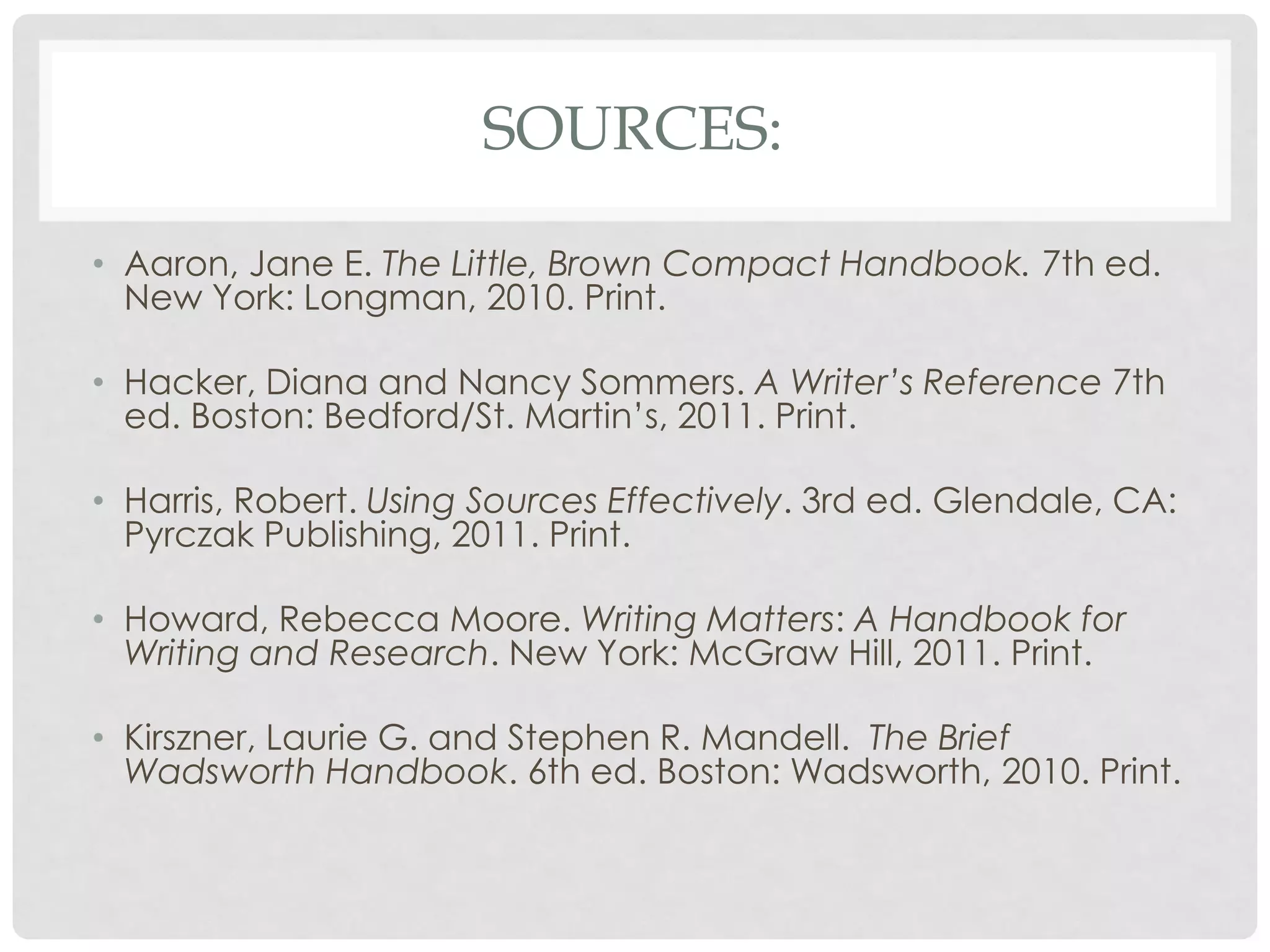
SOURCES:

• Aaron, Jane E. The Little, Brown Compact Handbook. 7th ed.
  New York: Longman, 2010. Print.

• Hacker, Diana and Nancy Sommers. A Writer’s Reference 7th
  ed. Boston: Bedford/St. Martin’s, 2011. Print.

• Harris, Robert. Using Sources Effectively. 3rd ed. Glendale, CA:
  Pyrczak Publishing, 2011. Print.

• Howard, Rebecca Moore. Writing Matters: A Handbook for
  Writing and Research. New York: McGraw Hill, 2011. Print.

• Kirszner, Laurie G. and Stephen R. Mandell. The Brief
  Wadsworth Handbook. 6th ed. Boston: Wadsworth, 2010. Print.

Integrating paraphrases into your writing

  • 1.
    INTEGRATING PARAPHRASES INTO YOUR WRITING
  • 2.
    SIGNAL PHRASES • Youalways want to introduce your paraphrase with a signal phrase by mentioning the author’s name AND include a page reference (in parentheses) at the end of the borrowed passage. This type of bookending of a paraphrase signals to your reader that these are not your own words or ideas and tells them where source material ends and your ideas begin.
  • 3.
    SIGNAL PHRASES • Usingsignal phrases is the best way to ensure that you integrate borrowed source material smoothly. A signal phrase couples the name of the writer from whom you are borrowing words or ideas with a verb that conveys your sense of the writer’s intent. In choosing a verb, consider the attitude or position of the writer you are citing. In most cases, you should also contextualize borrowed information. The first time you cite a source, establish the writer’s authority, and explain the significance of the paraphrase. You want to vary the verbs that you use to introduce a source’s words or ideas (instead of repeating says).
  • 4.
    TRY SOME OFTHESE SIGNAL VERBS: Acknowledges Concludes Admits Concurs Affirms Believes Claims Comments Discloses Explains Finds Illustrates Implies Indicates Insists Notes Observes Predicts Proposes Reports Speculates Suggests Summarizes States
  • 5.
    SOURCES: • Aaron, JaneE. The Little, Brown Compact Handbook. 7th ed. New York: Longman, 2010. Print. • Hacker, Diana and Nancy Sommers. A Writer’s Reference 7th ed. Boston: Bedford/St. Martin’s, 2011. Print. • Harris, Robert. Using Sources Effectively. 3rd ed. Glendale, CA: Pyrczak Publishing, 2011. Print. • Howard, Rebecca Moore. Writing Matters: A Handbook for Writing and Research. New York: McGraw Hill, 2011. Print. • Kirszner, Laurie G. and Stephen R. Mandell. The Brief Wadsworth Handbook. 6th ed. Boston: Wadsworth, 2010. Print.