How to keep engaged with your reading to
                improve comprehension:
Making connections helps
    readers!
   Remember the following techniques to make
    connections:
    • Relate to characters.
    • Visualize.
    • Avoid boredom...if you start to get bored, take a short break.
    • Pay attention, take your reading seriously.
    • Listen to others’ ideas about the reading.
    • Read actively and read with intention.
    • Ask questions.
    • Use an Annotation Method, mark your text, or utilize Double-
      Entry Diaries.
Text-to-Reader Connections:
How to relate to your reading
 Text to self: Connections between the text
  and the reader’s experiences and memories.
  The more experiences and memories a
  reader has about a topic, the easier the
  material is to read.
 Text to world: Connections the reader
  makes between the text and what he knows
  about the world (facts and information).
 Text to text: Connections the reader makes
  between two or more types of texts. The
  reader may make connections relative to
  plot, content, structure, or style.
Voices: What you “hear” when
you are reading
 Reciting Voice - The voice a reader hears when he is only
  reciting the words and not drawing meaning from the text.
 Conversation Voice - The voice that has a conversation
  with the text. It represents the reader’s thinking as he/she
  talks back to the text in an interactive way. It can take two
  forms:
   Interacting Voice - This voice encourages the reader to
     infer, make connections, ask questions, and synthesize
     information.
   Distracting Voice - This voice pulls the reader away from
     the text.
   Your goal to make the most effective
    use of your reading is to strive for the
    Interacting Conversation Voice!
Questioning/I Wonder…
   Questions can be more powerful than
    answers. Good readers ask questions
    throughout the reading process: before,
    during, and after reading. Readers who ask
    questions when they read assume
    responsibility for their learning and improve
    their comprehension in four ways:
       By interacting with text.
       By motivating themselves to read.
       By clarifying information in the text.
       By inferring beyond the literal meaning.
An Annotation Method
Use one of the annotation methods to clear
up confusion and make connections while
reading:
• Sticky Notes
Place sticky notes next to passages that
cause confusion so that you can return to
them.
• Highlighters
Use highlighters to mark places you
understand (pink) and places that are
confusing (yellow).
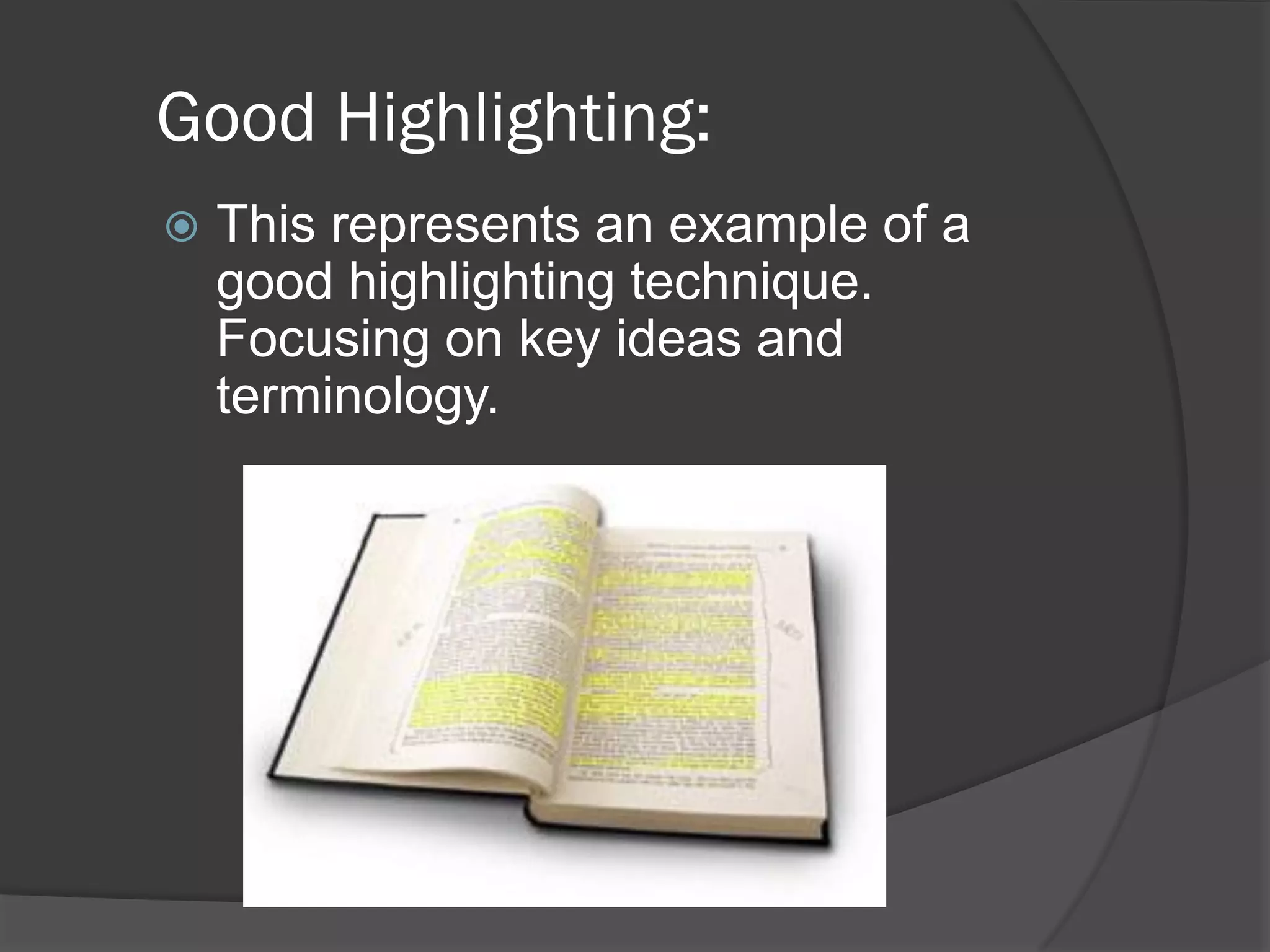
Good Highlighting:
   This represents an example of a
    good highlighting technique.
    Focusing on key ideas and
    terminology.
Bad Highlighting:
   Just because you are highlighting the
    text doesn’t mean you are doing it
    effectively. Do not highlight everything.
Marking Text
 Marking text helps readers pay attention and
 remember what they read. Try this marking
 method as a way to increase reading
 comprehension:
 • Assign codes to the types of thinking in which
 you engage. As you read, mark these codes next
 to the passages in the text that trigger these kinds
 of thinking and explain the connection.
     o C = connection reader makes to own life and
     text
     o ? = questions reader has about text
     o I = inference or conclusion reader draws
     from text
Double-entry Diaries (DED)
 DEDs are similar to taking notes.
 But are a good Comprehension Technique. Try some of the
 following DED strategies:
 • Divide page in half with questions and main ideas on the
 left and specific information on the right.
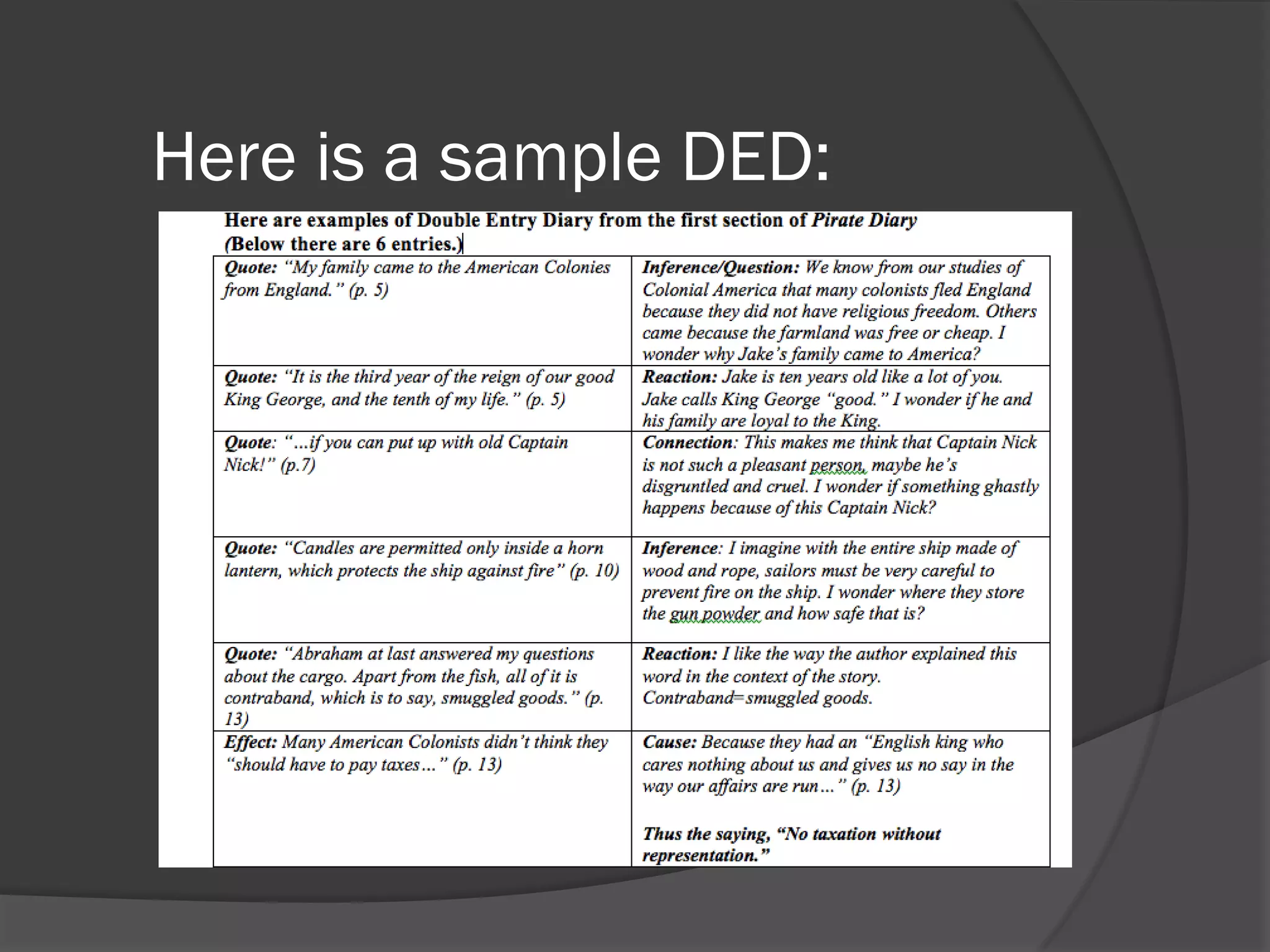
 • Divide page in half with direct quote from text and page
 number on the left and thinking options on the right (reader’s
 reactions). A sample of this type of DED is on the next slide.
 • Divide page in half with facts or details on the left and
 author’s message on the right.
 • Divide page in half with confusing part in text on the left
 and reader’s attempt to get unstuck on the right.
 • Divide page in half with new/confusing vocabulary on the
 left and reader’s knowledge on the right.
Here is a sample DED:
Sources:
 “Academic Support Guides: Reading
  Comprehension.” Cuesta College.
  http://academic.cuesta.edu/acasupp/as/300IN
  DEX.HTM
 Krieg, Elaine G. Strategies for College
  Readers. New York: Longman, 2008. Print.
 “Study Skills Activities: Reading as a Study
  Skill.” Montana State Literacy Resources: A
  Service of the National Institute of Literacy.
  http://www.nwlincs.org/mtlincs/pilotproject/stu
  dyskills/studyskillsindex.htm

Making connections

  • 1.
    How to keepengaged with your reading to improve comprehension:
  • 2.
    Making connections helps readers!  Remember the following techniques to make connections: • Relate to characters. • Visualize. • Avoid boredom...if you start to get bored, take a short break. • Pay attention, take your reading seriously. • Listen to others’ ideas about the reading. • Read actively and read with intention. • Ask questions. • Use an Annotation Method, mark your text, or utilize Double- Entry Diaries.
  • 3.
    Text-to-Reader Connections: How torelate to your reading  Text to self: Connections between the text and the reader’s experiences and memories. The more experiences and memories a reader has about a topic, the easier the material is to read.  Text to world: Connections the reader makes between the text and what he knows about the world (facts and information).  Text to text: Connections the reader makes between two or more types of texts. The reader may make connections relative to plot, content, structure, or style.
  • 4.
    Voices: What you“hear” when you are reading  Reciting Voice - The voice a reader hears when he is only reciting the words and not drawing meaning from the text.  Conversation Voice - The voice that has a conversation with the text. It represents the reader’s thinking as he/she talks back to the text in an interactive way. It can take two forms:  Interacting Voice - This voice encourages the reader to infer, make connections, ask questions, and synthesize information.  Distracting Voice - This voice pulls the reader away from the text.  Your goal to make the most effective use of your reading is to strive for the Interacting Conversation Voice!
  • 5.
    Questioning/I Wonder…  Questions can be more powerful than answers. Good readers ask questions throughout the reading process: before, during, and after reading. Readers who ask questions when they read assume responsibility for their learning and improve their comprehension in four ways:  By interacting with text.  By motivating themselves to read.  By clarifying information in the text.  By inferring beyond the literal meaning.
  • 6.
    An Annotation Method Useone of the annotation methods to clear up confusion and make connections while reading: • Sticky Notes Place sticky notes next to passages that cause confusion so that you can return to them. • Highlighters Use highlighters to mark places you understand (pink) and places that are confusing (yellow).
  • 7.
    Good Highlighting:  This represents an example of a good highlighting technique. Focusing on key ideas and terminology.
  • 8.
    Bad Highlighting:  Just because you are highlighting the text doesn’t mean you are doing it effectively. Do not highlight everything.
  • 9.
    Marking Text Markingtext helps readers pay attention and remember what they read. Try this marking method as a way to increase reading comprehension: • Assign codes to the types of thinking in which you engage. As you read, mark these codes next to the passages in the text that trigger these kinds of thinking and explain the connection. o C = connection reader makes to own life and text o ? = questions reader has about text o I = inference or conclusion reader draws from text
  • 10.
    Double-entry Diaries (DED) DEDs are similar to taking notes. But are a good Comprehension Technique. Try some of the following DED strategies: • Divide page in half with questions and main ideas on the left and specific information on the right. • Divide page in half with direct quote from text and page number on the left and thinking options on the right (reader’s reactions). A sample of this type of DED is on the next slide. • Divide page in half with facts or details on the left and author’s message on the right. • Divide page in half with confusing part in text on the left and reader’s attempt to get unstuck on the right. • Divide page in half with new/confusing vocabulary on the left and reader’s knowledge on the right.
  • 11.
    Here is asample DED:
  • 12.
    Sources:  “Academic SupportGuides: Reading Comprehension.” Cuesta College. http://academic.cuesta.edu/acasupp/as/300IN DEX.HTM  Krieg, Elaine G. Strategies for College Readers. New York: Longman, 2008. Print.  “Study Skills Activities: Reading as a Study Skill.” Montana State Literacy Resources: A Service of the National Institute of Literacy. http://www.nwlincs.org/mtlincs/pilotproject/stu dyskills/studyskillsindex.htm