Incorporating Sources into
Your Writing
English 102 - C.J. Hill
Information is taken from Becoming
Rhetorical by Jodie Nicotra
All research MUST be PART of a conversation
...that is in conversation with outside sources needs to have established a clear and
consistent way to signal (a) that it is participating in a conversation, and (b) how it is
participating in conversation.
Being able to signal your participation in a given conversation in a smooth,
knowledgeable way is a sure way to bolster your ethos with your audience. So while
you may find issues of formatting like summarizing, paraphrasing, quoting, and citing
insufferably dull, it may help you to know that paying careful attention to these
details helps ensure that your message is actually taken seriously by your audience.
Use summary when...
You are responding to a specific piece: for instance, you would need
to summarize when you’re doing a review, or when you’re writing a letter to the
editor or composing something in response to some other composition.
Use paraphrase when...
The content you want to incorporate into your composition is more factual or data-
based (you don’t need to directly quote someone else’s presentation of statistics, for
instance).
You want to maintain the flow of your own piece. Too many “undigested” quotes
makes a piece feel choppy. Plus, if the communicator uses too many direct quotes, it
creates the impression of laziness, as if they were implicitly saying, “Well, I’ll just let
someone else go ahead and say this.”
You want to incorporate only information that’s relevant to the topic of your
composition (you can also mix paraphrase and quoting).
Use direct quotations when...
It’s important that you capture how someone has said something—if you’re
introducing a contentious idea, for instance.
Often, incorporating sources involves a mix of summarizing, quoting, and
paraphrasing: For instance, you might quote a somewhat complicated or
difficult passage, and then explain it “in other words.” Or you can paraphrase
part of what the author is saying and quote only the important bits.
Example: Dr. John Bonbon, the curator of the new exhibit “Kangaroos in Glass,”
first conceived of the idea when he realized that the world associated
kangaroos with dirty creatures who bound across the Outback or get into
“kangaroo boxing matches,” which are filmed and uploaded to YouTube by
curious bystanders. It was his intention to highlight kangaroos’ more elegant
characteristics. “These animals are really quite graceful, even delicate,” he
explains in the exhibit brochure. “I wanted to show that they’re more than just
silly, goofy creatures with pouches and big tails.” The exhibit features life-sized
sculptures of kangaroos composed in transparent materials from glass to
glycerin.
Indicating use of sources
To smoothly incorporate outside sources, you must establish a consistent way of
indicating that you’re using them. In writing or in podcasts, you might use phrases
like these:
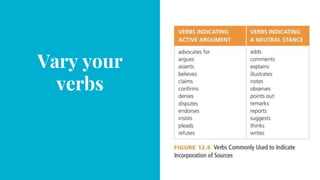
● In her article “. . . ,” X [argues] that. . . “[this can be followed by either a direct quote
or a paraphrase].”
● According to X, “. . .”
● X [articulates the issue as] “. . .”
● “. . . ,” writes X.
● As X has [noted], “. . .”
Vary your
verbs
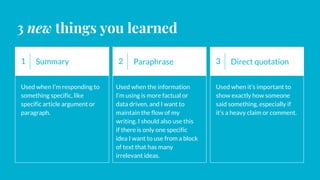
3 new things you learned
1 Summary
Used when I’m responding to
something specific, like
specific article argument or
paragraph.
2 Paraphrase
Used when the information
I’m using is more factual or
data driven, and I want to
maintain the flow of my
writing. I should also use this
if there is only one specific
idea I want to use from a block
of text that has many
irrelevant ideas.
3 Direct quotation
Used when it’s important to
show exactly how someone
said something, especially if
it’s a heavy claim or comment.
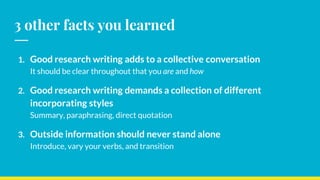
3 other facts you learned
1. Good research writing adds to a collective conversation
It should be clear throughout that you are and how
2. Good research writing demands a collection of different
incorporating styles
Summary, paraphrasing, direct quotation
3. Outside information should never stand alone
Introduce, vary your verbs, and transition
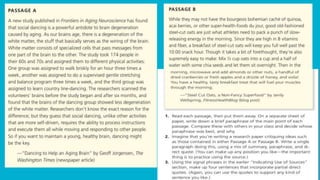
Individual Activity
Type out your answers to the questions on the following slide on a Word
document and email as an attachment to Caitlin by 1:30 pm on
Wednesday March 7.
Disregard instructions that ask you to share work with group members.
Incorporating sources

Incorporating sources

  • 1.
    Incorporating Sources into YourWriting English 102 - C.J. Hill Information is taken from Becoming Rhetorical by Jodie Nicotra
  • 2.
    All research MUSTbe PART of a conversation ...that is in conversation with outside sources needs to have established a clear and consistent way to signal (a) that it is participating in a conversation, and (b) how it is participating in conversation. Being able to signal your participation in a given conversation in a smooth, knowledgeable way is a sure way to bolster your ethos with your audience. So while you may find issues of formatting like summarizing, paraphrasing, quoting, and citing insufferably dull, it may help you to know that paying careful attention to these details helps ensure that your message is actually taken seriously by your audience.
  • 3.
    Use summary when... Youare responding to a specific piece: for instance, you would need to summarize when you’re doing a review, or when you’re writing a letter to the editor or composing something in response to some other composition.
  • 4.
    Use paraphrase when... Thecontent you want to incorporate into your composition is more factual or data- based (you don’t need to directly quote someone else’s presentation of statistics, for instance). You want to maintain the flow of your own piece. Too many “undigested” quotes makes a piece feel choppy. Plus, if the communicator uses too many direct quotes, it creates the impression of laziness, as if they were implicitly saying, “Well, I’ll just let someone else go ahead and say this.” You want to incorporate only information that’s relevant to the topic of your composition (you can also mix paraphrase and quoting).
  • 5.
    Use direct quotationswhen... It’s important that you capture how someone has said something—if you’re introducing a contentious idea, for instance.
  • 6.
    Often, incorporating sourcesinvolves a mix of summarizing, quoting, and paraphrasing: For instance, you might quote a somewhat complicated or difficult passage, and then explain it “in other words.” Or you can paraphrase part of what the author is saying and quote only the important bits. Example: Dr. John Bonbon, the curator of the new exhibit “Kangaroos in Glass,” first conceived of the idea when he realized that the world associated kangaroos with dirty creatures who bound across the Outback or get into “kangaroo boxing matches,” which are filmed and uploaded to YouTube by curious bystanders. It was his intention to highlight kangaroos’ more elegant characteristics. “These animals are really quite graceful, even delicate,” he explains in the exhibit brochure. “I wanted to show that they’re more than just silly, goofy creatures with pouches and big tails.” The exhibit features life-sized sculptures of kangaroos composed in transparent materials from glass to glycerin.
  • 7.
    Indicating use ofsources To smoothly incorporate outside sources, you must establish a consistent way of indicating that you’re using them. In writing or in podcasts, you might use phrases like these: ● In her article “. . . ,” X [argues] that. . . “[this can be followed by either a direct quote or a paraphrase].” ● According to X, “. . .” ● X [articulates the issue as] “. . .” ● “. . . ,” writes X. ● As X has [noted], “. . .”
  • 8.
  • 9.
    3 new thingsyou learned 1 Summary Used when I’m responding to something specific, like specific article argument or paragraph. 2 Paraphrase Used when the information I’m using is more factual or data driven, and I want to maintain the flow of my writing. I should also use this if there is only one specific idea I want to use from a block of text that has many irrelevant ideas. 3 Direct quotation Used when it’s important to show exactly how someone said something, especially if it’s a heavy claim or comment.
  • 10.
    3 other factsyou learned 1. Good research writing adds to a collective conversation It should be clear throughout that you are and how 2. Good research writing demands a collection of different incorporating styles Summary, paraphrasing, direct quotation 3. Outside information should never stand alone Introduce, vary your verbs, and transition
  • 11.
    Individual Activity Type outyour answers to the questions on the following slide on a Word document and email as an attachment to Caitlin by 1:30 pm on Wednesday March 7. Disregard instructions that ask you to share work with group members.