Win-Win approach for every one???
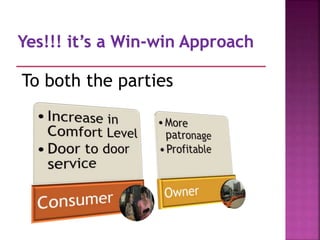
To both the parties
Hassle Free Journey -
PassengerMore Profit -
Owner
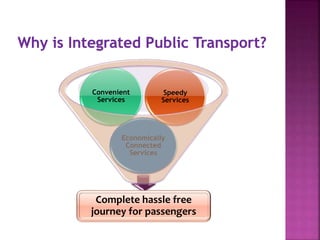
Complete hassle free
journey for passengers
Economically
Connected
Services
Convenient
Services
Speedy
Services
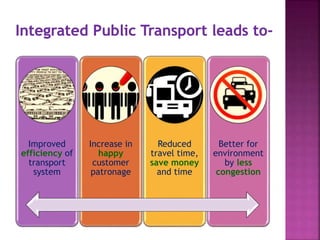
Improved
efficiency of
transport
system
Increase in
happy
customer
patronage
Reduced
travel time,
save money
and time
Better for
environment
by less
congestion
Physical Integration
Institutional Integration
Network Integration
Information Integration
Fare Integration
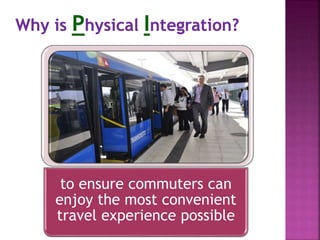
to ensure commuters can
enjoy the most convenient
travel experience possible
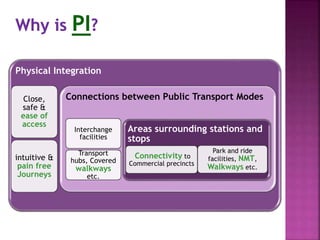
Physical Integration
Close,
safe &
ease of
access
intuitive &
pain free
Journeys
Connections between Public Transport Modes
Interchange
facilities
Transport
hubs, Covered
walkways
etc.
Areas surrounding stations and
stops
Connectivity to
Commercial precincts
Park and ride
facilities, NMT,
Walkways etc.
PI -Between different
modes
-Surrounding stations
and stops
-With commercial
precincts
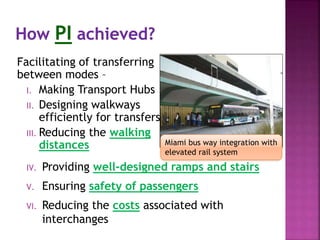
Facilitating of transferring
between modes –
I. Making Transport Hubs
II. Designing walkways
efficiently for transfers
III. Reducing the walking
distances Miami bus way integration with
elevated rail system
IV. Providing well-designed ramps and stairs
V. Ensuring safety of passengers
VI. Reducing the costs associated with
interchanges
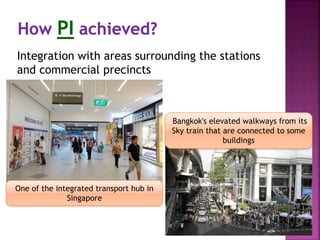
Integration with areas surrounding the stations
and commercial precincts
One of the integrated transport hub in
Singapore
Bangkok's elevated walkways from its
Sky train that are connected to some
buildings
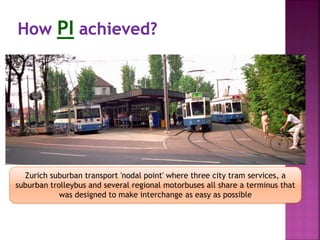
Zurich suburban transport 'nodal point' where three city tram services, a
suburban trolleybus and several regional motorbuses all share a terminus that
was designed to make interchange as easy as possible
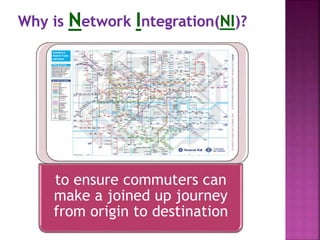
to ensure commuters can
make a joined up journey
from origin to destination
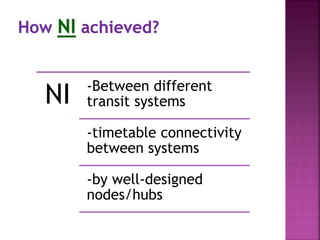
NI -Between different
transit systems
-timetable connectivity
between systems
-by well-designed
nodes/hubs
I. Making transport hubs
II. Time table connectivity between two systems
III. Turn up and go services between different
systems
IV. Efficient intra modal and intermodal services
to ensure commuters can
make informed decisions
before and during their
journey
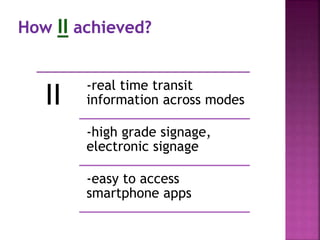
II
-real time transit
information across modes
-high grade signage,
electronic signage
-easy to access
smartphone apps
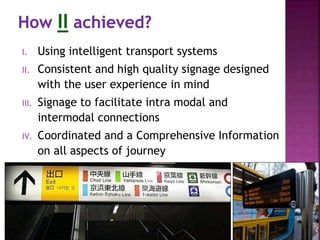
I. Using intelligent transport systems
II. Consistent and high quality signage designed
with the user experience in mind
III. Signage to facilitate intra modal and
intermodal connections
IV. Coordinated and a Comprehensive Information
on all aspects of journey
to ensure commuters aren’t
penalized for making the
most efficient use of an
integrated transport system
FI
-single fare card for
multiple transit services
-smart rider cards such
oyster in London or octopus
in Singapore
-easy to access smartphone
apps
I. Single area wide fare structure –permit
users pay at the beginning of the trip and
transfer freely between all modes or lines of
service covered by the system.
II. create an easy-to-understand fare system
based on principles accepted by the users.
to ensure the right transport
choices are made for
commuters
InI
-allow for a robust assessment of
all mode options within a
corridor
-Single governing authority helps
to implement integration with a
minimum of political obstacles.
-ensures transport planning,
pricing and operational aspects
span all modes
I. Single Agency
allows transport
planning to be
modally agnostic
when transport
investment decisions
are being made.
II. Create an Cooperation and Coordination
amongst government agencies, and between
the private and public sectors.
All Images Source: World Wide Web

Integrated public transport

  • 1.
  • 2.
    To both theparties
  • 3.
    Hassle Free Journey- PassengerMore Profit - Owner
  • 4.
    Complete hassle free journeyfor passengers Economically Connected Services Convenient Services Speedy Services
  • 5.
    Improved efficiency of transport system Increase in happy customer patronage Reduced traveltime, save money and time Better for environment by less congestion
  • 6.
    Physical Integration Institutional Integration NetworkIntegration Information Integration Fare Integration
  • 7.
    to ensure commuterscan enjoy the most convenient travel experience possible
  • 8.
    Physical Integration Close, safe & easeof access intuitive & pain free Journeys Connections between Public Transport Modes Interchange facilities Transport hubs, Covered walkways etc. Areas surrounding stations and stops Connectivity to Commercial precincts Park and ride facilities, NMT, Walkways etc.
  • 9.
    PI -Between different modes -Surroundingstations and stops -With commercial precincts
  • 10.
    Facilitating of transferring betweenmodes – I. Making Transport Hubs II. Designing walkways efficiently for transfers III. Reducing the walking distances Miami bus way integration with elevated rail system IV. Providing well-designed ramps and stairs V. Ensuring safety of passengers VI. Reducing the costs associated with interchanges
  • 11.
    Integration with areassurrounding the stations and commercial precincts One of the integrated transport hub in Singapore Bangkok's elevated walkways from its Sky train that are connected to some buildings
  • 12.
    Zurich suburban transport'nodal point' where three city tram services, a suburban trolleybus and several regional motorbuses all share a terminus that was designed to make interchange as easy as possible
  • 13.
    to ensure commuterscan make a joined up journey from origin to destination
  • 14.
    NI -Between different transitsystems -timetable connectivity between systems -by well-designed nodes/hubs
  • 15.
    I. Making transporthubs II. Time table connectivity between two systems III. Turn up and go services between different systems IV. Efficient intra modal and intermodal services
  • 16.
    to ensure commuterscan make informed decisions before and during their journey
  • 17.
    II -real time transit informationacross modes -high grade signage, electronic signage -easy to access smartphone apps
  • 18.
    I. Using intelligenttransport systems II. Consistent and high quality signage designed with the user experience in mind III. Signage to facilitate intra modal and intermodal connections IV. Coordinated and a Comprehensive Information on all aspects of journey
  • 19.
    to ensure commutersaren’t penalized for making the most efficient use of an integrated transport system
  • 20.
    FI -single fare cardfor multiple transit services -smart rider cards such oyster in London or octopus in Singapore -easy to access smartphone apps
  • 21.
    I. Single areawide fare structure –permit users pay at the beginning of the trip and transfer freely between all modes or lines of service covered by the system. II. create an easy-to-understand fare system based on principles accepted by the users.
  • 22.
    to ensure theright transport choices are made for commuters
  • 23.
    InI -allow for arobust assessment of all mode options within a corridor -Single governing authority helps to implement integration with a minimum of political obstacles. -ensures transport planning, pricing and operational aspects span all modes
  • 24.
    I. Single Agency allowstransport planning to be modally agnostic when transport investment decisions are being made. II. Create an Cooperation and Coordination amongst government agencies, and between the private and public sectors.
  • 25.
    All Images Source:World Wide Web

Editor's Notes

  • #5 integration means the speedy, convenient and economical connection of services to make up complete journeys for passengers from their origins to their final destinations.