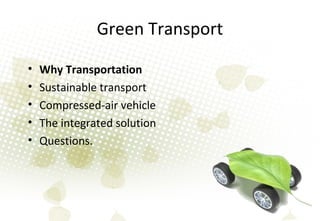
Green Transport
• Why Transportation.
• Sustainable transport
• Compressed-air vehicle
• The integrated solution
• Questions.
Green Transport
• Why Transportation
• Sustainable transport
• Compressed-air vehicle
• The integrated solution
• Questions.
Why Transportation.
Sustainable Transport
Compressed-air vehicle
The integrated solution.
Questions.
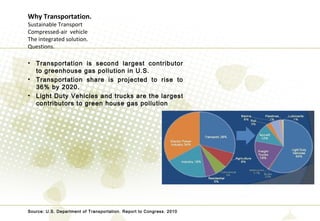
• Transportation is second largest contributor
to greenhouse gas pollution in U.S.
• Transportation share is projected to rise to
36% by 2020.
• Light Duty Vehicles and trucks are the largest
contributors to green house gas pollution
Source: U.S. Department of Transportation. Report to Congress. 2010
Why Transportation.
Sustainable Transport
Compressed-air vehicle
The integrated solution.
Questions.
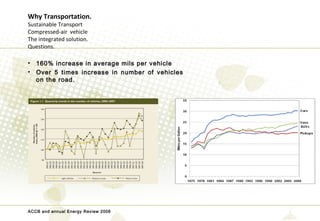
• 160% increase in average mils per vehicle
• Over 5 times increase in number of vehicles
on the road.
ACCB and annual Energy Review 2006
Green Transport
• Why Transportation
• Sustainable transport
• Compressed-air vehicle
• The integrated solution
• Questions.
Why Transportation.
Sustainable Transport
Compressed-air vehicle
The integrated solution.
Questions.
• It includes road vehicle , railways,
waterways, canals, pipelines, and terminals.
• It measures transportation system
effectiveness, efficiency and environmental
impacts.
• Traditional transport planning aims to
improve mobility, especially for vehicle, and
may fail to adequately consider
environmental impact.
Why Transportation.
Sustainable Transport
Compressed-air vehicle
The integrated solution.
Questions.
Green Vehicles:
•Currently 95% of transport energy comes from
petroleum.
•Green vehicle intends to have less
environmental impact than equivalent standard
vehicle.
•Electric vehicle, Hybrid vehicle, Natural gas
vehicle, Biofuels vehicle, Compressed air
vehicle are samples of Green vehicle.
IPCC fourth assessment reports: Mitigation of Climate change, Chapter5, Transport and it’s infrastructure. 2009
Why Transportation.
Sustainable Transport
Compressed-air vehicle
The integrated solution.
Questions.
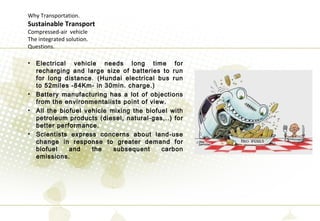
• Electrical vehicle needs long time for
recharging and large size of batteries to run
for long distance. (Hundai electrical bus run
to 52miles -84Km- in 30min. charge.)
• Battery manufacturing has a lot of objections
from the environmentalists point of view.
• All the biofuel vehicle mixing the biofuel with
petroleum products (diesel, natural-gas,..) for
better performance.
• Scientists express concerns about land-use
change in response to greater demand for
biofuel and the subsequent carbon
emissions.
Green Transport
• Why Transportation
• Sustainable transport
• Compressed-air vehicle
• The integrated solution
• Questions.
Why Transportation.
Sustainable Transport
Compressed-air vehicle
The integrated solution.
Questions.
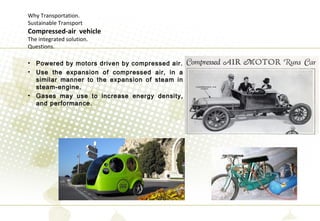
• Powered by motors driven by compressed air.
• Use the expansion of compressed air, in a
similar manner to the expansion of steam in
steam-engine.
• Gases may use to increase energy density,
and performance.
Why Transportation.
Sustainable Transport
Compressed-air vehicle
The integrated solution.
Questions.
• Compressed-air car is emission-free at the
exhaust.
• By using clean source of electricity, the total
impact will be environmental.
• Researches are running now on the
MultiCATs transporter (car pooling).
Why Transportation.
Sustainable Transport
Compressed-air vehicle
The integrated solution.
Questions.
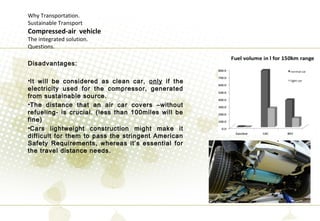
Disadvantages:
•It will be considered as clean car, only if the
electricity used for the compressor, generated
from sustainable source.
•The distance that an air car covers –without
refueling- is crucial. (less than 100miles will be
fine)
•Cars lightweight construction might make it
difficult for them to pass the stringent American
Safety Requirements, whereas it’s essential for
the travel distance needs.
Green Transport
• Why Transportation
• Sustainable transport
• Compressed-air vehicle
• The integrated solution
• Questions.
Why Transportation.
Sustainable Transport
Compressed-air vehicle
The integrated solution
Questions.
Which vehicle should use Compressed-air
engine?
•Should be worked for short travel distance.
•Should have stops within it’s trip for refueling.
•Do not require high speed, because high speed
consume too much air, which enlarge the tank
sizes.
Why Transportation.
Sustainable Transport
Compressed-air vehicle
The integrated solution
Questions.
Sample of vehicle might be used:
•Passenger bus at airport property.
•Public buses.
•Garbage collector vans.
•Taxis
** Bus stops in this proposal, would work as
intermediate fuel station for these vehicle.
Why Transportation.
Sustainable Transport
Compressed-air vehicle
The integrated solution
Questions.
Sustainable source of power for refuel points
(Bus stops):
1- Solar photo-voltaic panel:
Advantages:
*Renewable and sustainable resource.
* Solar Cells are totally silent.
* Require very little maintenance.
*Manufacturers have 20-year
warranties.
Disadvantages:
* Solar panels are expensive to buy
*Storage system usually include
batteries.
Why Transportation.
Sustainable Transport
Compressed-air vehicle
The integrated solution
Questions.
Sustainable source of power for refuel points
(Bus stops):
2- Stirling engine:
•A Stirling engine is a heat engine operating by
cyclic compression and expansion of air, other
gas, or liquid.
•Its efficient, quiet operation, and it can use
almost any heat source (such as solar).
**Watch it working on the path
http://www.youtube.com/watch?v=vfVv9RVGizY
Why Transportation.
Sustainable Transport
Compressed-air vehicle
The integrated solution
Questions.
Sample of proposed Bus Stop
Under ground air tank
Air pump for re-fueling
Solar Stirling engine
Photo-voltaic panels
Bus stop, Dubai - UAE
Mamdouh Amin

Green Transport

  • 2.
    Green Transport • WhyTransportation. • Sustainable transport • Compressed-air vehicle • The integrated solution • Questions.
  • 3.
    Green Transport • WhyTransportation • Sustainable transport • Compressed-air vehicle • The integrated solution • Questions.
  • 4.
    Why Transportation. Sustainable Transport Compressed-airvehicle The integrated solution. Questions. • Transportation is second largest contributor to greenhouse gas pollution in U.S. • Transportation share is projected to rise to 36% by 2020. • Light Duty Vehicles and trucks are the largest contributors to green house gas pollution Source: U.S. Department of Transportation. Report to Congress. 2010
  • 5.
    Why Transportation. Sustainable Transport Compressed-airvehicle The integrated solution. Questions. • 160% increase in average mils per vehicle • Over 5 times increase in number of vehicles on the road. ACCB and annual Energy Review 2006
  • 6.
    Green Transport • WhyTransportation • Sustainable transport • Compressed-air vehicle • The integrated solution • Questions.
  • 7.
    Why Transportation. Sustainable Transport Compressed-airvehicle The integrated solution. Questions. • It includes road vehicle , railways, waterways, canals, pipelines, and terminals. • It measures transportation system effectiveness, efficiency and environmental impacts. • Traditional transport planning aims to improve mobility, especially for vehicle, and may fail to adequately consider environmental impact.
  • 8.
    Why Transportation. Sustainable Transport Compressed-airvehicle The integrated solution. Questions. Green Vehicles: •Currently 95% of transport energy comes from petroleum. •Green vehicle intends to have less environmental impact than equivalent standard vehicle. •Electric vehicle, Hybrid vehicle, Natural gas vehicle, Biofuels vehicle, Compressed air vehicle are samples of Green vehicle. IPCC fourth assessment reports: Mitigation of Climate change, Chapter5, Transport and it’s infrastructure. 2009
  • 9.
    Why Transportation. Sustainable Transport Compressed-airvehicle The integrated solution. Questions. • Electrical vehicle needs long time for recharging and large size of batteries to run for long distance. (Hundai electrical bus run to 52miles -84Km- in 30min. charge.) • Battery manufacturing has a lot of objections from the environmentalists point of view. • All the biofuel vehicle mixing the biofuel with petroleum products (diesel, natural-gas,..) for better performance. • Scientists express concerns about land-use change in response to greater demand for biofuel and the subsequent carbon emissions.
  • 10.
    Green Transport • WhyTransportation • Sustainable transport • Compressed-air vehicle • The integrated solution • Questions.
  • 11.
    Why Transportation. Sustainable Transport Compressed-airvehicle The integrated solution. Questions. • Powered by motors driven by compressed air. • Use the expansion of compressed air, in a similar manner to the expansion of steam in steam-engine. • Gases may use to increase energy density, and performance.
  • 12.
    Why Transportation. Sustainable Transport Compressed-airvehicle The integrated solution. Questions. • Compressed-air car is emission-free at the exhaust. • By using clean source of electricity, the total impact will be environmental. • Researches are running now on the MultiCATs transporter (car pooling).
  • 13.
    Why Transportation. Sustainable Transport Compressed-airvehicle The integrated solution. Questions. Disadvantages: •It will be considered as clean car, only if the electricity used for the compressor, generated from sustainable source. •The distance that an air car covers –without refueling- is crucial. (less than 100miles will be fine) •Cars lightweight construction might make it difficult for them to pass the stringent American Safety Requirements, whereas it’s essential for the travel distance needs.
  • 14.
    Green Transport • WhyTransportation • Sustainable transport • Compressed-air vehicle • The integrated solution • Questions.
  • 15.
    Why Transportation. Sustainable Transport Compressed-airvehicle The integrated solution Questions. Which vehicle should use Compressed-air engine? •Should be worked for short travel distance. •Should have stops within it’s trip for refueling. •Do not require high speed, because high speed consume too much air, which enlarge the tank sizes.
  • 16.
    Why Transportation. Sustainable Transport Compressed-airvehicle The integrated solution Questions. Sample of vehicle might be used: •Passenger bus at airport property. •Public buses. •Garbage collector vans. •Taxis ** Bus stops in this proposal, would work as intermediate fuel station for these vehicle.
  • 17.
    Why Transportation. Sustainable Transport Compressed-airvehicle The integrated solution Questions. Sustainable source of power for refuel points (Bus stops): 1- Solar photo-voltaic panel: Advantages: *Renewable and sustainable resource. * Solar Cells are totally silent. * Require very little maintenance. *Manufacturers have 20-year warranties. Disadvantages: * Solar panels are expensive to buy *Storage system usually include batteries.
  • 18.
    Why Transportation. Sustainable Transport Compressed-airvehicle The integrated solution Questions. Sustainable source of power for refuel points (Bus stops): 2- Stirling engine: •A Stirling engine is a heat engine operating by cyclic compression and expansion of air, other gas, or liquid. •Its efficient, quiet operation, and it can use almost any heat source (such as solar). **Watch it working on the path http://www.youtube.com/watch?v=vfVv9RVGizY
  • 19.
    Why Transportation. Sustainable Transport Compressed-airvehicle The integrated solution Questions. Sample of proposed Bus Stop Under ground air tank Air pump for re-fueling Solar Stirling engine Photo-voltaic panels Bus stop, Dubai - UAE
  • 20.