Lesson Five
Understanding how to create partnerships and routines
and their importance
Overview
• Parents as partners
• Routines
Childminders who have an excellent relationship with parents of children in their
care are able to understand their needs and interests in context with the family
background.
Work hard to make parents and carers feel included in their child’s learning and
development. Encourage parents and carers to observe their child at play in the
home and use this to develop their learning.
Parents as Partners
Parents as Partners cont...
Use different ways to communicate with parents and carers:
• Daily diaries of significant events for their children
• Text messages
• Email for photos
• Twitter
• Regular newsletters
• Social events
• Workshops
Routines
With parents as partners, childminders can offer an appropriate routine for each
child.
Why routines are good for children
• They can teach younger children healthy habits like brushing their teeth,
getting some exercise or washing hands after using the toilet
• An organised and predictable environment helps children and young people
feel safe and secure
• Routines built around fun or spending time together strengthen relationships
Routines cont...
Why routines are good for children
• Daily routines help set our body clocks. For example, bedtime routines help
children’s bodies ‘know’ when it’s time to sleep
• If the child needs to take medicine regularly, a routine for this will help make
both of you less likely to forget
• Routines help develop basic work skills and time management
• Routines are important for children who find it hard to understand or cope with
change
Routines cont...
Childminders should:
• Recognise that the background, needs and preferences of each child are unique
• Make sure that they meet each child’s needs by working very closely with
parents and others involved
• Make sure they understand the culture of every child and include these in daily
discussions and activities
• Observe and talk to the children about their likes and dislikes and interests.
• Include outings and trips in the weekly routines
Routines cont...
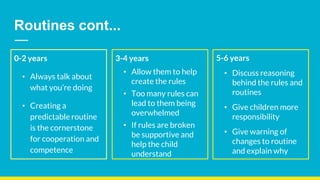
0-2 years
• Always talk about
what you’re doing
• Creating a
predictable routine
is the cornerstone
for cooperation and
competence
3-4 years
• Allow them to help
create the rules
• Too many rules can
lead to them being
overwhelmed
• If rules are broken
be supportive and
help the child
understand
5-6 years
• Discuss reasoning
behind the rules and
routines
• Give children more
responsibility
• Give warning of
changes to routine
and explain why
Routines cont...
How to show you welcome and value the children at your setting:
• Praise the children when they do a job or task well.
• Listen to the children.
• Share your own imperfections, especially in cases where your mistake affects a
child. Celebrate each child's uniqueness
• Spend one-on-one time with each child
• Talk to the children regularly.
• Celebrate even the smallest of achievements the children make.
• Read to the children, and ask them to read to you.
• Allow the children to make choices.

5. Lesson Five - Partnerships and Routines

  • 1.
    Lesson Five Understanding howto create partnerships and routines and their importance
  • 2.
    Overview • Parents aspartners • Routines
  • 3.
    Childminders who havean excellent relationship with parents of children in their care are able to understand their needs and interests in context with the family background. Work hard to make parents and carers feel included in their child’s learning and development. Encourage parents and carers to observe their child at play in the home and use this to develop their learning. Parents as Partners
  • 4.
    Parents as Partnerscont... Use different ways to communicate with parents and carers: • Daily diaries of significant events for their children • Text messages • Email for photos • Twitter • Regular newsletters • Social events • Workshops
  • 5.
    Routines With parents aspartners, childminders can offer an appropriate routine for each child. Why routines are good for children • They can teach younger children healthy habits like brushing their teeth, getting some exercise or washing hands after using the toilet • An organised and predictable environment helps children and young people feel safe and secure • Routines built around fun or spending time together strengthen relationships
  • 6.
    Routines cont... Why routinesare good for children • Daily routines help set our body clocks. For example, bedtime routines help children’s bodies ‘know’ when it’s time to sleep • If the child needs to take medicine regularly, a routine for this will help make both of you less likely to forget • Routines help develop basic work skills and time management • Routines are important for children who find it hard to understand or cope with change
  • 7.
    Routines cont... Childminders should: •Recognise that the background, needs and preferences of each child are unique • Make sure that they meet each child’s needs by working very closely with parents and others involved • Make sure they understand the culture of every child and include these in daily discussions and activities • Observe and talk to the children about their likes and dislikes and interests. • Include outings and trips in the weekly routines
  • 8.
    Routines cont... 0-2 years •Always talk about what you’re doing • Creating a predictable routine is the cornerstone for cooperation and competence 3-4 years • Allow them to help create the rules • Too many rules can lead to them being overwhelmed • If rules are broken be supportive and help the child understand 5-6 years • Discuss reasoning behind the rules and routines • Give children more responsibility • Give warning of changes to routine and explain why
  • 9.
    Routines cont... How toshow you welcome and value the children at your setting: • Praise the children when they do a job or task well. • Listen to the children. • Share your own imperfections, especially in cases where your mistake affects a child. Celebrate each child's uniqueness • Spend one-on-one time with each child • Talk to the children regularly. • Celebrate even the smallest of achievements the children make. • Read to the children, and ask them to read to you. • Allow the children to make choices.