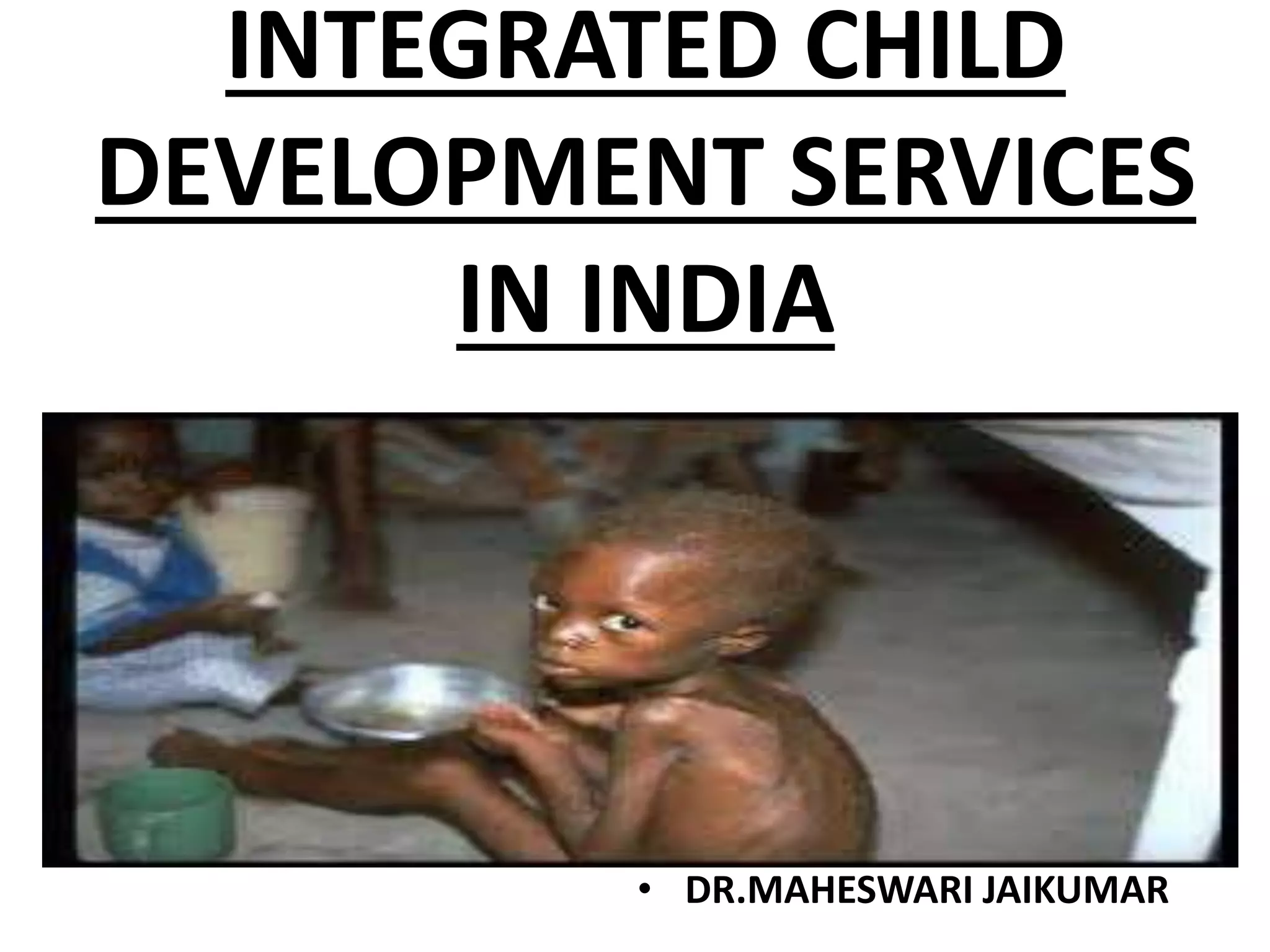
INTEGRATED CHILD
DEVELOPMENT SERVICES
IN INDIA
• DR.MAHESWARI JAIKUMAR
ICDS
• Important scheme in the field of child
welfare.
• The blue print of the programme was
prepared in 1975.
• Was taken up as a pilot project in 75 -76
in Delhi (4 urban & 19 rural areas & 10
tribal areas)
OBJECTIVES
1. To improve the nutritional &
health status of children in
the age group 0-6 yrs.
2. To lay the foundations for
proper psychological,
physical & social
development of the child.
3. To reduce mortality & morbidity,
malnutrition & school drop out.
4. To achieve an effective co
ordination of policy &
implementation among various
departments working for the
promotion of child
development.
5. To enhance the capability of the
mother & nutritional needs of
the child through proper
nutrition & health education.
HEALTH CARE DELIVERY
SYSTEM
1.Implementd through ANGANWADI
CENTRES.
2.revised norm for AWC rural & urban
areas:
a.AWC for 400-800 pop.
b.AWC for 800-1200 pop.
c.AWC for 1600-2400 pop (for multiples
of 800 pop –MINI AWC for 150-400 pop)
FOR TRIBAL & HILLY AREAS
1 AWC for 300-800 pop.
1 MINI AWC for 150-300 pop
PACKAGE OF SERVICES
BENEFICIARY SERVICES
PREGNANT WOMEN 1. Health Check up.
2. Immunization against tetanus.
3. Supplementary nutrition.
4. Nutrition & Health Education.
NURSING MOTHERS 1. Health check ups.
2. Supplementary nutrition.
3. Nutrition & Health
Education.
PACKAGE OF SERVICES
BENEFICIARY SERVICES
OTHER WOMEN
15-45 yrs
1. Nutrition & Health Education.
2. Supplementary nutrition.
CHILDREN < 3 YRS 1. Health check ups.
2. Supplementary nutrition.
3. Immunization
4.Referral Services
PACKAGE OF SERVICES
BENEFICIARY SERVICES
CHILDREN 3-6 YRS 1. Supplementary nutrition.
2. Immunization.
3. Health Check up.
4. Referral services.
5. Non formal education.
ADOLESCENT
GIRLS 11-18 YRS
1. Supplementary nutrition.
2. Nutrition & Health Education.
DELIVERY OF
HEALTH SERVICES
SUPLEMENTARY NUTRITION
• THE AIM IS TO SUPPLEMENT NUTRITIONAL
INTAKE AS FOLLOWS
1.Each child 6-72 Mo of age to get 500 Kcal & 12-
15 gms of protein /child/day.
2.Severely malnourished child (6-72 Mo) to get
800 Kcal & 20-25 gms of protein /child/day.
3.Each pregnant mother & nursing women to get
600 Kcal & 18-20 gms of protein/mother/day.
1. Compulsory one meal to a child
attending AWCs which includes
providing a morning snaks in form of
milk/bannana/egg/seasonal
fruit/micro nutrient fortified food
followed by cooked hot meal.
FOR CHILDREN < 3 YRS & PREGNANT &
LACTATING MOTHER
1.“Take Home Ration” is provided.
2.All are eligible to avail services of
ICDS
3.Supplementary nutrition is given for
300 days in a year.
4. Children are weighed every month.
5.Nutrition & Health education is given
to mothers of children suffering from
1st degree malnutrition.
6.Therapeutic food is given to children
suffering from 2nd & 3rd degree
malnutrition
7.Children suffering from 4th degree
malnutrition are recommended
hospitalization.
NUTRITION & HEALTH EDUCATION
• Nutrition education & Health Education
is given to all women in the age group
15-45 yrs, giving priority to nursing &
expectant mothers.
• It is imparted by specially designed
courses in village during home visits by
anganwadi workers
IMMUNIZATION
• CHILDREN : Immunization of
children against 6 VPDs
• MOTHERS: immunization against
tetanus
HEALTH CHECK UP
INCLUDES:
1.Antenatal care of expectant
mothers.
2.Post natal care & new born care.
3.Care of children < 6 yrs.
4.IFA supplementation along with protein
for mothers.
5.A minimum of 3 physical examination.
6.Referral of High Risk Mothers
HEALTH CARE OF <6 YRS -
COMPONENTS
1.Record of weight & height of children
at periodical intervals.
2.Watch over mile stones.
3.Immunization.
4.General check up every 3-6 Mo.
5.Treatment for diseases like diarrhoea,
dysentery, RTI.
6.Deworming.
7.Prophylaxis against Vit A deficiency &
anaemia.
8.Referral of serious cases to hospital.
HEALTH RECORDS
• Health records of children &
mothers are maintained.
• A card containing the health record
of child is given to the mother.
NON FORMAL PRE - SCHOOL
EDUCATION
• Children between 3 & 6 yrs are imparted
non formal pre school education.
• The objective is to provide
opportunities to develop desirable
attitudes, values & behavioural pattern.
• Locally produced in expensive toys are
used in organizing play & creative
activity.
SCHEMES FOR ADOLESCENT
GIRLS
• KISHORI SAKTHI YOJANA.
• NUTRITION PROGRAMME FOR
ADOLESCENT GIRLS
KISHORI SHAKTHI YOJANA
• The scheme targets adolescent girls of
11 – 18 yrs.
• The programme addresses their needs
of self development, nutrition & health
status, literacy & numerical skills &
vocational skills.
NUTRITION PROGRAMME FOR
ADOLESCENT GIRLS
• Was approved in 2009-10.
• The project is implemented in 51
identified districts.
• Undernourished girls (11-15 yrs) < 30 kg
& (15-19 yrs) < 35 kg are covered under
the scheme
• 6 kg of free food grain is provided
for each beneficiary per month.
• The programme is implemented
through ICDS scheme at the state,
Dt, block & Anganwadi centre level.
TWO MORE SCHEMES ARE ALSO
IMPLEMENTED.
• 1.RAJIV GANDHI SCHEME FOR
EMPOWERMENT OF ADOLESCENT GIRLS,
&”SABLA” (11-18 YRS) to improve their
nutritional health status.
• 2.GANDHI MATRUTVA SAHAYOG YOJNA
(IGMSY) – Conditional cash transfer to
pregnant women & lactating mothers to
improve their nutritional status
ADMINISTRATIVE UNIT OF ICDS
1. COMMUNITY DEVELOPMENT
BLOCK.
2. TRIBAL DEVELOPMENT BLOCK
THANK YOU

INTEGRATED CHILD DEVELOPMENT PROGRAMME-INDIA

  • 1.
    INTEGRATED CHILD DEVELOPMENT SERVICES ININDIA • DR.MAHESWARI JAIKUMAR
  • 4.
    ICDS • Important schemein the field of child welfare. • The blue print of the programme was prepared in 1975. • Was taken up as a pilot project in 75 -76 in Delhi (4 urban & 19 rural areas & 10 tribal areas)
  • 5.
    OBJECTIVES 1. To improvethe nutritional & health status of children in the age group 0-6 yrs. 2. To lay the foundations for proper psychological, physical & social development of the child.
  • 6.
    3. To reducemortality & morbidity, malnutrition & school drop out. 4. To achieve an effective co ordination of policy & implementation among various departments working for the promotion of child development.
  • 7.
    5. To enhancethe capability of the mother & nutritional needs of the child through proper nutrition & health education.
  • 8.
    HEALTH CARE DELIVERY SYSTEM 1.Implementdthrough ANGANWADI CENTRES. 2.revised norm for AWC rural & urban areas: a.AWC for 400-800 pop. b.AWC for 800-1200 pop. c.AWC for 1600-2400 pop (for multiples of 800 pop –MINI AWC for 150-400 pop)
  • 9.
    FOR TRIBAL &HILLY AREAS 1 AWC for 300-800 pop. 1 MINI AWC for 150-300 pop
  • 10.
    PACKAGE OF SERVICES BENEFICIARYSERVICES PREGNANT WOMEN 1. Health Check up. 2. Immunization against tetanus. 3. Supplementary nutrition. 4. Nutrition & Health Education. NURSING MOTHERS 1. Health check ups. 2. Supplementary nutrition. 3. Nutrition & Health Education.
  • 11.
    PACKAGE OF SERVICES BENEFICIARYSERVICES OTHER WOMEN 15-45 yrs 1. Nutrition & Health Education. 2. Supplementary nutrition. CHILDREN < 3 YRS 1. Health check ups. 2. Supplementary nutrition. 3. Immunization 4.Referral Services
  • 12.
    PACKAGE OF SERVICES BENEFICIARYSERVICES CHILDREN 3-6 YRS 1. Supplementary nutrition. 2. Immunization. 3. Health Check up. 4. Referral services. 5. Non formal education. ADOLESCENT GIRLS 11-18 YRS 1. Supplementary nutrition. 2. Nutrition & Health Education.
  • 13.
  • 14.
    SUPLEMENTARY NUTRITION • THEAIM IS TO SUPPLEMENT NUTRITIONAL INTAKE AS FOLLOWS 1.Each child 6-72 Mo of age to get 500 Kcal & 12- 15 gms of protein /child/day. 2.Severely malnourished child (6-72 Mo) to get 800 Kcal & 20-25 gms of protein /child/day. 3.Each pregnant mother & nursing women to get 600 Kcal & 18-20 gms of protein/mother/day.
  • 15.
    1. Compulsory onemeal to a child attending AWCs which includes providing a morning snaks in form of milk/bannana/egg/seasonal fruit/micro nutrient fortified food followed by cooked hot meal.
  • 16.
    FOR CHILDREN <3 YRS & PREGNANT & LACTATING MOTHER 1.“Take Home Ration” is provided. 2.All are eligible to avail services of ICDS 3.Supplementary nutrition is given for 300 days in a year.
  • 17.
    4. Children areweighed every month. 5.Nutrition & Health education is given to mothers of children suffering from 1st degree malnutrition. 6.Therapeutic food is given to children suffering from 2nd & 3rd degree malnutrition
  • 18.
    7.Children suffering from4th degree malnutrition are recommended hospitalization.
  • 19.
    NUTRITION & HEALTHEDUCATION • Nutrition education & Health Education is given to all women in the age group 15-45 yrs, giving priority to nursing & expectant mothers. • It is imparted by specially designed courses in village during home visits by anganwadi workers
  • 20.
    IMMUNIZATION • CHILDREN :Immunization of children against 6 VPDs • MOTHERS: immunization against tetanus
  • 21.
    HEALTH CHECK UP INCLUDES: 1.Antenatalcare of expectant mothers. 2.Post natal care & new born care. 3.Care of children < 6 yrs.
  • 22.
    4.IFA supplementation alongwith protein for mothers. 5.A minimum of 3 physical examination. 6.Referral of High Risk Mothers
  • 23.
    HEALTH CARE OF<6 YRS - COMPONENTS 1.Record of weight & height of children at periodical intervals. 2.Watch over mile stones. 3.Immunization. 4.General check up every 3-6 Mo.
  • 24.
    5.Treatment for diseaseslike diarrhoea, dysentery, RTI. 6.Deworming. 7.Prophylaxis against Vit A deficiency & anaemia. 8.Referral of serious cases to hospital.
  • 25.
    HEALTH RECORDS • Healthrecords of children & mothers are maintained. • A card containing the health record of child is given to the mother.
  • 26.
    NON FORMAL PRE- SCHOOL EDUCATION • Children between 3 & 6 yrs are imparted non formal pre school education. • The objective is to provide opportunities to develop desirable attitudes, values & behavioural pattern. • Locally produced in expensive toys are used in organizing play & creative activity.
  • 28.
    SCHEMES FOR ADOLESCENT GIRLS •KISHORI SAKTHI YOJANA. • NUTRITION PROGRAMME FOR ADOLESCENT GIRLS
  • 29.
    KISHORI SHAKTHI YOJANA •The scheme targets adolescent girls of 11 – 18 yrs. • The programme addresses their needs of self development, nutrition & health status, literacy & numerical skills & vocational skills.
  • 30.
    NUTRITION PROGRAMME FOR ADOLESCENTGIRLS • Was approved in 2009-10. • The project is implemented in 51 identified districts. • Undernourished girls (11-15 yrs) < 30 kg & (15-19 yrs) < 35 kg are covered under the scheme
  • 31.
    • 6 kgof free food grain is provided for each beneficiary per month. • The programme is implemented through ICDS scheme at the state, Dt, block & Anganwadi centre level.
  • 33.
    TWO MORE SCHEMESARE ALSO IMPLEMENTED. • 1.RAJIV GANDHI SCHEME FOR EMPOWERMENT OF ADOLESCENT GIRLS, &”SABLA” (11-18 YRS) to improve their nutritional health status. • 2.GANDHI MATRUTVA SAHAYOG YOJNA (IGMSY) – Conditional cash transfer to pregnant women & lactating mothers to improve their nutritional status
  • 34.
    ADMINISTRATIVE UNIT OFICDS 1. COMMUNITY DEVELOPMENT BLOCK. 2. TRIBAL DEVELOPMENT BLOCK
  • 36.