INTRODUCTION
ICDS Scheme represents one of the world’s largest and
most unique programmes for early childhood
development. ICDS is the foremost symbol of India’s
commitment to her children. The main beneficiaries
of the programme were aimed to be the girl child up to
her adolescence, all children below 6 years of age,
pregnant and lactating mothers.
Purpose of initiation
 Routine MCH services not reaching target
population.
 Nutritional component not covered by health
services.
 Need for community participation.
OBJECTIVES
 To improve the nutritional status of preschool children 0-6
years of age group.
 To lay the foundation of proper psychological development
of the child
 To reduce the incidence of mortality, morbidity
malnutrition and school drop out
 To achieve effective coordination of policy and
implementation in various departments to promote child
development
 To enhance the capability of the mother to look after the
normal health and nutritional needs of of the child
through proper nutrition and health education
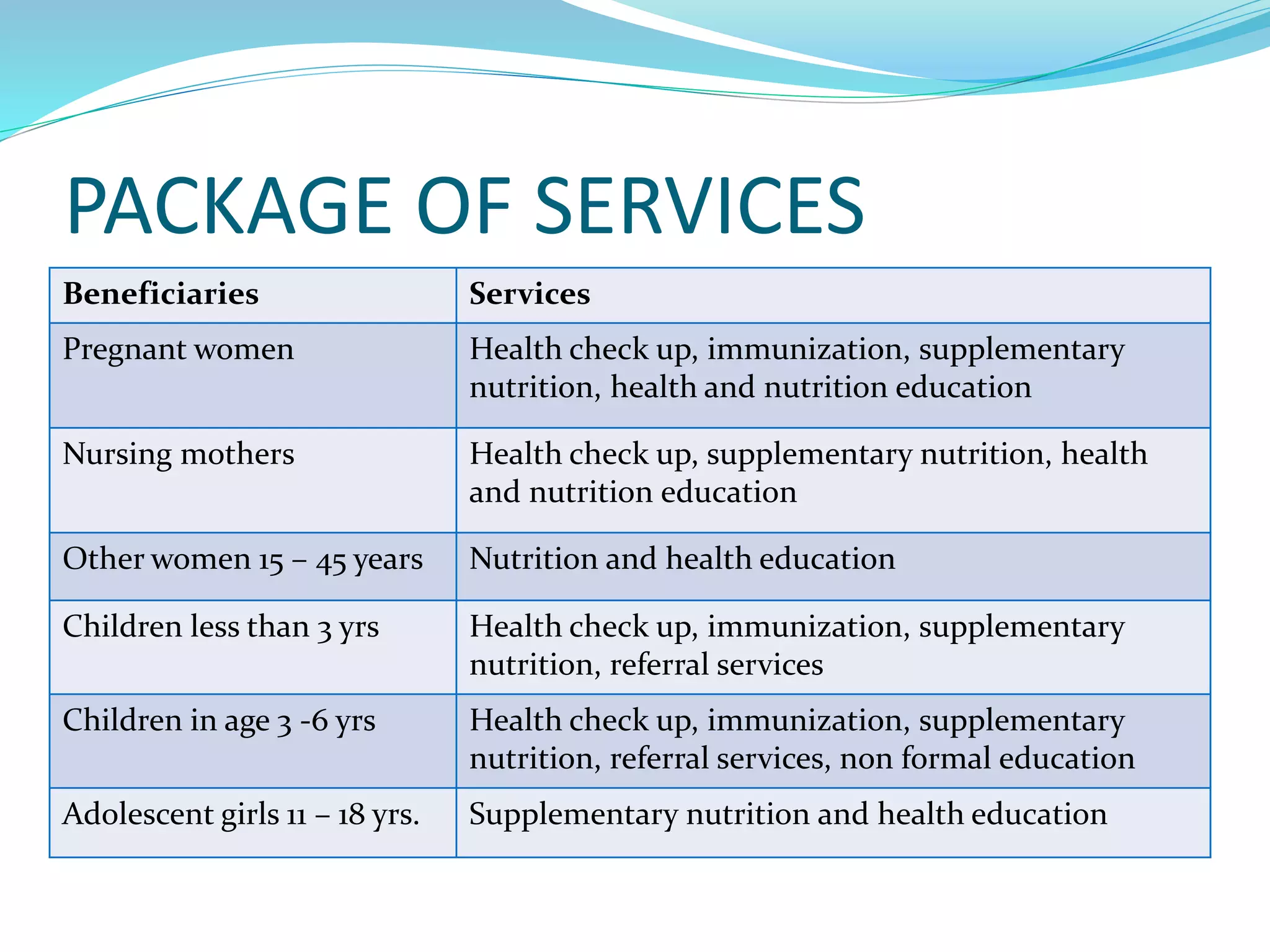
PACKAGE OF SERVICES
Beneficiaries Services
Pregnant women Health check up, immunization, supplementary
nutrition, health and nutrition education
Nursing mothers Health check up, supplementary nutrition, health
and nutrition education
Other women 15 – 45 years Nutrition and health education
Children less than 3 yrs Health check up, immunization, supplementary
nutrition, referral services
Children in age 3 -6 yrs Health check up, immunization, supplementary
nutrition, referral services, non formal education
Adolescent girls 11 – 18 yrs. Supplementary nutrition and health education
COMPONENT OF ICDS
 Health Check-ups.
 Immunization.
 Growth Promotion and Supplementary Feeding.
 Referral Services.
 Early Childhood Care and Pre-school Education.
 Nutrition and Health Education.
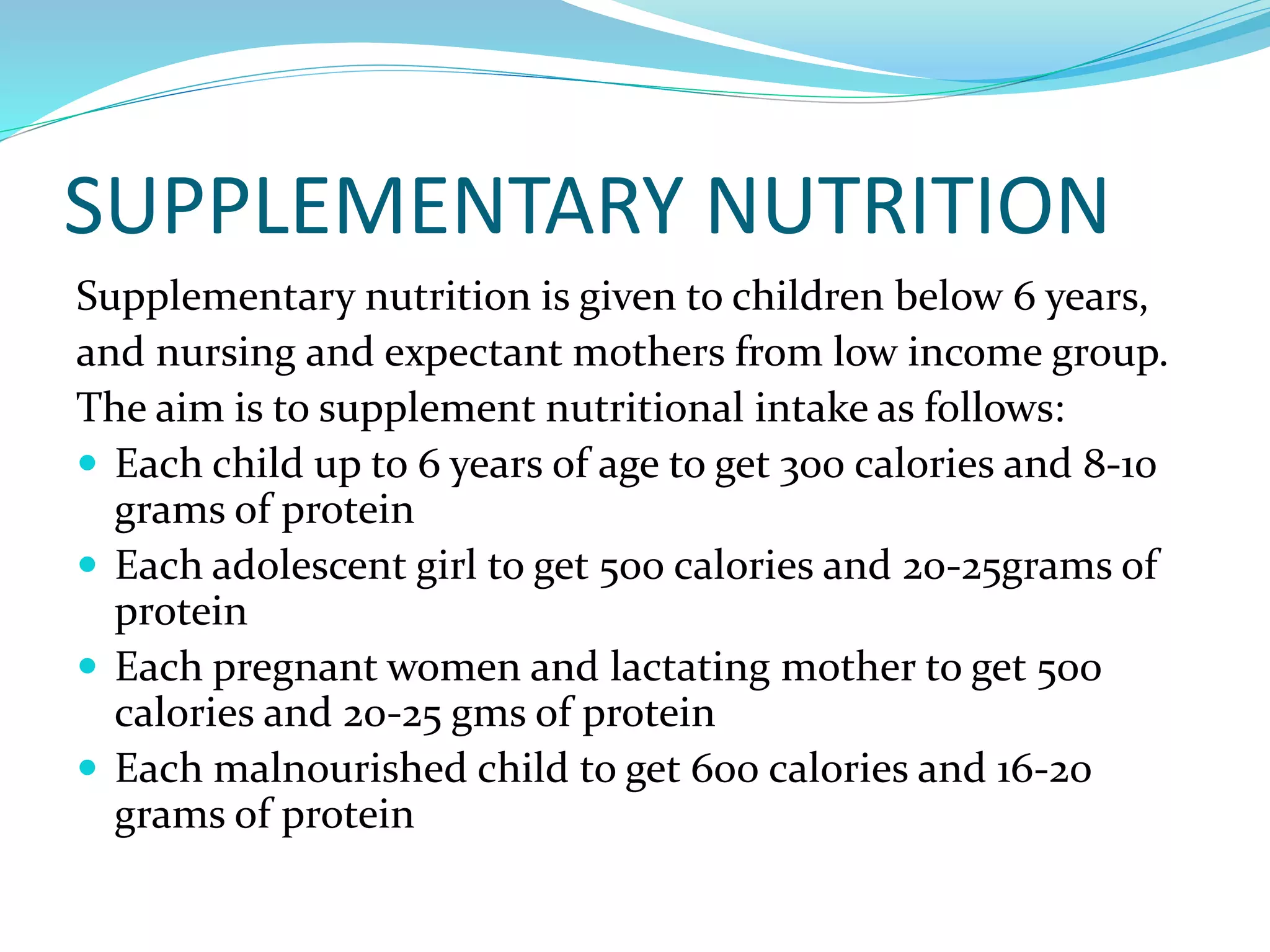
SUPPLEMENTARY NUTRITION
Supplementary nutrition is given to children below 6 years,
and nursing and expectant mothers from low income group.
The aim is to supplement nutritional intake as follows:
 Each child up to 6 years of age to get 300 calories and 8-10
grams of protein
 Each adolescent girl to get 500 calories and 20-25grams of
protein
 Each pregnant women and lactating mother to get 500
calories and 20-25 gms of protein
 Each malnourished child to get 600 calories and 16-20
grams of protein
IMMUNIZATION-
 Immunization of children against 6 vaccine
preventable disease is being done, while for expectant
mothers, immunization against tetanus is
recommended.
HEALTH CHECK UP
 Record of weight and height of children at periodical intervals
 Watch over milestones
 Immunization
 Deworming
 General check up for
detection of disease
 Treatment of diseases like
diarrhea, ARI
 Prophylaxis against vitamin A
deficiency and anemia
 Referral of serious cases
 Antenatal care of expectant mothers
 Post natal care of nursing mothers and care of new born infants
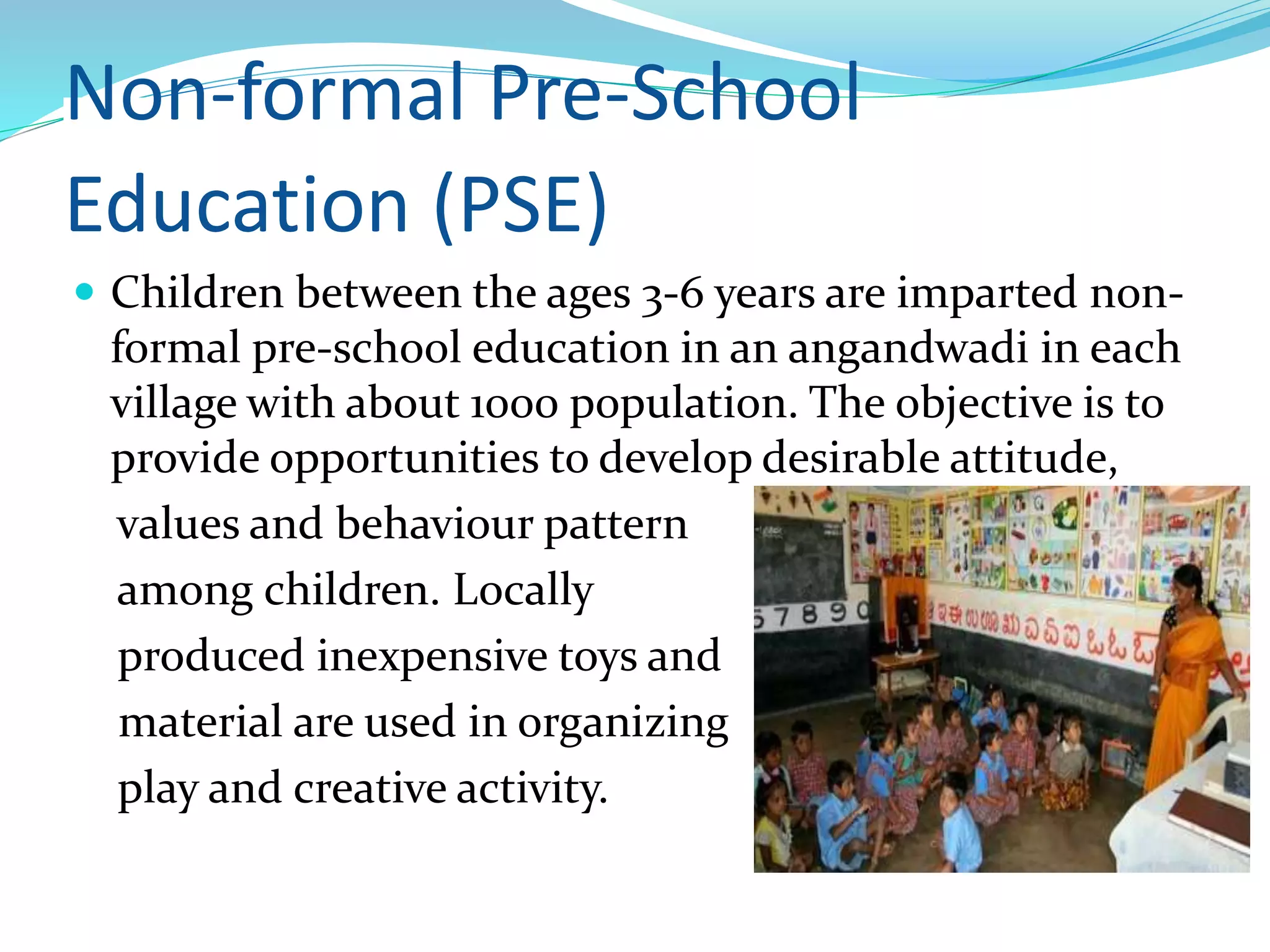
Non-formal Pre-School
Education (PSE)
 Children between the ages 3-6 years are imparted non-
formal pre-school education in an angandwadi in each
village with about 1000 population. The objective is to
provide opportunities to develop desirable attitude,
values and behaviour pattern
among children. Locally
produced inexpensive toys and
material are used in organizing
play and creative activity.
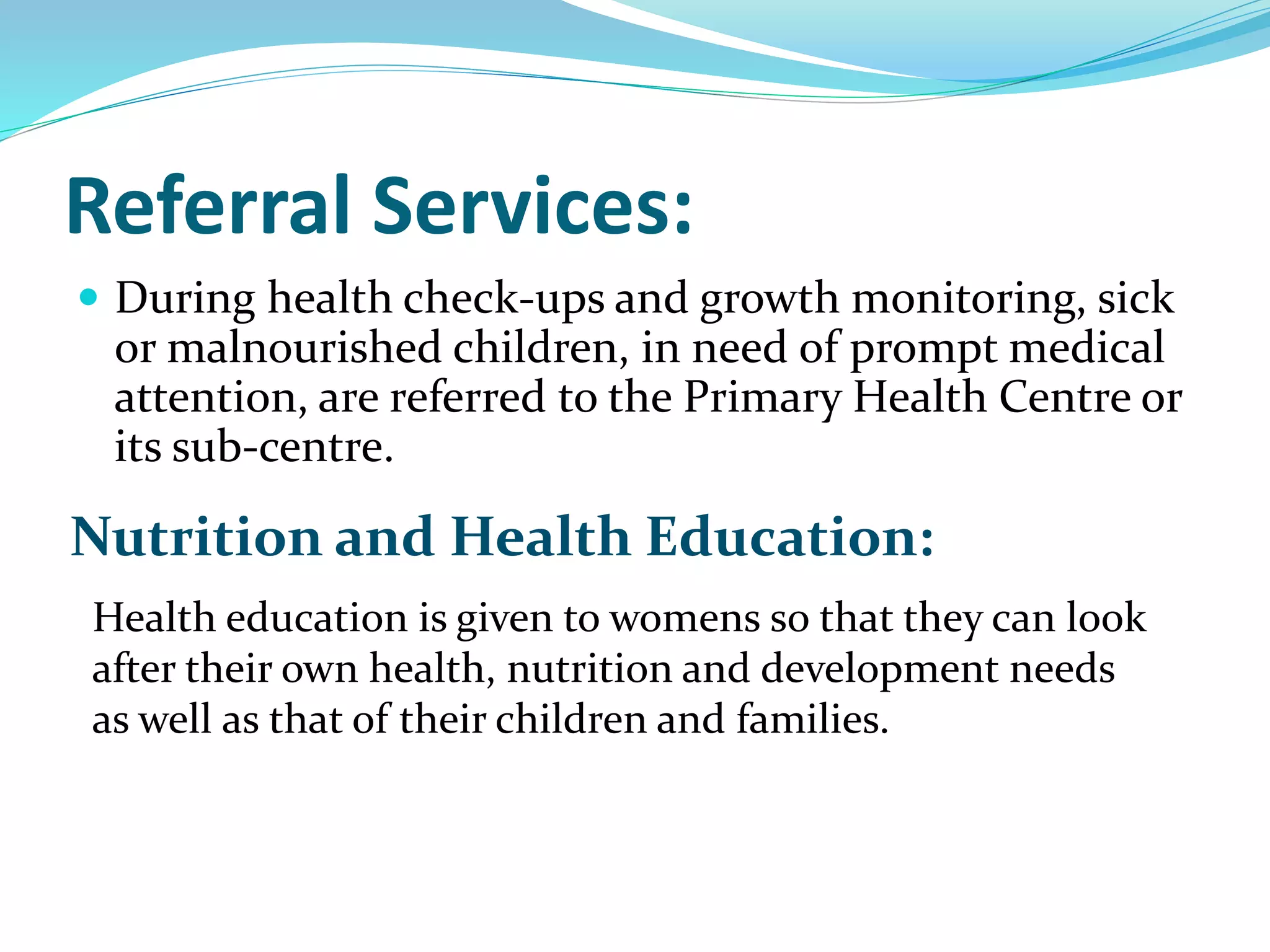
Referral Services:
 During health check-ups and growth monitoring, sick
or malnourished children, in need of prompt medical
attention, are referred to the Primary Health Centre or
its sub-centre.
Nutrition and Health Education:
Health education is given to womens so that they can look
after their own health, nutrition and development needs
as well as that of their children and families.
Population Norms:-
 Anganwadi Centres
For Rural/Urban Projects
400-800 - 1 AWC
800-1600 - 2 AWCs
1600-2400 - 3 AWCs
Thereafter in multiples of 800 1 AWC
 For Mini-AWC - 150-400 1 Mini-AWC
 For Tribal /Riverine/Desert, Hilly and other
difficult areas/ Projects - 300-800 - 1 AWC
 For Mini- AWC - 150-300 1 Mini AWC
Funding pattern
 ICDS is a Centrally-sponsored Scheme implemented
through the State Governments/UT Administrations.
 Prior to 2005-06, 100% financial assistance for inputs
other than supplementary nutrition, which the States
were to provided out of their own resources, was being
provided by the Government of India.
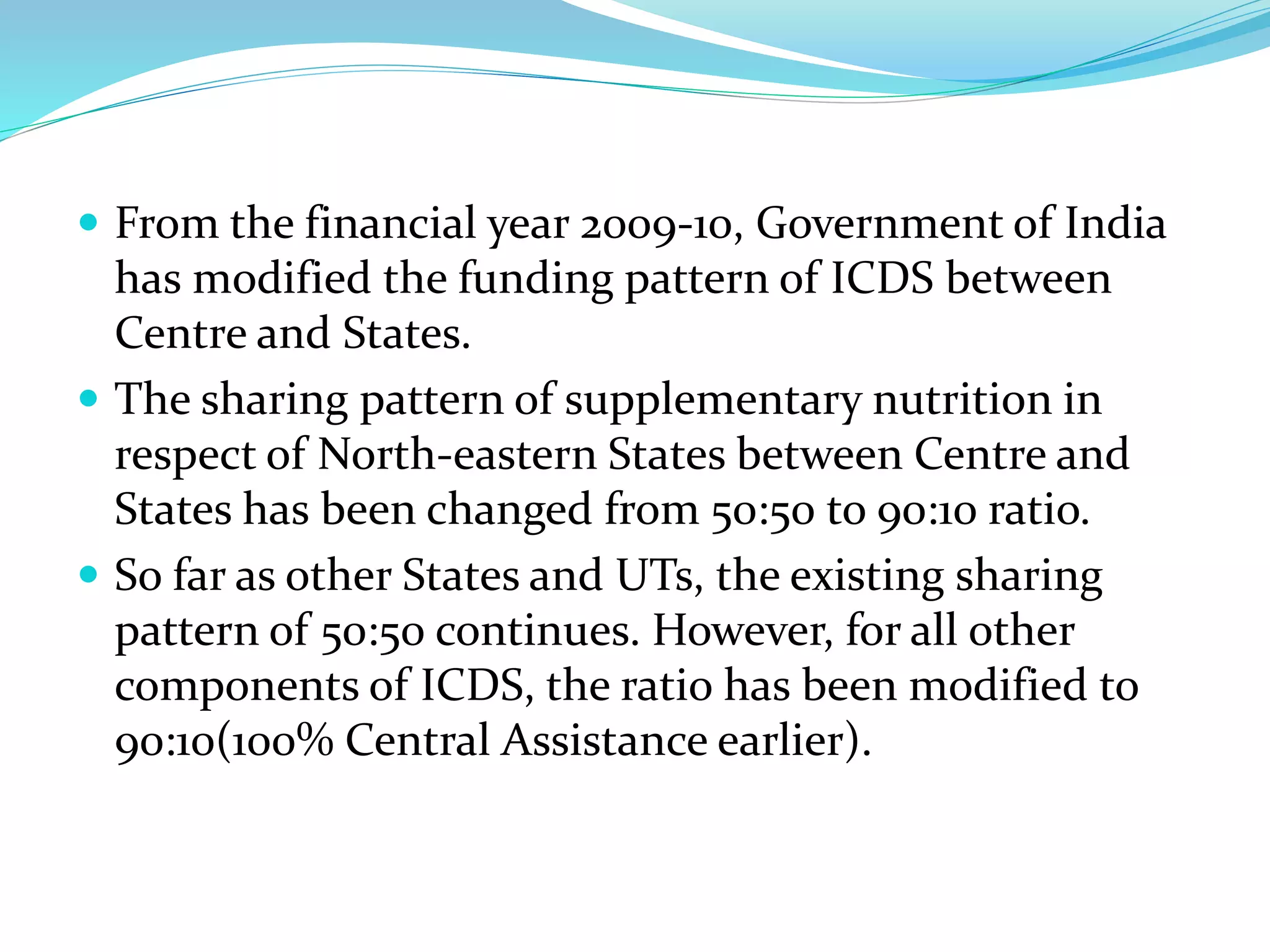
 From the financial year 2009-10, Government of India
has modified the funding pattern of ICDS between
Centre and States.
 The sharing pattern of supplementary nutrition in
respect of North-eastern States between Centre and
States has been changed from 50:50 to 90:10 ratio.
 So far as other States and UTs, the existing sharing
pattern of 50:50 continues. However, for all other
components of ICDS, the ratio has been modified to
90:10(100% Central Assistance earlier).
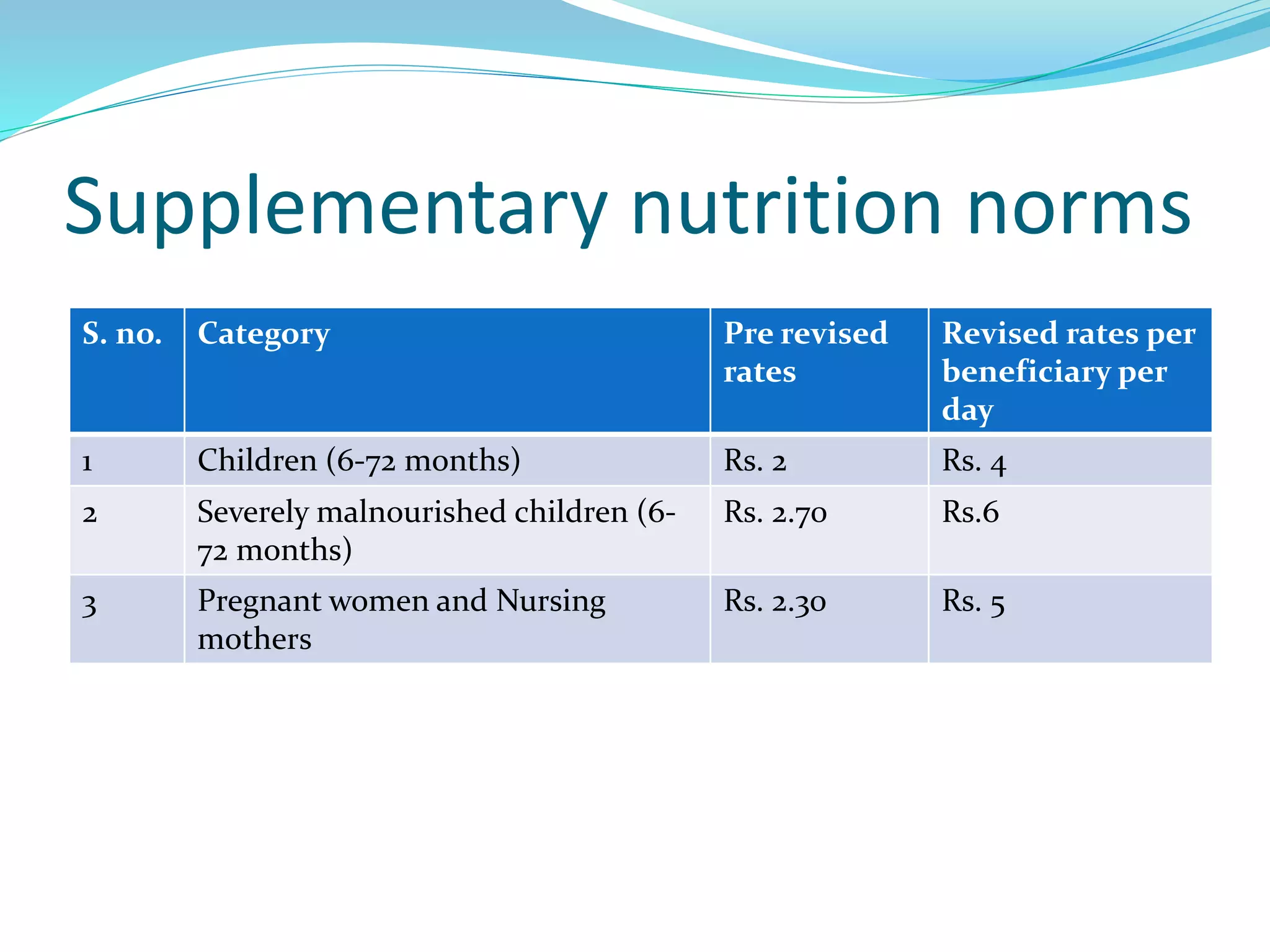
Supplementary nutrition norms
S. no. Category Pre revised
rates
Revised rates per
beneficiary per
day
1 Children (6-72 months) Rs. 2 Rs. 4
2 Severely malnourished children (6-
72 months)
Rs. 2.70 Rs.6
3 Pregnant women and Nursing
mothers
Rs. 2.30 Rs. 5
Nutritional Norms:- dated
24.2.2009
S.no. Category Pre revised Revised
Calories
(Kcal)
Proteins
(g)
Calories
(kcal)
Proteins
(g)
1 Children (6-72
months)
300 8 -10 500 12 - 15
2 Severely
malnourished
children (6-72
months)
600 20 800 15-20
3 Pregnant women and
nursing mother
500 15-20 600 18-20
Type of Supplementary Nutrition :
 Children in the age group 0 – 6 months : For
Children in this age group, States/ UTs may ensure
continuation of current guidelines of early initiation
(within one hour of birth) and exclusive breast-feeding
for children for the first 6 months of life.
 Children in the age group 6 months to 3 years : For
children in this age group, the existing pattern of Take
Home Ration (THR) under the ICDS Scheme will
continue. THR should be given in the form that is
palatable to the child instead of the entire family.
 Children in the age group 3 to 6 years : For the
children in this age group, State/ UTs have been
requested to make arrangements to serve Hot Cooked
Meal in AWCs and mini-AWCs under the ICDS
Scheme. Since the child of this age group is not
capable of consuming a meal of 500 calories in one
sitting, the States/ UTs are advised to consider serving
more than one meal to the children who come to
AWCs.
THE ICDS TEAM:
 The ICDS team comprises the Anganwadi Workers,
Anganwadi Helpers, Supervisors, Child Development
Project Officers (CDPOs) and District Programme
Officers (DPOs).
 Medical officers, Auxiliary Nurse Midwife (ANM) and
Accredited Social Health Activist (ASHA) form a team
with the ICDS functionaries to achieve convergence of
different services.
STATUS OF ANGANWADI
WORKERS AND HELPERS:
 Government of India has enhanced the honoraria of
these Workers, w.e.f. 1.4.2008 by Rs.500 above the last
honorarium drawn by Anganwadi Workers (AWWs)
and by Rs.250 of the last honorarium drawn by
Helpers of AWCs and Workers of Mini-AWCs. Prior to
enhancement, AWWs were being paid a monthly
honoraria ranging from Rs. 938/ to Rs. 1063/- per
month depending on their educational qualifications
and experience. Similarly, AWHs were being paid
monthly honoraria of Rs. 500/-
Type of training courses
 Three types of regular training are imparted to AWWs,
AWHs, Supervisors, CDPOs/ACDPOs and Instructors
of AWTCs
 Induction Training (on initial
engagement/appointment) mainly to AWWs
 Job/Orientation Training (once during service period)
 Refresher Training (in-service, once in every two years)
Training infrastructure
 Anganwadi Workers Training Centres (AWTCs) for
the training of Anganwadi Workers and Helpers.
 Middle Level Training Centres (MLTCs) for the
training of Supervisors and Trainers of AWTCs;
 National Institute of Public Cooperation and Child
Development (NIPCCD) and its Regional Centres for
training of CDPOs/ACDPOs and Trainers of MLTCs.
NIPCCD also conducts several skill development
training programmes.
 Monitoring & Supervision of Training
Programme: A separate ICDS Training Unit within
the Ministry of Women and Child Development
headed by a Director/Dy. Secretary level officer is
responsible for overall monitoring, supervision and
evaluation of the training programme.
 Recent Initiatives: The Ministry has recently
initiated a process of consultations with the States and
other stakeholders to review and identify gaps in the
existing training system and make suggestions to
strengthen the ICDS Training programme.
INTERNATIONAL PARTNERS
Government of India partners with the following
international agencies to supplement interventions
under the ICDS:
 United Nations International Children’ Emergency
Fund (UNICEF)
 Cooperative for Assistance and Relief Everywhere
(CARE)
 World Food Programme (WFP)
Integrated child development services

Integrated child development services

  • 2.
    INTRODUCTION ICDS Scheme representsone of the world’s largest and most unique programmes for early childhood development. ICDS is the foremost symbol of India’s commitment to her children. The main beneficiaries of the programme were aimed to be the girl child up to her adolescence, all children below 6 years of age, pregnant and lactating mothers.
  • 3.
    Purpose of initiation Routine MCH services not reaching target population.  Nutritional component not covered by health services.  Need for community participation.
  • 4.
    OBJECTIVES  To improvethe nutritional status of preschool children 0-6 years of age group.  To lay the foundation of proper psychological development of the child  To reduce the incidence of mortality, morbidity malnutrition and school drop out  To achieve effective coordination of policy and implementation in various departments to promote child development  To enhance the capability of the mother to look after the normal health and nutritional needs of of the child through proper nutrition and health education
  • 5.
    PACKAGE OF SERVICES BeneficiariesServices Pregnant women Health check up, immunization, supplementary nutrition, health and nutrition education Nursing mothers Health check up, supplementary nutrition, health and nutrition education Other women 15 – 45 years Nutrition and health education Children less than 3 yrs Health check up, immunization, supplementary nutrition, referral services Children in age 3 -6 yrs Health check up, immunization, supplementary nutrition, referral services, non formal education Adolescent girls 11 – 18 yrs. Supplementary nutrition and health education
  • 6.
    COMPONENT OF ICDS Health Check-ups.  Immunization.  Growth Promotion and Supplementary Feeding.  Referral Services.  Early Childhood Care and Pre-school Education.  Nutrition and Health Education.
  • 7.
    SUPPLEMENTARY NUTRITION Supplementary nutritionis given to children below 6 years, and nursing and expectant mothers from low income group. The aim is to supplement nutritional intake as follows:  Each child up to 6 years of age to get 300 calories and 8-10 grams of protein  Each adolescent girl to get 500 calories and 20-25grams of protein  Each pregnant women and lactating mother to get 500 calories and 20-25 gms of protein  Each malnourished child to get 600 calories and 16-20 grams of protein
  • 8.
    IMMUNIZATION-  Immunization ofchildren against 6 vaccine preventable disease is being done, while for expectant mothers, immunization against tetanus is recommended.
  • 9.
    HEALTH CHECK UP Record of weight and height of children at periodical intervals  Watch over milestones  Immunization  Deworming  General check up for detection of disease  Treatment of diseases like diarrhea, ARI  Prophylaxis against vitamin A deficiency and anemia  Referral of serious cases  Antenatal care of expectant mothers  Post natal care of nursing mothers and care of new born infants
  • 10.
    Non-formal Pre-School Education (PSE) Children between the ages 3-6 years are imparted non- formal pre-school education in an angandwadi in each village with about 1000 population. The objective is to provide opportunities to develop desirable attitude, values and behaviour pattern among children. Locally produced inexpensive toys and material are used in organizing play and creative activity.
  • 11.
    Referral Services:  Duringhealth check-ups and growth monitoring, sick or malnourished children, in need of prompt medical attention, are referred to the Primary Health Centre or its sub-centre. Nutrition and Health Education: Health education is given to womens so that they can look after their own health, nutrition and development needs as well as that of their children and families.
  • 12.
    Population Norms:-  AnganwadiCentres For Rural/Urban Projects 400-800 - 1 AWC 800-1600 - 2 AWCs 1600-2400 - 3 AWCs Thereafter in multiples of 800 1 AWC  For Mini-AWC - 150-400 1 Mini-AWC  For Tribal /Riverine/Desert, Hilly and other difficult areas/ Projects - 300-800 - 1 AWC  For Mini- AWC - 150-300 1 Mini AWC
  • 13.
    Funding pattern  ICDSis a Centrally-sponsored Scheme implemented through the State Governments/UT Administrations.  Prior to 2005-06, 100% financial assistance for inputs other than supplementary nutrition, which the States were to provided out of their own resources, was being provided by the Government of India.
  • 14.
     From thefinancial year 2009-10, Government of India has modified the funding pattern of ICDS between Centre and States.  The sharing pattern of supplementary nutrition in respect of North-eastern States between Centre and States has been changed from 50:50 to 90:10 ratio.  So far as other States and UTs, the existing sharing pattern of 50:50 continues. However, for all other components of ICDS, the ratio has been modified to 90:10(100% Central Assistance earlier).
  • 15.
    Supplementary nutrition norms S.no. Category Pre revised rates Revised rates per beneficiary per day 1 Children (6-72 months) Rs. 2 Rs. 4 2 Severely malnourished children (6- 72 months) Rs. 2.70 Rs.6 3 Pregnant women and Nursing mothers Rs. 2.30 Rs. 5
  • 16.
    Nutritional Norms:- dated 24.2.2009 S.no.Category Pre revised Revised Calories (Kcal) Proteins (g) Calories (kcal) Proteins (g) 1 Children (6-72 months) 300 8 -10 500 12 - 15 2 Severely malnourished children (6-72 months) 600 20 800 15-20 3 Pregnant women and nursing mother 500 15-20 600 18-20
  • 17.
    Type of SupplementaryNutrition :  Children in the age group 0 – 6 months : For Children in this age group, States/ UTs may ensure continuation of current guidelines of early initiation (within one hour of birth) and exclusive breast-feeding for children for the first 6 months of life.  Children in the age group 6 months to 3 years : For children in this age group, the existing pattern of Take Home Ration (THR) under the ICDS Scheme will continue. THR should be given in the form that is palatable to the child instead of the entire family.
  • 18.
     Children inthe age group 3 to 6 years : For the children in this age group, State/ UTs have been requested to make arrangements to serve Hot Cooked Meal in AWCs and mini-AWCs under the ICDS Scheme. Since the child of this age group is not capable of consuming a meal of 500 calories in one sitting, the States/ UTs are advised to consider serving more than one meal to the children who come to AWCs.
  • 19.
    THE ICDS TEAM: The ICDS team comprises the Anganwadi Workers, Anganwadi Helpers, Supervisors, Child Development Project Officers (CDPOs) and District Programme Officers (DPOs).  Medical officers, Auxiliary Nurse Midwife (ANM) and Accredited Social Health Activist (ASHA) form a team with the ICDS functionaries to achieve convergence of different services.
  • 20.
    STATUS OF ANGANWADI WORKERSAND HELPERS:  Government of India has enhanced the honoraria of these Workers, w.e.f. 1.4.2008 by Rs.500 above the last honorarium drawn by Anganwadi Workers (AWWs) and by Rs.250 of the last honorarium drawn by Helpers of AWCs and Workers of Mini-AWCs. Prior to enhancement, AWWs were being paid a monthly honoraria ranging from Rs. 938/ to Rs. 1063/- per month depending on their educational qualifications and experience. Similarly, AWHs were being paid monthly honoraria of Rs. 500/-
  • 21.
    Type of trainingcourses  Three types of regular training are imparted to AWWs, AWHs, Supervisors, CDPOs/ACDPOs and Instructors of AWTCs  Induction Training (on initial engagement/appointment) mainly to AWWs  Job/Orientation Training (once during service period)  Refresher Training (in-service, once in every two years)
  • 22.
    Training infrastructure  AnganwadiWorkers Training Centres (AWTCs) for the training of Anganwadi Workers and Helpers.  Middle Level Training Centres (MLTCs) for the training of Supervisors and Trainers of AWTCs;  National Institute of Public Cooperation and Child Development (NIPCCD) and its Regional Centres for training of CDPOs/ACDPOs and Trainers of MLTCs. NIPCCD also conducts several skill development training programmes.
  • 23.
     Monitoring &Supervision of Training Programme: A separate ICDS Training Unit within the Ministry of Women and Child Development headed by a Director/Dy. Secretary level officer is responsible for overall monitoring, supervision and evaluation of the training programme.  Recent Initiatives: The Ministry has recently initiated a process of consultations with the States and other stakeholders to review and identify gaps in the existing training system and make suggestions to strengthen the ICDS Training programme.
  • 24.
    INTERNATIONAL PARTNERS Government ofIndia partners with the following international agencies to supplement interventions under the ICDS:  United Nations International Children’ Emergency Fund (UNICEF)  Cooperative for Assistance and Relief Everywhere (CARE)  World Food Programme (WFP)