INTEGRATED CHILD
DEVELOPMENT SERVICES (ICDS)
T LIKITHA
ROLL NO - 139
ICDS
• This programme was started in 1975 in pursuance of the National Policy for
children.
• There is a strong nutrition component in this programme in the form of
supplementary nutrition, Vit A prophylaxis, Iron and folic acid distribution.
• Preschool children <6 yrs
• Adolescent girls ( 11-18 yrs )
• Pregnant and lactating mothers
• Other women ( 15-45 yrs )
Beneficiaries :-
Anganwadi
• The workers at the village level who deliver the services are called as
anganwadi workers.
• Each anganwadi unit covers a population of about 400-800 and a mini-AWC
covers about 150-400
• For tribal/hilly areas- there is usually 1 AWC for 300-800 population and 1 mini-
AWC for 150-300 population
• Anganwadi on demand - where a settlement has atleast 40 children under 6 yr
but no anganwadi center
• The work of anganwadis is supervised by mukhyasevikas. Field supervision is
done by Child Development Project Officer ( CDPO )
Objectives:-
• To improve the nutritional and health status of children in the age group (0-
6yrs)
• To lay the foundations for proper psychological, physical and social devt of the
child
• To reduce mortality, morbidity, malnutrition and school dropouts
• To achieve an effective coordination of policy and implementation among the
various departments working for the promotion of child devt
• To enhance the capability of the mother and nutritional needs of the child
through proper nutrition and health education
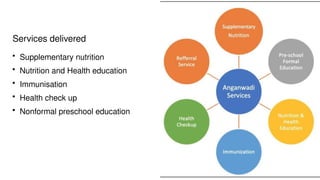
• Supplementary nutrition
• Nutrition and Health education
• Immunisation
• Health check up
• Nonformal preschool education
Services delivered
1. Supplementary nutrition
• It is given to children <6yrs of age, nursing and expectant mothers from low
income group
• Type of food depends upon the local availability, location of project etc.
• Meal includes providing a morning snack in the form of milk/
banana/egg/seasonal fruit/micronutrient food followed by a hot cooked meal.
• For children below 3yrs, pregnant and lactating mothers ‘ take home ration’ is
to be provided.
• Supplementary nutrition is given for 300 days in a year.
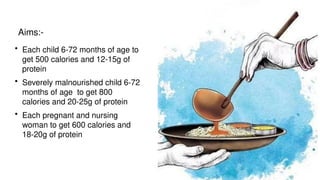
• Each child 6-72 months of age to
get 500 calories and 12-15g of
protein
• Severely malnourished child 6-72
months of age to get 800
calories and 20-25g of protein
• Each pregnant and nursing
woman to get 600 calories and
18-20g of protein
Aims:-
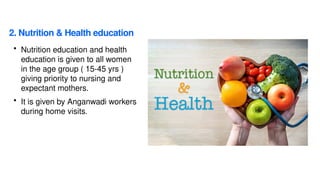
2. Nutrition & Health education
• Nutrition education and health
education is given to all women
in the age group ( 15-45 yrs )
giving priority to nursing and
expectant mothers.
• It is given by Anganwadi workers
during home visits.
3. Immunisation
• Immunisation of children against
nine vaccine preventable
diseases is being done, while for
expectant mothers immunisation
against tetanus is recommended
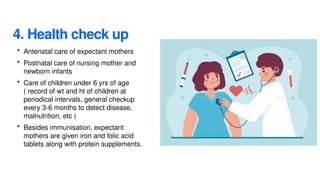
4. Health check up
• Antenatal care of expectant mothers
• Postnatal care of nursing mother and
newborn infants
• Care of children under 6 yrs of age
( record of wt and ht of children at
periodical intervals, general checkup
every 3-6 months to detect disease,
malnutrition, etc )
• Besides immunisation, expectant
mothers are given iron and folic acid
tablets along with protein supplements.
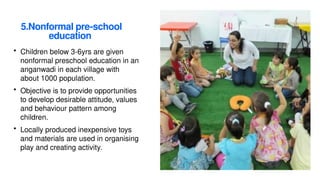
5.Nonformal pre-school
education
• Children below 3-6yrs are given
nonformal preschool education in an
anganwadi in each village with
about 1000 population.
• Objective is to provide opportunities
to develop desirable attitude, values
and behaviour pattern among
children.
• Locally produced inexpensive toys
and materials are used in organising
play and creating activity.
Poshan Abhiyan
• Govt of India has launched Poshan Abhiyan on 18th Dec,2017 for a period of
3 years.
• The goals are to achieve improvement in nutritional status of children from 0-6
yrs, adolescent girls, pregnant women and lactating mothers with fixed targets.
• It is the convergence of various programmes i.e; anganwadi services, Pradhan
Mantri Matru Vandana Yojana , Janani Suraksha Yojana, National Health
Mission of Ministry of Health and Family Welfare, Swachh Bharat Mission of
Ministry of Jal Shakti, etc.
Objectives and targets:-
• Prevent and reduce stunting in children by 6%
• Prevent and reduce undernutrition and underweight prevalence by 8%
• Reduce prevalence of Anaemia among children by 9%
• Reduce prevalence of Anaemia among girls and women (15-45yrs ) by 9%
• Reduce LBW by 6%
Other schemes implemented at ICDS level
• Kishori Shakti Yojana - addresses their needs of self devt, nutrition and health
status, numerical skills, vocational skills, etc.
• Nutrition Programme for Adolescent Girls- approved in 2009-10. 6 kg of free
food grain is provided to each beneficiary per month.
• Rajiv Gandhi Scheme for Empowerment of Adolescent Girls ( SABLA ) - to
improve their nutritional and health status.
• Indira Gandhi Matritva Sahyog Yojana ( IGMSY ) - conditional cash transfer
will be made to pregnant and lactating mothers to improve their nutritional and
health status.
integrated child development services icds

integrated child development services icds

  • 1.
    INTEGRATED CHILD DEVELOPMENT SERVICES(ICDS) T LIKITHA ROLL NO - 139
  • 2.
    ICDS • This programmewas started in 1975 in pursuance of the National Policy for children. • There is a strong nutrition component in this programme in the form of supplementary nutrition, Vit A prophylaxis, Iron and folic acid distribution.
  • 3.
    • Preschool children<6 yrs • Adolescent girls ( 11-18 yrs ) • Pregnant and lactating mothers • Other women ( 15-45 yrs ) Beneficiaries :-
  • 4.
    Anganwadi • The workersat the village level who deliver the services are called as anganwadi workers. • Each anganwadi unit covers a population of about 400-800 and a mini-AWC covers about 150-400 • For tribal/hilly areas- there is usually 1 AWC for 300-800 population and 1 mini- AWC for 150-300 population • Anganwadi on demand - where a settlement has atleast 40 children under 6 yr but no anganwadi center • The work of anganwadis is supervised by mukhyasevikas. Field supervision is done by Child Development Project Officer ( CDPO )
  • 5.
    Objectives:- • To improvethe nutritional and health status of children in the age group (0- 6yrs) • To lay the foundations for proper psychological, physical and social devt of the child • To reduce mortality, morbidity, malnutrition and school dropouts • To achieve an effective coordination of policy and implementation among the various departments working for the promotion of child devt • To enhance the capability of the mother and nutritional needs of the child through proper nutrition and health education
  • 6.
    • Supplementary nutrition •Nutrition and Health education • Immunisation • Health check up • Nonformal preschool education Services delivered
  • 7.
    1. Supplementary nutrition •It is given to children <6yrs of age, nursing and expectant mothers from low income group • Type of food depends upon the local availability, location of project etc. • Meal includes providing a morning snack in the form of milk/ banana/egg/seasonal fruit/micronutrient food followed by a hot cooked meal. • For children below 3yrs, pregnant and lactating mothers ‘ take home ration’ is to be provided. • Supplementary nutrition is given for 300 days in a year.
  • 8.
    • Each child6-72 months of age to get 500 calories and 12-15g of protein • Severely malnourished child 6-72 months of age to get 800 calories and 20-25g of protein • Each pregnant and nursing woman to get 600 calories and 18-20g of protein Aims:-
  • 9.
    2. Nutrition &Health education • Nutrition education and health education is given to all women in the age group ( 15-45 yrs ) giving priority to nursing and expectant mothers. • It is given by Anganwadi workers during home visits.
  • 10.
    3. Immunisation • Immunisationof children against nine vaccine preventable diseases is being done, while for expectant mothers immunisation against tetanus is recommended
  • 11.
    4. Health checkup • Antenatal care of expectant mothers • Postnatal care of nursing mother and newborn infants • Care of children under 6 yrs of age ( record of wt and ht of children at periodical intervals, general checkup every 3-6 months to detect disease, malnutrition, etc ) • Besides immunisation, expectant mothers are given iron and folic acid tablets along with protein supplements.
  • 12.
    5.Nonformal pre-school education • Childrenbelow 3-6yrs are given nonformal preschool education in an anganwadi in each village with about 1000 population. • Objective is to provide opportunities to develop desirable attitude, values and behaviour pattern among children. • Locally produced inexpensive toys and materials are used in organising play and creating activity.
  • 14.
    Poshan Abhiyan • Govtof India has launched Poshan Abhiyan on 18th Dec,2017 for a period of 3 years. • The goals are to achieve improvement in nutritional status of children from 0-6 yrs, adolescent girls, pregnant women and lactating mothers with fixed targets. • It is the convergence of various programmes i.e; anganwadi services, Pradhan Mantri Matru Vandana Yojana , Janani Suraksha Yojana, National Health Mission of Ministry of Health and Family Welfare, Swachh Bharat Mission of Ministry of Jal Shakti, etc.
  • 15.
    Objectives and targets:- •Prevent and reduce stunting in children by 6% • Prevent and reduce undernutrition and underweight prevalence by 8% • Reduce prevalence of Anaemia among children by 9% • Reduce prevalence of Anaemia among girls and women (15-45yrs ) by 9% • Reduce LBW by 6%
  • 16.
    Other schemes implementedat ICDS level • Kishori Shakti Yojana - addresses their needs of self devt, nutrition and health status, numerical skills, vocational skills, etc. • Nutrition Programme for Adolescent Girls- approved in 2009-10. 6 kg of free food grain is provided to each beneficiary per month. • Rajiv Gandhi Scheme for Empowerment of Adolescent Girls ( SABLA ) - to improve their nutritional and health status. • Indira Gandhi Matritva Sahyog Yojana ( IGMSY ) - conditional cash transfer will be made to pregnant and lactating mothers to improve their nutritional and health status.