DR.S.SUJATHA M.D., D.P.H.,
Assistant Professor
Chengalpattu Medical College
OBJECTIVES
1. To improve the nutritional and health status of children in the
age group 0-6 years.
2. To lay the foundations for proper psychological,physical and
social development of the child.
3. To reduce mortality ,morbidity, malnutrition and school drop-
outs.
4. To achieve an effective co-ordination of policy and
implementation among the various departments working for
the promotion of child development.
5. To enhance the capability of the mother and nutritional needs
of the child through proper nutrition and health education
4/29/2018 2Chengalpattu Medical College
4/29/2018 3Chengalpattu Medical College
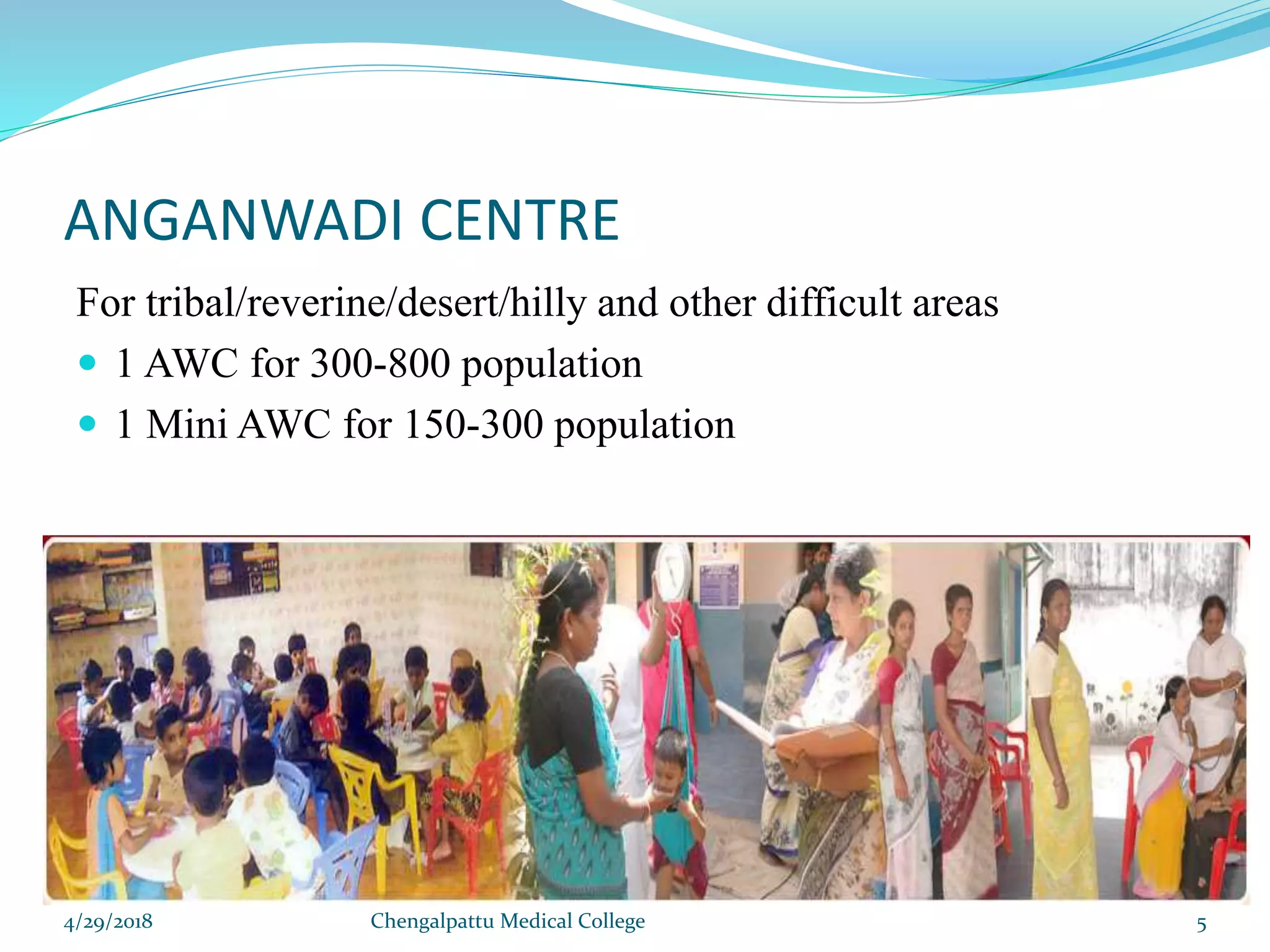
ANGANWADI CENTRE
For AWCs in rural/urban projects
 1 AWC for 400-800 population
 2 AWC for 800-1600 population
 3 AWC for 1600-2400 population
Thereafter one AWC for multiplies of 800 population.
For Mini-AWC , the norm is
 1 Mini-AWC for 150-400 population
4/29/2018 4Chengalpattu Medical College
ANGANWADI CENTRE
For tribal/reverine/desert/hilly and other difficult areas
 1 AWC for 300-800 population
 1 Mini AWC for 150-300 population
4/29/2018 5Chengalpattu Medical College
ADMINISTRATIVE UNIT
 Community development block in rural areas
 Tribal development block in tribal and a group of
slums
1. Rural /Urban project has a population of 100000
2. Tribal project – 35000 population
Number of villages in rural project -100
Number of villages in tribal project -50
4/29/2018 6Chengalpattu Medical College
ICDS PROJECT
 Child Development Project Officer[CDPO]
 4 supervisors [ Mukiya Sevikas ]
 100 AWW [ AnganWadi Workers]
4/29/2018 7Chengalpattu Medical College
Anganwadi worker
 Trained local woman AWW
 Selected from the community
 Provides direct link to children and mother
 Assists CDPO in survey of community and beneficiaries
 Organizes non-formal education sessions
 Provides health and nutrition education to mothers
 Prepares the food daily and delivers to the beneficiaries
 Assists PHC staffs in providing health services
 Maintains records of Immunisation,feeding and preschool
attendance
 Liaises with block administrator ,local school
teachers,community leaders , health staff and community and
works for community based activities ,like family planning.
4/29/2018 8Chengalpattu Medical College
THE ICDS TEAM:
 The ICDS team comprises –
1. the Anganwadi Workers,
2. Anganwadi Helpers,
3. supervisors,
4. Child Development Project Officers (CDPOs) and
5. District Program Officers.
 Besides, the medical officers, Auxiliary Nurse Midwife (ANM)
and Accredited Social Health Activist (ASHA) form a team
with the ICDS functionaries to achieve convergence of
different service.
4/29/2018 9Chengalpattu Medical College
ICDS Training Program:
 Training and capacity building is the most crucial element in
the ICDS Scheme to achieve the program goals.
 Training under ICDS scheme is a continuous program and is
implemented through National Institute of Public Cooperation
and Child Development (NIPCCD) .
4/29/2018 10Chengalpattu Medical College
Training Infrastructure
 Anganwadi Workers Training Centers (AWTCs) for the
training of Anganwadi Workers and Helpers.
 Middle Level Training Centers (MLTCs) for the training of
Supervisors and Trainers of AWTCs;
 National Institute of Public Cooperation and Child
Development (NIPCCD) and its Regional Centers for training
of CDPOs/ACDPOs and Trainers of MLTCs.
 NIPCCD also conducts several skill development training
program.
4/29/2018 11Chengalpattu Medical College
UNIFORM GIVEN TO ANGANWADI WORKERS
4/29/2018 12Chengalpattu Medical College
ICDS
SERVICES
4/29/2018 13Chengalpattu Medical College
BENEFICIARY SERVICES
1.Pregnant women •Health check-up
•Immunization against tetanus
•Supplementary nutrition
•Nutrition and health education
2. Nursing mothers •Health check-up
•Supplementary nutrition
•Nutrition and health education
3. Other women 15-45 years •Nutrition and health education
4. Children less than 3 years •Supplementary nutrition
•Immunization
•Health check-up
•Referral services
5. Children in age group 3-6 years •Supplementary nutrition
•Immunization
•Health check-up
•Referral services
•Non – formal education
6. Adolescent girls 11-18 years •Supplementary nutrition
•Nutrition and health education
4/29/2018 14Chengalpattu Medical College
DELIVERY OF SERVICES
1. Supplementary nutrition
2. Nutrition and Health Education
3. Immunization
4. Health check-up
5. Non-formal pre-school education
6. Medical referral services
7. Schemes for Adolescent girls
4/29/2018 15Chengalpattu Medical College
Supplementary nutrition
BENEFICIARY ENERGY AND PROTEIN
Each child 6-72 months of age 500 calories & 12 – 15 grams of protein
( finanacial norms of Rs. 4 /child/day)
Severely malnourished child 6-72 months
of age
800 calories & 20 – 25 grams of protein
( finanacial norms of Rs. 6/child/day)
Each pregnant and nursing woman 600 calories & 18-20 grams of protein
( financial norms of Rs.5/beneficiary/day)
4/29/2018 16Chengalpattu Medical College
Supplementary nutrition
 Given 300 days in a year
 Morning snack – milk/banana/egg/seasonal
fruit/micro – nutrient fortified food followed by a
HOT –COOKED MEAL
4/29/2018 17Chengalpattu Medical College
Type of Supplementary Nutrition:
 Children in the age group 0 – 6 months: Continuation of
current guidelines of early initiation and exclusive breast-
feeding for children for the first 6 months of life.
 Children in the age group 6 months to 3 years: For children
in this age group, the existing pattern of Take Home Ration
(THR) under the ICDS Scheme will continue. THR should be
given in the form that is palatable to the child .
4/29/2018 18Chengalpattu Medical College
Children in the age group 3 to 6 years:
 500 calories/day/children
 Since the child is not capable of consuming a meal of 500
calories in one sitting, the States/ UTs are advised to consider
serving more than one meal to the children in the form of
morning snacks and afternoon cooked meal.
 Bengal gram/Green gram 20 gms Tuesday)
 3 boiled eggs per week (Mon ,Wed, Thursday)/banana
for non egg eating children , Potato(Friday)
4/29/2018 19Chengalpattu Medical College
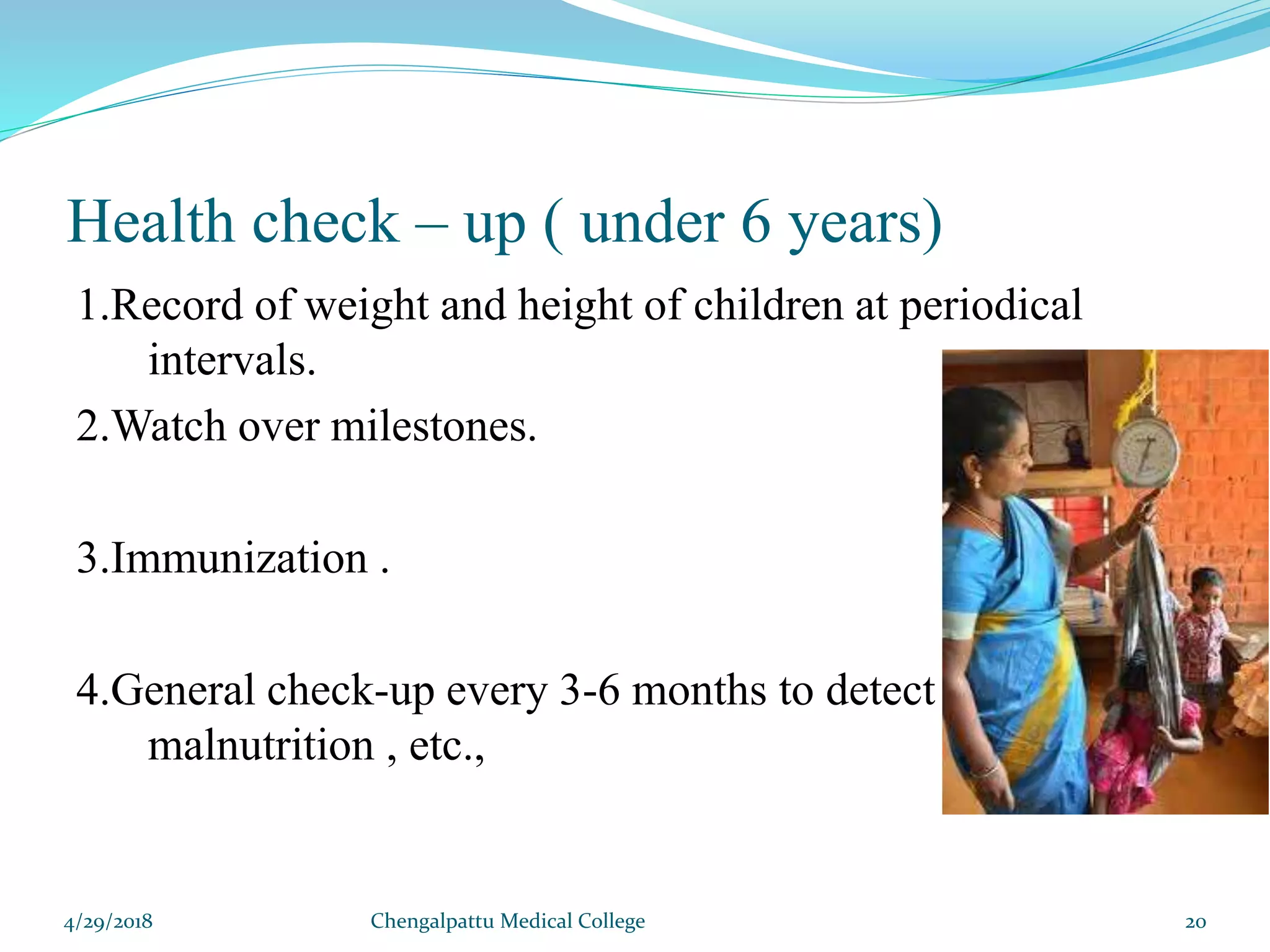
Health check – up ( under 6 years)
1.Record of weight and height of children at periodical
intervals.
2.Watch over milestones.
3.Immunization .
4.General check-up every 3-6 months to detect disease ,
malnutrition , etc.,
4/29/2018 20Chengalpattu Medical College
Health check – up ( under 6 years)
5.Treatment for diseases like diarrhoea dysentry, respiratory
tract infections which are widely prevalent.
6.Deworming
7.Prophylaxis against Vitamin A deficiency and Anemia
8.Referral of serious cases to hospital .
4/29/2018 21Chengalpattu Medical College
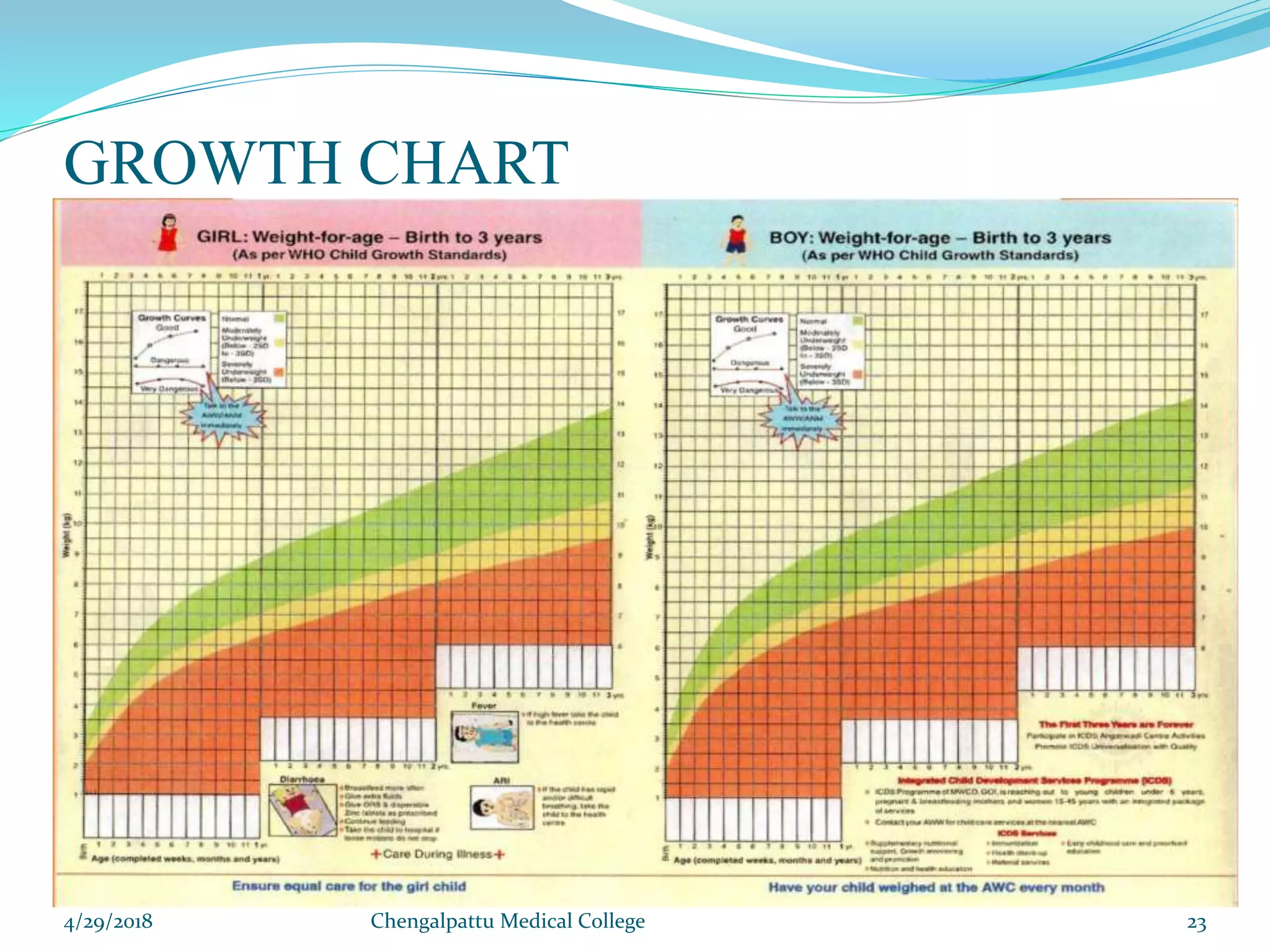
INTRODUCTION OF WHO GROWTH
STANDARDS IN ICDS
 The Ministry of Women and Child Development and Ministry
of Health have adopted the New WHO Child Growth Standard
in India on 15th of August, 2008 for monitoring the Growth of
Children through ICDS and NRHM.
 Implication
1. The Anganwadi Worker with the help of New Growth Chart
would be able to assess correctly severely underweight
children The number of normal children would also increase
in all the Anganwadi Centers.
• The new charts would now help us in comparing growth of our
children within projects, districts, states & also other countries.
4/29/2018 22Chengalpattu Medical College
GROWTH CHART
4/29/2018 23Chengalpattu Medical College
4/29/2018
PSE - KIT
 Pre – School Education Kit
Chengalpattu Medical College
PRE-SCHOOL EDUCATION
4/29/2018 25Chengalpattu Medical College
L earningintheIC D S
experience
I play I explore
I love to learn!
4/29/2018 Chengalpattu Medical College
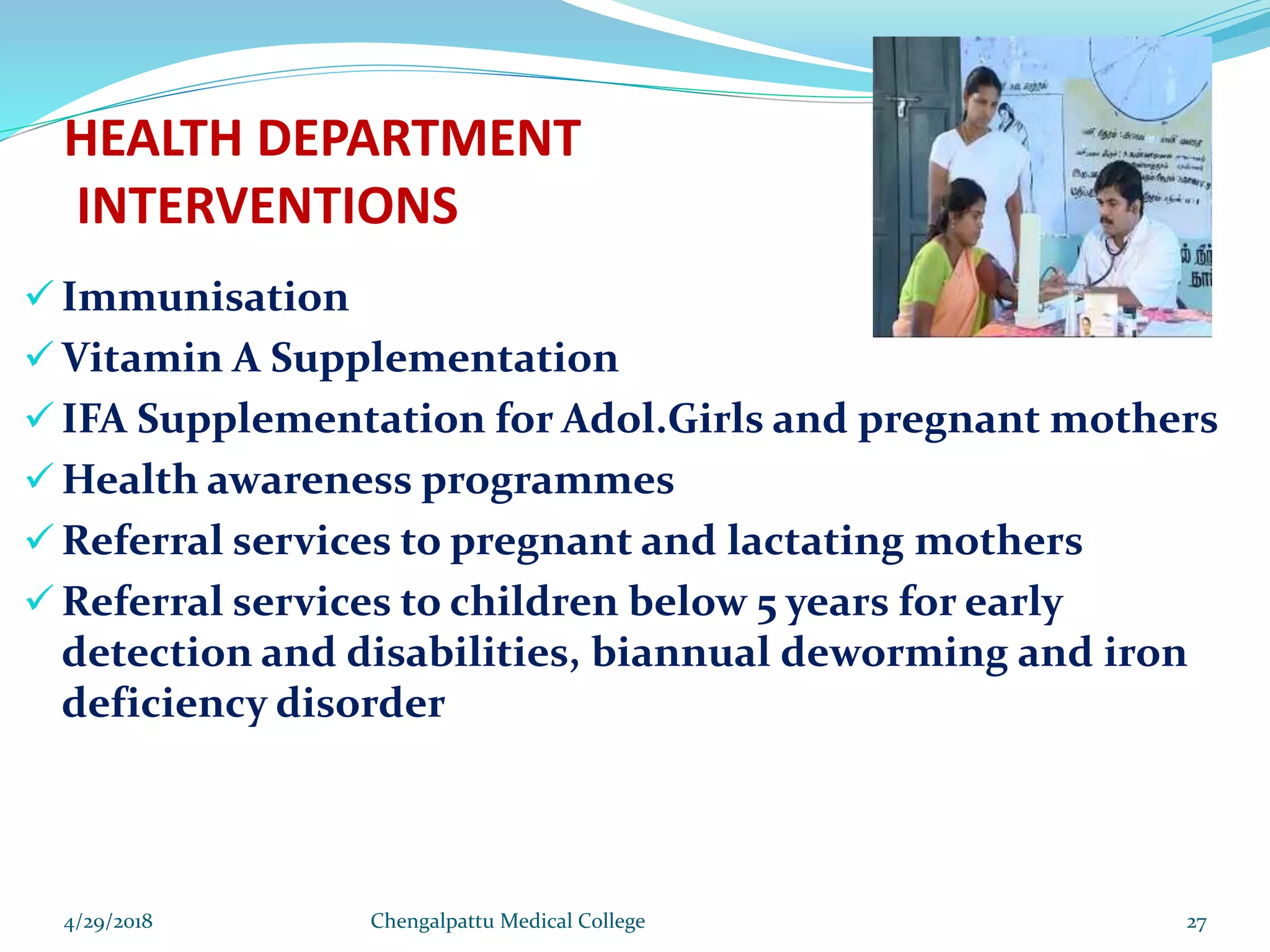
HEALTH DEPARTMENT
INTERVENTIONS
 Immunisation
 Vitamin A Supplementation
 IFA Supplementation for Adol.Girls and pregnant mothers
 Health awareness programmes
 Referral services to pregnant and lactating mothers
 Referral services to children below 5 years for early
detection and disabilities, biannual deworming and iron
deficiency disorder
4/29/2018 27Chengalpattu Medical College
SUPPLY OF MEDICINE KITS
• Supply of medicines through TNMSC4/29/2018 Chengalpattu Medical College
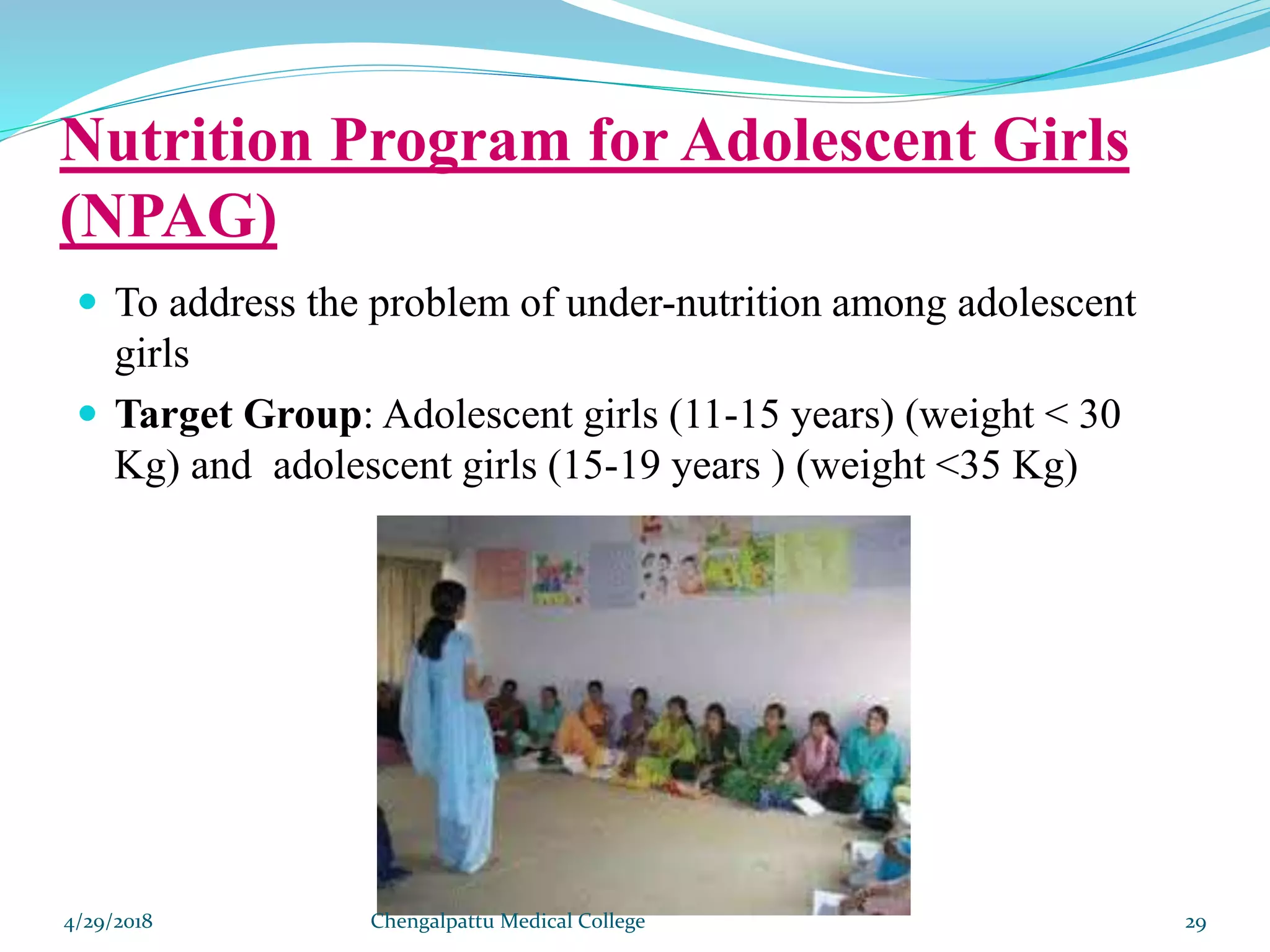
Nutrition Program for Adolescent Girls
(NPAG)
 To address the problem of under-nutrition among adolescent
girls
 Target Group: Adolescent girls (11-15 years) (weight < 30
Kg) and adolescent girls (15-19 years ) (weight <35 Kg)
4/29/2018 29Chengalpattu Medical College
Services:
 (i) 6 kg of free food-grains (wheat/rice/Maize based on
habitual consumption pattern of the state) /per month per
beneficiary through PDS.
 (ii) Nutrition and Health Education to the beneficiaries and
their families.
4/29/2018 30Chengalpattu Medical College
Kishori Shakti Yojana
This scheme is a redesign of the already existing Adolescent Girls (AG)
Scheme being implemented as a component under the centrally
sponsored Integrated Child Development Services (ICDS) Scheme.
Objective:
• To improve the nutritional, health and development status of
adolescent girls.
• Promote awareness of health, hygiene, nutrition and family care.
• Link them to opportunities for learning life skills.
• Going back to school.
• Help them gain a better understanding of their social environment
and take initiatives to become productive members of the society.
4/29/2018 31Chengalpattu Medical College
SABLA- RAJIV GANDHI SCHEME
FOR EMPOWERMENT OF
ADOLESCENT GIRLS
 A scheme for empowerment of adolescent girls, launched on
International Women's Day this year, includes a complete
nutrition program for adolescent girls in the age group of 11 to
19 years.
 The scheme launched through Integrated Child Development
Scheme (ICDS)
4/29/2018 32Chengalpattu Medical College
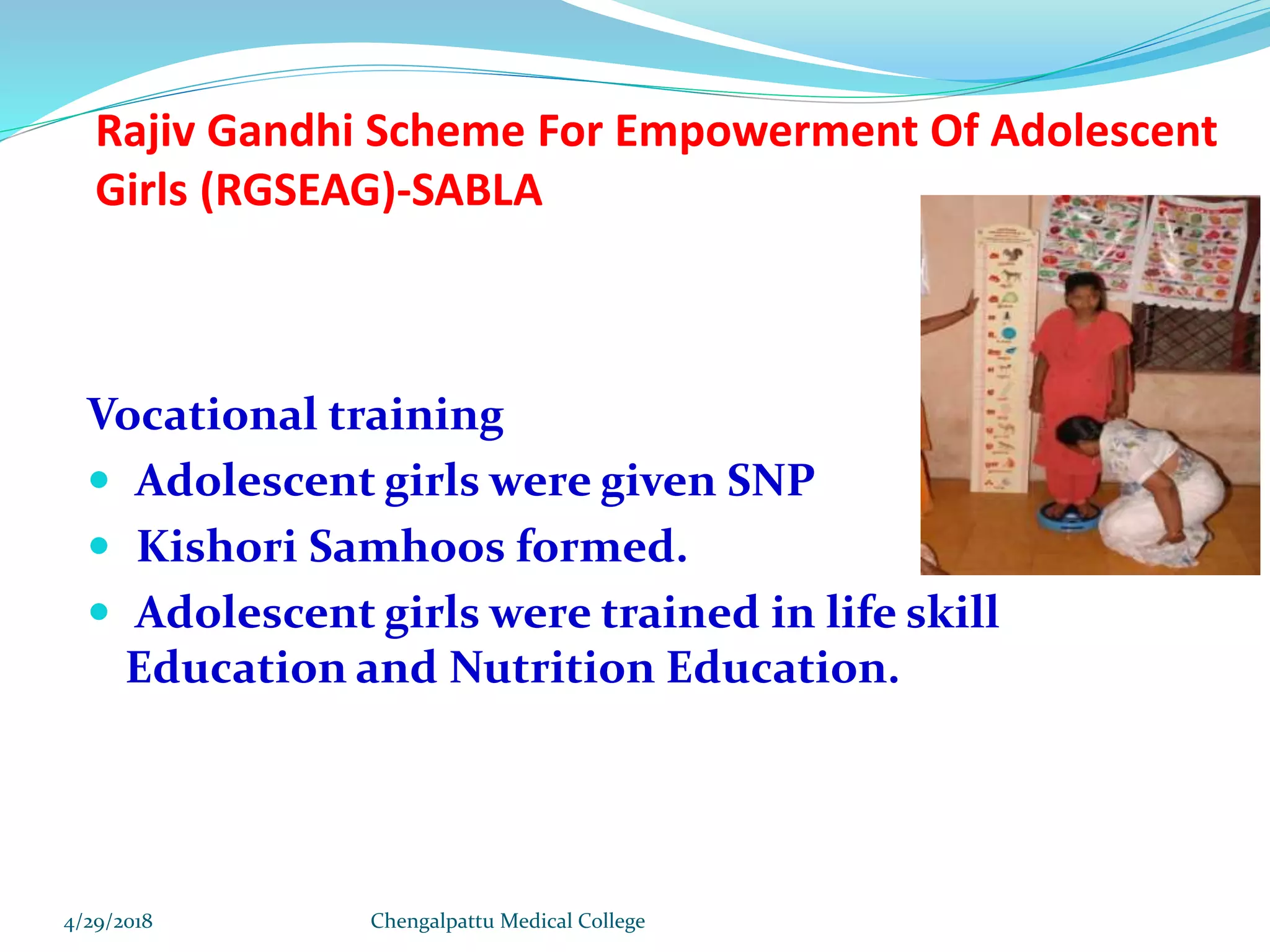
Rajiv Gandhi Scheme For Empowerment Of Adolescent
Girls (RGSEAG)-SABLA
Vocational training
 Adolescent girls were given SNP
 Kishori Samhoos formed.
 Adolescent girls were trained in life skill
Education and Nutrition Education.
4/29/2018 Chengalpattu Medical College
Indira Gandhi Matritva Sahayog
Yojana(IGMSY)
• This scheme has been approved by GOI which provides
cash incentive of Rs.4,000/- to pregnant and Nursing
mothers to compensate wage loss and get
supplementary nutrition during pregnancy and delivery
period.
• Scheme is piloted in Tamil Nadu in two districts of
Erode and Cuddalore using ICDS platform
• Implemented In synergy with state scheme of
Dr.Muthulakshmi Reddy Maternity Benefit Scheme
4/29/2018 34Chengalpattu Medical College
INFORMATION EDUCATION AND
COMMUNICATION( IEC)
The communication contents will be built around the
following themes :
• Early registration in AWC
• Timely initiation of breast feeding within 1 hr. of birth
• Exclusive breast feeding during the first six months of life.
• Timely introduction of complementary foods at six months
• Age appropriate foods for children six months to two years
• Introduction of Preschool education in time
• Hygienic feeding practices
• Immunization, Vitamin A supplementation with de-worming
• Education on prevention of illness to children
• Therapeutic feeding for children with severe acute malnutrition
• Adequate nutrition and health support for AN/PN mothers
4/29/2018 35Chengalpattu Medical College
MONITORING AND EVALUATION
Monitoring and Evaluation is done by
 Field visits- Supervisors ,
CDPOs, DPOs, District Collectors, State Officials and
other line departments
 Review meetings-
Monthly meetings by CDPOs, DPOs, Principal
Secretary/Special Commissioner
4/29/2018 Chengalpattu Medical College
IMPACT OF THE PROGRAMME-
INDICATORS
 Increased birth weight
 Reduced incidence of malnutrition
 Increased immunisation coverage
 Reduced infant and child mortality
4/29/2018 37Chengalpattu Medical College
4/29/2018 38Chengalpattu Medical College

Integrated Child Development Services

  • 1.
    DR.S.SUJATHA M.D., D.P.H., AssistantProfessor Chengalpattu Medical College
  • 2.
    OBJECTIVES 1. To improvethe nutritional and health status of children in the age group 0-6 years. 2. To lay the foundations for proper psychological,physical and social development of the child. 3. To reduce mortality ,morbidity, malnutrition and school drop- outs. 4. To achieve an effective co-ordination of policy and implementation among the various departments working for the promotion of child development. 5. To enhance the capability of the mother and nutritional needs of the child through proper nutrition and health education 4/29/2018 2Chengalpattu Medical College
  • 3.
  • 4.
    ANGANWADI CENTRE For AWCsin rural/urban projects  1 AWC for 400-800 population  2 AWC for 800-1600 population  3 AWC for 1600-2400 population Thereafter one AWC for multiplies of 800 population. For Mini-AWC , the norm is  1 Mini-AWC for 150-400 population 4/29/2018 4Chengalpattu Medical College
  • 5.
    ANGANWADI CENTRE For tribal/reverine/desert/hillyand other difficult areas  1 AWC for 300-800 population  1 Mini AWC for 150-300 population 4/29/2018 5Chengalpattu Medical College
  • 6.
    ADMINISTRATIVE UNIT  Communitydevelopment block in rural areas  Tribal development block in tribal and a group of slums 1. Rural /Urban project has a population of 100000 2. Tribal project – 35000 population Number of villages in rural project -100 Number of villages in tribal project -50 4/29/2018 6Chengalpattu Medical College
  • 7.
    ICDS PROJECT  ChildDevelopment Project Officer[CDPO]  4 supervisors [ Mukiya Sevikas ]  100 AWW [ AnganWadi Workers] 4/29/2018 7Chengalpattu Medical College
  • 8.
    Anganwadi worker  Trainedlocal woman AWW  Selected from the community  Provides direct link to children and mother  Assists CDPO in survey of community and beneficiaries  Organizes non-formal education sessions  Provides health and nutrition education to mothers  Prepares the food daily and delivers to the beneficiaries  Assists PHC staffs in providing health services  Maintains records of Immunisation,feeding and preschool attendance  Liaises with block administrator ,local school teachers,community leaders , health staff and community and works for community based activities ,like family planning. 4/29/2018 8Chengalpattu Medical College
  • 9.
    THE ICDS TEAM: The ICDS team comprises – 1. the Anganwadi Workers, 2. Anganwadi Helpers, 3. supervisors, 4. Child Development Project Officers (CDPOs) and 5. District Program Officers.  Besides, the medical officers, Auxiliary Nurse Midwife (ANM) and Accredited Social Health Activist (ASHA) form a team with the ICDS functionaries to achieve convergence of different service. 4/29/2018 9Chengalpattu Medical College
  • 10.
    ICDS Training Program: Training and capacity building is the most crucial element in the ICDS Scheme to achieve the program goals.  Training under ICDS scheme is a continuous program and is implemented through National Institute of Public Cooperation and Child Development (NIPCCD) . 4/29/2018 10Chengalpattu Medical College
  • 11.
    Training Infrastructure  AnganwadiWorkers Training Centers (AWTCs) for the training of Anganwadi Workers and Helpers.  Middle Level Training Centers (MLTCs) for the training of Supervisors and Trainers of AWTCs;  National Institute of Public Cooperation and Child Development (NIPCCD) and its Regional Centers for training of CDPOs/ACDPOs and Trainers of MLTCs.  NIPCCD also conducts several skill development training program. 4/29/2018 11Chengalpattu Medical College
  • 12.
    UNIFORM GIVEN TOANGANWADI WORKERS 4/29/2018 12Chengalpattu Medical College
  • 13.
  • 14.
    BENEFICIARY SERVICES 1.Pregnant women•Health check-up •Immunization against tetanus •Supplementary nutrition •Nutrition and health education 2. Nursing mothers •Health check-up •Supplementary nutrition •Nutrition and health education 3. Other women 15-45 years •Nutrition and health education 4. Children less than 3 years •Supplementary nutrition •Immunization •Health check-up •Referral services 5. Children in age group 3-6 years •Supplementary nutrition •Immunization •Health check-up •Referral services •Non – formal education 6. Adolescent girls 11-18 years •Supplementary nutrition •Nutrition and health education 4/29/2018 14Chengalpattu Medical College
  • 15.
    DELIVERY OF SERVICES 1.Supplementary nutrition 2. Nutrition and Health Education 3. Immunization 4. Health check-up 5. Non-formal pre-school education 6. Medical referral services 7. Schemes for Adolescent girls 4/29/2018 15Chengalpattu Medical College
  • 16.
    Supplementary nutrition BENEFICIARY ENERGYAND PROTEIN Each child 6-72 months of age 500 calories & 12 – 15 grams of protein ( finanacial norms of Rs. 4 /child/day) Severely malnourished child 6-72 months of age 800 calories & 20 – 25 grams of protein ( finanacial norms of Rs. 6/child/day) Each pregnant and nursing woman 600 calories & 18-20 grams of protein ( financial norms of Rs.5/beneficiary/day) 4/29/2018 16Chengalpattu Medical College
  • 17.
    Supplementary nutrition  Given300 days in a year  Morning snack – milk/banana/egg/seasonal fruit/micro – nutrient fortified food followed by a HOT –COOKED MEAL 4/29/2018 17Chengalpattu Medical College
  • 18.
    Type of SupplementaryNutrition:  Children in the age group 0 – 6 months: Continuation of current guidelines of early initiation and exclusive breast- feeding for children for the first 6 months of life.  Children in the age group 6 months to 3 years: For children in this age group, the existing pattern of Take Home Ration (THR) under the ICDS Scheme will continue. THR should be given in the form that is palatable to the child . 4/29/2018 18Chengalpattu Medical College
  • 19.
    Children in theage group 3 to 6 years:  500 calories/day/children  Since the child is not capable of consuming a meal of 500 calories in one sitting, the States/ UTs are advised to consider serving more than one meal to the children in the form of morning snacks and afternoon cooked meal.  Bengal gram/Green gram 20 gms Tuesday)  3 boiled eggs per week (Mon ,Wed, Thursday)/banana for non egg eating children , Potato(Friday) 4/29/2018 19Chengalpattu Medical College
  • 20.
    Health check –up ( under 6 years) 1.Record of weight and height of children at periodical intervals. 2.Watch over milestones. 3.Immunization . 4.General check-up every 3-6 months to detect disease , malnutrition , etc., 4/29/2018 20Chengalpattu Medical College
  • 21.
    Health check –up ( under 6 years) 5.Treatment for diseases like diarrhoea dysentry, respiratory tract infections which are widely prevalent. 6.Deworming 7.Prophylaxis against Vitamin A deficiency and Anemia 8.Referral of serious cases to hospital . 4/29/2018 21Chengalpattu Medical College
  • 22.
    INTRODUCTION OF WHOGROWTH STANDARDS IN ICDS  The Ministry of Women and Child Development and Ministry of Health have adopted the New WHO Child Growth Standard in India on 15th of August, 2008 for monitoring the Growth of Children through ICDS and NRHM.  Implication 1. The Anganwadi Worker with the help of New Growth Chart would be able to assess correctly severely underweight children The number of normal children would also increase in all the Anganwadi Centers. • The new charts would now help us in comparing growth of our children within projects, districts, states & also other countries. 4/29/2018 22Chengalpattu Medical College
  • 23.
  • 24.
    4/29/2018 PSE - KIT Pre – School Education Kit Chengalpattu Medical College
  • 25.
  • 26.
    L earningintheIC DS experience I play I explore I love to learn! 4/29/2018 Chengalpattu Medical College
  • 27.
    HEALTH DEPARTMENT INTERVENTIONS  Immunisation Vitamin A Supplementation  IFA Supplementation for Adol.Girls and pregnant mothers  Health awareness programmes  Referral services to pregnant and lactating mothers  Referral services to children below 5 years for early detection and disabilities, biannual deworming and iron deficiency disorder 4/29/2018 27Chengalpattu Medical College
  • 28.
    SUPPLY OF MEDICINEKITS • Supply of medicines through TNMSC4/29/2018 Chengalpattu Medical College
  • 29.
    Nutrition Program forAdolescent Girls (NPAG)  To address the problem of under-nutrition among adolescent girls  Target Group: Adolescent girls (11-15 years) (weight < 30 Kg) and adolescent girls (15-19 years ) (weight <35 Kg) 4/29/2018 29Chengalpattu Medical College
  • 30.
    Services:  (i) 6kg of free food-grains (wheat/rice/Maize based on habitual consumption pattern of the state) /per month per beneficiary through PDS.  (ii) Nutrition and Health Education to the beneficiaries and their families. 4/29/2018 30Chengalpattu Medical College
  • 31.
    Kishori Shakti Yojana Thisscheme is a redesign of the already existing Adolescent Girls (AG) Scheme being implemented as a component under the centrally sponsored Integrated Child Development Services (ICDS) Scheme. Objective: • To improve the nutritional, health and development status of adolescent girls. • Promote awareness of health, hygiene, nutrition and family care. • Link them to opportunities for learning life skills. • Going back to school. • Help them gain a better understanding of their social environment and take initiatives to become productive members of the society. 4/29/2018 31Chengalpattu Medical College
  • 32.
    SABLA- RAJIV GANDHISCHEME FOR EMPOWERMENT OF ADOLESCENT GIRLS  A scheme for empowerment of adolescent girls, launched on International Women's Day this year, includes a complete nutrition program for adolescent girls in the age group of 11 to 19 years.  The scheme launched through Integrated Child Development Scheme (ICDS) 4/29/2018 32Chengalpattu Medical College
  • 33.
    Rajiv Gandhi SchemeFor Empowerment Of Adolescent Girls (RGSEAG)-SABLA Vocational training  Adolescent girls were given SNP  Kishori Samhoos formed.  Adolescent girls were trained in life skill Education and Nutrition Education. 4/29/2018 Chengalpattu Medical College
  • 34.
    Indira Gandhi MatritvaSahayog Yojana(IGMSY) • This scheme has been approved by GOI which provides cash incentive of Rs.4,000/- to pregnant and Nursing mothers to compensate wage loss and get supplementary nutrition during pregnancy and delivery period. • Scheme is piloted in Tamil Nadu in two districts of Erode and Cuddalore using ICDS platform • Implemented In synergy with state scheme of Dr.Muthulakshmi Reddy Maternity Benefit Scheme 4/29/2018 34Chengalpattu Medical College
  • 35.
    INFORMATION EDUCATION AND COMMUNICATION(IEC) The communication contents will be built around the following themes : • Early registration in AWC • Timely initiation of breast feeding within 1 hr. of birth • Exclusive breast feeding during the first six months of life. • Timely introduction of complementary foods at six months • Age appropriate foods for children six months to two years • Introduction of Preschool education in time • Hygienic feeding practices • Immunization, Vitamin A supplementation with de-worming • Education on prevention of illness to children • Therapeutic feeding for children with severe acute malnutrition • Adequate nutrition and health support for AN/PN mothers 4/29/2018 35Chengalpattu Medical College
  • 36.
    MONITORING AND EVALUATION Monitoringand Evaluation is done by  Field visits- Supervisors , CDPOs, DPOs, District Collectors, State Officials and other line departments  Review meetings- Monthly meetings by CDPOs, DPOs, Principal Secretary/Special Commissioner 4/29/2018 Chengalpattu Medical College
  • 37.
    IMPACT OF THEPROGRAMME- INDICATORS  Increased birth weight  Reduced incidence of malnutrition  Increased immunisation coverage  Reduced infant and child mortality 4/29/2018 37Chengalpattu Medical College
  • 38.