INTRODUCTION
• ICDS Schemerepresents one of the world's largest and most
unique programs for early childhood development. The main
beneficiaries of the programme were aimed to be the girl child
up to her adolescence, all children below 6 years of age,
pregnant and lactating mothers.
3.
Purpose of Initiation
•Routine MCH services not reaching target population.
• Nutritional component not covered by health services.
• Need for community participation.
4.
OBJECTIVES
• To improvethe nutritional status of preschool children 0-6 years of age
group.
• To lay the foundation of proper psychological development of the child.
• To reduce the incidence of mortality, morbidity malnutrition and school
drop out.
• To achieve effective coordination of policy and implementation in various
departments to promote child development.
• To enhance the capability of the mother to look after the normal health and
nutritional needs of the child through proper nutrition and health education
5.
PACKAGES OF SERVICES
BeneficiariesServices
Pregnant women Health check-up, Immunization against tetanus, supplementary
nutrition, nutrition and health education
Nursing mothers Health check up, supplementary nutrition, nutrition and health
education
Other women 15-45 year Nutrition and health education
Children less than 3 year Health check up, Supplementary nutrition, Immunization,
Referral Services
Children in a group 3-6 years Health check up, Supplementary nutrition, Immunization,
Referral Services, Non Formal education
Adolescent girls 11-18 years Supplementary nutrition, Nutrition and health education
6.
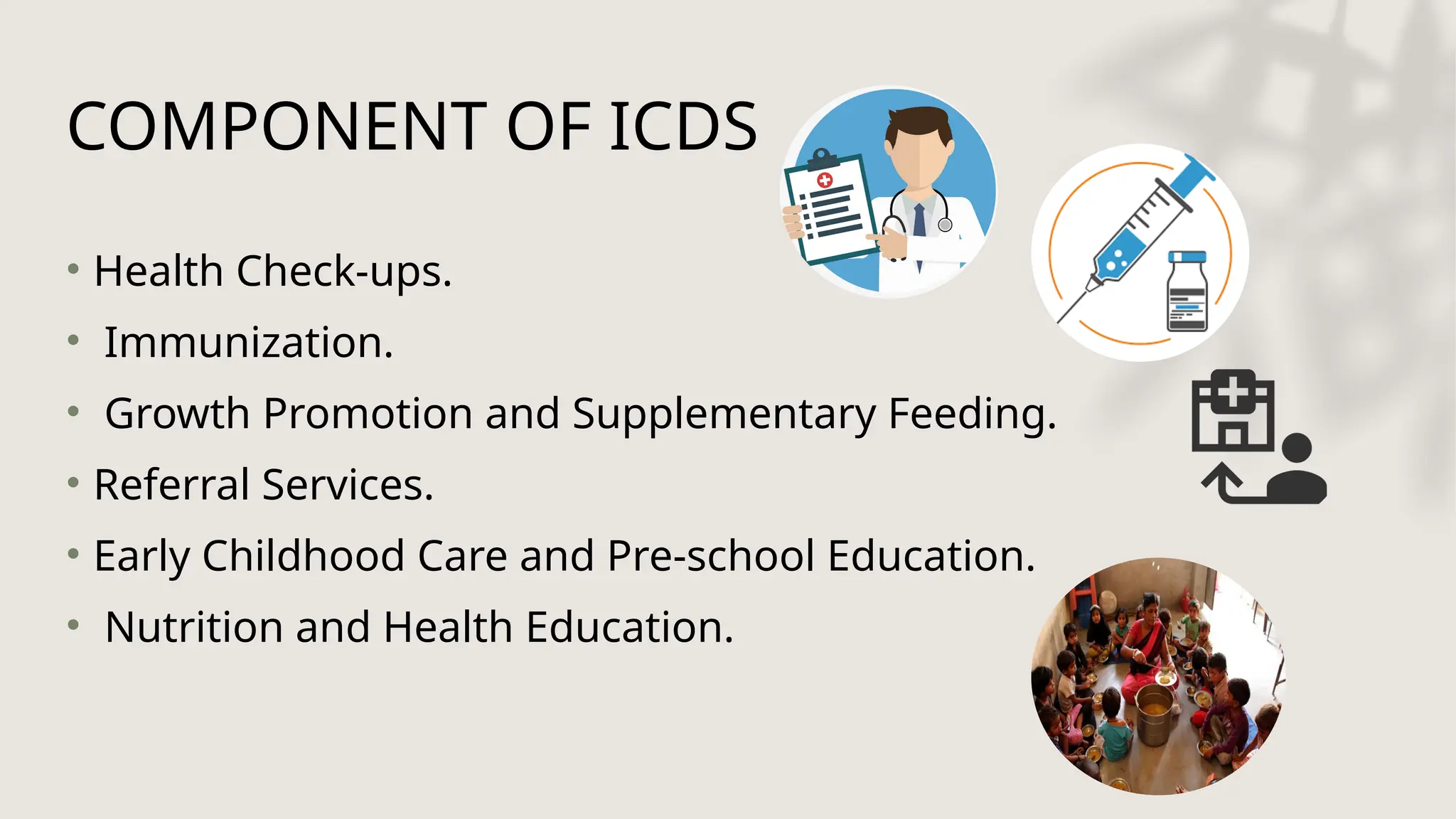
COMPONENT OF ICDS
•Health Check-ups.
• Immunization.
• Growth Promotion and Supplementary Feeding.
• Referral Services.
• Early Childhood Care and Pre-school Education.
• Nutrition and Health Education.
7.
SUPPLEMENTARY NUTRITION
• Supplementarynutrition is given to children below 6 years, and nursing
and expectant mothers from low income group. The aim is to supplement
nutritional intake as follows:
• Each child up to 6 years of age to get 300 calories and 8-10 grams of
protein.
• Each adolescent girl to get 500 calories and 20-25grams of protein.
• Each pregnant women and lactating mother to get 500 calories and 20-25
grams of protein.
• Each malnourished child to get 600 calories and 16-20 grams of protein
8.
IMMUNIZATION-
• Immunization ofchildren against 7 vaccine preventable diseases
(polio, diphtheria , whooping cough , tuberculosis , tetanus ,
measles , meningitis and hepatitis ) is being done, while for
expectant mothers, immunization against tetanus is
recommended.
9.
HEALTH CHECK UP
•Record of weight and height of children at periodical intervals
• Watch over milestones
• Immunization
• Deworming
• General check up for detection of disease
• Treatment of diseases like diarrhea, ARI
• Prophylaxis against vitamin A deficiency and anemia
• Referral of serious cases
• Antenatal care of expectant mothers
• Post natal care of nursing mothers and care of new born infants
10.
Non-formal Pre-school Education(PSE)
• Children between the ages 3-6 years are imparted non- formal
pre-school education in an Anganwadi in each village with about
1000 population. The objective is to provide opportunities to
develop desirable attitude, values and behavior pattern among
children. Locally produced inexpensive toys and material are
used in organizing play and creative activity.
11.
Referral Services:
During healthcheck-ups and growth monitoring, sick or
malnourished children, in need of prompt medical attention, are
referred to the Primary Health Centre or its sub-center.
12.
Nutrition and HealthEducation
• Nutrition education and health education is given to all women
in the age group 15- 45 years , giving priority to nursing and
expectant mothers. It is imparted by specially organized courses
in village during home visits by Anganwadi workers.
13.
THE ICDS TEAM:
TheICDS team comprises the
1) District Programme Officers (DPOs).
2)Child Development Project Officers (CDPOs)
3) Supervisors
4) Anganwadi Workers
5) Anganwadi Helpers
Medical officers, Auxiliary Nurse Midwife (ANM) and Accredited Social
Health Activist (ASHA) form a team with the ICDS functionaries to achieve
convergence of different services.
14.
INTERNATIONAL PARTNERS
Government ofIndia partners with the following international
agencies to supplement interventions under the ICDS:
• United Nations International Children' Emergency Fund
(UNICEF)
• Cooperative for Assistance and Relief Everywhere (CARE)
• World Food Programme(WFP)