MATHEMATICS
Class VI
Lecture # 7
MATHEMATICS
Mathematics is the science of
numbers and figures through
logical reasoning.
The coldest continent on Earth
is Antarctica where average
temperature range from 5°C in
summer to -80°C in winter. The
highest temperature ever
recorded in Antarctica was
15°C, while the lowest
temperature ever recorded in
Antarctica was -89.2°C.
In previous classes,
we have learnt about
whole numbers,
decimals and
fractions, such as 0,
9, 5.8 and
𝟏
𝟑
.
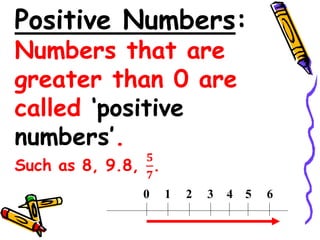
Positive Numbers:
Numbers that are
greater than 0 are
called ‘positive
numbers’.
Such as 8, 9.8,
𝟓
𝟕
.
0 1 2 3 4 5 6
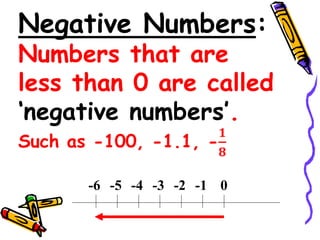
Negative Numbers:
Numbers that are
less than 0 are called
‘negative numbers’.
Such as -100, -1.1, -
𝟏
𝟖
0
-1
-2
-3
-4
-5
-6
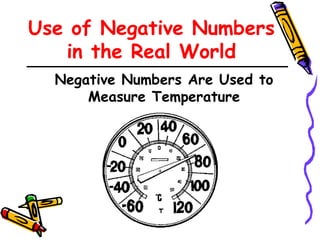
Use of Negative Numbers
in the Real World
Negative Numbers Are Used to
Measure Temperature
Negative Numbers Are Used to
Measure Under Sea Level
0
10
20
30
-10
-20
-30
-40
-50
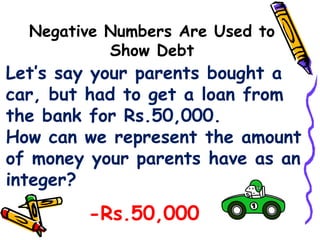
Negative Numbers Are Used to
Show Debt
Let’s say your parents bought a
car, but had to get a loan from
the bank for Rs.50,000.
How can we represent the amount
of money your parents have as an
integer?
-Rs.50,000
INTEGERS
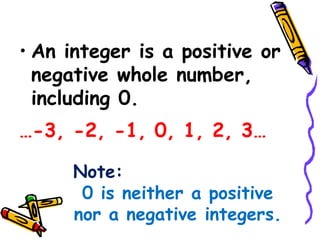
What is an
Integer?
• An integer is a positive or
negative whole number,
including 0.
…-3, -2, -1, 0, 1, 2, 3…
Note:
0 is neither a positive
nor a negative integers.
If you don’t see a
negative or positive
sign in front of a
number it is positive.
Tip:
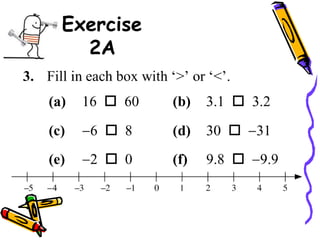
Exercise
2A
Answer:
Homework
Practice Now (Page 27)
Q.1. and Q.2. (in copy)
INTEGERS
Lecture # 8
Let’s Review…
What is an integer?
ANSWER
• An integer is a positive or
negative whole number,
including 0.
Note:
0 is neither a positive
nor a negative integers.
Can you give an example
of an integer?
ANSWER
• …-3, -2, -1, 0, 1, 2, 3…
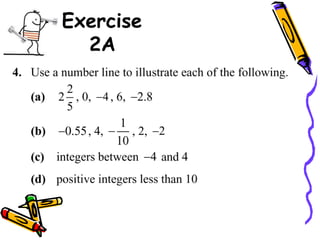
Exercise
2A
Answer:
Number Line
Exercise
2A
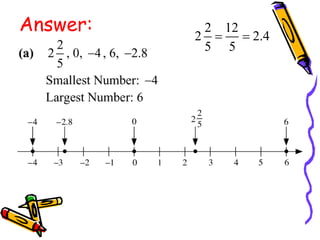
Answer:
Exercise
2A
Answer: 2 12
2 2.4
5 5
 
Answer:
1
0.1
10
  
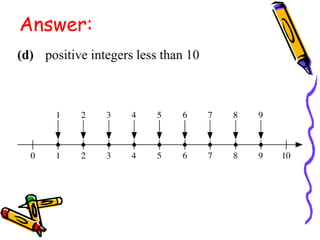
Answer:
Answer:
Homework
Practice Now (Page 29)
Q.1 and Q.2 (in copy)
There are
“4”
Integer
Operations
4 Integer Operations
• Addition +
• Subtraction -
• Multiplication x
• Division ÷
Rule #1 for
Adding Integers (+)
• The sum of two positive integers is
always positive.
5 + 1 = 6
Rule #2 for
Adding Integers (+)
• The sum of two negative integers is
always negative.
-5 + (-1) = -6
Rule #3 for
Adding Integers (+)
• The sum of a positive and a negative
integer could be positive, negative, or
zero.
Rule #3 for Adding
Integers Continued
• When you add a positive and negative
integer, you are really subtracting. Then,
you give the answer the sign of the
greater absolute value.
5 + (-1) = -4
-5 + 1 = 4
-5 + (-5) = 0
Let’s Practice “Addition”
1) 5 + 6 =
• -3 + (-2) =
• -6 + 5 =
• 8 + (-7) =
• -9 + 9 =
 Let’s Check
1) 5 + 6 = 11
• -3 + (-2) = -5
• -6 + 5 = -1
• 8 + (-7) = 1
• -9 + 9 = 0
Rules for
Subtracting Integers (-)
• To subtract an integer, add its
opposite.
• You will need to correctly change all
subtraction problems into addition
problems!
How do you
change a
subtraction
problem into an
addition problem?
There are three steps:
1. Keep the first integer the same.
(Same)
2. Change the subtraction sign into an
addition sign. (Change)
3. Take the opposite of the number
that immediately follows the newly
placed addition sign. (Change)
Same, Change, Change
Examples:
5 – (-2) = 5 + 2 = 7
-5 – 2 = -5 + (-2) = -7
Think …
Let’s Practice “Subtraction”
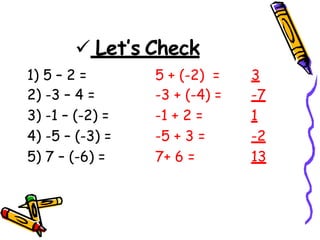
1) 5 – 2 =
2) -3 – 4 =
3) -1 – (-2) =
4) -5 – (-3) =
5) 7 – (-6) =
 Let’s Check
1) 5 – 2 = 5 + (-2) = 3
2) -3 – 4 = -3 + (-4) = -7
3) -1 – (-2) = -1 + 2 = 1
4) -5 – (-3) = -5 + 3 = -2
5) 7 – (-6) = 7+ 6 = 13
Rules for
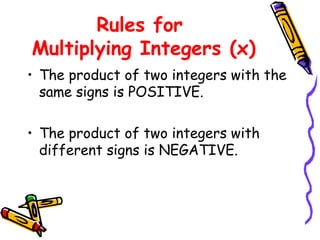
Multiplying Integers (x)
• The product of two integers with the
same signs is POSITIVE.
• The product of two integers with
different signs is NEGATIVE.
Rules Summary for
Multiplication
• Positive x Positive = Positive
• Negative x Negative = Positive
• Positive x Negative= Negative
• Negative x Positive = Negative
Let’s Practice “Multiplication”
1) 6 x (-3) =
2) 3 x 3 =
3) -4 x 5 =
4) -6 x (-2) =
5) -7 x (-8) =
 Let’s Check
1) 6 x (-3) = -18
2) 3 x 3 = 9
3) -4 x 5 = -20
4) -6 x (-2) = 12
5) -7 x (-8) = 56
Did you know that
the rules for
multiplication and
division are the
same?
Guess what….
They are!
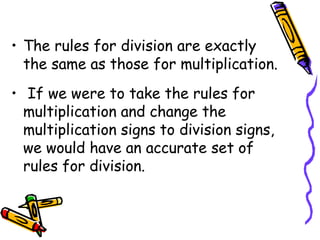
• The rules for division are exactly
the same as those for multiplication.
• If we were to take the rules for
multiplication and change the
multiplication signs to division signs,
we would have an accurate set of
rules for division.
Rules for
Dividing Integers (÷)
• The quotient of two integers with
the same signs is POSITIVE.
• The quotient of two integers with
different signs is NEGATIVE.
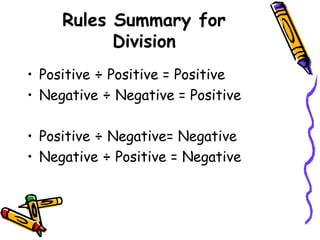
Rules Summary for
Division
• Positive ÷ Positive = Positive
• Negative ÷ Negative = Positive
• Positive ÷ Negative= Negative
• Negative ÷ Positive = Negative
Let’s Practice “Division”
1) 18 ÷ (-2) =
2) -48 ÷ (-6) =
3) -27 ÷ 9 =
4) 64 ÷ 8 =
5) 30 ÷ (-5) =
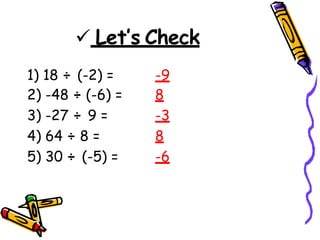
 Let’s Check
1) 18 ÷ (-2) = -9
2) -48 ÷ (-6) = 8
3) -27 ÷ 9 = -3
4) 64 ÷ 8 = 8
5) 30 ÷ (-5) = -6
What are the four
operations?
ANSWER
• The four operations are:
addition, subtraction,
multiplication, and division.
How do you add
integers?
ANSWER
• The sum of two positive integers is always
positive.
• The sum of two negative integers is always
negative.
• When you add a positive and negative
integer, you are really subtracting. Then, you
give the answer the sign of the greater
absolute value.
How do you
subtract integers?
ANSWER
• To subtract an integer, add its
opposite.
• Same, Change, Change
How do you multiply
integers?
ANSWER
• If the signs are the same, your answer
is always positive.
• If the signs are different, your answer
is always negative.
How do you divide
integers?
ANSWER
• If the signs are the same, your answer is
always positive.
• If the signs are different, your answer is
always negative.
*Multiplication and Division Rules are the
same!
Class 6 - Maths (Integers).pptx

Class 6 - Maths (Integers).pptx