Lesson 4   INTEGERS

LESSON 4 INTEGERS

1. POSITIVE AND NEGATIVE NUMBERS
We can use negative numbers in different situations:
·Positions:
A submarine which is sailing 700 m below sea level: – 700 m
The second floor of a subterranean garage: – 2
·Money:
He is €400 overdrawn: – 400
·Temperatures:
The temperature in Siberia has risen 25ºC below zero: -25ºC


Negative numbers are less than zero.
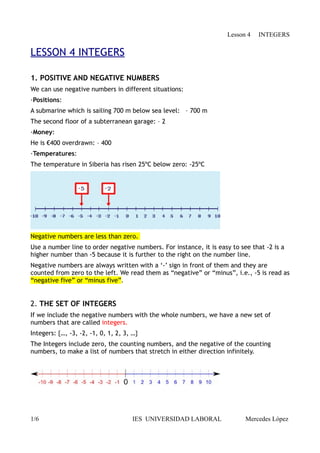
Use a number line to order negative numbers. For instance, it is easy to see that -2 is a
higher number than -5 because it is further to the right on the number line.
Negative numbers are always written with a ‘-’ sign in front of them and they are
counted from zero to the left. We read them as “negative” or “minus”, i.e., -5 is read as
“negative five” or “minus five”.


2. THE SET OF INTEGERS
If we include the negative numbers with the whole numbers, we have a new set of
numbers that are called integers.
Integers: {…, -3, -2, -1, 0, 1, 2, 3, …}
The Integers include zero, the counting numbers, and the negative of the counting
numbers, to make a list of numbers that stretch in either direction infinitely.


1/6                                   IES UNIVERSIDAD LABORAL              Mercedes López
Lesson 4   INTEGERS

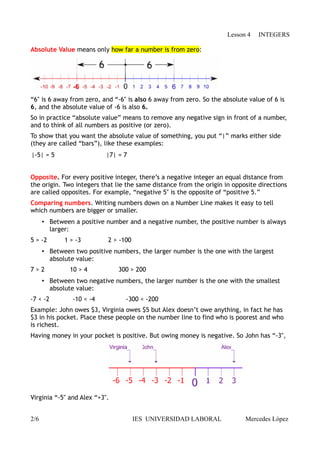
Absolute Value means only how far a number is from zero:


“6″ is 6 away from zero, and “-6″ is also 6 away from zero. So the absolute value of 6 is
6, and the absolute value of -6 is also 6.
So in practice “absolute value” means to remove any negative sign in front of a number,
and to think of all numbers as positive (or zero).
To show that you want the absolute value of something, you put “|” marks either side
(they are called “bars”), like these examples:
|-5| = 5                   |7| = 7


Opposite. For every positive integer, there’s a negative integer an equal distance from
the origin. Two integers that lie the same distance from the origin in opposite directions
are called opposites. For example, “negative 5″ is the opposite of “positive 5.”
Comparing numbers. Writing numbers down on a Number Line makes it easy to tell
which numbers are bigger or smaller.
      • Between a positive number and a negative number, the positive number is always
        larger:
5 > -2       1 > -3        2 > -100
      • Between two positive numbers, the larger number is the one with the largest
        absolute value:
7>2            10 > 4          300 > 200
      • Between two negative numbers, the larger number is the one with the smallest
        absolute value:
-7 < -2         -10 < -4         -300 < -200
Example: John owes $3, Virginia owes $5 but Alex doesn’t owe anything, in fact he has
$3 in his pocket. Place these people on the number line to find who is poorest and who
is richest.
Having money in your pocket is positive. But owing money is negative. So John has “-3″,


Virginia “-5″ and Alex “+3″.


2/6                                   IES UNIVERSIDAD LABORAL              Mercedes López
Lesson 4   INTEGERS

Now it is easy to see that Virginia is poorer than John (-5 is less than -3) and John is
poorer than Alex (-3 is smaller than 3), and Alex is, of course, the richest!


3. ADDING AND SUBTRACTING INTEGERS
Using the Number Line
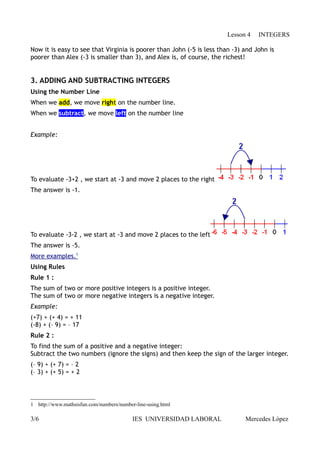
When we add, we move right on the number line.
When we subtract, we move left on the number line


Example:


To evaluate -3+2 , we start at -3 and move 2 places to the right
The answer is -1.


To evaluate -3-2 , we start at -3 and move 2 places to the left
The answer is -5.
More examples.1
Using Rules
Rule 1 :
The sum of two or more positive integers is a positive integer.
The sum of two or more negative integers is a negative integer.
Example:
(+7) + (+ 4) = + 11
(-8) + (– 9) = – 17
Rule 2 :
To find the sum of a positive and a negative integer:
Subtract the two numbers (ignore the signs) and then keep the sign of the larger integer.
(– 9) + (+ 7) = – 2
(– 3) + (+ 5) = + 2


1 http://www.mathsisfun.com/numbers/number-line-using.html

3/6                                       IES UNIVERSIDAD LABORAL            Mercedes López
Lesson 4   INTEGERS

4. ADDITIONS AND SUBTRACTIONS WITH BRACKETS
Remember: If a number has no sign it usually means that it is a positive number.
Example: 5 is really +5
Adding positive numbers is just simple addition. Example: 2 + 3 = 5 is really saying
“Positive 2 plus Positive 3 equals Positive 5″
You could write it as (+2) + (+3) = (+5)
Subtracting positive numbers is just simple subtraction.Example: 6 – 3 = 3 is really
saying
“Positive 6 minus Positive 3 equals Positive 3″
You could write it as (+6) – (+3) = (+3).
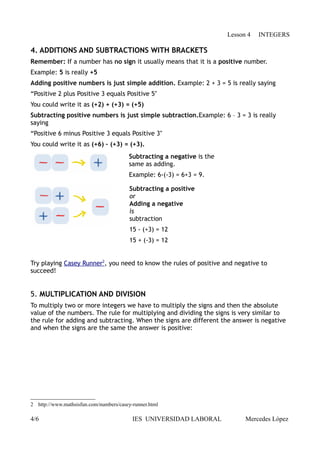
                                        Subtracting a negative is the
                                        same as adding.
                                        Example: 6-(-3) = 6+3 = 9.

                                         Subtracting a positive
                                         or
                                         Adding a negative
                                         is
                                         subtraction
                                         15 - (+3) = 12
                                         15 + (-3) = 12


Try playing Casey Runner2, you need to know the rules of positive and negative to
succeed!


5. MULTIPLICATION AND DIVISION
To multiply two or more integers we have to multiply the signs and then the absolute
value of the numbers. The rule for multiplying and dividing the signs is very similar to
the rule for adding and subtracting. When the signs are different the answer is negative
and when the signs are the same the answer is positive:


2 http://www.mathsisfun.com/numbers/casey-runner.html

4/6                                       IES UNIVERSIDAD LABORAL             Mercedes López
Lesson 4     INTEGERS

Now try a Test Bite3


6. POWERS AND ROOTS
The sign of a power depends on the base and the exponent.
If the base is positive, the power will be positive, as you learnt in lesson 2.
If the base is negative,
        and the exponent is even, the power will be positive:
        (–3)4 = (–3)(–3)(–3)(–3)
        = (9)(9)
        = 81
        and the exponent is odd, the power will be negative:
        (–3)5 = (–3)(–3)(–3)(–3)(–3)
        = (9)(9)(–3)
        = –243
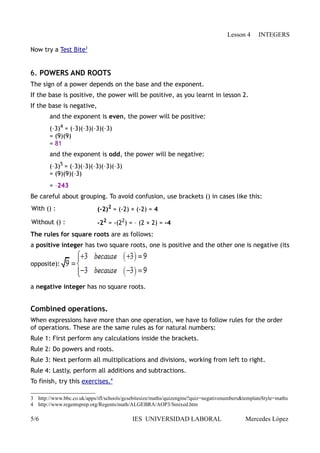
Be careful about grouping. To avoid confusion, use brackets () in cases like this:
With () :                   (-2)2 = (-2) × (-2) = 4

Without () :                -22 = -(22) = – (2 × 2) = -4
The rules for square roots are as follows:
a positive integer has two square roots, one is positive and the other one is negative (its

opposite):


a negative integer has no square roots.


Combined operations.
When expressions have more than one operation, we have to follow rules for the order
of operations. These are the same rules as for natural numbers:
Rule 1: First perform any calculations inside the brackets.
Rule 2: Do powers and roots.
Rule 3: Next perform all multiplications and divisions, working from left to right.
Rule 4: Lastly, perform all additions and subtractions.
To finish, try this exercises.4

3 http://www.bbc.co.uk/apps/ifl/schools/gcsebitesize/maths/quizengine?quiz=negativenumbers&templateStyle=maths
4 http://www.regentsprep.org/Regents/math/ALGEBRA/AOP3/Smixed.htm

5/6                                        IES UNIVERSIDAD LABORAL                         Mercedes López
Lesson 4   INTEGERS

GLOSSARY
Look for the following words in this dictionary5 and copy them in your notebook.
Sign
Absolute value
Opposite
Even
Odd


5 http://www.amathsdictionaryforkids.com/dictionary.html

6/6                                        IES UNIVERSIDAD LABORAL         Mercedes López

Lesson4 integers

  • 1.
    Lesson 4 INTEGERS LESSON 4 INTEGERS 1. POSITIVE AND NEGATIVE NUMBERS We can use negative numbers in different situations: ·Positions: A submarine which is sailing 700 m below sea level: – 700 m The second floor of a subterranean garage: – 2 ·Money: He is €400 overdrawn: – 400 ·Temperatures: The temperature in Siberia has risen 25ºC below zero: -25ºC Negative numbers are less than zero. Use a number line to order negative numbers. For instance, it is easy to see that -2 is a higher number than -5 because it is further to the right on the number line. Negative numbers are always written with a ‘-’ sign in front of them and they are counted from zero to the left. We read them as “negative” or “minus”, i.e., -5 is read as “negative five” or “minus five”. 2. THE SET OF INTEGERS If we include the negative numbers with the whole numbers, we have a new set of numbers that are called integers. Integers: {…, -3, -2, -1, 0, 1, 2, 3, …} The Integers include zero, the counting numbers, and the negative of the counting numbers, to make a list of numbers that stretch in either direction infinitely. 1/6 IES UNIVERSIDAD LABORAL Mercedes López
  • 2.
    Lesson 4 INTEGERS Absolute Value means only how far a number is from zero: “6″ is 6 away from zero, and “-6″ is also 6 away from zero. So the absolute value of 6 is 6, and the absolute value of -6 is also 6. So in practice “absolute value” means to remove any negative sign in front of a number, and to think of all numbers as positive (or zero). To show that you want the absolute value of something, you put “|” marks either side (they are called “bars”), like these examples: |-5| = 5 |7| = 7 Opposite. For every positive integer, there’s a negative integer an equal distance from the origin. Two integers that lie the same distance from the origin in opposite directions are called opposites. For example, “negative 5″ is the opposite of “positive 5.” Comparing numbers. Writing numbers down on a Number Line makes it easy to tell which numbers are bigger or smaller. • Between a positive number and a negative number, the positive number is always larger: 5 > -2 1 > -3 2 > -100 • Between two positive numbers, the larger number is the one with the largest absolute value: 7>2 10 > 4 300 > 200 • Between two negative numbers, the larger number is the one with the smallest absolute value: -7 < -2 -10 < -4 -300 < -200 Example: John owes $3, Virginia owes $5 but Alex doesn’t owe anything, in fact he has $3 in his pocket. Place these people on the number line to find who is poorest and who is richest. Having money in your pocket is positive. But owing money is negative. So John has “-3″, Virginia “-5″ and Alex “+3″. 2/6 IES UNIVERSIDAD LABORAL Mercedes López
  • 3.
    Lesson 4 INTEGERS Now it is easy to see that Virginia is poorer than John (-5 is less than -3) and John is poorer than Alex (-3 is smaller than 3), and Alex is, of course, the richest! 3. ADDING AND SUBTRACTING INTEGERS Using the Number Line When we add, we move right on the number line. When we subtract, we move left on the number line Example: To evaluate -3+2 , we start at -3 and move 2 places to the right The answer is -1. To evaluate -3-2 , we start at -3 and move 2 places to the left The answer is -5. More examples.1 Using Rules Rule 1 : The sum of two or more positive integers is a positive integer. The sum of two or more negative integers is a negative integer. Example: (+7) + (+ 4) = + 11 (-8) + (– 9) = – 17 Rule 2 : To find the sum of a positive and a negative integer: Subtract the two numbers (ignore the signs) and then keep the sign of the larger integer. (– 9) + (+ 7) = – 2 (– 3) + (+ 5) = + 2 1 http://www.mathsisfun.com/numbers/number-line-using.html 3/6 IES UNIVERSIDAD LABORAL Mercedes López
  • 4.
    Lesson 4 INTEGERS 4. ADDITIONS AND SUBTRACTIONS WITH BRACKETS Remember: If a number has no sign it usually means that it is a positive number. Example: 5 is really +5 Adding positive numbers is just simple addition. Example: 2 + 3 = 5 is really saying “Positive 2 plus Positive 3 equals Positive 5″ You could write it as (+2) + (+3) = (+5) Subtracting positive numbers is just simple subtraction.Example: 6 – 3 = 3 is really saying “Positive 6 minus Positive 3 equals Positive 3″ You could write it as (+6) – (+3) = (+3). Subtracting a negative is the same as adding. Example: 6-(-3) = 6+3 = 9. Subtracting a positive or Adding a negative is subtraction 15 - (+3) = 12 15 + (-3) = 12 Try playing Casey Runner2, you need to know the rules of positive and negative to succeed! 5. MULTIPLICATION AND DIVISION To multiply two or more integers we have to multiply the signs and then the absolute value of the numbers. The rule for multiplying and dividing the signs is very similar to the rule for adding and subtracting. When the signs are different the answer is negative and when the signs are the same the answer is positive: 2 http://www.mathsisfun.com/numbers/casey-runner.html 4/6 IES UNIVERSIDAD LABORAL Mercedes López
  • 5.
    Lesson 4 INTEGERS Now try a Test Bite3 6. POWERS AND ROOTS The sign of a power depends on the base and the exponent. If the base is positive, the power will be positive, as you learnt in lesson 2. If the base is negative, and the exponent is even, the power will be positive: (–3)4 = (–3)(–3)(–3)(–3) = (9)(9) = 81 and the exponent is odd, the power will be negative: (–3)5 = (–3)(–3)(–3)(–3)(–3) = (9)(9)(–3) = –243 Be careful about grouping. To avoid confusion, use brackets () in cases like this: With () : (-2)2 = (-2) × (-2) = 4 Without () : -22 = -(22) = – (2 × 2) = -4 The rules for square roots are as follows: a positive integer has two square roots, one is positive and the other one is negative (its opposite): a negative integer has no square roots. Combined operations. When expressions have more than one operation, we have to follow rules for the order of operations. These are the same rules as for natural numbers: Rule 1: First perform any calculations inside the brackets. Rule 2: Do powers and roots. Rule 3: Next perform all multiplications and divisions, working from left to right. Rule 4: Lastly, perform all additions and subtractions. To finish, try this exercises.4 3 http://www.bbc.co.uk/apps/ifl/schools/gcsebitesize/maths/quizengine?quiz=negativenumbers&templateStyle=maths 4 http://www.regentsprep.org/Regents/math/ALGEBRA/AOP3/Smixed.htm 5/6 IES UNIVERSIDAD LABORAL Mercedes López
  • 6.
    Lesson 4 INTEGERS GLOSSARY Look for the following words in this dictionary5 and copy them in your notebook. Sign Absolute value Opposite Even Odd 5 http://www.amathsdictionaryforkids.com/dictionary.html 6/6 IES UNIVERSIDAD LABORAL Mercedes López