
INTEGERS
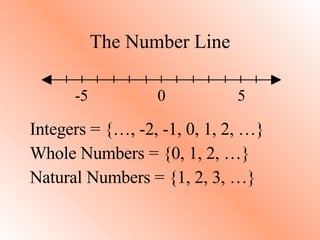
The Number Line Integers = {…, -2, -1, 0, 1, 2, …} Whole Numbers = {0, 1, 2, …} Natural Numbers = {1, 2, 3, …} -5 0 5
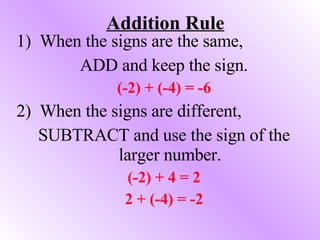
Addition Rule 1)  When the signs are the same, ADD and keep the sign. (-2) + (-4) = -6 2)  When the signs are different, SUBTRACT and use the sign of the larger number. (-2) + 4 = 2 2 + (-4) = -2
Karaoke Time! Addition Rule: Sung to the tune of “Row, row, row, your boat” Same signs add and keep, different signs subtract, keep the sign of the higher number, then it will be exact! Can your class do different rounds?
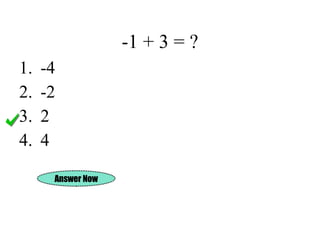
-1 + 3 = ? -4 -2 2 4 Answer Now
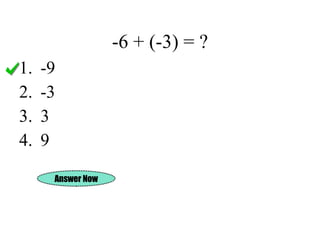
-6 + (-3) = ? -9 -3 3 9 Answer Now
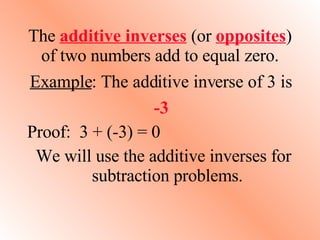
The  additive inverses   (or  opposites ) of two numbers add to equal zero. -3 Proof:  3 + (-3) = 0 We will use the additive inverses for subtraction problems. Example :  The additive inverse of 3 is
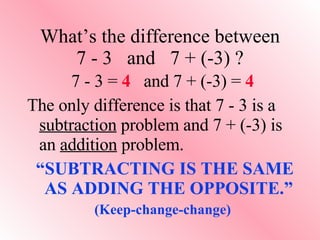
What’s the difference between 7 - 3  and  7 + (-3) ? 7 - 3 =  4   and 7 + (-3) =  4 The only difference is that 7 - 3 is a  subtraction  problem and 7 + (-3) is an  addition  problem. “ SUBTRACTING IS THE SAME AS ADDING THE OPPOSITE.” (Keep-change-change)
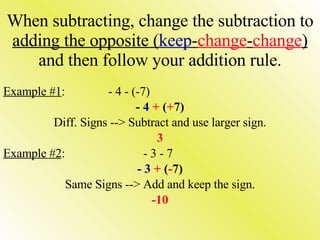
When subtracting, change the subtraction to  adding the opposite ( keep - change - change )  and then follow your addition rule. Example #1 :    - 4 - (-7) - 4   +  ( + 7) Diff. Signs --> Subtract and use larger sign. 3 Example #2 :     - 3 - 7 - 3   +  ( - 7) Same Signs --> Add and keep the sign. -10
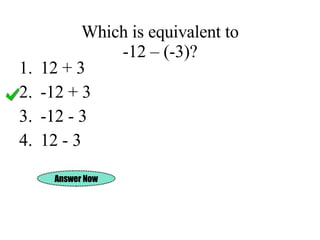
Which is equivalent to -12 – (-3)? 12 + 3 -12 + 3 -12 - 3 12 - 3 Answer Now
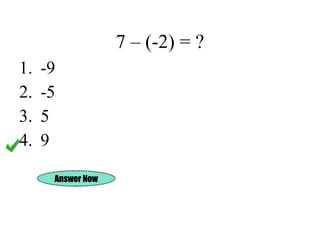
7 – (-2) = ? -9 -5 5 9 Answer Now
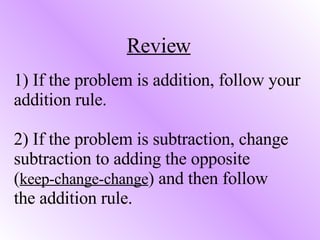
1) If the problem is addition, follow your addition rule. 2) If the problem is subtraction, change subtraction to adding the opposite  ( keep-change-change ) and then follow  the addition rule. Review
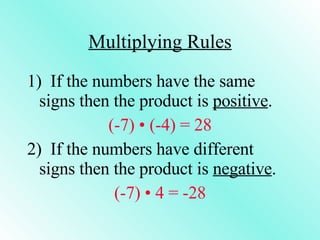
Multiplying Rules 1)  If the numbers have the same signs then the product is  positive . (-7) • (-4) = 28 2)  If the numbers have different signs then the product is  negative . (-7) • 4 = -28
When multiplying two negative numbers, the product is negative. True False Answer Now
When multiplying a negative number and a positive number, use the sign of the larger number. True False Answer Now
Multiply: (-3)(4)(2) 24 -24 12 -12 Answer Now
Dividing Rules 1)  If the numbers have the same signs then the quotient is  positive . -32 ÷ (-8 )= 4 2)  If the numbers have different signs then the quotient is  negative . 81 ÷ (-9) = -9
When dividing two negative numbers, the quotient is positive. True False Answer Now
When dividing a negative number and a positive number, use the sign of the larger number. True False Answer Now
What is the quotient of -21 ÷ -3? 18 -18 7 -7 Answer Now
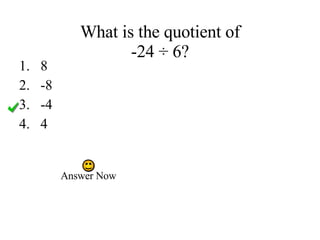
What is the quotient of -24 ÷ 6? 8 -8 -4 4 Answer Now

Integers

  • 1.
  • 2.
    The Number LineIntegers = {…, -2, -1, 0, 1, 2, …} Whole Numbers = {0, 1, 2, …} Natural Numbers = {1, 2, 3, …} -5 0 5
  • 3.
    Addition Rule 1) When the signs are the same, ADD and keep the sign. (-2) + (-4) = -6 2) When the signs are different, SUBTRACT and use the sign of the larger number. (-2) + 4 = 2 2 + (-4) = -2
  • 4.
    Karaoke Time! AdditionRule: Sung to the tune of “Row, row, row, your boat” Same signs add and keep, different signs subtract, keep the sign of the higher number, then it will be exact! Can your class do different rounds?
  • 5.
    -1 + 3= ? -4 -2 2 4 Answer Now
  • 6.
    -6 + (-3)= ? -9 -3 3 9 Answer Now
  • 7.
    The additiveinverses (or opposites ) of two numbers add to equal zero. -3 Proof: 3 + (-3) = 0 We will use the additive inverses for subtraction problems. Example : The additive inverse of 3 is
  • 8.
    What’s the differencebetween 7 - 3 and 7 + (-3) ? 7 - 3 = 4 and 7 + (-3) = 4 The only difference is that 7 - 3 is a subtraction problem and 7 + (-3) is an addition problem. “ SUBTRACTING IS THE SAME AS ADDING THE OPPOSITE.” (Keep-change-change)
  • 9.
    When subtracting, changethe subtraction to adding the opposite ( keep - change - change ) and then follow your addition rule. Example #1 : - 4 - (-7) - 4 + ( + 7) Diff. Signs --> Subtract and use larger sign. 3 Example #2 : - 3 - 7 - 3 + ( - 7) Same Signs --> Add and keep the sign. -10
  • 10.
    Which is equivalentto -12 – (-3)? 12 + 3 -12 + 3 -12 - 3 12 - 3 Answer Now
  • 11.
    7 – (-2)= ? -9 -5 5 9 Answer Now
  • 12.
    1) If theproblem is addition, follow your addition rule. 2) If the problem is subtraction, change subtraction to adding the opposite ( keep-change-change ) and then follow the addition rule. Review
  • 13.
    Multiplying Rules 1) If the numbers have the same signs then the product is positive . (-7) • (-4) = 28 2) If the numbers have different signs then the product is negative . (-7) • 4 = -28
  • 14.
    When multiplying twonegative numbers, the product is negative. True False Answer Now
  • 15.
    When multiplying anegative number and a positive number, use the sign of the larger number. True False Answer Now
  • 16.
    Multiply: (-3)(4)(2) 24-24 12 -12 Answer Now
  • 17.
    Dividing Rules 1) If the numbers have the same signs then the quotient is positive . -32 ÷ (-8 )= 4 2) If the numbers have different signs then the quotient is negative . 81 ÷ (-9) = -9
  • 18.
    When dividing twonegative numbers, the quotient is positive. True False Answer Now
  • 19.
    When dividing anegative number and a positive number, use the sign of the larger number. True False Answer Now
  • 20.
    What is thequotient of -21 ÷ -3? 18 -18 7 -7 Answer Now
  • 21.
    What is thequotient of -24 ÷ 6? 8 -8 -4 4 Answer Now