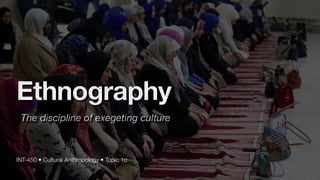
Ethnography
The discipline of exegeting culture
INT-450 • Cultural Anthropology • Topic 1c
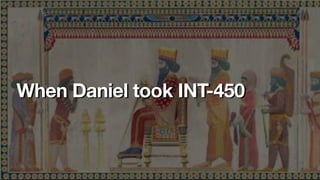
When Daniel took INT-450
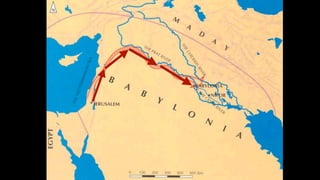
In the third year of the reign of Jehoiakim king of Judah,
Nebuchadnezzar king of Babylon came to Jerusalem and
besieged it. And the Lord gave Jehoiakim king of Judah
into his hand, with some of the vessels of the house of
God. And he brought them to the land of Shinar, to the
house of his god, and placed the vessels in the treasury of
his god.
(Daniel 1:1–2 ESV)
Then the king commanded Ashpenaz, his chief eunuch, to
bring some of the people of Israel, both of the royal family
and of the nobility, youths without blemish, of good
appearance and skillful in all wisdom, endowed with
knowledge, understanding learning, and competent to
stand in the king’s palace, and to teach them the literature
and language of the Chaldeans.
(Dan 1:3–4 ESV)
The king assigned them a daily portion of the food that the
king ate, and of the wine that he drank. They were to be
educated for three years, and at the end of that time they
were to stand before the king. Among these were Daniel,
Hananiah, Mishael, and Azariah of the tribe of Judah. And
the chief of the eunuchs gave them names: Daniel he
called Belteshazzar, Hananiah he called Shadrach, Mishael
he called Meshach, and Azariah he called Abednego
(Dan 1:5–7 ESV)
How was Daniel trained in
intercultural competence?
Culture
Culture is
Is the total way of life of a group of people that is (a) learned, (b)
dynamic, (c) shared, (d) power laden, and (e) integrated
(Howell & Paris, 2019, p. 64)
Culture
• Learned — All cultural behaviors are acquired.
11
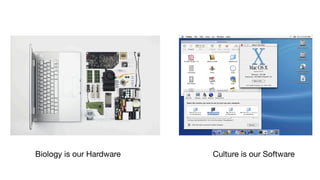
Biology is our Hardware Culture is our Software
Culture
• Learned — All cultural behaviors are acquired.
• Dynamic — culture constantly changes and adapts to peoples needs.
13
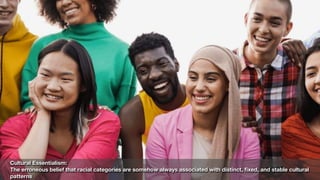
Cultural Essentialism:
The erroneous belief that racial categories are somehow always associated with distinct,
fi
xed, and stable cultural
patterns
Culture
• Learned — All cultural behaviors are acquired.
• Dynamic — culture constantly changes and adapts to peoples needs.
• Shared — Culture is socially constructed. It is not individual.
15
Culture
• Learned — All cultural behaviors are acquired.
• Dynamic — culture constantly changes and adapts to peoples needs.
• Shared — Culture is socially constructed. It is not individual.
• Power Laden — Culture is not neutral. People use cultural resources to attain
goals.
16
Culture
• Learned — All cultural behaviors are acquired.
• Dynamic — culture constantly changes and adapts to peoples needs.
• Shared — Culture is socially constructed. It is not individual.
• Power Laden — Culture is not neutral. People use cultural resources to attain
goals.
• Integrated — All aspects of culture are related to other parts of culture.
17
What aspects of Western Culture are rooted in ancient pagan religions?
18
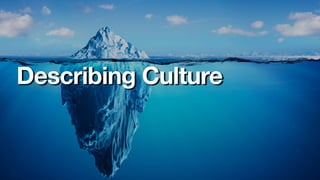
Describing Culture
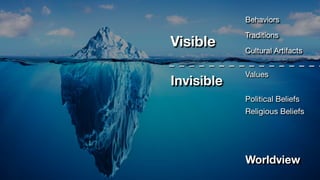
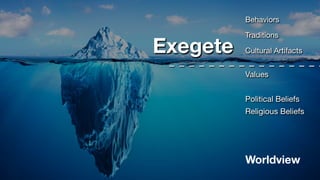
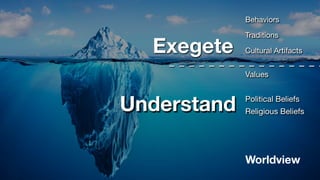
Cultural Iceberg
Visible
Invisible
Behaviors
Traditions
Cultural Artifacts
Values
Political Beliefs
Religious Beliefs
Worldview
Visible
Invisible
Behaviors
Traditions
Cultural Artifacts
Values
Political Beliefs
Religious Beliefs
Worldview
Exegete
Behaviors
Traditions
Cultural Artifacts
Values
Political Beliefs
Religious Beliefs
Worldview
Exegete
Understand
Ethnographic Methods
Ethnography is how we exegete culture
Britannica, T. Editors of Encyclopaedia (2023, October 27). ethnography. Encyclopedia Britannica. https://www.britannica.com/science/ethnography
Ethnography
The descriptive study of a human society or the process
of making such a study. Contemporary ethnography is
based almost entirely on
fi
eldwork and requires the
complete immersion of the anthropologist in
the culture and everyday life of the people who are the
subject of his study.
Britannica, T. Editors of Encyclopaedia (2023, October 27). ethnography. Encyclopedia Britannica. https://www.britannica.com/science/ethnography
An ethnographer…is a person who writes a description of
a cultural group or situation using participant observation
and informant interviews. The product of the research is
the ethnography.
Shalinsky, Audrey. Ethnographer. In James Birx Ed. Encyclopedia of anthropology. Vol. 1 Sage Publication. p. 849
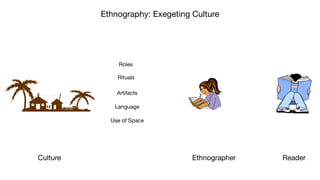
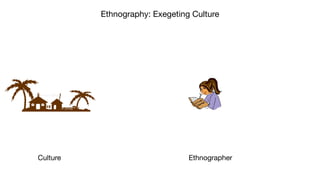
Ethnography: Exegeting Culture
Culture Ethnographer
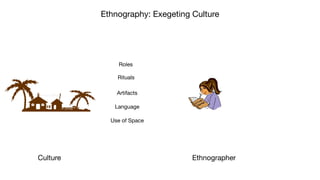
Ethnography: Exegeting Culture
Culture Ethnographer
Roles
Rituals
Artifacts
Use of Space
Language
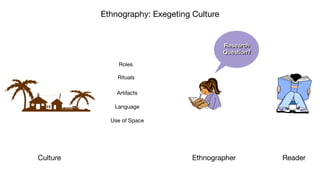
Ethnography: Exegeting Culture
Culture Ethnographer Reader
Roles
Rituals
Artifacts
Use of Space
Language
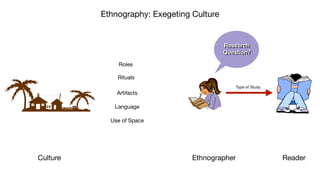
Ethnography: Exegeting Culture
Culture Ethnographer Reader
Roles
Rituals
Artifacts
Use of Space
Language
Research
Question?
Ethnography: Exegeting Culture
Culture Ethnographer Reader
Type of Study
Roles
Rituals
Artifacts
Use of Space
Language
Research
Question?
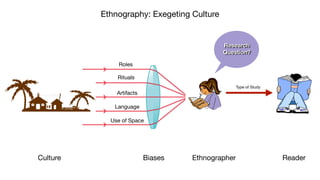
Ethnography: Exegeting Culture
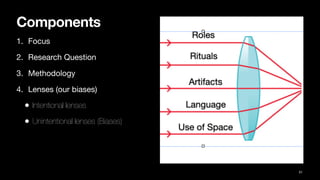
Culture Ethnographer Reader
Biases
Type of Study
Roles
Rituals
Artifacts
Use of Space
Language
Research
Question?
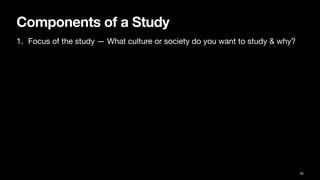
Components of a Study
1. Focus of the study — What culture or society do you want to study & why?
35
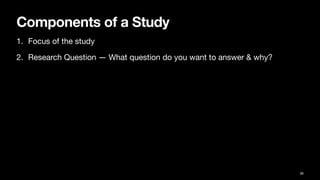
Components of a Study
1. Focus of the study
2. Research Question — What question do you want to answer & why?
36
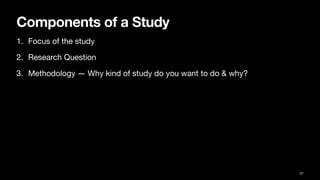
Components of a Study
1. Focus of the study
2. Research Question
3. Methodology — Why kind of study do you want to do & why?
37
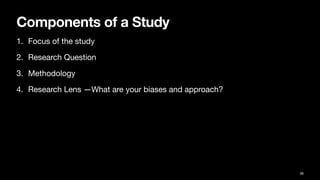
Components of a Study
1. Focus of the study
2. Research Question
3. Methodology
4. Research Lens —What are your biases and approach?
38
Components
1. Focus — The Proposal
39
What culture did you decide?
Components
1. Focus
2. Research Question
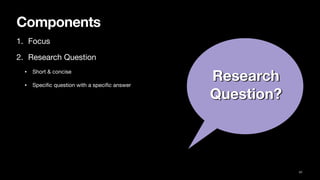
• Short & concise
• Speci
fi
c question with a speci
fi
c answer
41
Research
Question?
Research Questions
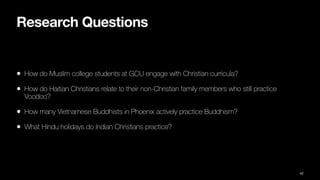
• How do Muslim college students at GCU engage with Christian curricula?
• How do Haitian Christians relate to their non-Christian family members who still practice
Voodoo?
• How many Vietnamese Buddhists in Phoenix actively practice Buddhism?
• What Hindu holidays do Indian Christians practice?
42
Research Questions
• TPS — What are some questions you have about the culture you’re studying?
43
Components
1. Focus
2. Research Question
3. Methodology
• Quantitative
• Qualitative
44
Methods of Research
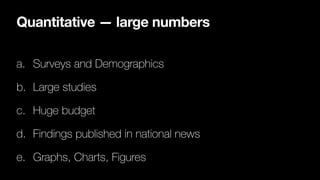
Quantitative — large numbers
a. Surveys and Demographics
b. Large studies
c. Huge budget
d. Findings published in national news
e. Graphs, Charts, Figures
Qualitative — Small numbers
a. Interviews — one-on-one, in-person
Qualitative
a. Interviews
b. Participant Observation — Field notes, in person
Qualitative
a. Interviews
b. Participant Observation
c. Focus Groups — groups of people interviews
Qualitative
a. Interviews
b. Participant Observation
c. Focus Groups
d. Archival — reviewing literature & existing studies
Components
1. Focus
2. Research Question
3. Methodology
4. Lenses (our biases)
• Intentional lenses
• Unintentional lenses (Biases)
51
Intentional Lens
Intentional Lenses
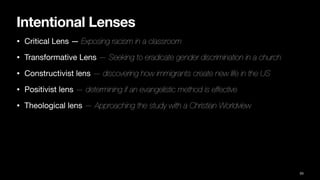
• Critical Lens — Exposing racism in a classroom
• Transformative Lens — Seeking to eradicate gender discrimination in a church
• Constructivist lens — discovering how immigrants create new life in the US
• Positivist lens — determining if an evangelistic method is effective
• Theological lens — Approaching the study with a Christian Worldview
53
Unintentional Lenses: Biases
What are some of our cultural biases, and how do
they distort the way we exegete culture?
How do we try to suspend our biases?
Example of Ethnography
Margaret Meade’s Field Notes on the Moccasin
Game, Omaha Tribe (June, 1932)
Ethnographic Study of Seinfeld’s “The Pie” 1994
1. What cultural artifacts were in the scene?
2. What were people’s role in the scene?
3. Describe the social organization participants.
4. What rituals were done in the scene?
5. What values were in conflict?
6. Describe the two cultures depicted and their differences.

INT-450 Topic 1c Ethnography.pdf

  • 2.
    Ethnography The discipline ofexegeting culture INT-450 • Cultural Anthropology • Topic 1c
  • 3.
  • 4.
    In the thirdyear of the reign of Jehoiakim king of Judah, Nebuchadnezzar king of Babylon came to Jerusalem and besieged it. And the Lord gave Jehoiakim king of Judah into his hand, with some of the vessels of the house of God. And he brought them to the land of Shinar, to the house of his god, and placed the vessels in the treasury of his god. (Daniel 1:1–2 ESV)
  • 5.
    Then the kingcommanded Ashpenaz, his chief eunuch, to bring some of the people of Israel, both of the royal family and of the nobility, youths without blemish, of good appearance and skillful in all wisdom, endowed with knowledge, understanding learning, and competent to stand in the king’s palace, and to teach them the literature and language of the Chaldeans. (Dan 1:3–4 ESV)
  • 6.
    The king assignedthem a daily portion of the food that the king ate, and of the wine that he drank. They were to be educated for three years, and at the end of that time they were to stand before the king. Among these were Daniel, Hananiah, Mishael, and Azariah of the tribe of Judah. And the chief of the eunuchs gave them names: Daniel he called Belteshazzar, Hananiah he called Shadrach, Mishael he called Meshach, and Azariah he called Abednego (Dan 1:5–7 ESV)

  • 8.
    How was Danieltrained in intercultural competence?
  • 9.
  • 10.
    Culture is Is thetotal way of life of a group of people that is (a) learned, (b) dynamic, (c) shared, (d) power laden, and (e) integrated (Howell & Paris, 2019, p. 64)
  • 11.
    Culture • Learned —All cultural behaviors are acquired. 11
  • 12.
    Biology is ourHardware Culture is our Software
  • 13.
    Culture • Learned —All cultural behaviors are acquired. • Dynamic — culture constantly changes and adapts to peoples needs. 13
  • 14.
    Cultural Essentialism: The erroneousbelief that racial categories are somehow always associated with distinct, fi xed, and stable cultural patterns
  • 15.
    Culture • Learned —All cultural behaviors are acquired. • Dynamic — culture constantly changes and adapts to peoples needs. • Shared — Culture is socially constructed. It is not individual. 15
  • 16.
    Culture • Learned —All cultural behaviors are acquired. • Dynamic — culture constantly changes and adapts to peoples needs. • Shared — Culture is socially constructed. It is not individual. • Power Laden — Culture is not neutral. People use cultural resources to attain goals. 16
  • 17.
    Culture • Learned —All cultural behaviors are acquired. • Dynamic — culture constantly changes and adapts to peoples needs. • Shared — Culture is socially constructed. It is not individual. • Power Laden — Culture is not neutral. People use cultural resources to attain goals. • Integrated — All aspects of culture are related to other parts of culture. 17
  • 18.
    What aspects ofWestern Culture are rooted in ancient pagan religions? 18
  • 19.
  • 20.
  • 21.
  • 22.
  • 23.
  • 24.
  • 25.
  • 26.
    Ethnography is howwe exegete culture Britannica, T. Editors of Encyclopaedia (2023, October 27). ethnography. Encyclopedia Britannica. https://www.britannica.com/science/ethnography
  • 27.
    Ethnography The descriptive studyof a human society or the process of making such a study. Contemporary ethnography is based almost entirely on fi eldwork and requires the complete immersion of the anthropologist in the culture and everyday life of the people who are the subject of his study. Britannica, T. Editors of Encyclopaedia (2023, October 27). ethnography. Encyclopedia Britannica. https://www.britannica.com/science/ethnography
  • 28.
    An ethnographer…is aperson who writes a description of a cultural group or situation using participant observation and informant interviews. The product of the research is the ethnography. Shalinsky, Audrey. Ethnographer. In James Birx Ed. Encyclopedia of anthropology. Vol. 1 Sage Publication. p. 849
  • 29.
  • 30.
    Ethnography: Exegeting Culture CultureEthnographer Roles Rituals Artifacts Use of Space Language
  • 31.
    Ethnography: Exegeting Culture CultureEthnographer Reader Roles Rituals Artifacts Use of Space Language
  • 32.
    Ethnography: Exegeting Culture CultureEthnographer Reader Roles Rituals Artifacts Use of Space Language Research Question?
  • 33.
    Ethnography: Exegeting Culture CultureEthnographer Reader Type of Study Roles Rituals Artifacts Use of Space Language Research Question?
  • 34.
    Ethnography: Exegeting Culture CultureEthnographer Reader Biases Type of Study Roles Rituals Artifacts Use of Space Language Research Question?
  • 35.
    Components of aStudy 1. Focus of the study — What culture or society do you want to study & why? 35
  • 36.
    Components of aStudy 1. Focus of the study 2. Research Question — What question do you want to answer & why? 36
  • 37.
    Components of aStudy 1. Focus of the study 2. Research Question 3. Methodology — Why kind of study do you want to do & why? 37
  • 38.
    Components of aStudy 1. Focus of the study 2. Research Question 3. Methodology 4. Research Lens —What are your biases and approach? 38
  • 39.
    Components 1. Focus —The Proposal 39
  • 40.
    What culture didyou decide?
  • 41.
    Components 1. Focus 2. ResearchQuestion • Short & concise • Speci fi c question with a speci fi c answer 41 Research Question?
  • 42.
    Research Questions • Howdo Muslim college students at GCU engage with Christian curricula? • How do Haitian Christians relate to their non-Christian family members who still practice Voodoo? • How many Vietnamese Buddhists in Phoenix actively practice Buddhism? • What Hindu holidays do Indian Christians practice? 42
  • 43.
    Research Questions • TPS— What are some questions you have about the culture you’re studying? 43
  • 44.
    Components 1. Focus 2. ResearchQuestion 3. Methodology • Quantitative • Qualitative 44
  • 45.
  • 46.
    Quantitative — largenumbers a. Surveys and Demographics b. Large studies c. Huge budget d. Findings published in national news e. Graphs, Charts, Figures
  • 47.
    Qualitative — Smallnumbers a. Interviews — one-on-one, in-person
  • 48.
    Qualitative a. Interviews b. ParticipantObservation — Field notes, in person
  • 49.
    Qualitative a. Interviews b. ParticipantObservation c. Focus Groups — groups of people interviews
  • 50.
    Qualitative a. Interviews b. ParticipantObservation c. Focus Groups d. Archival — reviewing literature & existing studies
  • 51.
    Components 1. Focus 2. ResearchQuestion 3. Methodology 4. Lenses (our biases) • Intentional lenses • Unintentional lenses (Biases) 51
  • 52.
  • 53.
    Intentional Lenses • CriticalLens — Exposing racism in a classroom • Transformative Lens — Seeking to eradicate gender discrimination in a church • Constructivist lens — discovering how immigrants create new life in the US • Positivist lens — determining if an evangelistic method is effective • Theological lens — Approaching the study with a Christian Worldview 53
  • 54.
  • 55.
    What are someof our cultural biases, and how do they distort the way we exegete culture?
  • 56.
    How do wetry to suspend our biases?
  • 57.
    Example of Ethnography MargaretMeade’s Field Notes on the Moccasin Game, Omaha Tribe (June, 1932)
  • 58.
    Ethnographic Study ofSeinfeld’s “The Pie” 1994 1. What cultural artifacts were in the scene? 2. What were people’s role in the scene? 3. Describe the social organization participants. 4. What rituals were done in the scene? 5. What values were in conflict? 6. Describe the two cultures depicted and their differences.