OBSTETRIC INSTRUMENTS
DC Dutta’s
OBSTETRICS
including
Perinatology and Contraception (Eighth Edition)
SIMPLE RUBBER CATHETER:
• SIMPLE RUBBER CATHETER: It is used to empty the bladder in cases
with retention of urine: A. during—
• (a) Pregnancy (Retroverted Gravid Uterus).
• (b) Labor— (i) when the woman fails to pass urine by herself,
(ii) before and after any operative interventions
• (c) Postpartum—(i) during management of postpartum hemorrhage,
(ii) retained placenta.
SIMPLE RUBBER CATHETER:
• B. Other uses—
• (a) as a tourniquet,
• (b) to administer O2 when nasal catheter is not available,
• (c) as a mucus sucker—when it is attached to a mechanical or electric
sucker.
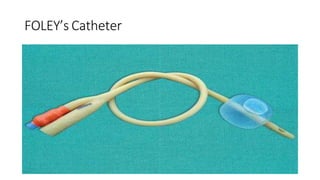
FOLEY’s Catheter
FOLEY’s Catheter
• FOLEY’s Catheter: It is used for
• continuous drainage of bladder in cases with:
• (i) Eclampsia.
• (ii) Retroverted gravid uterus.
• (iii) To give rest to the bladder following any destructive operation
and/ or in a case with suspected bladder injury. It is usually kept for
7–10 days.
• (iv) In the management of atonic PPH.
• (v) To control atonic PPH.
FOLEY’s Catheter
• The catheter is inserted within the uterine cavity and the catheter
balloon is inflated with normal saline. The balloon provides a
tamponade to the uterine surface. The catheter drains the blood
from the uterine cavity if there is any.
SIMS’ DOUBLE BLADED POSTERIOR
VAGINAL SPECULUM:
SIMS’ DOUBLE BLADED POSTERIOR
VAGINAL SPECULUM:
• SIMS’ DOUBLE BLADED POSTERIOR VAGINAL SPECULUM:
• The blades are of unequal breadth to facilitate introduction into
the vagina depending upon the space available (narrow blade in
nulliparous and the wider blade in parous women).
SIMS’ DOUBLE BLADED POSTERIOR
VAGINAL SPECULUM:
• It is used in obstetrics:
• (1) To inspect the cervix and vagina and to detect any injury following
delivery.
• (2) To clean the vagina following delivery.
• (3) To inspect the cervix and vagina to exclude any local cause for
bleeding in APH (Cusco’s speculum preferred).
• (4) During D & E operation.
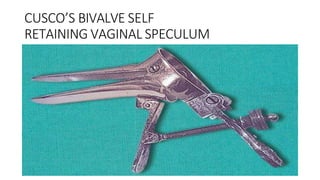
CUSCO’S BIVALVE SELF
RETAINING VAGINAL SPECULUM
CUSCO’S BIVALVE SELF
RETAINING VAGINAL SPECULUM
• CUSCO’S BIVALVE SELF RETAINING VAGINAL SPECULUM
• Uses:
• (i) To visualize the cervix and vaginal fornices for any local cause
(polyp, ectopy) of APH.
• (ii) To inspect the cervix and to prepare cervical smear for cytology
screening.
• (iii) To detect leakage of liqor from the cervical os in a case of
suspected PROM.
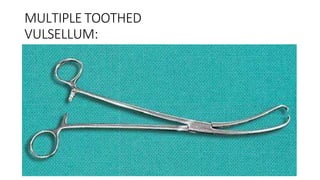
MULTIPLE TOOTHED
VULSELLUM:
MULTIPLE TOOTHED
VULSELLUM:
• It is used to catch hold the anterior lip of the cervix in (a) D + E
operation, (b) suction evacuation.
• As it produces trauma to the soft and vascular cervix, Allis tissue
forceps is used instead.
ALLIS TISSUE FORCEPS:
• Uses:
• (1) To catch hold the anterior lip of the cervix in D + E operation.
• (2) To hold the apex of the episiotomy wound during repair.
• (3) To catch hold of the margins of the peritoneum, rectus sheath,
vaginal mucosa during repair.
• (4) To catch hold of the torn ends of the sphincter aniexternus prior to
suture in repair of complete perineal tear.
• (5) To catch hold the margins and angles of the uterine flaps in LSCS
after the delivery of the baby as an alternative to Green-Armytage
hemostatic clamp.
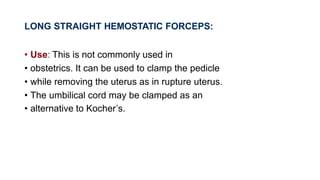
LONG STRAIGHT HEMOSTATIC FORCEPS:
• Use: This is not commonly used in
• obstetrics. It can be used to clamp the pedicle
• while removing the uterus as in rupture uterus.
• The umbilical cord may be clamped as an
• alternative to Kocher’s.
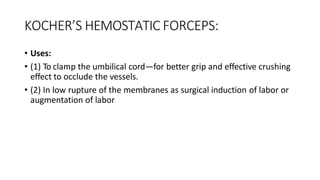
KOCHER’S HEMOSTATIC FORCEPS:
• Uses:
• (1) To clamp the umbilical cord—for better grip and effective crushing
effect to occlude the vessels.
• (2) In low rupture of the membranes as surgical induction of labor or
augmentation of labor
LONG STRAIGHT SCISSORS
• Uses: It is commonly used to cut the
• (i) umbilical cord
• (ii) to make episiotomy
• (iii) to cut suture materials as in cesarean section.
UTERINE SOUND
UTERINE SOUND
• It is an olive pointed, graduated, malleable, metallic uterine sound.
• Uses:
• (i) To know the position of the uterus and the length of the uterine
cavity prior to dilatation of the cervix in D + E operation.
• (ii) To sound the uterine cavity to detect any foreign body (IUCD).
• (iii) It acts as a first dilator of the cervical canal.
A and B CERVICAL DILATORS:
B
A
HAWKIN-AMBLER AND DAS OR HEGAR’S
DILATORS
• Hawkin-Ambler: It has got 16 sizes, the smallest one being 3/6 and
the largest one being 18/21. The number is arbitrary in the scale of
Hawkin- Ambler. The smaller one denotes measurement at the tip
and the larger one measures the maximum diameter at the base in
mm.
• Das or Hegar’s dilators is a double ended one. The minimum size is
1/2 and the maximum size is 11/12. The number represents the
diameter in mm. Both the sides are used with the lower number first.
HAWKIN-AMBLER AND DAS OR HEGAR’S
DILATORS
• Use: It is used in dilatation of the cervical canal prior to evacuation
operation.
• Degree of dilatation required:
• (i) Incomplete abortion—sufficient to introduce the index finger
(usually 16/19).
• (ii) In suction evacuation—one size smaller than the size of the
suction cannula.
• (iii) In MTP by D + E—sufficient dilatation to introduce ovum forceps
(usually 9/12).
FLUSHING CURETTE:
FLUSHING CURETTE:
• It is a blunt curette used in the operation of D + E. Previously, it was
used to flush the uterine cavity with lukewarm antiseptic solution—
passing through the communicating channel.
DOYEN’S RETRACTOR:
DOYEN’S RETRACTOR:
• It is used to retract the abdominal wall as well as the bladder for
proper exposure of lower uterine segment during LSCS.
• It is to be introduced after opening the abdomen; to be temporarily
taken off while the baby is delivered, to be reintroduced after
delivery of the baby and finally to be removed after toileting the
peritoneal cavity.
SPONGE HOLDING FORCEPS
• Uses:
• (1) Toileting the vulva, vagina and perineum prior to and following
delivery.
• (2) Antiseptic painting of the abdominal wall prior to cesarean
section. (3) To catch hold the membranes if it threatens to tear during
delivery of the placenta.
• (4) To catch hold the cervix (2 pairs are needed) for inspection in
suspected cervical tear.
• (5) To catch hold the cervix during encirclage operation.
OVUM FORCEPS:
OVUM FORCEPS:
• It has got no catch and the blades are slightly bent and fenestrated.
Absence of catch minimizes uterine injury, if accidentally caught. It
prevents crushing of the conceptus.
• It is to be introduced with the blades closed, to open up inside the
uterine cavity, to grasp the products and to take out the instrument
with a slight rotatory movement.
• The rotatory movements not only facilitate detachment of the
products from the uterine wall but also minimize the injury of the
uterine wall, if accidentally grasped.
UTERINE CURETTE:
UTERINE CURETTE:
• It may be sharp at both ends or sharp at one end and blunt at
the other.
• Its common use in obstetrics is in the operation of D + C for
incomplete abortion.
• In D + E operation, the curettage is done by blunt curette as the
uterine wall is very soft.
• It can also be used in D + C operation one week following
evacuation of hydatidiform mole.
UTERINE DRESSING FORCEPS:
• The instrument is most often confused with laminaria tent
introducing forceps.
• The blades are transversely serrated while in the latter, there is a
groove on either blade.
• It is used:
• (a) To swab the uterine cavity following D + E with small gauze pieces
• (b) To dilate the cervix in lochiometra or pyometra.
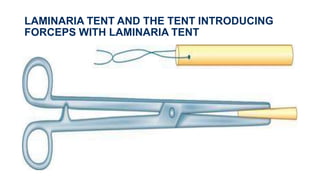
LAMINARIA TENT AND THE TENT INTRODUCING
FORCEPS WITH LAMINARIA TENT
LAMINARIA TENT AND THE TENT INTRODUCING
FORCEPS WITH LAMINARIA TENT
• The instrument is almost similar to uterine dressing forceps.
There is a groove on either blade to catch the laminaria tent.
• Laminaria tent: It is dehydrated, compressed, Chinese sea-
weeds. It is sterilized by keeping it in absolute alcohol at least
for 24 hours. Usually more than one tent is to be introduced to
prevent dumbling of the ends. It produces slow dilatation of the
cervical canal, as it swells up due to hygroscopic action.
• Isabgol tents (Isogel): It is dried granules prepared from the
husks of “certain mucilaginous tropical seeds”.
MANUAL VACUUM ASPIRATION (MVA)
SYRINGE
MANUAL VACUUM ASPIRATION (MVA)
SYRINGE
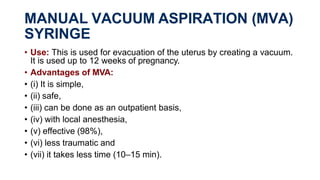
• Use: This is used for evacuation of the uterus by creating a vacuum.
It is used up to 12 weeks of pregnancy.
• Advantages of MVA:
• (i) It is simple,
• (ii) safe,
• (iii) can be done as an outpatient basis,
• (iv) with local anesthesia,
• (v) effective (98%),
• (vi) less traumatic and
• (vii) it takes less time (10–15 min).
PLASTIC SUCTION CANNULA
(KARMAN’S TYPE):
PLASTIC SUCTION CANNULA
(KARMAN’S TYPE):
• These are of different sizes (4, 5, 6, 7, 8, 9, 10 and 12 mm).
Appropriate size of the cannula (diameter in mm) needed for a
particular case, is same to the duration of pregnancy in weeks.
• In general, the size of the pregnant uterus (weeks) and the size
of the cannula (mm) are: 4–6 weeks size with 4–7mmcannula;
7–9 weeks size with 5–10 mm cannula and for 9–12 weeks with
8–12 mm size cannula.
• The plastic cannula has got advantages over the metallic one—
as it causes less damage to the uterine wall and the product
sucked out is visible.
PLASTIC SUCTION CANNULA
(KARMAN’S TYPE):
• The vacuum must be broken before it is withdrawal.
• It is used for S + E (p. 645) and MVA.
• Cannulas are used for S+ E (p. 645) when attached with MVA
syringe.
LONG CURVED OBSTETRIC FORCEPS
• It is commonly used in low forceps operation
SHORT CURVED OBSTETRIC FORCEPS
(WRIGLEY’S FORCEPS)
SHORT CURVED OBSTETRIC FORCEPS
(WRIGLEY’S FORCEPS)
• It can only be used as outlet forceps for extraction of the head.
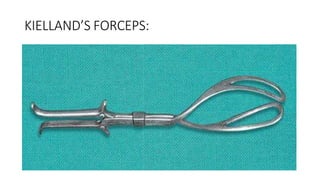
KIELLAND’S FORCEPS:
KIELLAND’S FORCEPS:
• It is usually used as rotation forceps in deep transverse arrest of
occipito-posterior position of the head or in unrotated vertex or face
presentation.
FORCEPS’ AXIS TRACTION
DEVICES
FORCEPS’ AXIS TRACTION
DEVICES
• It includes axis traction rods (right and left) and handle. The
rods are assembled in the blades of long-curved obstetric
forceps prior to introduction and lastly the handle is attached to
the rods.
• The devices are required where much forces are necessary for
traction as in mid forceps operation. These are less commonly
used now.
EPISIOTOMY SCISSORS
EPISIOTOMY SCISSORS
• It is bent on edge. The blade with blunt tip goes inside the vagina.
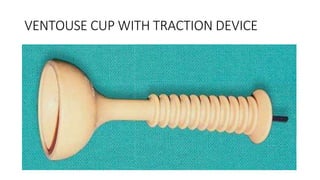
VENTOUSE CUP WITH TRACTION DEVICE
• Use: It is used in the operation of vacuum extraction of the head. The
cup is to be fitted to the scalp of the forecoming head by producing
“chignon” with the help of vacuum. The cup has got various sizes.
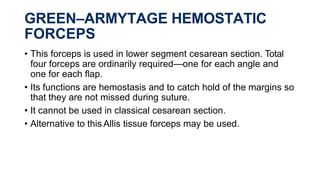
GREEN–ARMYTAGE HEMOSTATIC
FORCEPS
GREEN–ARMYTAGE HEMOSTATIC
FORCEPS
• This forceps is used in lower segment cesarean section. Total
four forceps are ordinarily required—one for each angle and
one for each flap.
• Its functions are hemostasis and to catch hold of the margins so
that they are not missed during suture.
• It cannot be used in classical cesarean section.
• Alternative to this Allis tissue forceps may be used.
Mucus sucker—Disposable
Mucus sucker—Metal
A and B MUCUS SUCKER
• (A) Disposable, (B) Metal—It is used to suck out the mucus
from the naso-oropharynx following delivery of the head of the
baby. To be of value, the mucus should be sucked prior to the
attempt of respiration, otherwise the tracheobronchial tree may
be occluded leading to inadequate pulmonary aeration and
development of asphyxia neonatorum. The metal sucker
requires a sterile simple rubber catheter to be fitted at one
end and a sterile piece of gauze to the other end. Currently
electric or the disposable sucker is being used.
CORD-CLAMP (DISPOSABLE)
• It is made of plastic and is supplied in a sterile pack. The serrated
surface and the lock make its grip firm. It occludes the umbilical
vessels effectively. The cord clamp is to be kept in place until it falls
off together with the detached stump of umbilical cord.
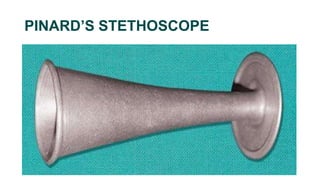
PINARD’S STETHOSCOPE
• Use: It should be held firmly at right angle to the point on the
abdominal wall.
• The ear must be firmly closed to the aural end. It should not be
touched by hand while listening.
PERFORATOR (OLDHAM’S)
• The instrument is required in craniotomy to perforate the skull
bone for decompression of the fetal head.
GIANT VULSELLUM
GIANT VULSELLUM
• It is used in destructive operation specially in evisceration to
have a good grip of the fetal parts for giving traction.
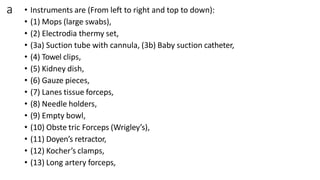
a • Instruments are (From left to right and top to down):
• (1) Mops (large swabs),
• (2) Electrodia thermy set,
• (3a) Suction tube with cannula, (3b) Baby suction catheter,
• (4) Towel clips,
• (5) Kidney dish,
• (6) Gauze pieces,
• (7) Lanes tissue forceps,
• (8) Needle holders,
• (9) Empty bowl,
• (10) Obste tric Forceps (Wrigley’s),
• (11) Doyen’s retractor,
• (12) Kocher’s clamps,
• (13) Long artery forceps,
a • (14) Allis tissue forceps (long variety),
• (15) Green Armytage forceps,
• (16) Little wood's forceps,
• (17) Allis tissue forceps (short variety),
• (18) Artery forceps (short variety),
• (19) Dissecting forceps toothed and non toothed,
• (20) Scissors (straight and curved variety),
• (21) Knives (two),
• (22) Bowl with povidone iodine lotion,
• (23) Sponge holding forceps (two),
• (24) Suture packets.

INSTRUMENTS IN OBSTETRICS.pptx

  • 1.
  • 2.
  • 3.
    SIMPLE RUBBER CATHETER: •SIMPLE RUBBER CATHETER: It is used to empty the bladder in cases with retention of urine: A. during— • (a) Pregnancy (Retroverted Gravid Uterus). • (b) Labor— (i) when the woman fails to pass urine by herself, (ii) before and after any operative interventions • (c) Postpartum—(i) during management of postpartum hemorrhage, (ii) retained placenta.
  • 4.
    SIMPLE RUBBER CATHETER: •B. Other uses— • (a) as a tourniquet, • (b) to administer O2 when nasal catheter is not available, • (c) as a mucus sucker—when it is attached to a mechanical or electric sucker.
  • 5.
  • 6.
    FOLEY’s Catheter • FOLEY’sCatheter: It is used for • continuous drainage of bladder in cases with: • (i) Eclampsia. • (ii) Retroverted gravid uterus. • (iii) To give rest to the bladder following any destructive operation and/ or in a case with suspected bladder injury. It is usually kept for 7–10 days. • (iv) In the management of atonic PPH. • (v) To control atonic PPH.
  • 7.
    FOLEY’s Catheter • Thecatheter is inserted within the uterine cavity and the catheter balloon is inflated with normal saline. The balloon provides a tamponade to the uterine surface. The catheter drains the blood from the uterine cavity if there is any.
  • 8.
    SIMS’ DOUBLE BLADEDPOSTERIOR VAGINAL SPECULUM:
  • 9.
    SIMS’ DOUBLE BLADEDPOSTERIOR VAGINAL SPECULUM: • SIMS’ DOUBLE BLADED POSTERIOR VAGINAL SPECULUM: • The blades are of unequal breadth to facilitate introduction into the vagina depending upon the space available (narrow blade in nulliparous and the wider blade in parous women).
  • 10.
    SIMS’ DOUBLE BLADEDPOSTERIOR VAGINAL SPECULUM: • It is used in obstetrics: • (1) To inspect the cervix and vagina and to detect any injury following delivery. • (2) To clean the vagina following delivery. • (3) To inspect the cervix and vagina to exclude any local cause for bleeding in APH (Cusco’s speculum preferred). • (4) During D & E operation.
  • 11.
  • 12.
    CUSCO’S BIVALVE SELF RETAININGVAGINAL SPECULUM • CUSCO’S BIVALVE SELF RETAINING VAGINAL SPECULUM • Uses: • (i) To visualize the cervix and vaginal fornices for any local cause (polyp, ectopy) of APH. • (ii) To inspect the cervix and to prepare cervical smear for cytology screening. • (iii) To detect leakage of liqor from the cervical os in a case of suspected PROM.
  • 13.
  • 14.
    MULTIPLE TOOTHED VULSELLUM: • Itis used to catch hold the anterior lip of the cervix in (a) D + E operation, (b) suction evacuation. • As it produces trauma to the soft and vascular cervix, Allis tissue forceps is used instead.
  • 15.
  • 16.
    ALLIS TISSUE FORCEPS: •Uses: • (1) To catch hold the anterior lip of the cervix in D + E operation. • (2) To hold the apex of the episiotomy wound during repair. • (3) To catch hold of the margins of the peritoneum, rectus sheath, vaginal mucosa during repair. • (4) To catch hold of the torn ends of the sphincter aniexternus prior to suture in repair of complete perineal tear. • (5) To catch hold the margins and angles of the uterine flaps in LSCS after the delivery of the baby as an alternative to Green-Armytage hemostatic clamp.
  • 17.
  • 18.
    LONG STRAIGHT HEMOSTATICFORCEPS: • Use: This is not commonly used in • obstetrics. It can be used to clamp the pedicle • while removing the uterus as in rupture uterus. • The umbilical cord may be clamped as an • alternative to Kocher’s.
  • 19.
  • 20.
    KOCHER’S HEMOSTATIC FORCEPS: •Uses: • (1) To clamp the umbilical cord—for better grip and effective crushing effect to occlude the vessels. • (2) In low rupture of the membranes as surgical induction of labor or augmentation of labor
  • 21.
  • 22.
    LONG STRAIGHT SCISSORS •Uses: It is commonly used to cut the • (i) umbilical cord • (ii) to make episiotomy • (iii) to cut suture materials as in cesarean section.
  • 23.
  • 24.
    UTERINE SOUND • Itis an olive pointed, graduated, malleable, metallic uterine sound. • Uses: • (i) To know the position of the uterus and the length of the uterine cavity prior to dilatation of the cervix in D + E operation. • (ii) To sound the uterine cavity to detect any foreign body (IUCD). • (iii) It acts as a first dilator of the cervical canal.
  • 25.
    A and BCERVICAL DILATORS: B A
  • 26.
    HAWKIN-AMBLER AND DASOR HEGAR’S DILATORS • Hawkin-Ambler: It has got 16 sizes, the smallest one being 3/6 and the largest one being 18/21. The number is arbitrary in the scale of Hawkin- Ambler. The smaller one denotes measurement at the tip and the larger one measures the maximum diameter at the base in mm. • Das or Hegar’s dilators is a double ended one. The minimum size is 1/2 and the maximum size is 11/12. The number represents the diameter in mm. Both the sides are used with the lower number first.
  • 27.
    HAWKIN-AMBLER AND DASOR HEGAR’S DILATORS • Use: It is used in dilatation of the cervical canal prior to evacuation operation. • Degree of dilatation required: • (i) Incomplete abortion—sufficient to introduce the index finger (usually 16/19). • (ii) In suction evacuation—one size smaller than the size of the suction cannula. • (iii) In MTP by D + E—sufficient dilatation to introduce ovum forceps (usually 9/12).
  • 28.
  • 29.
    FLUSHING CURETTE: • Itis a blunt curette used in the operation of D + E. Previously, it was used to flush the uterine cavity with lukewarm antiseptic solution— passing through the communicating channel.
  • 30.
  • 31.
    DOYEN’S RETRACTOR: • Itis used to retract the abdominal wall as well as the bladder for proper exposure of lower uterine segment during LSCS. • It is to be introduced after opening the abdomen; to be temporarily taken off while the baby is delivered, to be reintroduced after delivery of the baby and finally to be removed after toileting the peritoneal cavity.
  • 32.
  • 33.
    SPONGE HOLDING FORCEPS •Uses: • (1) Toileting the vulva, vagina and perineum prior to and following delivery. • (2) Antiseptic painting of the abdominal wall prior to cesarean section. (3) To catch hold the membranes if it threatens to tear during delivery of the placenta. • (4) To catch hold the cervix (2 pairs are needed) for inspection in suspected cervical tear. • (5) To catch hold the cervix during encirclage operation.
  • 34.
  • 35.
    OVUM FORCEPS: • Ithas got no catch and the blades are slightly bent and fenestrated. Absence of catch minimizes uterine injury, if accidentally caught. It prevents crushing of the conceptus. • It is to be introduced with the blades closed, to open up inside the uterine cavity, to grasp the products and to take out the instrument with a slight rotatory movement. • The rotatory movements not only facilitate detachment of the products from the uterine wall but also minimize the injury of the uterine wall, if accidentally grasped.
  • 36.
  • 37.
    UTERINE CURETTE: • Itmay be sharp at both ends or sharp at one end and blunt at the other. • Its common use in obstetrics is in the operation of D + C for incomplete abortion. • In D + E operation, the curettage is done by blunt curette as the uterine wall is very soft. • It can also be used in D + C operation one week following evacuation of hydatidiform mole.
  • 38.
  • 39.
    UTERINE DRESSING FORCEPS: •The instrument is most often confused with laminaria tent introducing forceps. • The blades are transversely serrated while in the latter, there is a groove on either blade. • It is used: • (a) To swab the uterine cavity following D + E with small gauze pieces • (b) To dilate the cervix in lochiometra or pyometra.
  • 40.
    LAMINARIA TENT ANDTHE TENT INTRODUCING FORCEPS WITH LAMINARIA TENT
  • 41.
    LAMINARIA TENT ANDTHE TENT INTRODUCING FORCEPS WITH LAMINARIA TENT • The instrument is almost similar to uterine dressing forceps. There is a groove on either blade to catch the laminaria tent. • Laminaria tent: It is dehydrated, compressed, Chinese sea- weeds. It is sterilized by keeping it in absolute alcohol at least for 24 hours. Usually more than one tent is to be introduced to prevent dumbling of the ends. It produces slow dilatation of the cervical canal, as it swells up due to hygroscopic action. • Isabgol tents (Isogel): It is dried granules prepared from the husks of “certain mucilaginous tropical seeds”.
  • 42.
  • 43.
    MANUAL VACUUM ASPIRATION(MVA) SYRINGE • Use: This is used for evacuation of the uterus by creating a vacuum. It is used up to 12 weeks of pregnancy. • Advantages of MVA: • (i) It is simple, • (ii) safe, • (iii) can be done as an outpatient basis, • (iv) with local anesthesia, • (v) effective (98%), • (vi) less traumatic and • (vii) it takes less time (10–15 min).
  • 44.
  • 45.
    PLASTIC SUCTION CANNULA (KARMAN’STYPE): • These are of different sizes (4, 5, 6, 7, 8, 9, 10 and 12 mm). Appropriate size of the cannula (diameter in mm) needed for a particular case, is same to the duration of pregnancy in weeks. • In general, the size of the pregnant uterus (weeks) and the size of the cannula (mm) are: 4–6 weeks size with 4–7mmcannula; 7–9 weeks size with 5–10 mm cannula and for 9–12 weeks with 8–12 mm size cannula. • The plastic cannula has got advantages over the metallic one— as it causes less damage to the uterine wall and the product sucked out is visible.
  • 46.
    PLASTIC SUCTION CANNULA (KARMAN’STYPE): • The vacuum must be broken before it is withdrawal. • It is used for S + E (p. 645) and MVA. • Cannulas are used for S+ E (p. 645) when attached with MVA syringe.
  • 47.
  • 48.
    LONG CURVED OBSTETRICFORCEPS • It is commonly used in low forceps operation
  • 49.
    SHORT CURVED OBSTETRICFORCEPS (WRIGLEY’S FORCEPS)
  • 50.
    SHORT CURVED OBSTETRICFORCEPS (WRIGLEY’S FORCEPS) • It can only be used as outlet forceps for extraction of the head.
  • 51.
  • 52.
    KIELLAND’S FORCEPS: • Itis usually used as rotation forceps in deep transverse arrest of occipito-posterior position of the head or in unrotated vertex or face presentation.
  • 53.
  • 54.
    FORCEPS’ AXIS TRACTION DEVICES •It includes axis traction rods (right and left) and handle. The rods are assembled in the blades of long-curved obstetric forceps prior to introduction and lastly the handle is attached to the rods. • The devices are required where much forces are necessary for traction as in mid forceps operation. These are less commonly used now.
  • 55.
  • 56.
    EPISIOTOMY SCISSORS • Itis bent on edge. The blade with blunt tip goes inside the vagina.
  • 57.
    VENTOUSE CUP WITHTRACTION DEVICE
  • 58.
    VENTOUSE CUP WITHTRACTION DEVICE
  • 59.
    VENTOUSE CUP WITHTRACTION DEVICE • Use: It is used in the operation of vacuum extraction of the head. The cup is to be fitted to the scalp of the forecoming head by producing “chignon” with the help of vacuum. The cup has got various sizes.
  • 60.
  • 61.
    GREEN–ARMYTAGE HEMOSTATIC FORCEPS • Thisforceps is used in lower segment cesarean section. Total four forceps are ordinarily required—one for each angle and one for each flap. • Its functions are hemostasis and to catch hold of the margins so that they are not missed during suture. • It cannot be used in classical cesarean section. • Alternative to this Allis tissue forceps may be used.
  • 62.
  • 63.
  • 64.
    A and BMUCUS SUCKER • (A) Disposable, (B) Metal—It is used to suck out the mucus from the naso-oropharynx following delivery of the head of the baby. To be of value, the mucus should be sucked prior to the attempt of respiration, otherwise the tracheobronchial tree may be occluded leading to inadequate pulmonary aeration and development of asphyxia neonatorum. The metal sucker requires a sterile simple rubber catheter to be fitted at one end and a sterile piece of gauze to the other end. Currently electric or the disposable sucker is being used.
  • 65.
  • 66.
    CORD-CLAMP (DISPOSABLE) • Itis made of plastic and is supplied in a sterile pack. The serrated surface and the lock make its grip firm. It occludes the umbilical vessels effectively. The cord clamp is to be kept in place until it falls off together with the detached stump of umbilical cord.
  • 67.
  • 68.
    PINARD’S STETHOSCOPE • Use:It should be held firmly at right angle to the point on the abdominal wall. • The ear must be firmly closed to the aural end. It should not be touched by hand while listening.
  • 69.
  • 70.
    PERFORATOR (OLDHAM’S) • Theinstrument is required in craniotomy to perforate the skull bone for decompression of the fetal head.
  • 71.
  • 72.
    GIANT VULSELLUM • Itis used in destructive operation specially in evisceration to have a good grip of the fetal parts for giving traction.
  • 74.
    a • Instrumentsare (From left to right and top to down): • (1) Mops (large swabs), • (2) Electrodia thermy set, • (3a) Suction tube with cannula, (3b) Baby suction catheter, • (4) Towel clips, • (5) Kidney dish, • (6) Gauze pieces, • (7) Lanes tissue forceps, • (8) Needle holders, • (9) Empty bowl, • (10) Obste tric Forceps (Wrigley’s), • (11) Doyen’s retractor, • (12) Kocher’s clamps, • (13) Long artery forceps,
  • 75.
    a • (14)Allis tissue forceps (long variety), • (15) Green Armytage forceps, • (16) Little wood's forceps, • (17) Allis tissue forceps (short variety), • (18) Artery forceps (short variety), • (19) Dissecting forceps toothed and non toothed, • (20) Scissors (straight and curved variety), • (21) Knives (two), • (22) Bowl with povidone iodine lotion, • (23) Sponge holding forceps (two), • (24) Suture packets.