
Eastern State
Ministry of health
Algatarif Maternity hospital
CTG INTERPRETATION
Presented by :Dr. Zuhair Adam 2023
11/11/2023 Dr.Zuhair Adam

What is cardiotocography(CTG)?
What is cardiotocography(CTG)?
 Cardiotocography (CTG) is used during pregnancy to
monitor fetal heart rate and uterine contractions. It is
most commonly used in the third trimester and its
purpose is to monitor fetal well-being and allow early
detection of fetal distress. An abnormal CTG may
indicate the need for further investigations and potential
intervention.
11/11/2023 Dr.Zuhair Adam
How to read a CTG
 To interpret a CTG you need a structured method of
assessing its various characteristics. The most popular
structure can be remembered using the acronym DR C
BRAVADO:
 DR: Define risk
 C: Contractions
 C: Contractions
 BRa: Baseline rate
 V: Variability
 A: Accelerations
 D: Decelerations
 O: Overall impression
11/11/2023 Dr.Zuhair Adam
Indications for continuous
cardiotocography monitoring in labour
1
1-
-antenatal maternal risk factors:
antenatal maternal risk factors:-
-
 1- Previous caesarean birth or other full thickness
uterine scar
 2- Any hypertensive disorder needing medication
 3-Prolonged ruptured membranes (but women
who are already in established labour at 24 hours
3-Prolonged ruptured membranes (but women
who are already in established labour at 24 hours
after their membranes ruptured do not need CTG
unless there are other concerns)
 •4-Any vaginal blood loss other than a show
 5- Suspected chorioamnionitis or maternal sepsis
 6-Pre-existing diabetes (type 1 or type 2) and
gestational diabetes requiring medication.
11/11/2023 Dr.Zuhair Adam
2
2-
-antenatal fetal risk factors:
antenatal fetal risk factors:-
-
 1- non-cephalic presentation (including breech,
transverse, oblique and cord), including while a
decision is made about mode of birth
 2- fetal growth restriction (estimated fetal weight
below 3rd centile)
 3- small for gestational age (estimated fetal weight
below 10th centile) with other high-risk features such
as abnormal doppler scan results, reduced liquor
volume or reduced growth velocity
 4- advanced gestational age (more than 42+0 weeks at
the onset of established labour)
 5- anhydramnios or polyhydramnios
 6- reduced fetal movements before the onset of
contractions
11/11/2023 Dr.Zuhair Adam
 3- intrapartum risk factors:-
 1- contractions that last longer than 2 minutes, or
5 or more contractions in 10 minutes
 2- the presence meconium
 3-maternal pyrexia (a temperature of 38°C or
above on a single reading or 37.5°C or above on 2
consecutive occasions 1 hour apart)
 4-suspected chorioamnionitis or sepsis
 5-pain reported by the woman that appears, based
on her description or her previous experience, to
differ from the pain normally associated with
contractions
 6-fresh vaginal bleeding that develops in labour
11/11/2023 Dr.Zuhair Adam
 7- blood-stained liquor not associated with vaginal examination, that is
likely to be uterine in origin (and may indicate suspected antepartum
haemorrhage)
 8- maternal pulse over 120 beats a minute on 2 occasions 30 minutes
apart
 9-severe hypertension (a single reading of either systolic blood pressure
of 160 mmHg or more or diastolic blood pressure of 110 mmHg or more,
measured between contractions)
 10-hypertension (either systolic blood pressure of 140 mmHg or more or
diastolic blood pressure of 90 mmHg or more on 2 consecutive readings
taken 30 minutes apart, measured between contractions)
 11- a reading of 2+ of protein on urinalysis and a single reading of either
raised systolic blood pressure (140 mmHg or more) or raised diastolic
blood pressure (90 mmHg or more)
 12- confirmed delay in the first or second stage of labour (see the NICE
guideline on intrapartum care for healthy women and babies)
 13- insertion of regional analgesia (for example, an epidural)
 14- use of oxytocin.
11/11/2023 Dr.Zuhair Adam
Use of cardiotocography for monitoring during labour
 Use of cardiotocography for monitoring during labour
 Review the previous fetal heart rate monitoring results,
including any previous CTG traces, as part of the hourly
risk assessment and in conjunction with other antenatal or
intrapartum risk factor.
 If there are changes in the fetal heart rate pattern over
time which indicate a change in the baby's condition,
If there are changes in the fetal heart rate pattern over
time which indicate a change in the baby's condition,
review antenatal or intrapartum risk factors for hypoxia.
 When reviewing a CTG trace, assess and document:
 1-contractions
 2- baseline fetal heart rate
 3- variability
 4- presence or absence of decelerations (and characteristics
of decelerations if present)
 5- presence of accelerations.
11/11/2023 Dr.Zuhair Adam
Features of cardiotocography

 Features of cardiotocography
Features of cardiotocography
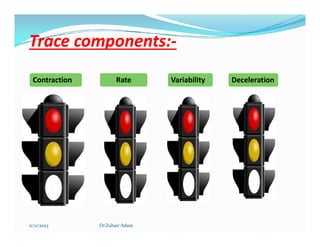
 Categorise the 4 features of the cardiotocography
trace (contractions, baseline fetal heart rate,
variability, decelerations) as
 white,
 amber or
 red (indicating increasing levels of concern) and
use alongside consideration of the presence of
accelerations to classify the overall CTG trace
11/11/2023 Dr.Zuhair Adam
Trace components:
Trace components:-
-
Contraction Rate Variability Deceleration
11/11/2023 Dr.Zuhair Adam
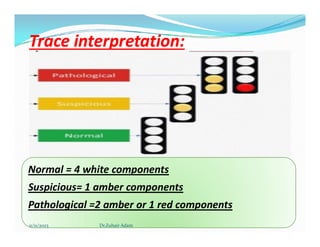
Trace interpretation:
Normal = 4 white components
Suspicious= 1 amber components
Pathological =2 amber or 1 red components
11/11/2023 Dr.Zuhair Adam
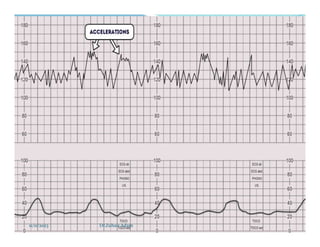
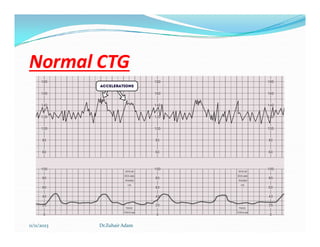
Accelerations
Accelerations
 Define accelerations as transient increases in fetal heart
rate of 15 beats a minute or more, lasting 15 seconds or
more.
 Take the following into account when assessing
accelerations in fetal heart rate:
 • the presence of fetal heart rate accelerations, even with
reduced variability, is generally a sign that the baby is
healthy
 • the absence of accelerations on an otherwise normal CTG
trace does not indicate fetal acidosi
11/11/2023 Dr.Zuhair Adam
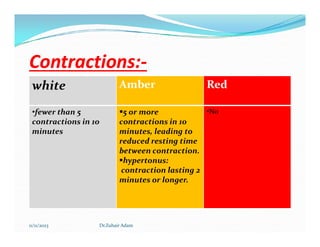
Contractions:
Contractions:-
-
white Amber Red
•fewer than 5
contractions in 10
5 or more
contractions in 10
•No
contractions in 10
minutes
contractions in 10
minutes, leading to
reduced resting time
between contraction.
hypertonus:
contraction lasting 2
minutes or longer.
11/11/2023 Dr.Zuhair Adam

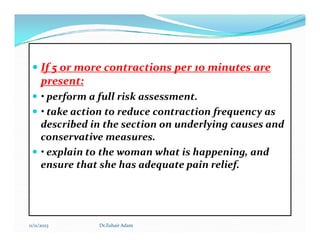
 If 5 or more contractions per 10 minutes are
If 5 or more contractions per 10 minutes are
present:
present:
 • perform a full risk assessment.
 • take action to reduce contraction frequency as
described in the section on underlying causes and
conservative measures.
 • explain to the woman what is happening, and
ensure that she has adequate pain relief.
11/11/2023 Dr.Zuhair Adam
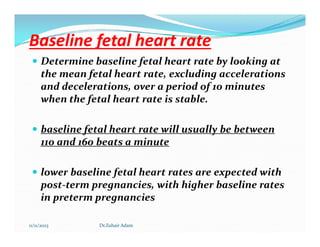
Baseline fetal heart rate
 Determine baseline fetal heart rate by looking at
the mean fetal heart rate, excluding accelerations
and decelerations, over a period of 10 minutes
when the fetal heart rate is stable.
baseline fetal heart rate will usually be between
 baseline fetal heart rate will usually be between
110 and 160 beats a minute
 lower baseline fetal heart rates are expected with
post-term pregnancies, with higher baseline rates
in preterm pregnancies
11/11/2023 Dr.Zuhair Adam
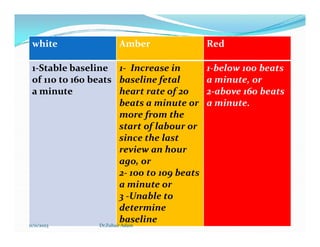
white Amber Red
1-Stable baseline
of 110 to 160 beats
a minute
1- Increase in
baseline fetal
heart rate of 20
beats a minute or
more from the
start of labour or
1-below 100 beats
a minute, or
2-above 160 beats
a minute.
start of labour or
since the last
review an hour
ago, or
2- 100 to 109 beats
a minute or
3 -Unable to
determine
baseline
11/11/2023 Dr.Zuhair Adam
• Arise in baseline fetal heart rate may
represent either :
represent either :-
-
1-Excessive fetal movements or fetal stimulation. If the fetus
is very active during the period when the CTG is being
performed, the fetal heart may not be showing a true
baseline. This should be classed as reactivity, but can be
mistakenly diagnosed as fetal tachycardia.
2-Maternal stress and anxiety. If the mother is in a stressful
situation, or has a high anxiety level, she will release
catecholamines, thereby stimulating the sympathetic
nervous system, resulting in an increase in both maternal
and fetal heart rates.
 3. Gestational age. A fetus at a gestational age of 32 weeks
or below can show a baseline tachycardia due to the
immaturity of the vagus nerve. The sympathetic nervous
system is dominant, resulting in a persistently high fetal
heart rate.
11/11/2023 Dr.Zuhair Adam
 4. Maternal tachycardia. This may be as a result of dehydration
and/or ketosis leading to poor uterine perfusion. Encouraging
fluids, isotonic drinks and appropriate diet would be
recommended
 5. Maternal pyrexia. A maternal pyrexia of 37.5°C or higher may
indicate infection and possible chorioamnionitis and is a risk
factor for poor neonatal outcome.

 6. Fetal infection. During infection, oxygen requirements are
raised. The heart rate rises to increase the oxygen transfer
around the body.


 7. Fetal hypoxia. Chronic changes in the levels of oxygen tension
in the blood and fetal tissues lead to an increase in the
sympathetic activity, resulting in a rise in heart rate.
 8. Fetal hormones. The fetus, in response to stressful situations,
e.g. a decrease in oxygen levels, can produce hormones from the
adrenal glands, adrenaline (epinephrine) and noradrenaline
(norepinephrine). Their effect is similar to an increase in
sympathetic activity, that is, a rise in the heart rate
11/11/2023 Dr.Zuhair Adam
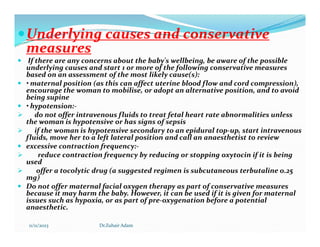
Base line Variability

 variability will usually be between
variability will usually be between 5
5 and
and 25
25 beats a minute
beats a minute
 Determine variability by looking at the minor oscillations
in the fetal heart rate, which usually occur at 3 to 5 cycles a
minute. Measure it by estimating the difference in beats
per minute between the highest heart rate and the lowest
heart rate in a 1-minute segment of the trace between
contractions, excluding decelerations and accelerations.
heart rate in a 1-minute segment of the trace between
contractions, excluding decelerations and accelerations.
 Variability represents the constant interaction of the
sympathetic and parasympathetic nervous systems as they
determine the appropriate heart rate and cardiac output in
response to constant minor changes in venous return and
metabolic demands of the fetus.
 Normal variability represents an intact nervous pathway
through the cerebral cortex, midbrain, vagus nerve and
cardiac conduction system.
11/11/2023 Dr.Zuhair Adam
Cause Decreased variability
 1. Fetal sleep. During fetal sleep the CTG commonly gives an
appearance of decreased variability; this should not be confused
with lack of reactivity. The pattern does not usually persist for
longer than 40 minutes, although it may last for up to 90
minutes.
 2. Administration of drugs to the mother.
Decreased variability can be seen following the administration
of pethidine for pain relief in labour, or of sedative drugs. This
pattern may persist for longer than the normal sleep cycle of the
fetus.
 3. Gestational age. The CTG of a fetus at a gestational age of less
than 30–32 weeks may show decreased variability, probably due
to the immaturity of the autonomic nervous system.
 4. Hypoxia.
When the fetus is suffering from hypoxia the autonomic nervous
system fails to respond to stress and the changes in venous
return and metabolic demands of the fetus. This is due to a
reduction in the transmission of impulses through the nervous
system. In the presence of cerebral hypoxia, variability is often
severely diminished or absent
11/11/2023 Dr.Zuhair Adam
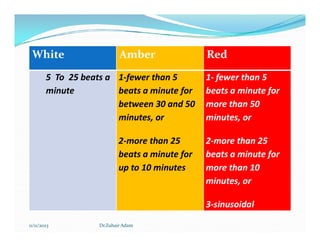
White Amber Red
5 To 25 beats a
minute
1-fewer than 5
beats a minute for
between 30 and 50
minutes, or
1- fewer than 5
beats a minute for
more than 50
minutes, or
2-more than 25
beats a minute for
up to 10 minutes
2-more than 25
beats a minute for
more than 10
minutes, or
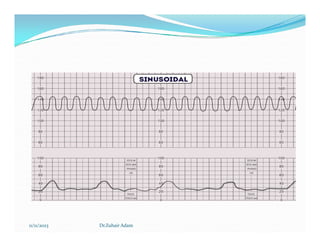
3-sinusoidal
11/11/2023 Dr.Zuhair Adam

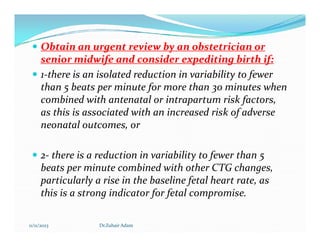
 Obtain an urgent review by an obstetrician or
Obtain an urgent review by an obstetrician or
senior midwife and consider expediting birth if:
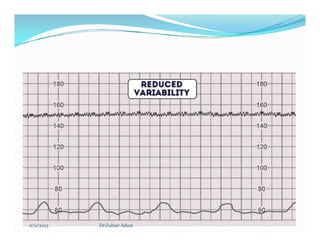
 1-there is an isolated reduction in variability to fewer
than 5 beats per minute for more than 30 minutes when
combined with antenatal or intrapartum risk factors,
as this is associated with an increased risk of adverse
neonatal outcomes, or
 2- there is a reduction in variability to fewer than 5
beats per minute combined with other CTG changes,
particularly a rise in the baseline fetal heart rate, as
this is a strong indicator for fetal compromise.
11/11/2023 Dr.Zuhair Adam
Normal CTG
Normal CTG
11/11/2023 Dr.Zuhair Adam
Decelerations
Decelerations
 Define decelerations as transient episodes when the fetal
heart rate slows to below the baseline level by more than 15
beats a minute, with each episode lasting 15 seconds or
more.
 1-When assessing the significance of decelerations in fetal
heart rate, consider:-
 • their timing (early, variable or late) in relation to the
peaks and duration of the contractions
 • the duration of the individual decelerations
 • whether or not the fetal heart rate returns to the baseline
heart rate
 • how long they have been present for
 • whether they occur with over 50% of contractions (defined
as repetitive)
 • the presence or absence of shouldering
 • the variability within the deceleration
11/11/2023 Dr.Zuhair Adam
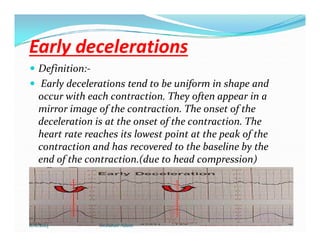
Early decelerations
Early decelerations
 Definition:-
 Early decelerations tend to be uniform in shape and
occur with each contraction. They often appear in a
mirror image of the contraction. The onset of the
deceleration is at the onset of the contraction. The
heart rate reaches its lowest point at the peak of the
contraction and has recovered to the baseline by the
end of the contraction.(due to head compression)
11/11/2023 Dr.Zuhair Adam
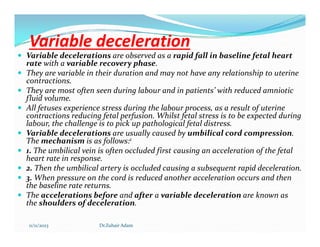
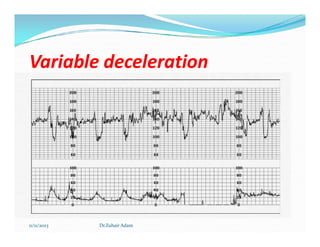
Variable deceleration
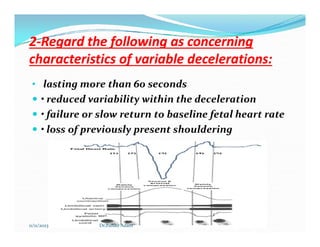
 Variable decelerations are observed as a rapid fall in baseline fetal heart
rate with a variable recovery phase.
 They are variable in their duration and may not have any relationship to uterine
contractions.
 They are most often seen during labour and in patients’ with reduced amniotic
fluid volume.
 All fetuses experience stress during the labour process, as a result of uterine
contractions reducing fetal perfusion. Whilst fetal stress is to be expected during
labour, the challenge is to pick up pathological fetal distress.
 Variable decelerations are usually caused by umbilical cord compression.
The mechanism is as follows:1
 1. The umbilical vein is often occluded first causing an acceleration of the fetal
heart rate in response.
 2. Then the umbilical artery is occluded causing a subsequent rapid deceleration.
 3. When pressure on the cord is reduced another acceleration occurs and then
the baseline rate returns.
 The accelerations before and after a variable deceleration are known as
the shoulders of deceleration.
11/11/2023 Dr.Zuhair Adam
Variable deceleration
11/11/2023 Dr.Zuhair Adam
2
2-
-Regard the following as concerning
Regard the following as concerning
characteristics of variable decelerations:
• lasting more than 60 seconds
 • reduced variability within the deceleration
 • failure or slow return to baseline fetal heart rate
• loss of previously present shouldering
 • loss of previously present shouldering
11/11/2023 Dr.Zuhair Adam
Late decelerations
Late decelerations
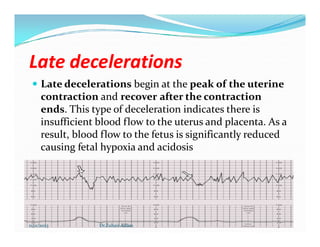
 Late decelerations begin at the peak of the uterine
contraction and recover after the contraction
ends. This type of deceleration indicates there is
insufficient blood flow to the uterus and placenta. As a
result, blood flow to the fetus is significantly reduced
causing fetal hypoxia and acidosis
11/11/2023 Dr.Zuhair Adam
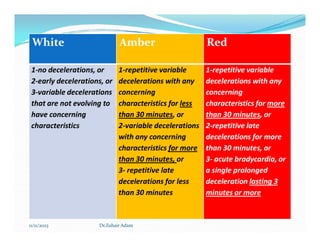
White Amber Red
1-no decelerations, or
2-early decelerations, or
3-variable decelerations
that are not evolving to
have concerning
characteristics
1-repetitive variable
decelerations with any
concerning
characteristics for less
than 30 minutes, or
2-variable decelerations
1-repetitive variable
decelerations with any
concerning
characteristics for more
than 30 minutes, or
2-repetitive late
characteristics 2-variable decelerations
with any concerning
characteristics for more
than 30 minutes, or
3- repetitive late
decelerations for less
than 30 minutes
2-repetitive late
decelerations for more
than 30 minutes, or
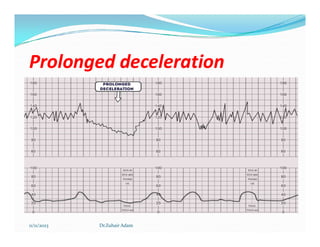
3- acute bradycardia, or
a single prolonged
deceleration lasting 3
minutes or more
11/11/2023 Dr.Zuhair Adam
Prolonged deceleration
11/11/2023 Dr.Zuhair Adam
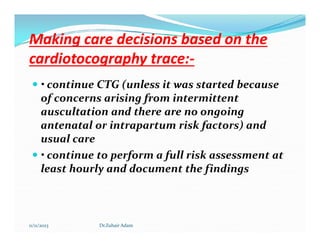
Making care decisions based on the
cardiotocography trace:
cardiotocography trace:-
-
 • continue CTG (unless it was started because
of concerns arising from intermittent
auscultation and there are no ongoing
antenatal or intrapartum risk factors) and
usual care
 • continue to perform a full risk assessment at
least hourly and document the findings
11/11/2023 Dr.Zuhair Adam
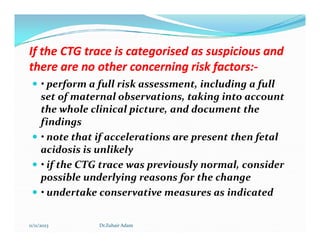
If the CTG trace is categorised as suspicious and
there are no other concerning risk factors:
there are no other concerning risk factors:-
-
 • perform a full risk assessment, including a full
set of maternal observations, taking into account
the whole clinical picture, and document the
findings
findings
 • note that if accelerations are present then fetal
acidosis is unlikely
 • if the CTG trace was previously normal, consider
possible underlying reasons for the change
 • undertake conservative measures as indicated
11/11/2023 Dr.Zuhair Adam
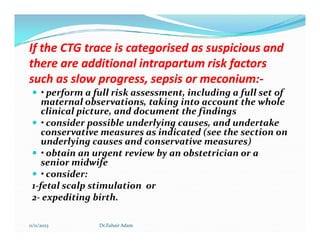
If the CTG trace is categorised as suspicious and
there are additional intrapartum risk factors
such as slow progress, sepsis or
such as slow progress, sepsis or meconium
meconium:
:-
-
 • perform a full risk assessment, including a full set of
maternal observations, taking into account the whole
clinical picture, and document the findings
 • consider possible underlying causes, and undertake
conservative measures as indicated (see the section on
underlying causes and conservative measures)
 • obtain an urgent review by an obstetrician or a
senior midwife
 • consider:
1-fetal scalp stimulation or
2- expediting birth.
11/11/2023 Dr.Zuhair Adam
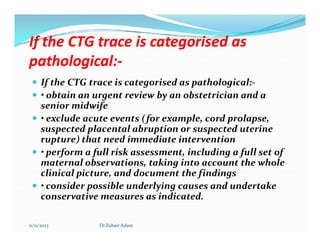
If the CTG trace is categorised as
pathological:
pathological:-
-
 If the CTG trace is categorised as pathological:-
 • obtain an urgent review by an obstetrician and a
senior midwife
 • exclude acute events (for example, cord prolapse,
suspected placental abruption or suspected uterine
• exclude acute events (for example, cord prolapse,
suspected placental abruption or suspected uterine
rupture) that need immediate intervention
 • perform a full risk assessment, including a full set of
maternal observations, taking into account the whole
clinical picture, and document the findings
 • consider possible underlying causes and undertake
conservative measures as indicated.
11/11/2023 Dr.Zuhair Adam

 If the CTG trace is still pathological
If the CTG trace is still pathological
after implementing conservative
measures:
measures:-
-
 • obtain a further urgent review by an obstetrician
and a senior midwife
 • evaluate the whole clinical picture and consider
expediting birth
 • if there are evolving intrapartum risk factors for
fetal compromise, have a very low threshold for
expediting birth.
11/11/2023 Dr.Zuhair Adam

 If there is an acute
If there is an acute bradycardia
bradycardia, or a single
, or a single
prolonged deceleration for 3 minutes or
more:
more:
 • urgently seek obstetric review
 • if there has been an acute event (for example,
cord prolapse, suspected placental abruption or
suspected uterine rupture), expedite the birth
 • consider possible underlying causes and
undertake conservative measures as indicated
(see the section on underlying causes and
conservative measures)
 • make preparations for an urgent birth, including
a request for paediatric or neonatal support
11/11/2023 Dr.Zuhair Adam
 Fetal scalp stimulation
 If the CTG trace is suspicious with antenatal or
intrapartum risk factors for fetal compromise, then
consider digital fetal scalp stimulation. If this leads
to an acceleration in fetal heart rate and a
sustained improvement in the CTG trace, continue
to monitor the fetal heart rate and clinical picture.
 Be aware that the absence of an acceleration in
response to fetal scalp stimulation is a worrying
sign that fetal compromise may be present, and
that expedited birth may be necessary.
11/11/2023 Dr.Zuhair Adam
 Fetal blood sampling
 NICE is unable to make a recommendation about fetal
blood sampling because of limited evidence
result classification
>7.25 Normal
11/11/2023 Dr.Zuhair Adam
>7.25 Normal
7.21- 7.24 Borderline repeat in 30 mins
<7.21 Abnormal birth expedited
 Fetal scalp stimulation
 If the CTG trace is suspicious with antenatal or
intrapartum risk factors for fetal compromise, then consider
digital fetal scalp stimulation. If this leads to an
acceleration in fetal heart rate and a sustained improvement
in the CTG trace, continue to monitor the fetal heart rate
and clinical picture.
 Be aware that the absence of an acceleration in response to
fetal scalp stimulation is a worrying sign that fetal
compromise may be present, and that expedited birth may
be necessary.
11/11/2023 Dr.Zuhair Adam
 In the second stage of labour:
 if fetal heart rate accelerations are recorded, be aware that these
are most likely to be maternal pulse.
 • if fetal heart rate decelerations are recorded, look for other
signs of hypoxia (for example, a rise in the baseline fetal heart
rate or a reduction in variability).
 Take into account that onset of hypoxia is both more common
and more rapid in the active second stage of labour. Take an
increase in the baseline fetal heart rate of 20 beats a minute or
more as a red feature in active second stage labour. [2022]
 If CTG concerns arise in the active second stage of labour:
 • obtain an obstetric review
 • consider discouraging pushing and stopping any oxytocin
infusion to allow the baby to recover, unless birth is imminent
 • agree and document a clear plan with time limits for the next
review.
11/11/2023 Dr.Zuhair Adam

Underlying causes and conservative
Underlying causes and conservative
measures
measures
 If there are any concerns about the baby's wellbeing, be aware of the possible
underlying causes and start 1 or more of the following conservative measures
based on an assessment of the most likely cause(s):
 • maternal position (as this can affect uterine blood flow and cord compression),
encourage the woman to mobilise, or adopt an alternative position, and to avoid
being supine
 • hypotension:-
 do not offer intravenous fluids to treat fetal heart rate abnormalities unless
the woman is hypotensive or has signs of sepsis
 if the woman is hypotensive secondary to an epidural top-up, start intravenous
fluids, move her to a left lateral position and call an anaesthetist to review
 excessive contraction frequency:-
 reduce contraction frequency by reducing or stopping oxytocin if it is being
used
 offer a tocolytic drug (a suggested regimen is subcutaneous terbutaline 0.25
mg)
 Do not offer maternal facial oxygen therapy as part of conservative measures
because it may harm the baby. However, it can be used if it is given for maternal
issues such as hypoxia, or as part of pre-oxygenation before a potential
anaesthetic.
11/11/2023 Dr.Zuhair Adam

Record keeping for cardiotocography
Record keeping for cardiotocography
 - To ensure accurate record keeping for CTG:
 1-make sure that date and time clocks on the
cardiotocograph monitor are set correctly
 2- ensure the recording or paper speed is set at 1 cm a
minute and that adequate paper is available
 3- label traces with the woman's name, date of birth,
hospital number or NHS number and pulse at the start of
3- label traces with the woman's name, date of birth,
hospital number or NHS number and pulse at the start of
monitoring, and the date of the CTG
 4-Individual units should develop a system for recording
relevant intrapartum events (for example, vaginal
examination and siting of an epidural) in standard notes
and/or on the cardiotocograph trace.
 Keep cardiotocograph traces for 25 years and, if possible,
store them electronically.
11/11/2023 Dr.Zuhair Adam
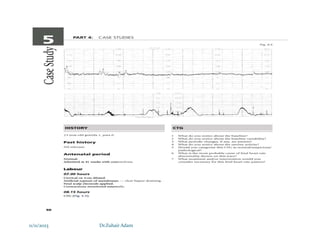
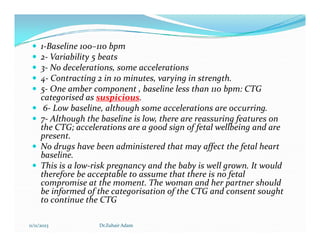
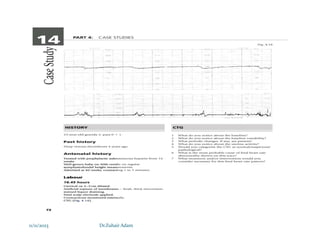
 1-Baseline 100–110 bpm
 2- Variability 5 beats
 3- No decelerations, some accelerations
 4- Contracting 2 in 10 minutes, varying in strength.
 5- One amber component , baseline less than 110 bpm: CTG
categorised as suspicious.
 6- Low baseline, although some accelerations are occurring.
 7- Although the baseline is low, there are reassuring features on
the CTG; accelerations are a good sign of fetal wellbeing and are
7- Although the baseline is low, there are reassuring features on
the CTG; accelerations are a good sign of fetal wellbeing and are
present.
 No drugs have been administered that may affect the fetal heart
baseline.
 This is a low-risk pregnancy and the baby is well grown. It would
therefore be acceptable to assume that there is no fetal
compromise at the moment. The woman and her partner should
be informed of the categorisation of the CTG and consent sought
to continue the CTG
11/11/2023 Dr.Zuhair Adam
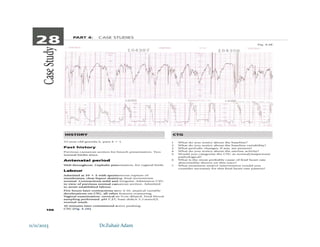
 Baseline 145–150 bpm
 2- Variability little or absent
 3- Shallow decelerations, cannot be classified as contractions not
monitored adequately No evidence of accelerations. Abnormal
 4- Contractions not monitored adequately.
 5- There is one red and one amber feature: the CTG is classified
as pathological.
 6- Decreased-variability decelerations, which look as though
they may be late. If the transducer has detected some uterine
pressure changes and the presence of fresh meconium must alert
the professional to the real possibility of fetal compromise. No
drugs have been administered and we have no information about
the fetal movements.
 7- Ascertain the presence of normal fetal movements. Obtain a
fetal blood sample if possible. Consider the need for immediate
delivery.
11/11/2023 Dr.Zuhair Adam
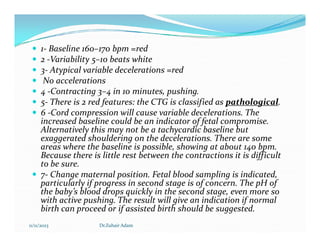
 1- Baseline 160–170 bpm =red
 2 -Variability 5–10 beats white
 3- Atypical variable decelerations =red
 No accelerations
 4 -Contracting 3–4 in 10 minutes, pushing.
 5- There is 2 red features: the CTG is classified as pathological.
 6 -Cord compression will cause variable decelerations. The
increased baseline could be an indicator of fetal compromise.
Alternatively this may not be a tachycardic baseline but
exaggerated shouldering on the decelerations. There are some
areas where the baseline is possible, showing at about 140 bpm.
Because there is little rest between the contractions it is difficult
to be sure.
 7- Change maternal position. Fetal blood sampling is indicated,
particularly if progress in second stage is of concern. The pH of
the baby’s blood drops quickly in the second stage, even more so
with active pushing. The result will give an indication if normal
birth can proceed or if assisted birth should be suggested.
11/11/2023 Dr.Zuhair Adam
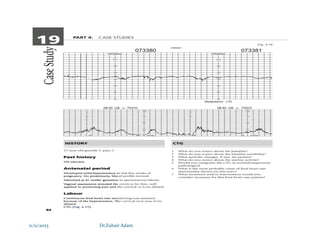
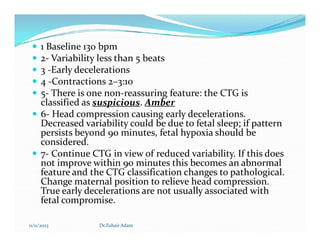
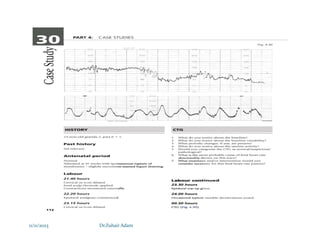
 1 Baseline 130 bpm
 2- Variability less than 5 beats
 3 -Early decelerations
 4 -Contractions 2–3:10
 5- There is one non-reassuring feature: the CTG is
classified as suspicious. Amber
 6- Head compression causing early decelerations.
Decreased variability could be due to fetal sleep; if pattern
persists beyond 90 minutes, fetal hypoxia should be
considered.
 7- Continue CTG in view of reduced variability. If this does
not improve within 90 minutes this becomes an abnormal
feature and the CTG classification changes to pathological.
Change maternal position to relieve head compression.
True early decelerations are not usually associated with
fetal compromise.
11/11/2023 Dr.Zuhair Adam
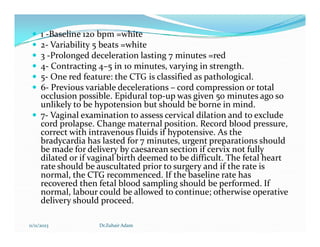
 1 -Baseline 120 bpm =white
 2- Variability 5 beats =white
 3 -Prolonged deceleration lasting 7 minutes =red
 4- Contracting 4–5 in 10 minutes, varying in strength.
 5- One red feature: the CTG is classified as pathological.
 6- Previous variable decelerations – cord compression or total
occlusion possible. Epidural top-up was given 50 minutes ago so
unlikely to be hypotension but should be borne in mind.
 7- Vaginal examination to assess cervical dilation and to exclude
cord prolapse. Change maternal position. Record blood pressure,
correct with intravenous fluids if hypotensive. As the
bradycardia has lasted for 7 minutes, urgent preparations should
be made for delivery by caesarean section if cervix not fully
dilated or if vaginal birth deemed to be difficult. The fetal heart
rate should be auscultated prior to surgery and if the rate is
normal, the CTG recommenced. If the baseline rate has
recovered then fetal blood sampling should be performed. If
normal, labour could be allowed to continue; otherwise operative
delivery should proceed.
11/11/2023 Dr.Zuhair Adam

CTG INTERPRETATION Dr zuhair 2023.pdf

  • 1.
    Eastern State Ministry ofhealth Algatarif Maternity hospital CTG INTERPRETATION Presented by :Dr. Zuhair Adam 2023 11/11/2023 Dr.Zuhair Adam
  • 2.
     What is cardiotocography(CTG)? Whatis cardiotocography(CTG)?  Cardiotocography (CTG) is used during pregnancy to monitor fetal heart rate and uterine contractions. It is most commonly used in the third trimester and its purpose is to monitor fetal well-being and allow early purpose is to monitor fetal well-being and allow early detection of fetal distress. An abnormal CTG may indicate the need for further investigations and potential intervention. 11/11/2023 Dr.Zuhair Adam
  • 3.
    How to reada CTG  To interpret a CTG you need a structured method of assessing its various characteristics. The most popular structure can be remembered using the acronym DR C BRAVADO:  DR: Define risk  C: Contractions  C: Contractions  BRa: Baseline rate  V: Variability  A: Accelerations  D: Decelerations  O: Overall impression 11/11/2023 Dr.Zuhair Adam
  • 4.
    Indications for continuous Indicationsfor continuous cardiotocography monitoring in labour cardiotocography monitoring in labour 1 1- -antenatal maternal risk factors: antenatal maternal risk factors:- -  1- Previous caesarean birth or other full thickness uterine scar  2- Any hypertensive disorder needing medication  3-Prolonged ruptured membranes (but women who are already in established labour at 24 hours 3-Prolonged ruptured membranes (but women who are already in established labour at 24 hours after their membranes ruptured do not need CTG unless there are other concerns)  •4-Any vaginal blood loss other than a show  5- Suspected chorioamnionitis or maternal sepsis  6-Pre-existing diabetes (type 1 or type 2) and gestational diabetes requiring medication. 11/11/2023 Dr.Zuhair Adam
  • 5.
    2 2- -antenatal fetal riskfactors: antenatal fetal risk factors:- -  1- non-cephalic presentation (including breech, transverse, oblique and cord), including while a decision is made about mode of birth  2- fetal growth restriction (estimated fetal weight below 3rd centile)  3- small for gestational age (estimated fetal weight below 10th centile) with other high-risk features such as abnormal doppler scan results, reduced liquor as abnormal doppler scan results, reduced liquor volume or reduced growth velocity  4- advanced gestational age (more than 42+0 weeks at the onset of established labour)  5- anhydramnios or polyhydramnios  6- reduced fetal movements before the onset of contractions 11/11/2023 Dr.Zuhair Adam
  • 6.
     3- intrapartumrisk factors:-  1- contractions that last longer than 2 minutes, or 5 or more contractions in 10 minutes  2- the presence meconium  3-maternal pyrexia (a temperature of 38°C or above on a single reading or 37.5°C or above on 2 consecutive occasions 1 hour apart) consecutive occasions 1 hour apart)  4-suspected chorioamnionitis or sepsis  5-pain reported by the woman that appears, based on her description or her previous experience, to differ from the pain normally associated with contractions  6-fresh vaginal bleeding that develops in labour 11/11/2023 Dr.Zuhair Adam
  • 7.
     7- blood-stainedliquor not associated with vaginal examination, that is likely to be uterine in origin (and may indicate suspected antepartum haemorrhage)  8- maternal pulse over 120 beats a minute on 2 occasions 30 minutes apart  9-severe hypertension (a single reading of either systolic blood pressure of 160 mmHg or more or diastolic blood pressure of 110 mmHg or more, measured between contractions)  10-hypertension (either systolic blood pressure of 140 mmHg or more or diastolic blood pressure of 90 mmHg or more on 2 consecutive readings taken 30 minutes apart, measured between contractions) taken 30 minutes apart, measured between contractions)  11- a reading of 2+ of protein on urinalysis and a single reading of either raised systolic blood pressure (140 mmHg or more) or raised diastolic blood pressure (90 mmHg or more)  12- confirmed delay in the first or second stage of labour (see the NICE guideline on intrapartum care for healthy women and babies)  13- insertion of regional analgesia (for example, an epidural)  14- use of oxytocin. 11/11/2023 Dr.Zuhair Adam
  • 8.
    Use of cardiotocographyfor monitoring during labour Use of cardiotocography for monitoring during labour  Use of cardiotocography for monitoring during labour  Review the previous fetal heart rate monitoring results, including any previous CTG traces, as part of the hourly risk assessment and in conjunction with other antenatal or intrapartum risk factor.  If there are changes in the fetal heart rate pattern over time which indicate a change in the baby's condition, If there are changes in the fetal heart rate pattern over time which indicate a change in the baby's condition, review antenatal or intrapartum risk factors for hypoxia.  When reviewing a CTG trace, assess and document:  1-contractions  2- baseline fetal heart rate  3- variability  4- presence or absence of decelerations (and characteristics of decelerations if present)  5- presence of accelerations. 11/11/2023 Dr.Zuhair Adam
  • 9.
    Features of cardiotocography Featuresof cardiotocography   Features of cardiotocography Features of cardiotocography  Categorise the 4 features of the cardiotocography trace (contractions, baseline fetal heart rate, variability, decelerations) as variability, decelerations) as  white,  amber or  red (indicating increasing levels of concern) and use alongside consideration of the presence of accelerations to classify the overall CTG trace 11/11/2023 Dr.Zuhair Adam
  • 10.
    Trace components: Trace components:- - ContractionRate Variability Deceleration 11/11/2023 Dr.Zuhair Adam
  • 11.
    Trace interpretation: Trace interpretation: Normal= 4 white components Suspicious= 1 amber components Pathological =2 amber or 1 red components 11/11/2023 Dr.Zuhair Adam
  • 12.
    Accelerations Accelerations  Define accelerationsas transient increases in fetal heart rate of 15 beats a minute or more, lasting 15 seconds or more.  Take the following into account when assessing accelerations in fetal heart rate:  • the presence of fetal heart rate accelerations, even with  • the presence of fetal heart rate accelerations, even with reduced variability, is generally a sign that the baby is healthy  • the absence of accelerations on an otherwise normal CTG trace does not indicate fetal acidosi 11/11/2023 Dr.Zuhair Adam
  • 13.
  • 14.
    Contractions: Contractions:- - white Amber Red •fewerthan 5 contractions in 10 5 or more contractions in 10 •No contractions in 10 minutes contractions in 10 minutes, leading to reduced resting time between contraction. hypertonus: contraction lasting 2 minutes or longer. 11/11/2023 Dr.Zuhair Adam
  • 15.
      If 5or more contractions per 10 minutes are If 5 or more contractions per 10 minutes are present: present:  • perform a full risk assessment.  • take action to reduce contraction frequency as described in the section on underlying causes and described in the section on underlying causes and conservative measures.  • explain to the woman what is happening, and ensure that she has adequate pain relief. 11/11/2023 Dr.Zuhair Adam
  • 16.
    Baseline fetal heartrate Baseline fetal heart rate  Determine baseline fetal heart rate by looking at the mean fetal heart rate, excluding accelerations and decelerations, over a period of 10 minutes when the fetal heart rate is stable. baseline fetal heart rate will usually be between  baseline fetal heart rate will usually be between 110 and 160 beats a minute  lower baseline fetal heart rates are expected with post-term pregnancies, with higher baseline rates in preterm pregnancies 11/11/2023 Dr.Zuhair Adam
  • 17.
    white Amber Red 1-Stablebaseline of 110 to 160 beats a minute 1- Increase in baseline fetal heart rate of 20 beats a minute or more from the start of labour or 1-below 100 beats a minute, or 2-above 160 beats a minute. start of labour or since the last review an hour ago, or 2- 100 to 109 beats a minute or 3 -Unable to determine baseline 11/11/2023 Dr.Zuhair Adam
  • 18.
    • Arise inbaseline fetal heart rate may • Arise in baseline fetal heart rate may represent either : represent either :- - 1-Excessive fetal movements or fetal stimulation. If the fetus is very active during the period when the CTG is being performed, the fetal heart may not be showing a true baseline. This should be classed as reactivity, but can be mistakenly diagnosed as fetal tachycardia. 2-Maternal stress and anxiety. If the mother is in a stressful 2-Maternal stress and anxiety. If the mother is in a stressful situation, or has a high anxiety level, she will release catecholamines, thereby stimulating the sympathetic nervous system, resulting in an increase in both maternal and fetal heart rates.  3. Gestational age. A fetus at a gestational age of 32 weeks or below can show a baseline tachycardia due to the immaturity of the vagus nerve. The sympathetic nervous system is dominant, resulting in a persistently high fetal heart rate. 11/11/2023 Dr.Zuhair Adam
  • 19.
     4. Maternaltachycardia. This may be as a result of dehydration and/or ketosis leading to poor uterine perfusion. Encouraging fluids, isotonic drinks and appropriate diet would be recommended  5. Maternal pyrexia. A maternal pyrexia of 37.5°C or higher may indicate infection and possible chorioamnionitis and is a risk factor for poor neonatal outcome.   6. Fetal infection. During infection, oxygen requirements are raised. The heart rate rises to increase the oxygen transfer around the body.    7. Fetal hypoxia. Chronic changes in the levels of oxygen tension in the blood and fetal tissues lead to an increase in the sympathetic activity, resulting in a rise in heart rate.  8. Fetal hormones. The fetus, in response to stressful situations, e.g. a decrease in oxygen levels, can produce hormones from the adrenal glands, adrenaline (epinephrine) and noradrenaline (norepinephrine). Their effect is similar to an increase in sympathetic activity, that is, a rise in the heart rate 11/11/2023 Dr.Zuhair Adam
  • 20.
    Base line Variability Baseline Variability   variability will usually be between variability will usually be between 5 5 and and 25 25 beats a minute beats a minute  Determine variability by looking at the minor oscillations in the fetal heart rate, which usually occur at 3 to 5 cycles a minute. Measure it by estimating the difference in beats per minute between the highest heart rate and the lowest heart rate in a 1-minute segment of the trace between contractions, excluding decelerations and accelerations. heart rate in a 1-minute segment of the trace between contractions, excluding decelerations and accelerations.  Variability represents the constant interaction of the sympathetic and parasympathetic nervous systems as they determine the appropriate heart rate and cardiac output in response to constant minor changes in venous return and metabolic demands of the fetus.  Normal variability represents an intact nervous pathway through the cerebral cortex, midbrain, vagus nerve and cardiac conduction system. 11/11/2023 Dr.Zuhair Adam
  • 21.
    Cause Decreased variability CauseDecreased variability  1. Fetal sleep. During fetal sleep the CTG commonly gives an appearance of decreased variability; this should not be confused with lack of reactivity. The pattern does not usually persist for longer than 40 minutes, although it may last for up to 90 minutes.  2. Administration of drugs to the mother. Decreased variability can be seen following the administration of pethidine for pain relief in labour, or of sedative drugs. This of pethidine for pain relief in labour, or of sedative drugs. This pattern may persist for longer than the normal sleep cycle of the fetus.  3. Gestational age. The CTG of a fetus at a gestational age of less than 30–32 weeks may show decreased variability, probably due to the immaturity of the autonomic nervous system.  4. Hypoxia. When the fetus is suffering from hypoxia the autonomic nervous system fails to respond to stress and the changes in venous return and metabolic demands of the fetus. This is due to a reduction in the transmission of impulses through the nervous system. In the presence of cerebral hypoxia, variability is often severely diminished or absent 11/11/2023 Dr.Zuhair Adam
  • 22.
    White Amber Red 5To 25 beats a minute 1-fewer than 5 beats a minute for between 30 and 50 minutes, or 1- fewer than 5 beats a minute for more than 50 minutes, or 2-more than 25 beats a minute for up to 10 minutes 2-more than 25 beats a minute for more than 10 minutes, or 3-sinusoidal 11/11/2023 Dr.Zuhair Adam
  • 23.
      Obtain anurgent review by an obstetrician or Obtain an urgent review by an obstetrician or senior midwife and consider expediting birth if: senior midwife and consider expediting birth if:  1-there is an isolated reduction in variability to fewer than 5 beats per minute for more than 30 minutes when combined with antenatal or intrapartum risk factors, as this is associated with an increased risk of adverse neonatal outcomes, or neonatal outcomes, or  2- there is a reduction in variability to fewer than 5 beats per minute combined with other CTG changes, particularly a rise in the baseline fetal heart rate, as this is a strong indicator for fetal compromise. 11/11/2023 Dr.Zuhair Adam
  • 24.
  • 25.
  • 26.
  • 27.
    Decelerations Decelerations  Define decelerationsas transient episodes when the fetal heart rate slows to below the baseline level by more than 15 beats a minute, with each episode lasting 15 seconds or more.  1-When assessing the significance of decelerations in fetal heart rate, consider:-  • their timing (early, variable or late) in relation to the  • their timing (early, variable or late) in relation to the peaks and duration of the contractions  • the duration of the individual decelerations  • whether or not the fetal heart rate returns to the baseline heart rate  • how long they have been present for  • whether they occur with over 50% of contractions (defined as repetitive)  • the presence or absence of shouldering  • the variability within the deceleration 11/11/2023 Dr.Zuhair Adam
  • 28.
    Early decelerations Early decelerations Definition:-  Early decelerations tend to be uniform in shape and occur with each contraction. They often appear in a mirror image of the contraction. The onset of the deceleration is at the onset of the contraction. The deceleration is at the onset of the contraction. The heart rate reaches its lowest point at the peak of the contraction and has recovered to the baseline by the end of the contraction.(due to head compression) 11/11/2023 Dr.Zuhair Adam
  • 29.
    Variable deceleration  Variabledecelerations are observed as a rapid fall in baseline fetal heart rate with a variable recovery phase.  They are variable in their duration and may not have any relationship to uterine contractions.  They are most often seen during labour and in patients’ with reduced amniotic fluid volume.  All fetuses experience stress during the labour process, as a result of uterine contractions reducing fetal perfusion. Whilst fetal stress is to be expected during labour, the challenge is to pick up pathological fetal distress. labour, the challenge is to pick up pathological fetal distress.  Variable decelerations are usually caused by umbilical cord compression. The mechanism is as follows:1  1. The umbilical vein is often occluded first causing an acceleration of the fetal heart rate in response.  2. Then the umbilical artery is occluded causing a subsequent rapid deceleration.  3. When pressure on the cord is reduced another acceleration occurs and then the baseline rate returns.  The accelerations before and after a variable deceleration are known as the shoulders of deceleration. 11/11/2023 Dr.Zuhair Adam
  • 30.
  • 31.
    2 2- -Regard the followingas concerning Regard the following as concerning characteristics of variable decelerations: characteristics of variable decelerations: • lasting more than 60 seconds  • reduced variability within the deceleration  • failure or slow return to baseline fetal heart rate • loss of previously present shouldering  • loss of previously present shouldering 11/11/2023 Dr.Zuhair Adam
  • 32.
    Late decelerations Late decelerations Late decelerations begin at the peak of the uterine contraction and recover after the contraction ends. This type of deceleration indicates there is insufficient blood flow to the uterus and placenta. As a insufficient blood flow to the uterus and placenta. As a result, blood flow to the fetus is significantly reduced causing fetal hypoxia and acidosis 11/11/2023 Dr.Zuhair Adam
  • 33.
    White Amber Red 1-nodecelerations, or 2-early decelerations, or 3-variable decelerations that are not evolving to have concerning characteristics 1-repetitive variable decelerations with any concerning characteristics for less than 30 minutes, or 2-variable decelerations 1-repetitive variable decelerations with any concerning characteristics for more than 30 minutes, or 2-repetitive late characteristics 2-variable decelerations with any concerning characteristics for more than 30 minutes, or 3- repetitive late decelerations for less than 30 minutes 2-repetitive late decelerations for more than 30 minutes, or 3- acute bradycardia, or a single prolonged deceleration lasting 3 minutes or more 11/11/2023 Dr.Zuhair Adam
  • 34.
  • 35.
    Making care decisionsbased on the Making care decisions based on the cardiotocography trace: cardiotocography trace:- -  • continue CTG (unless it was started because of concerns arising from intermittent auscultation and there are no ongoing antenatal or intrapartum risk factors) and antenatal or intrapartum risk factors) and usual care  • continue to perform a full risk assessment at least hourly and document the findings 11/11/2023 Dr.Zuhair Adam
  • 36.
    If the CTGtrace is categorised as suspicious and If the CTG trace is categorised as suspicious and there are no other concerning risk factors: there are no other concerning risk factors:- -  • perform a full risk assessment, including a full set of maternal observations, taking into account the whole clinical picture, and document the findings findings  • note that if accelerations are present then fetal acidosis is unlikely  • if the CTG trace was previously normal, consider possible underlying reasons for the change  • undertake conservative measures as indicated 11/11/2023 Dr.Zuhair Adam
  • 37.
    If the CTGtrace is categorised as suspicious and If the CTG trace is categorised as suspicious and there are additional intrapartum risk factors there are additional intrapartum risk factors such as slow progress, sepsis or such as slow progress, sepsis or meconium meconium: :- -  • perform a full risk assessment, including a full set of maternal observations, taking into account the whole clinical picture, and document the findings  • consider possible underlying causes, and undertake  • consider possible underlying causes, and undertake conservative measures as indicated (see the section on underlying causes and conservative measures)  • obtain an urgent review by an obstetrician or a senior midwife  • consider: 1-fetal scalp stimulation or 2- expediting birth. 11/11/2023 Dr.Zuhair Adam
  • 38.
    If the CTGtrace is categorised as If the CTG trace is categorised as pathological: pathological:- -  If the CTG trace is categorised as pathological:-  • obtain an urgent review by an obstetrician and a senior midwife  • exclude acute events (for example, cord prolapse, suspected placental abruption or suspected uterine • exclude acute events (for example, cord prolapse, suspected placental abruption or suspected uterine rupture) that need immediate intervention  • perform a full risk assessment, including a full set of maternal observations, taking into account the whole clinical picture, and document the findings  • consider possible underlying causes and undertake conservative measures as indicated. 11/11/2023 Dr.Zuhair Adam
  • 39.
      If theCTG trace is still pathological If the CTG trace is still pathological after implementing conservative after implementing conservative measures: measures:- -  • obtain a further urgent review by an obstetrician and a senior midwife  • evaluate the whole clinical picture and consider  • evaluate the whole clinical picture and consider expediting birth  • if there are evolving intrapartum risk factors for fetal compromise, have a very low threshold for expediting birth. 11/11/2023 Dr.Zuhair Adam
  • 40.
      If thereis an acute If there is an acute bradycardia bradycardia, or a single , or a single prolonged deceleration for 3 minutes or prolonged deceleration for 3 minutes or more: more:  • urgently seek obstetric review  • if there has been an acute event (for example, cord prolapse, suspected placental abruption or suspected uterine rupture), expedite the birth suspected uterine rupture), expedite the birth  • consider possible underlying causes and undertake conservative measures as indicated (see the section on underlying causes and conservative measures)  • make preparations for an urgent birth, including a request for paediatric or neonatal support 11/11/2023 Dr.Zuhair Adam
  • 41.
     Fetal scalpstimulation  If the CTG trace is suspicious with antenatal or intrapartum risk factors for fetal compromise, then consider digital fetal scalp stimulation. If this leads to an acceleration in fetal heart rate and a sustained improvement in the CTG trace, continue to monitor the fetal heart rate and clinical picture. to monitor the fetal heart rate and clinical picture.  Be aware that the absence of an acceleration in response to fetal scalp stimulation is a worrying sign that fetal compromise may be present, and that expedited birth may be necessary. 11/11/2023 Dr.Zuhair Adam
  • 42.
     Fetal bloodsampling  NICE is unable to make a recommendation about fetal blood sampling because of limited evidence result classification >7.25 Normal 11/11/2023 Dr.Zuhair Adam >7.25 Normal 7.21- 7.24 Borderline repeat in 30 mins <7.21 Abnormal birth expedited
  • 43.
     Fetal scalpstimulation  If the CTG trace is suspicious with antenatal or intrapartum risk factors for fetal compromise, then consider digital fetal scalp stimulation. If this leads to an acceleration in fetal heart rate and a sustained improvement in the CTG trace, continue to monitor the fetal heart rate and clinical picture. and clinical picture.  Be aware that the absence of an acceleration in response to fetal scalp stimulation is a worrying sign that fetal compromise may be present, and that expedited birth may be necessary. 11/11/2023 Dr.Zuhair Adam
  • 44.
     In thesecond stage of labour:  if fetal heart rate accelerations are recorded, be aware that these are most likely to be maternal pulse.  • if fetal heart rate decelerations are recorded, look for other signs of hypoxia (for example, a rise in the baseline fetal heart rate or a reduction in variability).  Take into account that onset of hypoxia is both more common and more rapid in the active second stage of labour. Take an increase in the baseline fetal heart rate of 20 beats a minute or increase in the baseline fetal heart rate of 20 beats a minute or more as a red feature in active second stage labour. [2022]  If CTG concerns arise in the active second stage of labour:  • obtain an obstetric review  • consider discouraging pushing and stopping any oxytocin infusion to allow the baby to recover, unless birth is imminent  • agree and document a clear plan with time limits for the next review. 11/11/2023 Dr.Zuhair Adam
  • 45.
     Underlying causes andconservative Underlying causes and conservative measures measures  If there are any concerns about the baby's wellbeing, be aware of the possible underlying causes and start 1 or more of the following conservative measures based on an assessment of the most likely cause(s):  • maternal position (as this can affect uterine blood flow and cord compression), encourage the woman to mobilise, or adopt an alternative position, and to avoid being supine  • hypotension:-  do not offer intravenous fluids to treat fetal heart rate abnormalities unless the woman is hypotensive or has signs of sepsis the woman is hypotensive or has signs of sepsis  if the woman is hypotensive secondary to an epidural top-up, start intravenous fluids, move her to a left lateral position and call an anaesthetist to review  excessive contraction frequency:-  reduce contraction frequency by reducing or stopping oxytocin if it is being used  offer a tocolytic drug (a suggested regimen is subcutaneous terbutaline 0.25 mg)  Do not offer maternal facial oxygen therapy as part of conservative measures because it may harm the baby. However, it can be used if it is given for maternal issues such as hypoxia, or as part of pre-oxygenation before a potential anaesthetic. 11/11/2023 Dr.Zuhair Adam
  • 46.
     Record keeping forcardiotocography Record keeping for cardiotocography  - To ensure accurate record keeping for CTG:  1-make sure that date and time clocks on the cardiotocograph monitor are set correctly  2- ensure the recording or paper speed is set at 1 cm a minute and that adequate paper is available  3- label traces with the woman's name, date of birth, hospital number or NHS number and pulse at the start of 3- label traces with the woman's name, date of birth, hospital number or NHS number and pulse at the start of monitoring, and the date of the CTG  4-Individual units should develop a system for recording relevant intrapartum events (for example, vaginal examination and siting of an epidural) in standard notes and/or on the cardiotocograph trace.  Keep cardiotocograph traces for 25 years and, if possible, store them electronically. 11/11/2023 Dr.Zuhair Adam
  • 47.
  • 48.
     1-Baseline 100–110bpm  2- Variability 5 beats  3- No decelerations, some accelerations  4- Contracting 2 in 10 minutes, varying in strength.  5- One amber component , baseline less than 110 bpm: CTG categorised as suspicious.  6- Low baseline, although some accelerations are occurring.  7- Although the baseline is low, there are reassuring features on the CTG; accelerations are a good sign of fetal wellbeing and are 7- Although the baseline is low, there are reassuring features on the CTG; accelerations are a good sign of fetal wellbeing and are present.  No drugs have been administered that may affect the fetal heart baseline.  This is a low-risk pregnancy and the baby is well grown. It would therefore be acceptable to assume that there is no fetal compromise at the moment. The woman and her partner should be informed of the categorisation of the CTG and consent sought to continue the CTG 11/11/2023 Dr.Zuhair Adam
  • 49.
  • 50.
     Baseline 145–150bpm  2- Variability little or absent  3- Shallow decelerations, cannot be classified as contractions not monitored adequately No evidence of accelerations. Abnormal  4- Contractions not monitored adequately.  5- There is one red and one amber feature: the CTG is classified as pathological.  6- Decreased-variability decelerations, which look as though they may be late. If the transducer has detected some uterine they may be late. If the transducer has detected some uterine pressure changes and the presence of fresh meconium must alert the professional to the real possibility of fetal compromise. No drugs have been administered and we have no information about the fetal movements.  7- Ascertain the presence of normal fetal movements. Obtain a fetal blood sample if possible. Consider the need for immediate delivery. 11/11/2023 Dr.Zuhair Adam
  • 51.
  • 52.
     1- Baseline160–170 bpm =red  2 -Variability 5–10 beats white  3- Atypical variable decelerations =red  No accelerations  4 -Contracting 3–4 in 10 minutes, pushing.  5- There is 2 red features: the CTG is classified as pathological.  6 -Cord compression will cause variable decelerations. The increased baseline could be an indicator of fetal compromise. increased baseline could be an indicator of fetal compromise. Alternatively this may not be a tachycardic baseline but exaggerated shouldering on the decelerations. There are some areas where the baseline is possible, showing at about 140 bpm. Because there is little rest between the contractions it is difficult to be sure.  7- Change maternal position. Fetal blood sampling is indicated, particularly if progress in second stage is of concern. The pH of the baby’s blood drops quickly in the second stage, even more so with active pushing. The result will give an indication if normal birth can proceed or if assisted birth should be suggested. 11/11/2023 Dr.Zuhair Adam
  • 53.
  • 54.
     1 Baseline130 bpm  2- Variability less than 5 beats  3 -Early decelerations  4 -Contractions 2–3:10  5- There is one non-reassuring feature: the CTG is classified as suspicious. Amber  6- Head compression causing early decelerations. Decreased variability could be due to fetal sleep; if pattern Decreased variability could be due to fetal sleep; if pattern persists beyond 90 minutes, fetal hypoxia should be considered.  7- Continue CTG in view of reduced variability. If this does not improve within 90 minutes this becomes an abnormal feature and the CTG classification changes to pathological. Change maternal position to relieve head compression. True early decelerations are not usually associated with fetal compromise. 11/11/2023 Dr.Zuhair Adam
  • 55.
  • 56.
     1 -Baseline120 bpm =white  2- Variability 5 beats =white  3 -Prolonged deceleration lasting 7 minutes =red  4- Contracting 4–5 in 10 minutes, varying in strength.  5- One red feature: the CTG is classified as pathological.  6- Previous variable decelerations – cord compression or total occlusion possible. Epidural top-up was given 50 minutes ago so unlikely to be hypotension but should be borne in mind.  7- Vaginal examination to assess cervical dilation and to exclude cord prolapse. Change maternal position. Record blood pressure, cord prolapse. Change maternal position. Record blood pressure, correct with intravenous fluids if hypotensive. As the bradycardia has lasted for 7 minutes, urgent preparations should be made for delivery by caesarean section if cervix not fully dilated or if vaginal birth deemed to be difficult. The fetal heart rate should be auscultated prior to surgery and if the rate is normal, the CTG recommenced. If the baseline rate has recovered then fetal blood sampling should be performed. If normal, labour could be allowed to continue; otherwise operative delivery should proceed. 11/11/2023 Dr.Zuhair Adam
  • 57.