• A condition that occurs during pregnancy if a
blood and her
blood. Mother’s body create Rh
antibodies against the baby’s blood.
• Also known as haemolytic disease of the
fetus and newborn (HDFN) or
erythroblastosis fetalis.
June:6 2
Rhesus Incompatibility
INTRODUCTION:
Four blood types ( A, B, AB, and O)
Each blood type is additionally classified according to the
presence or absence of the Rh factor into Rh negative and Rh
positive.
Rh Incompatibility
Occurs when there is a
different Rh blood
type between that of
the pregnant mother
(Rh negative) and
that of the fetus (Rh
positive)
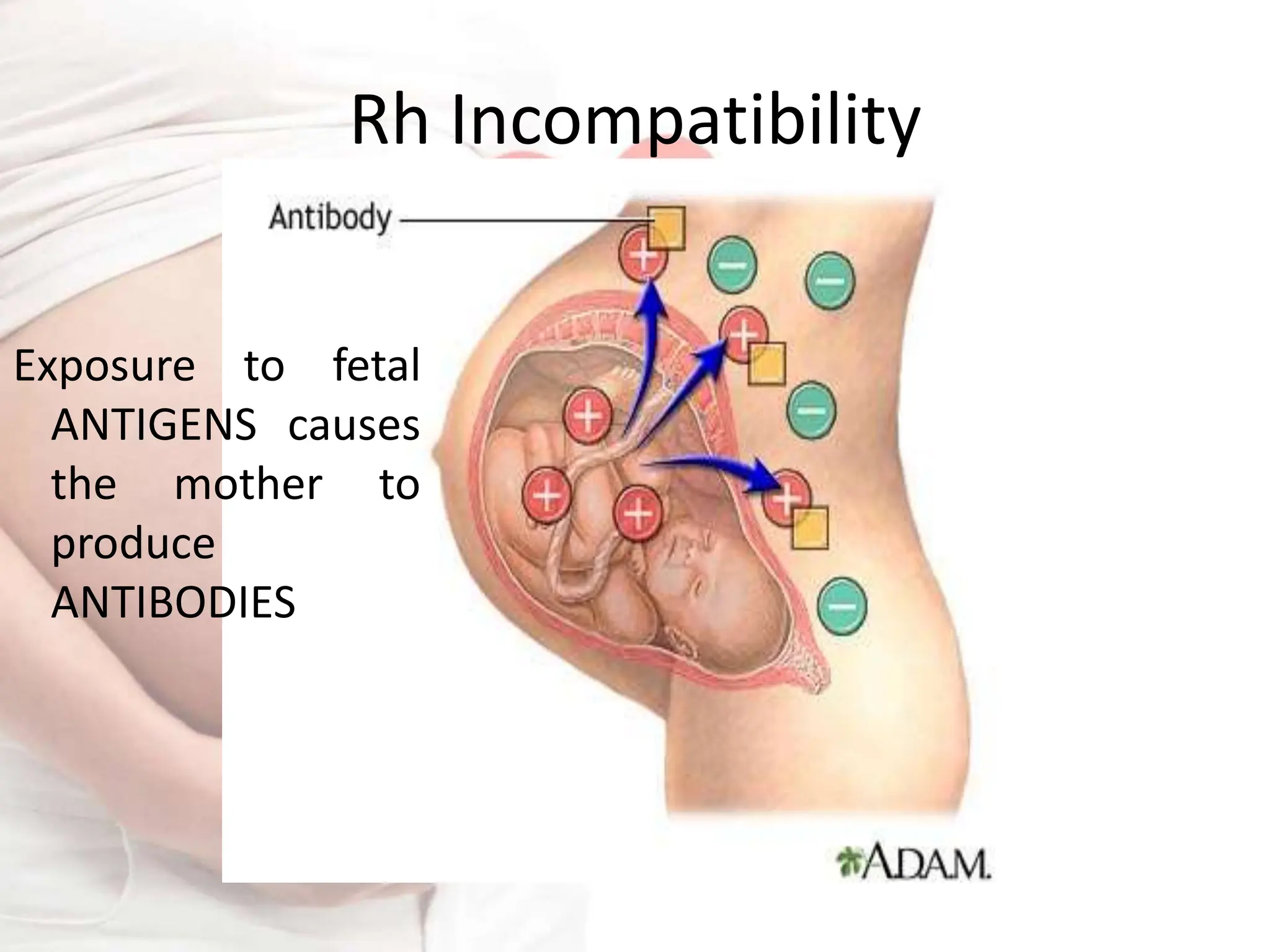
Rh Incompatibility
Exposure to fetal
ANTIGENS causes
the mother to
produce
ANTIBODIES
The placenta usually acts as a barrier to
fetal blood entering the maternal
circulation.
Fetal cells can enter the maternal
circulation through a “break” in the
“placental barrier”.
Maternal production of Rhesus antibodies
following introduction of Rhesus positive
blood
Maternal production of Rhesus antibodies
following introduction of Rhesus positive
blood
Introduction
• Rh-Ags are found on the surfaces of the RBCs may
cause isoimmunization.
• D-antigen, the most powerful Rh factor. If the
RBCs carry the D antigen, the person is Rh
positive and the reverse is correct.
• Exposure of Rh-ve group to even small amounts
of Rh+ve cells can result in the production of anti-
D alloantibody– Rh sensitization/isoimmunization
June:6 Rhesus Incompatibility 10
Pathogenesis
June:6 Rhesus Incompatibility 11
1. Rh-ve mother carrying Rh+ve
fetus
2. Entry of fetus Rh+ve RBC into
maternal circulation
3. Development of Rh antibodies
by the mother
1. Rh-ve mother carrying Rh+ve
fetus
• The chance of having Rh+ve fetus from
Rh+ve father ranges from 50% (if the father
is heterozygous Dd) to 100% (if the father is
homozygous DD).
• All offspring of the homozygous Rh-positive
person will be Rh-positive. The offspring of
the heterozygous Rh-positive person may be
Rh-positive or negative.
June:6 Rhesus Incompatibility 12
2. Entry of the fetal Rh+ve RBC into
maternal circulation
• Transfusion of incompatible blood (rare)
• Fetomaternal hemorrhage(through leaks in the
placenta- 3rd stage):
 Spontaneous/ induced abortion
 Ectopic gestation
 Antepartum hemorrhage: abruptio placenta,
amniocentesis, abdominal trauma, external cephalic
version.
• Worsen fetomaternal bleeding during labour are manual
removal of placenta, twin delivery and caeserian section.
• Fetal RBC are detected in the maternal circulation in 6%
in the 1st trimester, 15% in the 2nd trimester and 30% in
the 3rd trimester.
June:6 Rhesus Incompatibility 13
3. Development of Rh antibodies by
the mother
• Initially – Ig M (big Ig can’t pass the placental
barrier).
• Fetomaternal bleeding in the subsequent
pregnancies results in the anamenstic
reaction(Ab production against Ag) producing
Ig G (can pass placental barrier)
• Transfer of Ig G develops hemolytic disease of
the newborn and hydrops fetalis, antibodies
mediated destruction of the fetal RBCs.
• First neonate is usually spared but subsequent
Rh +ve fetuses are affected.
June:6 Rhesus Incompatibility 14
Risks of Rh incompatibility effect
June:6 Rhesus Incompatibility 15
Rh+ve father Rh-ve mother
1st Rh+ve baby
Usually unaffected
Rh+ve cells
Miscarriage/ Termination
of pregnancy
Ectopic pregnancy
Amniocentesis
Antepartum haemorrhage
Delivery of placenta
Rhesus antibodies
Pass to 2nd Rh+ve baby
Hemolysis of Rh +ve cells
Fetal Anemia
Hydrops fetalis
Intrauterine transfusion
Postnatal exchange transfusion
Treatment
Effects on the fetus and the newborn
• Hemolytic anemia
• Progressive anemia which eventually leads
to congestive HF and tissue hypoxia.
• Hydrop fetalis- generalized edema of the
fetus
• Kernicterus- unconjugated bilirubin crosses
the BBB(blood brain barrier) and damages
the basal ganglia manifested by convulsions
and paralysis
• Neonatal jaundice-⬆bilirubin in infant’s
June:6 16
Rhesus Incompatibility
Signs in a newborn baby
• Hemolytic anemia
₋ Pale,
₋ increased breathing rate,
₋ poor feeding
• Jaundice
₋ Yellow sclera, palms and soles
• Kernicterus
₋ Motor sensory and mental deficiencies
June:6 Rhesus Incompatibility 17
Investigations:
• At the first antenatal visit, all women are
screened for ABO and Rh type.
• If a woman has Rh-negative blood, the
paternal blood type and zygosity are
determined. If the father has Rh-positive
blood, maternal Rh Anti-D titres are measured
at 26 to 28 weeks.
• Maternal serum antibody titre is a guide to
disease severity.
June:6 Rhesus Incompatibility 18
Investigations:
• If antibody levels rise, the baby should be
examined for signs of anaemia.
June:6 Rhesus Incompatibility 19
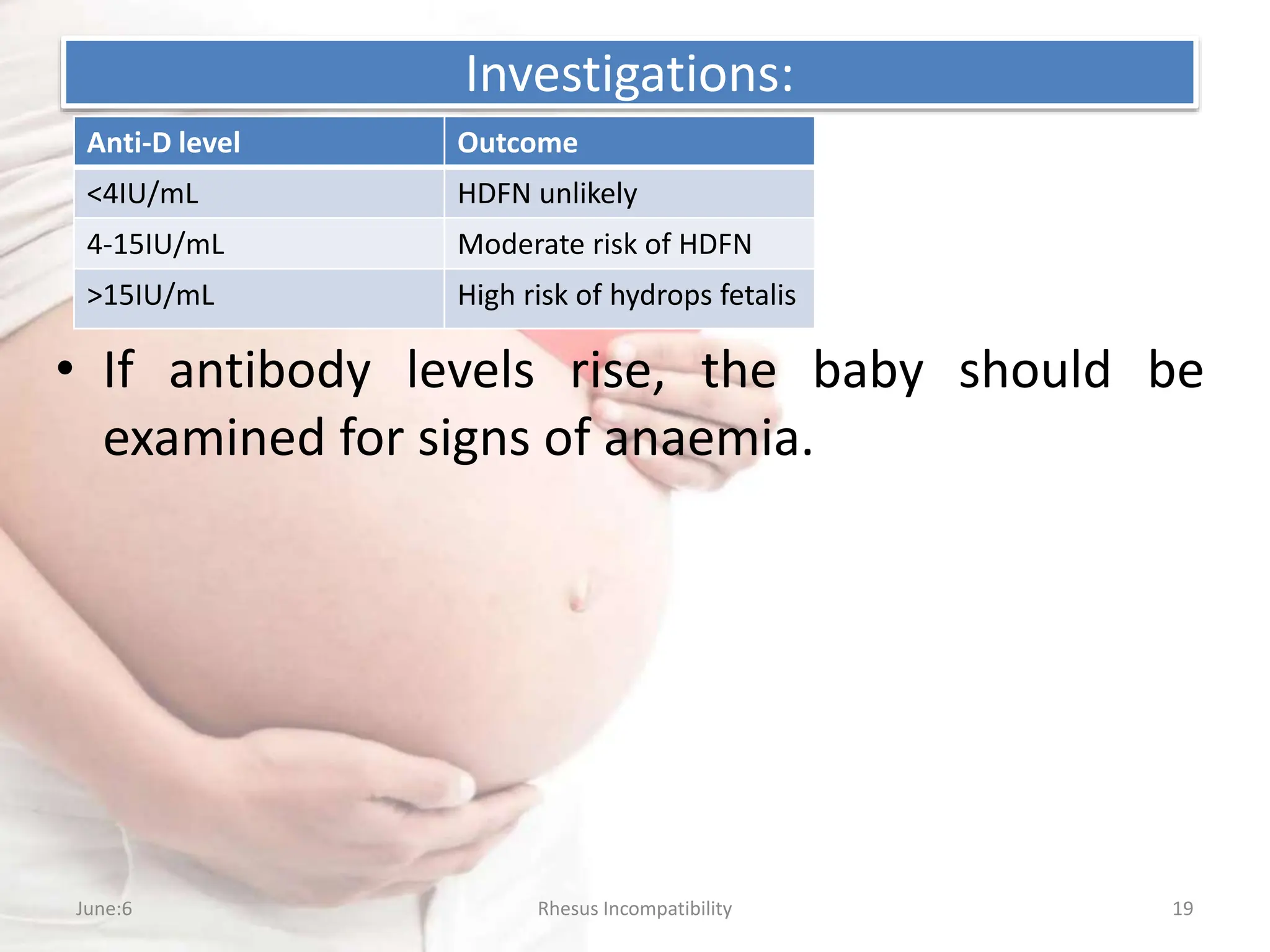
Anti-D level Outcome
<4IU/mL HDFN unlikely
4-15IU/mL Moderate risk of HDFN
>15IU/mL High risk of hydrops fetalis
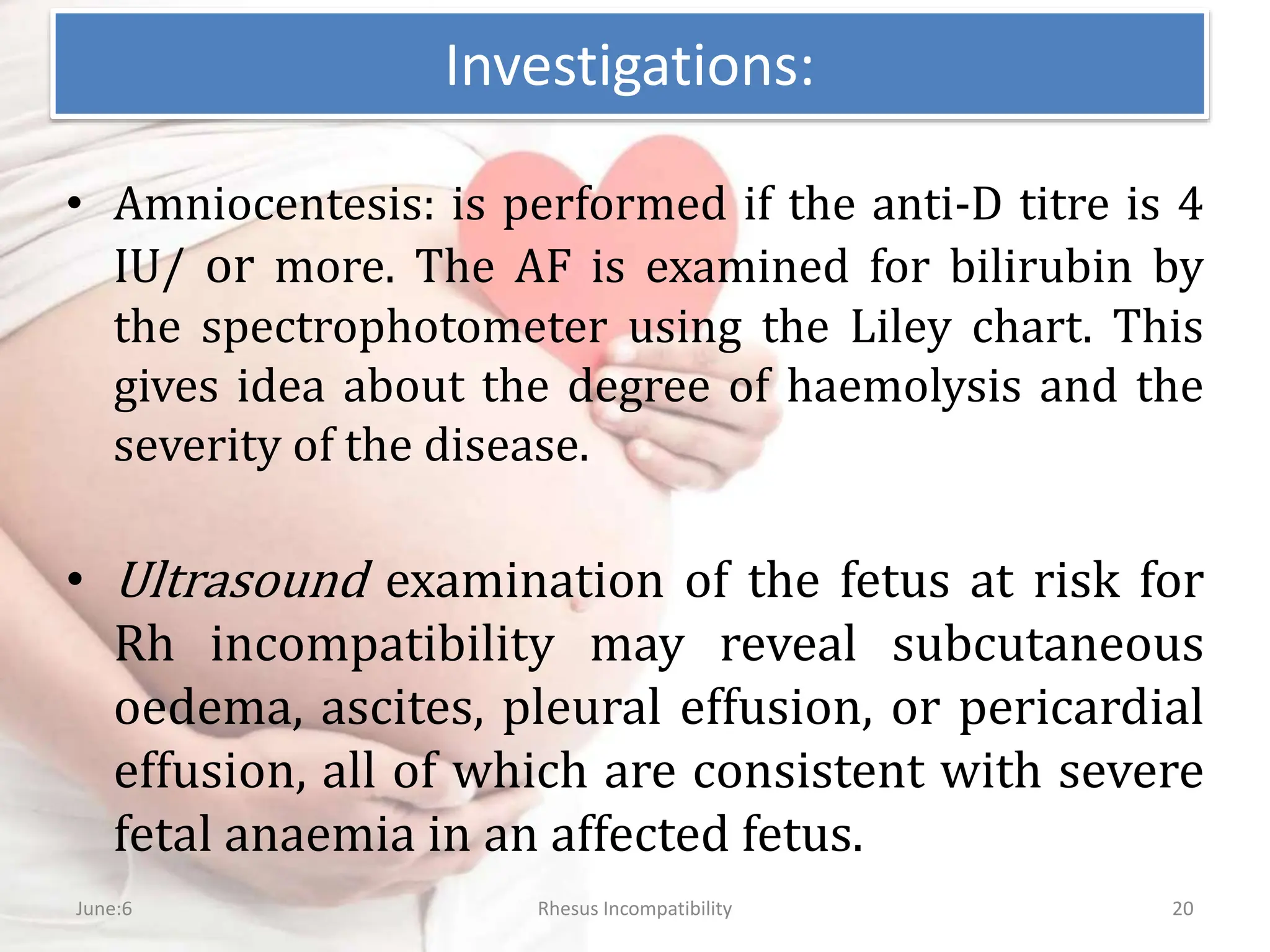
• Amniocentesis: is performed if the anti-D titre is 4
IU/ or more. The AF is examined for bilirubin by
the spectrophotometer using the Liley chart. This
gives idea about the degree of haemolysis and the
severity of the disease.
• Ultrasound examination of the fetus at risk for
Rh incompatibility may reveal subcutaneous
oedema, ascites, pleural effusion, or pericardial
effusion, all of which are consistent with severe
fetal anaemia in an affected fetus.
June:6 Rhesus Incompatibility 20
Investigations:
• Cordocentesis: Blood is obtained from the
umbilical vein to determine the HB conc., Hct,
blood group, direct coomb’s test and bilirubin
level. This is done using a needle passed under
ultrasound control.
• At delivery the cord blood is examined for: ABO
and Rh group, Hb %, level of bilirubin and direct
Coombs test to detect the presence of antibodies
on the surface of fetal RBCs.
June:6 Rhesus Incompatibility 21
Investigations:
Management
Management
Unsensitized
pregnancy
Identification
Management
Sensitized
pregnancy
Management
June:6 22
Rhesus Incompatibility
Management of Rh-ve unsensitized
pregnancy
• Provide anti D prophylaxis in cases with amniocentesis, APH,
external cephalic version.
• Following delivery determine blood group of the newborn and
antibody screening.
• If the newborn is Rh negative no further treatment is needed.
• If antibody screen is positive monitor the newborn for
haemolysis and manage next pregnancy as sensitized.
• If newborn is Rh positive and antibody screen is negative,
provide anti D gamma globulin within 72 hours. The usual
dose is 300 micrograms but ideally should be determined by
the extent of fetomaternal hemorrhage. This is done by
performing Kleihauer Betke test (acid elusion test). For
abortion of less than 12 weeks gestation the dose is 50
micrograms.
June:6 23
Rhesus Incompatibility
Management of sensitized mother
June:6 24
Rhesus Incompatibility
• Measurement of antibody levels in titers at
regular intervals,
• Amniocentesis for bilirubin levels
• Serial ultrasound for detection of hydrops and
management of neonatal anemia and
hyperbilirubinemia.
• Therefore, referral of these women is the
correct approach at health center level.
Treatment
• Intrauterine transfusion.
• Elect time of delivery.
• Maternal plasmapheresis(therapeutic
intervention –extracorporeal removal
,return,exchange of blood plasma and its
component).
• Exchange transfusion after delivery.
• Phototherapy after delivery.
June:6 25
Rhesus Incompatibility
Intrauterine transfusion
• The fetus can die in utero from severe anaemia and
hydrops before he can be delivered.
• An intrauterine transfusion can prolong the life in
utero of a fetus to a gestation where the risks of
prematurity are estimated as being less than those
of the Rh disease. This can be done by an:
1. Intraperitoneal transfusion guided by ultrasound.
2. Umbilical vein transfusion guided by ultrasound.
• Group O, Rh-negative blood is transfused under
ultrasound control.
June:6 Rhesus Incompatibility 26
Choose time of induction and best
method of delivery
• Balance the risks of prematurity (too soon) with
that of worsening Rh disease (too late).
• Usually done only after 34 weeks of gestation.
Before this time the fetus is too premature to
survive after delivery.
• The paediatric team should be in close and a
senior paediatrician present at the delivery
• fresh Rh-negative blood available.
June:6 Rhesus Incompatibility 27
Maternal plasmapheresis
• To wash antibodies from maternal blood.
Indicated for severe cases between 12 and
16 weeks of pregnancy when intrauterine
transfusion cannot be carried out. It is costly
and time consuming.
June:6 Rhesus Incompatibility 28
Resuscitation and Exchange transfusion
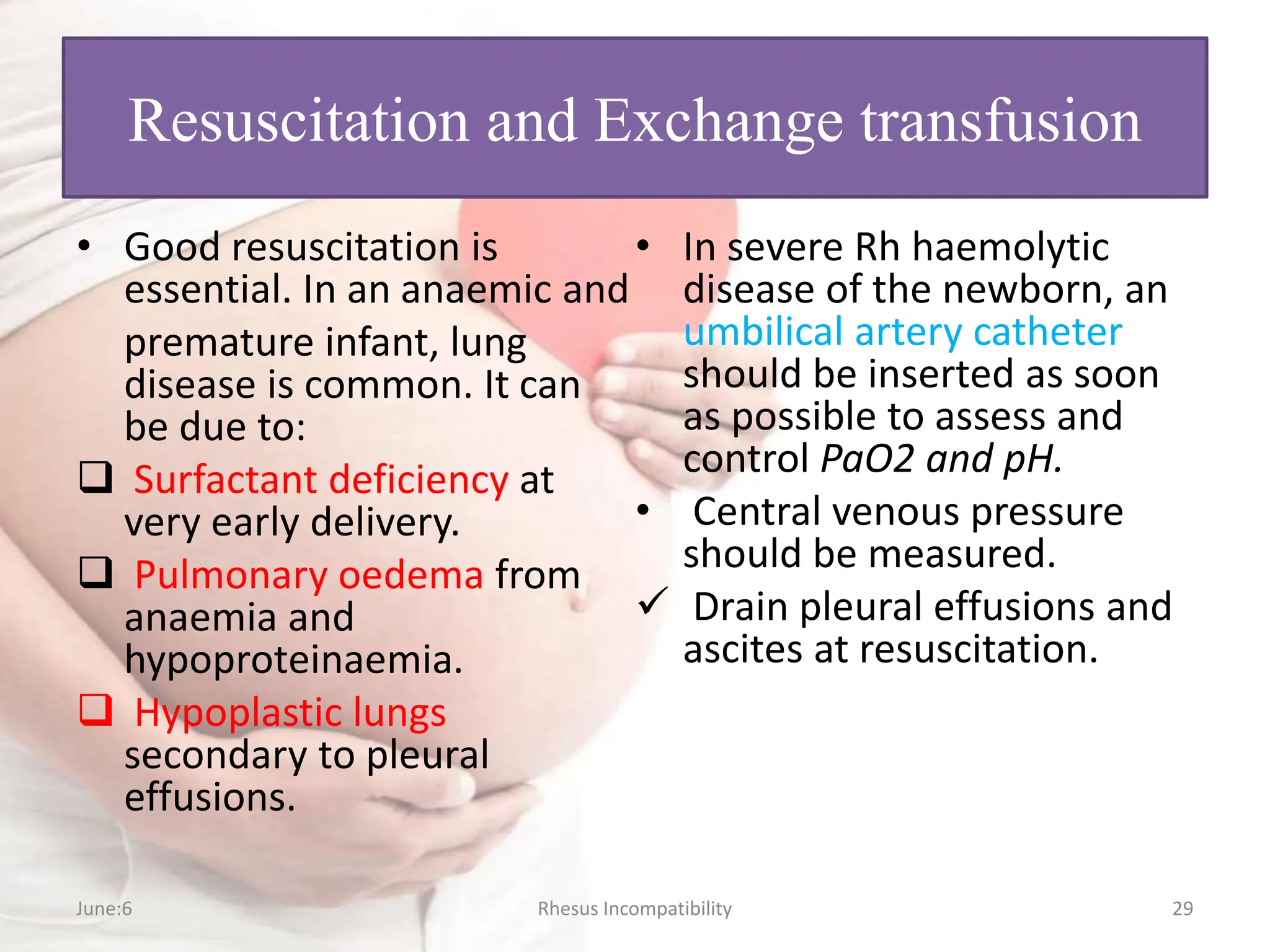
• Good resuscitation is
essential. In an anaemic and
premature infant, lung
disease is common. It can
be due to:
 Surfactant deficiency at
very early delivery.
 Pulmonary oedema from
anaemia and
hypoproteinaemia.
 Hypoplastic lungs
secondary to pleural
effusions.
• In severe Rh haemolytic
disease of the newborn, an
umbilical artery catheter
should be inserted as soon
as possible to assess and
control PaO2 and pH.
• Central venous pressure
should be measured.
 Drain pleural effusions and
ascites at resuscitation.
June:6 Rhesus Incompatibility 29
Indication for exchange
Transfusion:
1. Early: Decision mainly based
on cord haemoglobin
(in addition consider history of
previously affected babies).
• Cord haemoglobin <12g/dl.
• Strongly positive Coombs’ test.
• Dangerous level of cord
serum bilirubin which varies
according to weight of the
baby.
2. Late: Usually done for
hyperbilirubinaemia.
• The aims:
 Treat anaemia.
 Washes out IgG antibodies.
 Supply of Rh-negative cells
which will not haemolyse
 Removes bilirubin.
 Prevents kernicterus.
June:6 Rhesus Incompatibility 30
Resuscitation and Exchange transfusion
Phototherapy
• Placing newborn baby under a halogen or
fluorescent lamp with their eyes covered to avoid
retinal damage.
• Lowers the bilirubin levels in the baby’s blood
through photo-oxidation.The blue or blue green light
converts the insoluble unconjugated bilirubin into a
soluble form which is rapidly excreted in bile and
urine.
• With phototherapy, it is rarely necessary to need
exchange transfusion.
June:6 Rhesus Incompatibility 31
Prevention and Prophylaxis
• anti-D immunoglobulin to all Rh-negative women at 28
and 34 weeks routinely.
• Or give anti-D immunoglobulin
if she has a:
 Therapeutic abortion.
Spontaneous abortion/ectopic pregnancy.
 Amniocentesis.
 Any bleeding in pregnancy/threatened miscarriage.
 ECV.
 After delivery at any gestation within 72Hours.
June:6 32
Rhesus Incompatibility
Precautions after delivery
• After delivery, the cord is not milked and
immediately clamped to avoid further passage
of antibodies to the fetus.
• The cord is divided 3 inches from the
umbilicus to facilitate exchange transfusion
when needed.
June:6 33
Rhesus Incompatibility
ABO-incompatibility
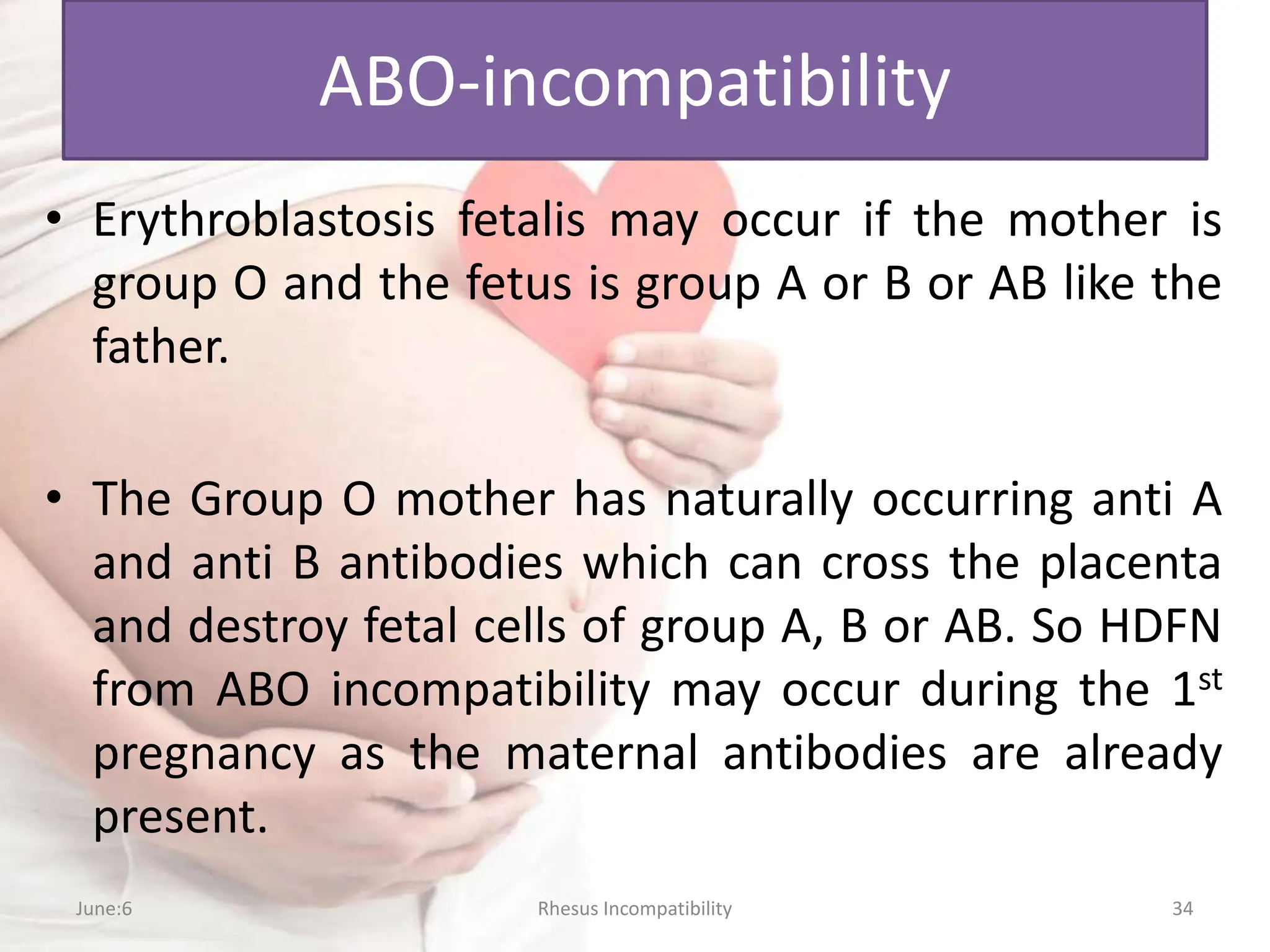
• Erythroblastosis fetalis may occur if the mother is
group O and the fetus is group A or B or AB like the
father.
• The Group O mother has naturally occurring anti A
and anti B antibodies which can cross the placenta
and destroy fetal cells of group A, B or AB. So HDFN
from ABO incompatibility may occur during the 1st
pregnancy as the maternal antibodies are already
present.
June:6 Rhesus Incompatibility 34
June:6 Rhesus Incompatibility 35

Rh Incompatibility a Gynecological disorder

  • 2.
    • A conditionthat occurs during pregnancy if a blood and her blood. Mother’s body create Rh antibodies against the baby’s blood. • Also known as haemolytic disease of the fetus and newborn (HDFN) or erythroblastosis fetalis. June:6 2 Rhesus Incompatibility
  • 3.
    INTRODUCTION: Four blood types( A, B, AB, and O) Each blood type is additionally classified according to the presence or absence of the Rh factor into Rh negative and Rh positive.
  • 4.
    Rh Incompatibility Occurs whenthere is a different Rh blood type between that of the pregnant mother (Rh negative) and that of the fetus (Rh positive)
  • 5.
    Rh Incompatibility Exposure tofetal ANTIGENS causes the mother to produce ANTIBODIES
  • 6.
    The placenta usuallyacts as a barrier to fetal blood entering the maternal circulation.
  • 7.
    Fetal cells canenter the maternal circulation through a “break” in the “placental barrier”.
  • 8.
    Maternal production ofRhesus antibodies following introduction of Rhesus positive blood
  • 9.
    Maternal production ofRhesus antibodies following introduction of Rhesus positive blood
  • 10.
    Introduction • Rh-Ags arefound on the surfaces of the RBCs may cause isoimmunization. • D-antigen, the most powerful Rh factor. If the RBCs carry the D antigen, the person is Rh positive and the reverse is correct. • Exposure of Rh-ve group to even small amounts of Rh+ve cells can result in the production of anti- D alloantibody– Rh sensitization/isoimmunization June:6 Rhesus Incompatibility 10
  • 11.
    Pathogenesis June:6 Rhesus Incompatibility11 1. Rh-ve mother carrying Rh+ve fetus 2. Entry of fetus Rh+ve RBC into maternal circulation 3. Development of Rh antibodies by the mother
  • 12.
    1. Rh-ve mothercarrying Rh+ve fetus • The chance of having Rh+ve fetus from Rh+ve father ranges from 50% (if the father is heterozygous Dd) to 100% (if the father is homozygous DD). • All offspring of the homozygous Rh-positive person will be Rh-positive. The offspring of the heterozygous Rh-positive person may be Rh-positive or negative. June:6 Rhesus Incompatibility 12
  • 13.
    2. Entry ofthe fetal Rh+ve RBC into maternal circulation • Transfusion of incompatible blood (rare) • Fetomaternal hemorrhage(through leaks in the placenta- 3rd stage):  Spontaneous/ induced abortion  Ectopic gestation  Antepartum hemorrhage: abruptio placenta, amniocentesis, abdominal trauma, external cephalic version. • Worsen fetomaternal bleeding during labour are manual removal of placenta, twin delivery and caeserian section. • Fetal RBC are detected in the maternal circulation in 6% in the 1st trimester, 15% in the 2nd trimester and 30% in the 3rd trimester. June:6 Rhesus Incompatibility 13
  • 14.
    3. Development ofRh antibodies by the mother • Initially – Ig M (big Ig can’t pass the placental barrier). • Fetomaternal bleeding in the subsequent pregnancies results in the anamenstic reaction(Ab production against Ag) producing Ig G (can pass placental barrier) • Transfer of Ig G develops hemolytic disease of the newborn and hydrops fetalis, antibodies mediated destruction of the fetal RBCs. • First neonate is usually spared but subsequent Rh +ve fetuses are affected. June:6 Rhesus Incompatibility 14
  • 15.
    Risks of Rhincompatibility effect June:6 Rhesus Incompatibility 15 Rh+ve father Rh-ve mother 1st Rh+ve baby Usually unaffected Rh+ve cells Miscarriage/ Termination of pregnancy Ectopic pregnancy Amniocentesis Antepartum haemorrhage Delivery of placenta Rhesus antibodies Pass to 2nd Rh+ve baby Hemolysis of Rh +ve cells Fetal Anemia Hydrops fetalis Intrauterine transfusion Postnatal exchange transfusion Treatment
  • 16.
    Effects on thefetus and the newborn • Hemolytic anemia • Progressive anemia which eventually leads to congestive HF and tissue hypoxia. • Hydrop fetalis- generalized edema of the fetus • Kernicterus- unconjugated bilirubin crosses the BBB(blood brain barrier) and damages the basal ganglia manifested by convulsions and paralysis • Neonatal jaundice-⬆bilirubin in infant’s June:6 16 Rhesus Incompatibility
  • 17.
    Signs in anewborn baby • Hemolytic anemia ₋ Pale, ₋ increased breathing rate, ₋ poor feeding • Jaundice ₋ Yellow sclera, palms and soles • Kernicterus ₋ Motor sensory and mental deficiencies June:6 Rhesus Incompatibility 17
  • 18.
    Investigations: • At thefirst antenatal visit, all women are screened for ABO and Rh type. • If a woman has Rh-negative blood, the paternal blood type and zygosity are determined. If the father has Rh-positive blood, maternal Rh Anti-D titres are measured at 26 to 28 weeks. • Maternal serum antibody titre is a guide to disease severity. June:6 Rhesus Incompatibility 18
  • 19.
    Investigations: • If antibodylevels rise, the baby should be examined for signs of anaemia. June:6 Rhesus Incompatibility 19 Anti-D level Outcome <4IU/mL HDFN unlikely 4-15IU/mL Moderate risk of HDFN >15IU/mL High risk of hydrops fetalis
  • 20.
    • Amniocentesis: isperformed if the anti-D titre is 4 IU/ or more. The AF is examined for bilirubin by the spectrophotometer using the Liley chart. This gives idea about the degree of haemolysis and the severity of the disease. • Ultrasound examination of the fetus at risk for Rh incompatibility may reveal subcutaneous oedema, ascites, pleural effusion, or pericardial effusion, all of which are consistent with severe fetal anaemia in an affected fetus. June:6 Rhesus Incompatibility 20 Investigations:
  • 21.
    • Cordocentesis: Bloodis obtained from the umbilical vein to determine the HB conc., Hct, blood group, direct coomb’s test and bilirubin level. This is done using a needle passed under ultrasound control. • At delivery the cord blood is examined for: ABO and Rh group, Hb %, level of bilirubin and direct Coombs test to detect the presence of antibodies on the surface of fetal RBCs. June:6 Rhesus Incompatibility 21 Investigations:
  • 22.
  • 23.
    Management of Rh-veunsensitized pregnancy • Provide anti D prophylaxis in cases with amniocentesis, APH, external cephalic version. • Following delivery determine blood group of the newborn and antibody screening. • If the newborn is Rh negative no further treatment is needed. • If antibody screen is positive monitor the newborn for haemolysis and manage next pregnancy as sensitized. • If newborn is Rh positive and antibody screen is negative, provide anti D gamma globulin within 72 hours. The usual dose is 300 micrograms but ideally should be determined by the extent of fetomaternal hemorrhage. This is done by performing Kleihauer Betke test (acid elusion test). For abortion of less than 12 weeks gestation the dose is 50 micrograms. June:6 23 Rhesus Incompatibility
  • 24.
    Management of sensitizedmother June:6 24 Rhesus Incompatibility • Measurement of antibody levels in titers at regular intervals, • Amniocentesis for bilirubin levels • Serial ultrasound for detection of hydrops and management of neonatal anemia and hyperbilirubinemia. • Therefore, referral of these women is the correct approach at health center level.
  • 25.
    Treatment • Intrauterine transfusion. •Elect time of delivery. • Maternal plasmapheresis(therapeutic intervention –extracorporeal removal ,return,exchange of blood plasma and its component). • Exchange transfusion after delivery. • Phototherapy after delivery. June:6 25 Rhesus Incompatibility
  • 26.
    Intrauterine transfusion • Thefetus can die in utero from severe anaemia and hydrops before he can be delivered. • An intrauterine transfusion can prolong the life in utero of a fetus to a gestation where the risks of prematurity are estimated as being less than those of the Rh disease. This can be done by an: 1. Intraperitoneal transfusion guided by ultrasound. 2. Umbilical vein transfusion guided by ultrasound. • Group O, Rh-negative blood is transfused under ultrasound control. June:6 Rhesus Incompatibility 26
  • 27.
    Choose time ofinduction and best method of delivery • Balance the risks of prematurity (too soon) with that of worsening Rh disease (too late). • Usually done only after 34 weeks of gestation. Before this time the fetus is too premature to survive after delivery. • The paediatric team should be in close and a senior paediatrician present at the delivery • fresh Rh-negative blood available. June:6 Rhesus Incompatibility 27
  • 28.
    Maternal plasmapheresis • Towash antibodies from maternal blood. Indicated for severe cases between 12 and 16 weeks of pregnancy when intrauterine transfusion cannot be carried out. It is costly and time consuming. June:6 Rhesus Incompatibility 28
  • 29.
    Resuscitation and Exchangetransfusion • Good resuscitation is essential. In an anaemic and premature infant, lung disease is common. It can be due to:  Surfactant deficiency at very early delivery.  Pulmonary oedema from anaemia and hypoproteinaemia.  Hypoplastic lungs secondary to pleural effusions. • In severe Rh haemolytic disease of the newborn, an umbilical artery catheter should be inserted as soon as possible to assess and control PaO2 and pH. • Central venous pressure should be measured.  Drain pleural effusions and ascites at resuscitation. June:6 Rhesus Incompatibility 29
  • 30.
    Indication for exchange Transfusion: 1.Early: Decision mainly based on cord haemoglobin (in addition consider history of previously affected babies). • Cord haemoglobin <12g/dl. • Strongly positive Coombs’ test. • Dangerous level of cord serum bilirubin which varies according to weight of the baby. 2. Late: Usually done for hyperbilirubinaemia. • The aims:  Treat anaemia.  Washes out IgG antibodies.  Supply of Rh-negative cells which will not haemolyse  Removes bilirubin.  Prevents kernicterus. June:6 Rhesus Incompatibility 30 Resuscitation and Exchange transfusion
  • 31.
    Phototherapy • Placing newbornbaby under a halogen or fluorescent lamp with their eyes covered to avoid retinal damage. • Lowers the bilirubin levels in the baby’s blood through photo-oxidation.The blue or blue green light converts the insoluble unconjugated bilirubin into a soluble form which is rapidly excreted in bile and urine. • With phototherapy, it is rarely necessary to need exchange transfusion. June:6 Rhesus Incompatibility 31
  • 32.
    Prevention and Prophylaxis •anti-D immunoglobulin to all Rh-negative women at 28 and 34 weeks routinely. • Or give anti-D immunoglobulin if she has a:  Therapeutic abortion. Spontaneous abortion/ectopic pregnancy.  Amniocentesis.  Any bleeding in pregnancy/threatened miscarriage.  ECV.  After delivery at any gestation within 72Hours. June:6 32 Rhesus Incompatibility
  • 33.
    Precautions after delivery •After delivery, the cord is not milked and immediately clamped to avoid further passage of antibodies to the fetus. • The cord is divided 3 inches from the umbilicus to facilitate exchange transfusion when needed. June:6 33 Rhesus Incompatibility
  • 34.
    ABO-incompatibility • Erythroblastosis fetalismay occur if the mother is group O and the fetus is group A or B or AB like the father. • The Group O mother has naturally occurring anti A and anti B antibodies which can cross the placenta and destroy fetal cells of group A, B or AB. So HDFN from ABO incompatibility may occur during the 1st pregnancy as the maternal antibodies are already present. June:6 Rhesus Incompatibility 34
  • 35.

Editor's Notes

  • #3 Rhesus disease gets worse with successive pregnancies.
  • #15 Anamenstic reaction: renewed rapid production of an antibody following second or later contact with the provoking antigen.
  • #33 Anti-D is given as prophylaxis and is useless once sensitization has occurred.
  • #34 Anti-D is given as prophylaxis and is useless once sensitization has occurred.