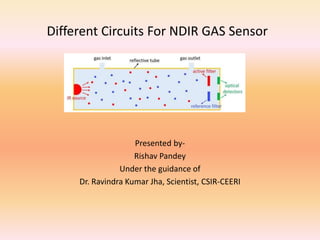
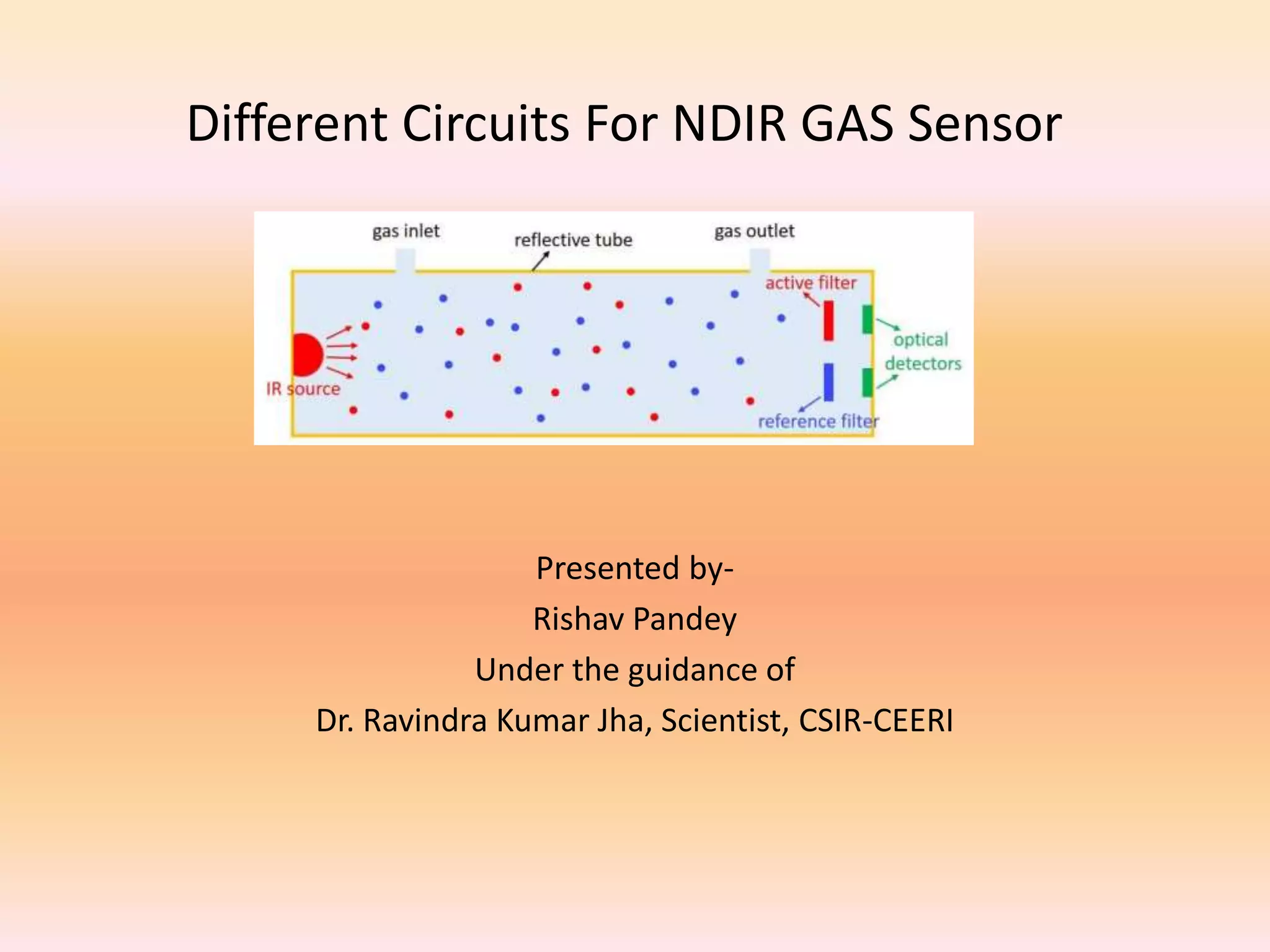
Different Circuits For NDIR GAS Sensor
Presented by-
Rishav Pandey
Under the guidance of
Dr. Ravindra Kumar Jha, Scientist, CSIR-CEERI
• In NDIR Gas Sensors, generally two main
things happen:
1. Beer-Lambert Law
2. IR-Spectroscopy
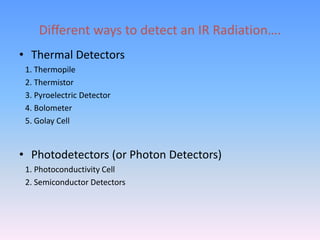
Different ways to detect an IR Radiation….
• Thermal Detectors
1. Thermopile
2. Thermistor
3. Pyroelectric Detector
4. Bolometer
5. Golay Cell
• Photodetectors (or Photon Detectors)
1. Photoconductivity Cell
2. Semiconductor Detectors
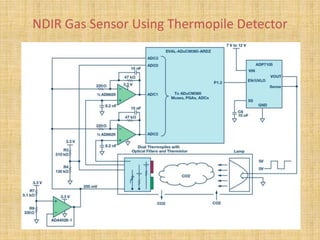
NDIR Gas Sensor Using Thermopile Detector
Cont….
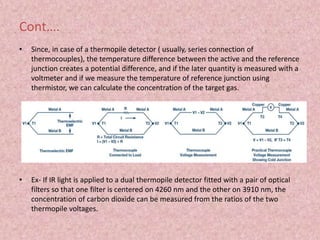
• Since, in case of a thermopile detector ( usually, series connection of
thermocouples), the temperature difference between the active and the reference
junction creates a potential difference, and if the later quantity is measured with a
voltmeter and if we measure the temperature of reference junction using
thermistor, we can calculate the concentration of the target gas.
• Ex- If IR light is applied to a dual thermopile detector fitted with a pair of optical
filters so that one filter is centered on 4260 nm and the other on 3910 nm, the
concentration of carbon dioxide can be measured from the ratios of the two
thermopile voltages.
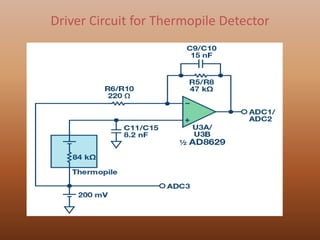
Driver Circuit for Thermopile Detector
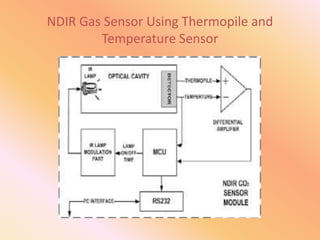
NDIR Gas Sensor Using Thermopile and
Temperature Sensor
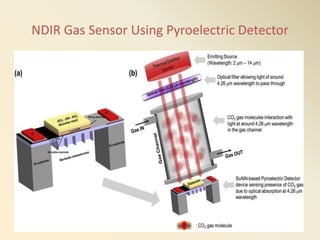
NDIR Gas Sensor Using Pyroelectric Detector
Cont….
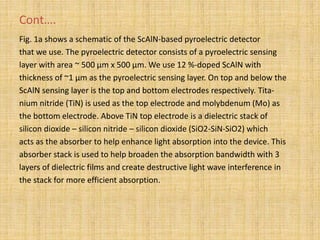
Fig. 1a shows a schematic of the ScAlN-based pyroelectric detector
that we use. The pyroelectric detector consists of a pyroelectric sensing
layer with area ~ 500 μm x 500 μm. We use 12 %-doped ScAlN with
thickness of ~1 μm as the pyroelectric sensing layer. On top and below the
ScAlN sensing layer is the top and bottom electrodes respectively. Tita-
nium nitride (TiN) is used as the top electrode and molybdenum (Mo) as
the bottom electrode. Above TiN top electrode is a dielectric stack of
silicon dioxide – silicon nitride – silicon dioxide (SiO2-SiN-SiO2) which
acts as the absorber to help enhance light absorption into the device. This
absorber stack is used to help broaden the absorption bandwidth with 3
layers of dielectric films and create destructive light wave interference in
the stack for more efficient absorption.
Cont….
• The top and bottom electrodes are connected to aluminium metal pads
which act as metal contacts for electrical connections. Below the bottom
electrode is a ~1 μm thick SiO2 layer with waffle-like structures. The SiO2
material helps to thermally isolate the thermal energy received by the
pyroelectric detector sensing layer, slowing down thermal conduction to
the medium below. In addition, the Si substrate is released from the
backside to form an air cavity area under the pyroelectric sensing region
to further reduce thermal losses as air is a poor thermal conductor. The
SiO2 ribs help to increase the mechanical stiffness of the pyroelectric
sensing region which is in membrane form.
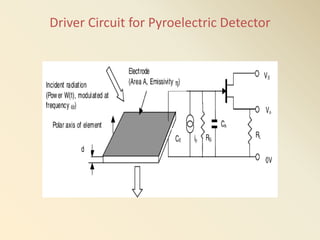
Driver Circuit for Pyroelectric Detector
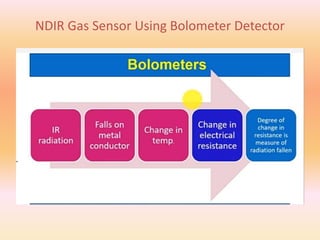
NDIR Gas Sensor Using Bolometer Detector
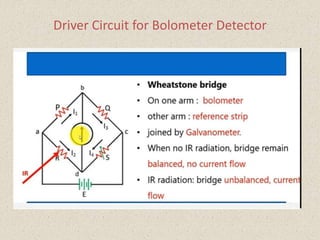
Driver Circuit for Bolometer Detector
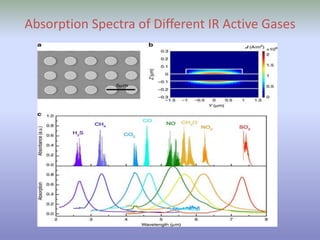
Absorption Spectra of Different IR Active Gases
References
• https://www.researchgate.net
• https://www.analog.com/
• https://www.sciencedirect.com/
• https://www.nature.com/
• https://www.semanticscholar.org/
• https://core.ac.uk/
Different circuits for ndir gas sensor

Different circuits for ndir gas sensor

  • 1.
    Different Circuits ForNDIR GAS Sensor Presented by- Rishav Pandey Under the guidance of Dr. Ravindra Kumar Jha, Scientist, CSIR-CEERI
  • 2.
    • In NDIRGas Sensors, generally two main things happen: 1. Beer-Lambert Law 2. IR-Spectroscopy
  • 3.
    Different ways todetect an IR Radiation…. • Thermal Detectors 1. Thermopile 2. Thermistor 3. Pyroelectric Detector 4. Bolometer 5. Golay Cell • Photodetectors (or Photon Detectors) 1. Photoconductivity Cell 2. Semiconductor Detectors
  • 4.
    NDIR Gas SensorUsing Thermopile Detector
  • 5.
    Cont…. • Since, incase of a thermopile detector ( usually, series connection of thermocouples), the temperature difference between the active and the reference junction creates a potential difference, and if the later quantity is measured with a voltmeter and if we measure the temperature of reference junction using thermistor, we can calculate the concentration of the target gas. • Ex- If IR light is applied to a dual thermopile detector fitted with a pair of optical filters so that one filter is centered on 4260 nm and the other on 3910 nm, the concentration of carbon dioxide can be measured from the ratios of the two thermopile voltages.
  • 6.
    Driver Circuit forThermopile Detector
  • 7.
    NDIR Gas SensorUsing Thermopile and Temperature Sensor
  • 8.
    NDIR Gas SensorUsing Pyroelectric Detector
  • 9.
    Cont…. Fig. 1a showsa schematic of the ScAlN-based pyroelectric detector that we use. The pyroelectric detector consists of a pyroelectric sensing layer with area ~ 500 μm x 500 μm. We use 12 %-doped ScAlN with thickness of ~1 μm as the pyroelectric sensing layer. On top and below the ScAlN sensing layer is the top and bottom electrodes respectively. Tita- nium nitride (TiN) is used as the top electrode and molybdenum (Mo) as the bottom electrode. Above TiN top electrode is a dielectric stack of silicon dioxide – silicon nitride – silicon dioxide (SiO2-SiN-SiO2) which acts as the absorber to help enhance light absorption into the device. This absorber stack is used to help broaden the absorption bandwidth with 3 layers of dielectric films and create destructive light wave interference in the stack for more efficient absorption.
  • 10.
    Cont…. • The topand bottom electrodes are connected to aluminium metal pads which act as metal contacts for electrical connections. Below the bottom electrode is a ~1 μm thick SiO2 layer with waffle-like structures. The SiO2 material helps to thermally isolate the thermal energy received by the pyroelectric detector sensing layer, slowing down thermal conduction to the medium below. In addition, the Si substrate is released from the backside to form an air cavity area under the pyroelectric sensing region to further reduce thermal losses as air is a poor thermal conductor. The SiO2 ribs help to increase the mechanical stiffness of the pyroelectric sensing region which is in membrane form.
  • 11.
    Driver Circuit forPyroelectric Detector
  • 12.
    NDIR Gas SensorUsing Bolometer Detector
  • 13.
    Driver Circuit forBolometer Detector
  • 14.
    Absorption Spectra ofDifferent IR Active Gases
  • 15.
    References • https://www.researchgate.net • https://www.analog.com/ •https://www.sciencedirect.com/ • https://www.nature.com/ • https://www.semanticscholar.org/ • https://core.ac.uk/