1
THERMAL DETECTORS OF
INFRA RED SPECTROPHOTOMETER
K.SAMPATH KUMAR
I/II Semester M.Pharm
(Pharmaceutical Analysis)
2
PRINCIPLE:
Thermal detectors contain a small active element on which radiation is
focused.
By blackening and insulating the element and by minimum the size of
the element, temperature change and detector response is maximized.
Temperature change is approximately inversely proportional to the
exposed surface area of the element.
As the intensity of the radiation increases the temperature change on
the element of the detector increases.
3
TYPES OF THERMAL DETECTORS:
1. Thermocouples : Thermocouple
2. Thermistors : Pyroelectric detector
3. Pneumatic devices : Golay cell.
Merits:
 Used for wide wavelength range.
 Linearity in response is seen.
Demerits:
Slow response time.
lower sensitivity.
4
Thermocouple:
5
THERMOCOUPLE:
o Two dissimilar metals like bismuth and antimony.
o Two ends are called Hot junction, Cold junction.
o The surface at the junction of the wires is coated with black metallic oxide.
o IR radiation falls on hot junction By heat source change in temperature at the
junction between the metallic wires causes an electric potential to develop
between the wires.
o The potential difference between the unjoined ends of the wires is amplified
and measured.
o Cold junction is not exposed to IR
o Response time is 60 m/sec
6
THERMISTORS:
• Thermistors are the devices that have an electric resistance that is higher
temperature dependent.
• The materials used in thermistors are sintered oxide of Cobalt, Manganese ,
Nickel.
• A constant potential is applied across the thermistor and the difference in
current flow between an illuminated thermistor and a non-illuminated
thermistor is measured using a differential operational amplifier.
• As the temperature of mixture increases, its electrical resistance decreases.
• Response time is 80 m/sec.
• It should be operate at a frequency of less than 12Hz.
7
PYROELECTRIC DETECTORS:
Pyroelectric detector contains a noncentrosymmetrical crystal, it
exhibits an internal electric field along the polar axis.
Pyroelectric effect depends on the rate of change of the detector
temperature rather than on the temperature itself.
These detectors operate with a much faster response time and makes
the choice for Fourier Transform Spectrometers where the response is
essential.
Materials used in pyroelectric detectors
i. Triglycine sulfate(TGS)
ii. Deuterated triglycine sulfate(DTGS)
iii. Lithium niobate(LiNbO3)
iv. Lithium tantalate(LiTaO ).
8
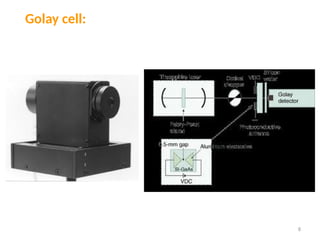
Golay cell:
9
Golay detector for far-ir
Uses light pointer from gas expansion on
heating.
GOLAY CELL
10
GOLAY CELL:
 Golay cell consists of a small metal cylindrical closed by a rigid blackened
metal plate.
Pneumatic chamber is filled with xenon gas.
At one end of cylinder a flexible silvered diaphragm and at the other end
Infra red transmitting window is present.
When infra red radiation is passed through infrared transmitting window
the blackened plate absorbs the heat. By this heat the xenon gas causes
expand
The resulting pressure of gas will cause deformation of diaphragm. This
motion of the diaphragm detects how much IR radiation falls on metal plate.
Light is made to fall on diaphragm which reflects light on photocell
11
References:
1. Instrumental methods of chemical analysis-by gurudeep, R.Chatwal, Sham
k. Anand.
2. Instrumental methods of chemical analysis-by Robert D. Braun 6th
edition
page No. 360-364.
3. www.wikipedia.com
4. Instrumental Methods Of Analysis by Willard, Merit, Dean, Settle 6th
edition Page No. 295-298.
12
Thankyou

thermaldetectorsofir-130320082217-phpapp01.pptx

  • 1.
    1 THERMAL DETECTORS OF INFRARED SPECTROPHOTOMETER K.SAMPATH KUMAR I/II Semester M.Pharm (Pharmaceutical Analysis)
  • 2.
    2 PRINCIPLE: Thermal detectors containa small active element on which radiation is focused. By blackening and insulating the element and by minimum the size of the element, temperature change and detector response is maximized. Temperature change is approximately inversely proportional to the exposed surface area of the element. As the intensity of the radiation increases the temperature change on the element of the detector increases.
  • 3.
    3 TYPES OF THERMALDETECTORS: 1. Thermocouples : Thermocouple 2. Thermistors : Pyroelectric detector 3. Pneumatic devices : Golay cell. Merits:  Used for wide wavelength range.  Linearity in response is seen. Demerits: Slow response time. lower sensitivity.
  • 4.
  • 5.
    5 THERMOCOUPLE: o Two dissimilarmetals like bismuth and antimony. o Two ends are called Hot junction, Cold junction. o The surface at the junction of the wires is coated with black metallic oxide. o IR radiation falls on hot junction By heat source change in temperature at the junction between the metallic wires causes an electric potential to develop between the wires. o The potential difference between the unjoined ends of the wires is amplified and measured. o Cold junction is not exposed to IR o Response time is 60 m/sec
  • 6.
    6 THERMISTORS: • Thermistors arethe devices that have an electric resistance that is higher temperature dependent. • The materials used in thermistors are sintered oxide of Cobalt, Manganese , Nickel. • A constant potential is applied across the thermistor and the difference in current flow between an illuminated thermistor and a non-illuminated thermistor is measured using a differential operational amplifier. • As the temperature of mixture increases, its electrical resistance decreases. • Response time is 80 m/sec. • It should be operate at a frequency of less than 12Hz.
  • 7.
    7 PYROELECTRIC DETECTORS: Pyroelectric detectorcontains a noncentrosymmetrical crystal, it exhibits an internal electric field along the polar axis. Pyroelectric effect depends on the rate of change of the detector temperature rather than on the temperature itself. These detectors operate with a much faster response time and makes the choice for Fourier Transform Spectrometers where the response is essential. Materials used in pyroelectric detectors i. Triglycine sulfate(TGS) ii. Deuterated triglycine sulfate(DTGS) iii. Lithium niobate(LiNbO3) iv. Lithium tantalate(LiTaO ).
  • 8.
  • 9.
    9 Golay detector forfar-ir Uses light pointer from gas expansion on heating. GOLAY CELL
  • 10.
    10 GOLAY CELL:  Golaycell consists of a small metal cylindrical closed by a rigid blackened metal plate. Pneumatic chamber is filled with xenon gas. At one end of cylinder a flexible silvered diaphragm and at the other end Infra red transmitting window is present. When infra red radiation is passed through infrared transmitting window the blackened plate absorbs the heat. By this heat the xenon gas causes expand The resulting pressure of gas will cause deformation of diaphragm. This motion of the diaphragm detects how much IR radiation falls on metal plate. Light is made to fall on diaphragm which reflects light on photocell
  • 11.
    11 References: 1. Instrumental methodsof chemical analysis-by gurudeep, R.Chatwal, Sham k. Anand. 2. Instrumental methods of chemical analysis-by Robert D. Braun 6th edition page No. 360-364. 3. www.wikipedia.com 4. Instrumental Methods Of Analysis by Willard, Merit, Dean, Settle 6th edition Page No. 295-298.
  • 12.

Editor's Notes