A
SEMINAR ON
STANDARD DEVIATION
DR. R.K RAO(PRINCIPAL) PRESENTED BY :
GUIDED BY NIKITA
SHEETAL GUPTA M.Sc. 2ND SEM
Assitant Proffessor. BIOTECHNOLOGY
G.D .RUNGTA GROUP OF SCIENCE AND TECHNLOGY
KOHKA- BHILAI
SYNOPSIS
 INTRODUCTION
 DEFINITION
 METHOD OF CALCULATING STANDARD DEVIATION
o STANDARD DEVIATION IN INDIVIDUAL SERIES
o STANDARD DEVIATION IN DISCRETE SERIES
o STANDARD DEVIATION IN GROUPED SERIES
 CO –EFFICIENT OF STANDARD DEVIATION
 MERITS OF STANDARD DEVIATION
 DEMERITS IN STANDARD DEVIATION
 USES OF STANDARD DEVIATION
 CONCLUSION
 REFERENCE
INTRODUCTION:
The measure of dispersion known as measure the scatteredness of the values that is how
are the data spread about an average values.
There are two methods of measuring dispersion
1. Methods of limits
Range
Inter – quartile range
Percentile range
2. Methods of averaging deviation
Quartile
Mean deviation
Standard deviation
DEFINITION:
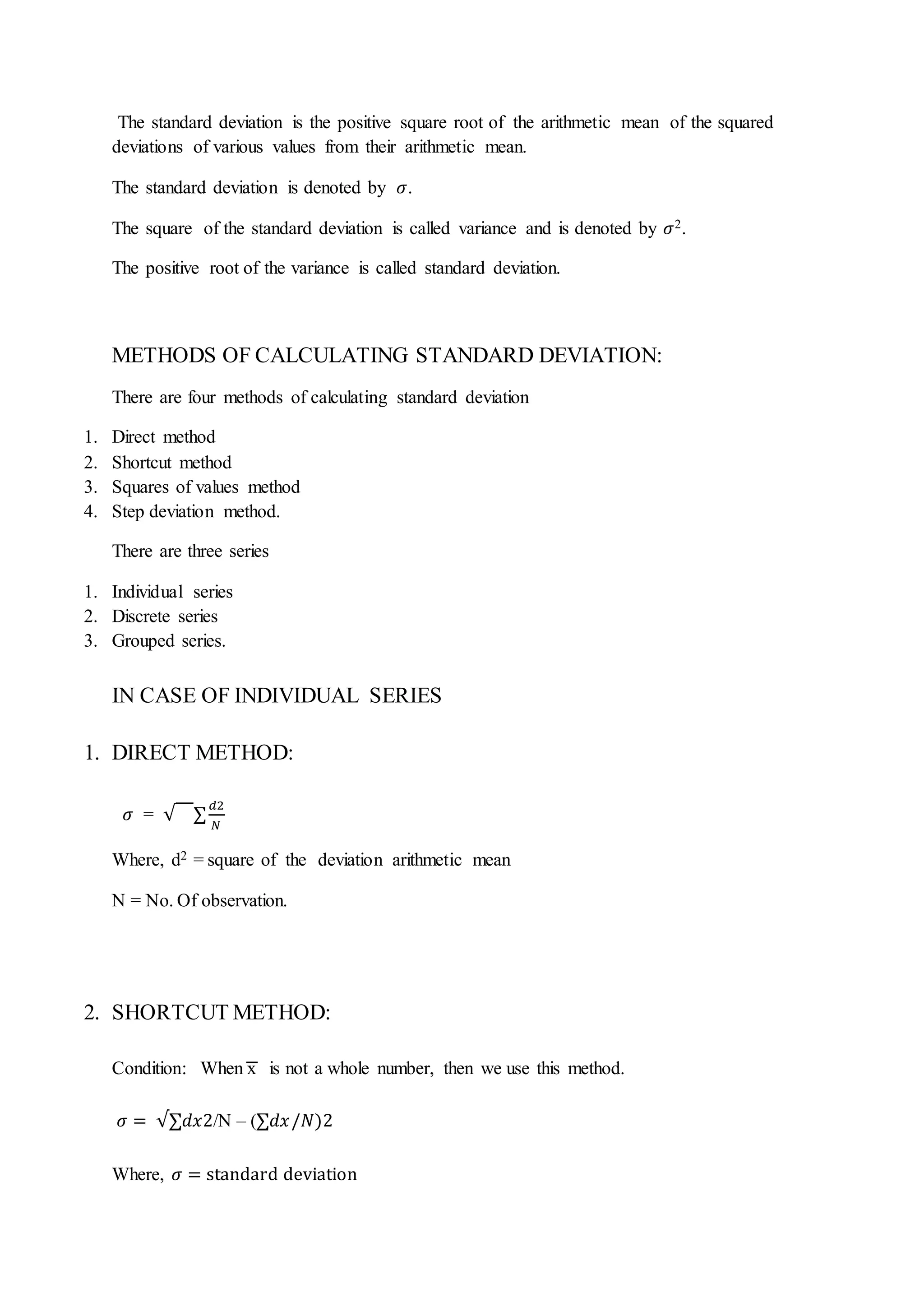
The standard deviation is the positive square root of the arithmetic mean of the squared
deviations of various values from their arithmetic mean.
The standard deviation is denoted by 𝜎.
The square of the standard deviation is called variance and is denoted by 𝜎2.
The positive root of the variance is called standard deviation.
METHODS OF CALCULATING STANDARD DEVIATION:
There are four methods of calculating standard deviation
1. Direct method
2. Shortcut method
3. Squares of values method
4. Step deviation method.
There are three series
1. Individual series
2. Discrete series
3. Grouped series.
IN CASE OF INDIVIDUAL SERIES
1. DIRECT METHOD:
𝜎 = √ ∑
𝑑2
𝑁
Where, d2 = square of the deviation arithmetic mean
N = No. Of observation.
2. SHORTCUT METHOD:
Condition: When x is not a whole number, then we use this method.
𝜎 = √∑𝑑𝑥2/N – (∑𝑑𝑥/𝑁)2
Where, 𝜎 = standard deviation
dx = deviation from assumed mean (A)
dx2 = square of X-A
N = No. Of terms
A = Assumed mean.
3. SQUARE OF VALUES METHOD:
𝜎 = √∑X2/N-[∑𝑋/𝑁]2
For example: find the standard deviation of the following.
Standard deviation
σ = √∑x2/N – (∑x/N)2
=√ 1918910- (35710)2
= √1918.9- 1274.49
= √644.41
= 25.4
IN CASE OF DISCRETE SERIES
1.DIRECT METHOD :
𝜎 = √ ∑
𝑓𝑑2
𝑁
Where, N = ∑f = total no. Of observation
X X2
59 3481
48 2304
65 4225
57 3249
31 961
60 3600
37 1369
∑X=357 ∑X2=
19189
∑fd2 = sum of product of frequency and square of deviations from arithmetic mean.
2.SHORT-CUT METHOD:
𝜎 = √∑𝑓𝑑𝑥2/N – (∑𝑓𝑑𝑥/𝑁)2
Where, A =assumed mean
dx = (X- A)
N = ∑f = Total frequency
3.SQUARE OF VALUES METHOD:
σ = √∑fX2/N – (∑fX/N)2
IN CASE OF GROUPED SERIES
1. DIRECT METHOD
σ = √∑f(X - X )2
or
σ = √∑fd2 /∑f
Where , f = frequency
2. SHORTCUT METHOD:
σ = √∑fdx2/N – (∑fdx/N)2
where, N = no. of observation.
f = frequency
3. STEP DEVIATION METHOD :
σ = √∑fds2/N – (∑fds/N)2 × i
where , i = common factor
ds = step deviation
N = no. Of observation
CO- EFFICIENT OF STANDARD DEVIATION:
To compare the dispersion between two or more series.
It is denoted by σ ⁄ X
In general σ / X × 100 is also known as coefficient of variation.
According to karl pearson , ‘coefficient of variation is the percentage variation in the
mean, the standard deviation being as the total variation in mean.
MERITS OF STANDARD DEVIATION :
1.Standard deviation is rigidly defined.
2.It is based in all observation .
3. It is not much affected by sampling fluctuation.
4.It is capable of further algebraic treatment .
5.It has a definite relationship with others measures of dispersion.
DEMERITS OF STANDARD DEVIATION.
1.It is difficult to calculate .
2.It gives greater weight to extreme values.
3.Its impossible to find it exactly in case of open end classes .
USES OF STANDARD DEVIATION.
1. It is widely used in statistics values.
2. It is used to measure the greater stability.
3. Standard deviation plays a greater role in sampling theory , co relation and
regression theory etc.
4. It is powerful measure of dispersion as ,mean is of central tendency.
CONCLUSION .
 It is an improvement of mean deviation.
 Statistical programmes widely use standard deviation for calculation
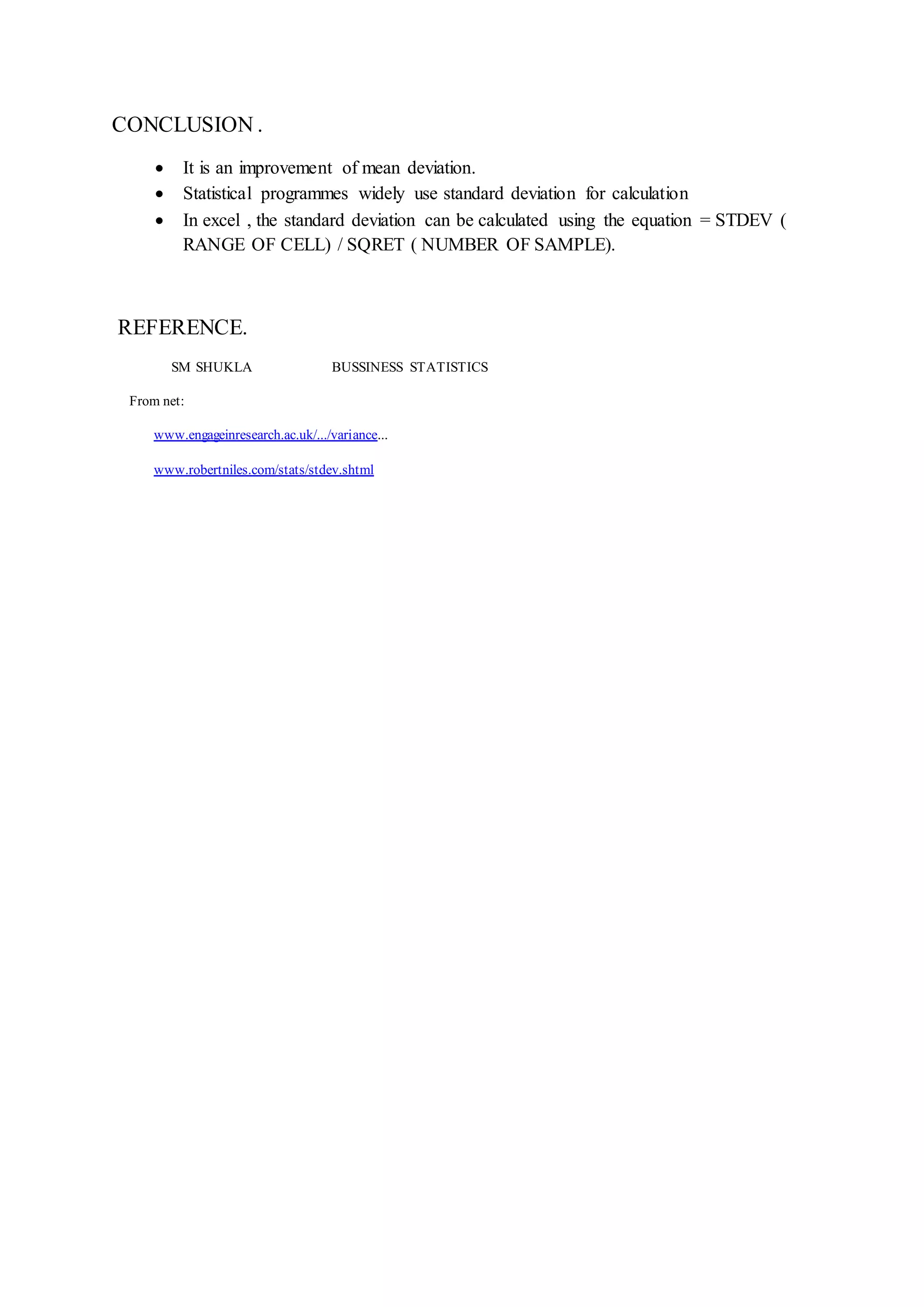
 In excel , the standard deviation can be calculated using the equation = STDEV (
RANGE OF CELL) / SQRET ( NUMBER OF SAMPLE).
REFERENCE.
SM SHUKLA BUSSINESS STATISTICS
From net:
www.engageinresearch.ac.uk/.../variance...
www.robertniles.com/stats/stdev.shtml

Standard deviation by nikita

  • 1.
    A SEMINAR ON STANDARD DEVIATION DR.R.K RAO(PRINCIPAL) PRESENTED BY : GUIDED BY NIKITA SHEETAL GUPTA M.Sc. 2ND SEM Assitant Proffessor. BIOTECHNOLOGY G.D .RUNGTA GROUP OF SCIENCE AND TECHNLOGY KOHKA- BHILAI
  • 2.
    SYNOPSIS  INTRODUCTION  DEFINITION METHOD OF CALCULATING STANDARD DEVIATION o STANDARD DEVIATION IN INDIVIDUAL SERIES o STANDARD DEVIATION IN DISCRETE SERIES o STANDARD DEVIATION IN GROUPED SERIES  CO –EFFICIENT OF STANDARD DEVIATION  MERITS OF STANDARD DEVIATION  DEMERITS IN STANDARD DEVIATION  USES OF STANDARD DEVIATION  CONCLUSION  REFERENCE INTRODUCTION: The measure of dispersion known as measure the scatteredness of the values that is how are the data spread about an average values. There are two methods of measuring dispersion 1. Methods of limits Range Inter – quartile range Percentile range 2. Methods of averaging deviation Quartile Mean deviation Standard deviation DEFINITION:
  • 3.
    The standard deviationis the positive square root of the arithmetic mean of the squared deviations of various values from their arithmetic mean. The standard deviation is denoted by 𝜎. The square of the standard deviation is called variance and is denoted by 𝜎2. The positive root of the variance is called standard deviation. METHODS OF CALCULATING STANDARD DEVIATION: There are four methods of calculating standard deviation 1. Direct method 2. Shortcut method 3. Squares of values method 4. Step deviation method. There are three series 1. Individual series 2. Discrete series 3. Grouped series. IN CASE OF INDIVIDUAL SERIES 1. DIRECT METHOD: 𝜎 = √ ∑ 𝑑2 𝑁 Where, d2 = square of the deviation arithmetic mean N = No. Of observation. 2. SHORTCUT METHOD: Condition: When x is not a whole number, then we use this method. 𝜎 = √∑𝑑𝑥2/N – (∑𝑑𝑥/𝑁)2 Where, 𝜎 = standard deviation
  • 4.
    dx = deviationfrom assumed mean (A) dx2 = square of X-A N = No. Of terms A = Assumed mean. 3. SQUARE OF VALUES METHOD: 𝜎 = √∑X2/N-[∑𝑋/𝑁]2 For example: find the standard deviation of the following. Standard deviation σ = √∑x2/N – (∑x/N)2 =√ 1918910- (35710)2 = √1918.9- 1274.49 = √644.41 = 25.4 IN CASE OF DISCRETE SERIES 1.DIRECT METHOD : 𝜎 = √ ∑ 𝑓𝑑2 𝑁 Where, N = ∑f = total no. Of observation X X2 59 3481 48 2304 65 4225 57 3249 31 961 60 3600 37 1369 ∑X=357 ∑X2= 19189
  • 5.
    ∑fd2 = sumof product of frequency and square of deviations from arithmetic mean. 2.SHORT-CUT METHOD: 𝜎 = √∑𝑓𝑑𝑥2/N – (∑𝑓𝑑𝑥/𝑁)2 Where, A =assumed mean dx = (X- A) N = ∑f = Total frequency 3.SQUARE OF VALUES METHOD: σ = √∑fX2/N – (∑fX/N)2 IN CASE OF GROUPED SERIES 1. DIRECT METHOD σ = √∑f(X - X )2 or σ = √∑fd2 /∑f Where , f = frequency 2. SHORTCUT METHOD: σ = √∑fdx2/N – (∑fdx/N)2 where, N = no. of observation. f = frequency 3. STEP DEVIATION METHOD : σ = √∑fds2/N – (∑fds/N)2 × i
  • 6.
    where , i= common factor ds = step deviation N = no. Of observation CO- EFFICIENT OF STANDARD DEVIATION: To compare the dispersion between two or more series. It is denoted by σ ⁄ X In general σ / X × 100 is also known as coefficient of variation. According to karl pearson , ‘coefficient of variation is the percentage variation in the mean, the standard deviation being as the total variation in mean. MERITS OF STANDARD DEVIATION : 1.Standard deviation is rigidly defined. 2.It is based in all observation . 3. It is not much affected by sampling fluctuation. 4.It is capable of further algebraic treatment . 5.It has a definite relationship with others measures of dispersion. DEMERITS OF STANDARD DEVIATION. 1.It is difficult to calculate . 2.It gives greater weight to extreme values. 3.Its impossible to find it exactly in case of open end classes . USES OF STANDARD DEVIATION. 1. It is widely used in statistics values. 2. It is used to measure the greater stability. 3. Standard deviation plays a greater role in sampling theory , co relation and regression theory etc. 4. It is powerful measure of dispersion as ,mean is of central tendency.
  • 7.
    CONCLUSION .  Itis an improvement of mean deviation.  Statistical programmes widely use standard deviation for calculation  In excel , the standard deviation can be calculated using the equation = STDEV ( RANGE OF CELL) / SQRET ( NUMBER OF SAMPLE). REFERENCE. SM SHUKLA BUSSINESS STATISTICS From net: www.engageinresearch.ac.uk/.../variance... www.robertniles.com/stats/stdev.shtml