
Insect ecological succession
Introduction
The new habitat are brought about by as a
results of phenomena's such as tectonic
activity, glacial movement, sea level changes,
sediments deposition or erosion.
1st insect species to colonize the new
environment are typically small in stature,
tolerant to exposure and able to exploit non-
organic or exogenous resources.
 What is ecology?
 This is the process by which a plant or animal community successively gives way to
another until a stable climax is reached or achieved. (correct)
 What is ecological succession?
 This is the process of community development on disturbed or newly exposed
sites.
What is insect ecological succession
This can be defined as the natural, gradual change in
the type of species that live in that given area.
Its can also be defined as the process of insect
community development on disturbed or newly
exposed sites.
This can also be defined as the gradual replacement
of one insect community by another through natural
process over time.
This can be either primary or secondary.
Patterns of succession
There are two types of succession
namely:
Primary succession
Secondary succession
Primary succession
Occurs on newly exposed substrate e.g. lava
flow, uplifted marine deposits, dunes newly
deposited, exposed beaches etc.
Primary succession typically involves a long
period of soil formation and colonization by
species requiring little substrate modification.
Primary succession occur were their has never
been insect species ever.
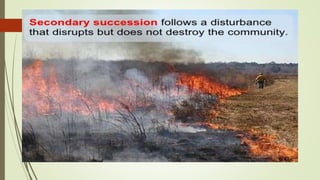
Secondary succession
Occur on sites where the previous
community was disturbed, and is
influenced by remnant substrate and
surviving individuals.
Secondary succession occur were once
their were insect species.
Factors affecting ecological succession
 Insect ecological Succession can progress along various alternative pathways
and reach alternative end-points depending on a variety of local abiotic and
biotic factors.
 These factors include :
 substrate conditions
 Composition of initial colonist and survivors from previous community.
 Sequence of disturbance during succession
 Granivores and herbivores species present
 Predators present
Substrate conditions
These affect the ability of organism to settle,
become established and derive necessary
resources.
Some substrates restrict species representation
e.g. serpentine soils, gypsum dunes and lava
flows.
Few species are able to tolerate such unique
substrate conditions or the exposure that results
from limited vegetative cover.
Composition of initial colonist and
survivors from previous community
The initial colonist of a site represent regional species pools and
their composition can vary depending on proximity to population
sources.
A site is more likely to be colonized by abundant species that by
rare species.
E.g. wood initially colonized by decay fungi such as those
inoculated by wood boring beetles, wasps and termites, decay
more rapidly, thereby affecting subsequent colonization than
does wood initially colonized by mold fungi, such as those
inoculated by bark and ambrosia beetles (Kaarik 1974 et al.200)
Sequence of disturbance during
succession
This plays a major role in determining the
composition of successive species assemblages.
E.g. Fire followed by drought would filter the
community though fire-tolerance sieve, then a
drought-tolerant sieve whereas flooding
followed by fire would produce a different
sequence of communities.
Granivores and herbivores species present
Granivores and herbivores tend to eat
largest seeds and plants respectively
which most often represent later
succession of plant species thus in turn
reducing the plant population which is a
primary food source in an ecosystem.
Predators present
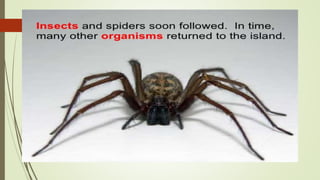
 Hodkinson et al.(2001) observed that spiders often are the earliest colonizers of
glacial moraine or other newly exposed habitats.
 Spider web trap living and dead prey and other organic debris.
 Spider webs are composed of structural proteins and may distribute nitrogen
over the surface.in additional webs may physically stabilize he surface and
increase surface moisture through condensation from the atmosphere.
 These effects of spider may facilitate development of cyanobacterial crust and
early successional vegetation
Models of succession
 Clement (1916) noted that the comparison of successional stages is less useful
than is an understanding of the process that affect the transition from one sere to
another.
 He proposed the Facilitation model which viewed
communities as an entity that showed progressive (facilitated) development
similar to the ontogeny of insect individual organism.
 According to this model also called relay floristics (Egler 1954) successive stage
cause progressive changes in environmental conditions that facilitate their
replacement by the subsequent stage and later successional species cannot
appear until sufficient environmental modification by earlier stages has occurred.
Example
The increasing porosity and altered nutrient
content of decomposing wood, resulting from
heterotroph activity, precludes further
recruitment of early successional species e.g. bark
beetles and anaerobic or microaerophilic
microorganisms and facilitates replacement by
later successional wood borers and more aerobic
microorganisms e.g. Edmonds and Eglitis 1989,
Tolerance model
 Eglar (1954) argued that secondary succession often may reflect the differential
longevity of colonizing species. Most of the eventual dominants colonize
relatively early, while competition is still low. Failure of species to become
established at this early stage reduces the probability of their future dominance.
 Juveniles of later species grow to maturity over a longer period, tolerating the
early dominance of ruderal species and eventually exclude the early successional
species.
End !

Insect ecological succession

  • 1.
  • 2.
    Introduction The new habitatare brought about by as a results of phenomena's such as tectonic activity, glacial movement, sea level changes, sediments deposition or erosion. 1st insect species to colonize the new environment are typically small in stature, tolerant to exposure and able to exploit non- organic or exogenous resources.
  • 3.
     What isecology?  This is the process by which a plant or animal community successively gives way to another until a stable climax is reached or achieved. (correct)  What is ecological succession?  This is the process of community development on disturbed or newly exposed sites.
  • 4.
    What is insectecological succession This can be defined as the natural, gradual change in the type of species that live in that given area. Its can also be defined as the process of insect community development on disturbed or newly exposed sites. This can also be defined as the gradual replacement of one insect community by another through natural process over time. This can be either primary or secondary.
  • 5.
    Patterns of succession Thereare two types of succession namely: Primary succession Secondary succession
  • 6.
    Primary succession Occurs onnewly exposed substrate e.g. lava flow, uplifted marine deposits, dunes newly deposited, exposed beaches etc. Primary succession typically involves a long period of soil formation and colonization by species requiring little substrate modification. Primary succession occur were their has never been insect species ever.
  • 13.
    Secondary succession Occur onsites where the previous community was disturbed, and is influenced by remnant substrate and surviving individuals. Secondary succession occur were once their were insect species.
  • 15.
    Factors affecting ecologicalsuccession  Insect ecological Succession can progress along various alternative pathways and reach alternative end-points depending on a variety of local abiotic and biotic factors.  These factors include :  substrate conditions  Composition of initial colonist and survivors from previous community.  Sequence of disturbance during succession  Granivores and herbivores species present  Predators present
  • 16.
    Substrate conditions These affectthe ability of organism to settle, become established and derive necessary resources. Some substrates restrict species representation e.g. serpentine soils, gypsum dunes and lava flows. Few species are able to tolerate such unique substrate conditions or the exposure that results from limited vegetative cover.
  • 17.
    Composition of initialcolonist and survivors from previous community The initial colonist of a site represent regional species pools and their composition can vary depending on proximity to population sources. A site is more likely to be colonized by abundant species that by rare species. E.g. wood initially colonized by decay fungi such as those inoculated by wood boring beetles, wasps and termites, decay more rapidly, thereby affecting subsequent colonization than does wood initially colonized by mold fungi, such as those inoculated by bark and ambrosia beetles (Kaarik 1974 et al.200)
  • 18.
    Sequence of disturbanceduring succession This plays a major role in determining the composition of successive species assemblages. E.g. Fire followed by drought would filter the community though fire-tolerance sieve, then a drought-tolerant sieve whereas flooding followed by fire would produce a different sequence of communities.
  • 19.
    Granivores and herbivoresspecies present Granivores and herbivores tend to eat largest seeds and plants respectively which most often represent later succession of plant species thus in turn reducing the plant population which is a primary food source in an ecosystem.
  • 20.
    Predators present  Hodkinsonet al.(2001) observed that spiders often are the earliest colonizers of glacial moraine or other newly exposed habitats.  Spider web trap living and dead prey and other organic debris.  Spider webs are composed of structural proteins and may distribute nitrogen over the surface.in additional webs may physically stabilize he surface and increase surface moisture through condensation from the atmosphere.  These effects of spider may facilitate development of cyanobacterial crust and early successional vegetation
  • 21.
    Models of succession Clement (1916) noted that the comparison of successional stages is less useful than is an understanding of the process that affect the transition from one sere to another.  He proposed the Facilitation model which viewed communities as an entity that showed progressive (facilitated) development similar to the ontogeny of insect individual organism.  According to this model also called relay floristics (Egler 1954) successive stage cause progressive changes in environmental conditions that facilitate their replacement by the subsequent stage and later successional species cannot appear until sufficient environmental modification by earlier stages has occurred.
  • 22.
    Example The increasing porosityand altered nutrient content of decomposing wood, resulting from heterotroph activity, precludes further recruitment of early successional species e.g. bark beetles and anaerobic or microaerophilic microorganisms and facilitates replacement by later successional wood borers and more aerobic microorganisms e.g. Edmonds and Eglitis 1989,
  • 23.
    Tolerance model  Eglar(1954) argued that secondary succession often may reflect the differential longevity of colonizing species. Most of the eventual dominants colonize relatively early, while competition is still low. Failure of species to become established at this early stage reduces the probability of their future dominance.  Juveniles of later species grow to maturity over a longer period, tolerating the early dominance of ruderal species and eventually exclude the early successional species.
  • 24.