SS.PRAVEEN JOSHI
2022505017
Red flour beetle- Tribolium castaneum {Tenebrionidae
Coleoptera}
 Its is one among the bran bugs which damages Broken
grains/ mechanically damaged grains, germ portion
and milled products.
 It feeds on cereals, flour, starchy material, fruit nuts,
millets and prepared cereal foods. It usually feed on broken
grains and results in dust formation.
 Worst pest of mill machinery
 Also important pest in commercial Corcyra production
units
 COSMOPOLITION , origin is believed to be south Asia
Biology of RFB
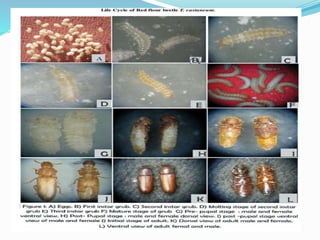
 Egg : Freshly laid eggs were very small, whitish,
cylindrical microscopic and often have bits of flour
stuck to their surface and harden, making them
difficult to see. The incubation period ranged from 4
to 7 days.
Grub : Elateriform with urogomphi and minute hairs all
over the body. 30 to 40 days { 6 instars}
pupa: Exarate type .5-9 days 8 { male 6-7 days and
female 7-9 days}
iology
Adult
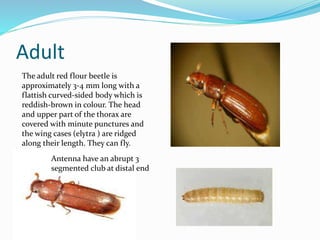
The adult red flour beetle is
approximately 3-4 mm long with a
flattish curved-sided body which is
reddish-brown in colour. The head
and upper part of the thorax are
covered with minute punctures and
the wing cases (elytra ) are ridged
along their length. They can fly.
Antenna have an abrupt 3
segmented club at distal end
Damage symptoms
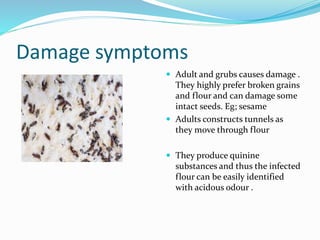
 Adult and grubs causes damage .
They highly prefer broken grains
and flour and can damage some
intact seeds. Eg; sesame
 Adults constructs tunnels as
they move through flour
 They produce quinine
substances and thus the infected
flour can be easily identified
with acidous odour .
Gaseous quinines
 They produced compounds like
2-ethyl-1,4 benzoquinone
2-methyl 1,4 benzoquinone
2 methoxy 1,4 benzoquinone
These compounds on inhaling continously causes
several respiratory problems like bronchitis skin
irritation , redness of eyes and when consumed causes
abdominal pain, burning sensation.
{International Iabour Organization}
Flour conditioning and cannibalism
in RFB
 As the beetles startes to feed , nutrition quality of flour
reduces, flour is now filled with feacal matter ,
quinone derivatives ,and exuvia . This process is called
flour conditioning.
RFB exhibits cannibalism , active stage feeds on inactive
stages
Effect of flour conditioning and
cannibalism {Earlier findings}
Flour conditioning is a result of depletion of nutrients and
the build up of waste materials, pheromones, and ethylquinone, which is a repellent
produced by the beetles (Sonleitner 1961)
Sonleitner (1961) showed that egg cannibalism in adult T. castaneum increased in
conditioned flour compared with fresh flour.
Cannibalism is directly proportional to flour conditioning
Later findings
 Adult male - cannibalism level was low
 Grub – cannibalism increased slightly as flour conditioning
increased
 Female : cannibalism is inversely proportional to flour
conditioning
 Since females didn’t prefer to dig the conditioned flour and
quinines acts as repellent to females
 To conclude
Conditioned flour acts as a ovipositional deterrent and protected
existing beetle from unwanted visitors
Females prefer to lay eggs on fresh flour
Reference
RED FLOUR BEETLE joshi.pptx

RED FLOUR BEETLE joshi.pptx

  • 1.
  • 2.
    Red flour beetle-Tribolium castaneum {Tenebrionidae Coleoptera}  Its is one among the bran bugs which damages Broken grains/ mechanically damaged grains, germ portion and milled products.  It feeds on cereals, flour, starchy material, fruit nuts, millets and prepared cereal foods. It usually feed on broken grains and results in dust formation.  Worst pest of mill machinery  Also important pest in commercial Corcyra production units  COSMOPOLITION , origin is believed to be south Asia
  • 3.
    Biology of RFB Egg : Freshly laid eggs were very small, whitish, cylindrical microscopic and often have bits of flour stuck to their surface and harden, making them difficult to see. The incubation period ranged from 4 to 7 days. Grub : Elateriform with urogomphi and minute hairs all over the body. 30 to 40 days { 6 instars} pupa: Exarate type .5-9 days 8 { male 6-7 days and female 7-9 days}
  • 4.
  • 5.
    Adult The adult redflour beetle is approximately 3-4 mm long with a flattish curved-sided body which is reddish-brown in colour. The head and upper part of the thorax are covered with minute punctures and the wing cases (elytra ) are ridged along their length. They can fly. Antenna have an abrupt 3 segmented club at distal end
  • 6.
    Damage symptoms  Adultand grubs causes damage . They highly prefer broken grains and flour and can damage some intact seeds. Eg; sesame  Adults constructs tunnels as they move through flour  They produce quinine substances and thus the infected flour can be easily identified with acidous odour .
  • 7.
    Gaseous quinines  Theyproduced compounds like 2-ethyl-1,4 benzoquinone 2-methyl 1,4 benzoquinone 2 methoxy 1,4 benzoquinone These compounds on inhaling continously causes several respiratory problems like bronchitis skin irritation , redness of eyes and when consumed causes abdominal pain, burning sensation. {International Iabour Organization}
  • 8.
    Flour conditioning andcannibalism in RFB  As the beetles startes to feed , nutrition quality of flour reduces, flour is now filled with feacal matter , quinone derivatives ,and exuvia . This process is called flour conditioning. RFB exhibits cannibalism , active stage feeds on inactive stages
  • 9.
    Effect of flourconditioning and cannibalism {Earlier findings} Flour conditioning is a result of depletion of nutrients and the build up of waste materials, pheromones, and ethylquinone, which is a repellent produced by the beetles (Sonleitner 1961) Sonleitner (1961) showed that egg cannibalism in adult T. castaneum increased in conditioned flour compared with fresh flour. Cannibalism is directly proportional to flour conditioning
  • 10.
    Later findings  Adultmale - cannibalism level was low  Grub – cannibalism increased slightly as flour conditioning increased  Female : cannibalism is inversely proportional to flour conditioning  Since females didn’t prefer to dig the conditioned flour and quinines acts as repellent to females  To conclude Conditioned flour acts as a ovipositional deterrent and protected existing beetle from unwanted visitors Females prefer to lay eggs on fresh flour
  • 11.