Hepatotoxicity What is it? Dr. B. K. Iyer
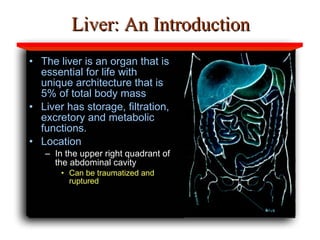
Liver: An Introduction The liver is an organ that is essential for life with  unique architecture that is 5% of total body mass  Liver has storage, filtration, excretory and metabolic functions.  Location In the upper right quadrant of the abdominal cavity Can be traumatized and ruptured
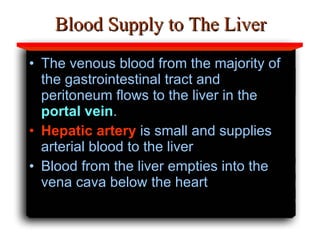
Blood Supply to The Liver The venous blood from the majority of the gastrointestinal tract and peritoneum flows to the liver in the  portal vein .  Hepatic artery  is small and supplies arterial blood to the liver Blood from the liver empties into the vena cava below the heart
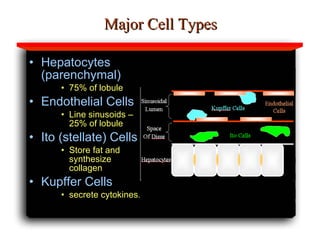
Major Cell Types Hepatocytes (parenchymal) 75% of lobule  Endothelial Cells Line sinusoids – 25% of lobule  Ito (stellate) Cells Store fat and synthesize collagen Kupffer Cells secrete cytokines .
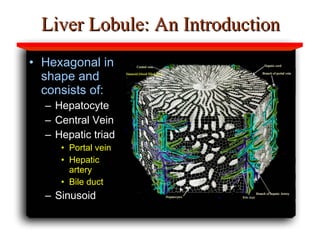
Liver Lobule: An Introduction Hexagonal in shape and consists of: Hepatocyte Central Vein Hepatic triad Portal vein Hepatic artery Bile duct Sinusoid
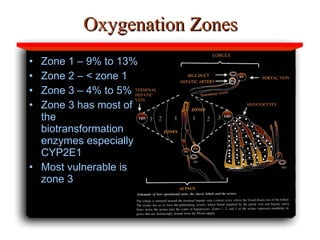
Oxygenation Zones Zone 1 – 9% to 13% Zone 2 – < zone 1  Zone 3 – 4% to 5% Zone 3 has most of the biotransformation enzymes especially CYP2E1 Most vulnerable is zone 3
Hepatotoxicity: What is it? Hepatotoxicity is the effect of harmful, or poisonous or toxic substances on the liver. The toxicity mechanisms & manifestations can be of various types and are uusually not due to any one cause  but result from a succession of   unlikely events, a &quot;multihit&quot; process.
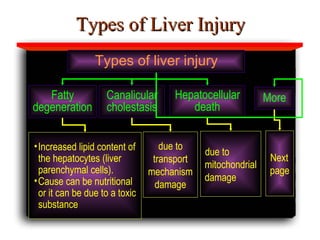
Types of Liver Injury Fatty degeneration Canalicular cholestasis Hepatocellular death More Increased lipid content of the hepatocytes (liver parenchymal cells).  Cause can be nutritional or it can be due to a toxic substance due to transport mechanism damage due to mitochondrial damage Next page Types of liver injury
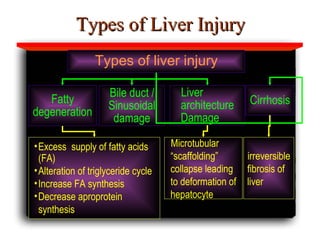
Types of Liver Injury Fatty degeneration Bile duct / Sinusoidal damage Liver architecture Damage Cirrhosis Excess  supply of fatty acids (FA) Alteration of triglyceride cycle  Increase FA synthesis  Decrease aproprotein synthesis Microtubular “scaffolding” collapse leading to deformation of hepatocyte irreversible fibrosis of liver Types of liver injury
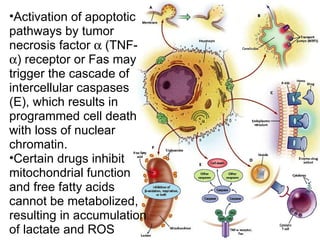
Activation of apoptotic pathways by tumor necrosis factor    (TNF-  ) receptor or Fas may trigger the cascade of intercellular caspases (E), which results in programmed cell death with loss of nuclear chromatin.  Certain drugs inhibit mitochondrial function and free fatty acids cannot be metabolized, resulting in accumulation of lactate and ROS
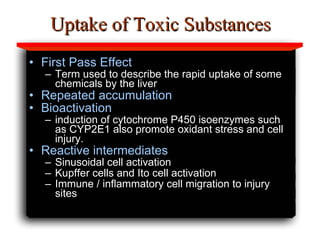
Uptake of Toxic Substances First Pass Effect Term used to describe the rapid uptake of some chemicals by the liver Repeated accumulation Bioactivation induction of cytochrome P450 isoenzymes such   as CYP2E1 also promote oxidant stress and cell injury.   Reactive intermediates Sinusoidal cell activation Kupffer cells and Ito cell activation Immune / inflammatory cell migration to injury sites
Uptake of Toxic Substances Many hepatocellular reactions are biotransformation processes  This can result in the formation of new, nonfunctioning adducts   — that is, drugs covalently bound to enzymes.
Uptake of Toxic Substances Adducts   that are large enough to serve as immune targets may migrate   to the surface of the hepatocyte, where they can: induce the   formation of antibodies (antibody-mediated cytotoxicity) or   induce direct cytolytic T-cell responses.  The secondary cytokine response thus evoked may cause   inflammation and additional neutrophil-mediated hepatotoxicity.
Defining DIH due to anti-TB drugs DIH is defined as normalization of liver function after withdrawal of all anti-TB drugs, and the presence of at least 1 of the following criteria:  A rise of 5 times the upper limit of normal levels (50 IU/L) of serum aspartate aminotransferase (AST) and/or alanine aminotransferase (ALT);  A rise in the level of serum total bilirubin > 1.5 mg/dl Any increase in AST and/or ALT above pretreatment levels together with anorexia, nausea, vomiting, and jaundice;  Absence of serologic evidence of infection with hepatitis virus A, B, C, or E.
Incidence of DIH Patients with extensive pulmonary tuberculosis develop DIH more commonly (38.8 %) than cases with minimal pulmonary disease  10-20% of adult patients on INH develop elevation of serum ALT and AST from 1-3 times the normal level during the first 2 months of therapy.  Typically normalizes within 3-6 weeks after discontinuing the drug.
DIH: Fatality rates About 10% of patients who develop mild transaminase elevations (1-2% of all adults treated) progress to severe hepatitis and liver failure unless the drug is discontinued.  fatality rate = approx. 10%
Risks for DIH Higher risk of hepatotoxicity to the first-line antitubercular agents [DIH] has been reported in Indian patients; Risk of DIH is 4 times in alcohol drinkers than non-drinkers; INH hepatotoxicity is more common in females than males; Other risk factors include pre-existing liver disease,   and advanced   TB.
Risks for DIH HCV and HIV infection also play an important role in the development of anti-TB medication   DIH . A recent study in Hong Kong showed that among patients treated with anti-TB drugs, the incidences of liver dysfunction and symptomatic hepatitis were rather high among Hepatitis B carriers compared with non-carriers.
Risks for DIH A genetic association   of human leukocyte antigen (HLA)-DR2 with pulmonary TB   in various populations is now established A genetic influence associated with the MHC class II region is also known to play an important role in the development of DIH
RIF and DIH RIF does not commonly   cause drug-induced hepatitis, although it might synergistically   increase the risk of INH-induced hepatitis. Rifampicin does not exacerbate INH-induced hepatotoxicity in short term, due to down-regulation of CYP2E1. While the most common presentation of INH hepatotoxicity is hepatocellular damage, patients occasionally may present with true drug hypersensitivity characterized by skin rash, fever, and eosinophilia.
PZA and DIH In India,there   does not appear to be a significant increase in hepatotoxicity   when PZA is added to INH and RIF   But, incidence of PZA-induced hepatotoxicity   and rash during treatment for active TB is higher than   previously recognized in countries other than India.
INH and DIH Most of the INH is acetylated and then further hydrolyzed to isonicotinic acid and acetylhydrazine. This INH metabolism produces reactive metabolites that bind to and damage cellular macromolecules.  The induction of CYP2E1 by hydrazine is involved in the hepatotoxicity of INH.  Diversion of INH metabolism to an alternate (eg, cytochrome P-450–mediated) pathway that occurs when given along with rifampicin may theoretically produce a toxic metabolite.
Signs / Symptoms of DIH Constitutional symptoms include fatigue, anorexia, nausea, myalgia and arthralgia and are there before the clinical symptoms of Weakness malaise and  jaundice  Nausea and vomiting Symptoms may also include right upper quadrant tenderness and gastrointestinal distress, dark urine, light-colored stools, bleeding diathesis, pruritus, confusion, and coma.
High risk cases for DIH Patients at high risk of developing DIH should be identified at the beginning of the treatment course & then monitored regularly. LFT should therefore be checked in such patients before the start of anti-TB treatment to monitor the progress of the potential DIH.  Thereafter, in such patients, it would be desirable to monitor LFT once every 2 weeks during initial 2 months of therapy, or more often as clinically indicated during checkup.
High risk cases for DIH High risk patients who are severely affected may remain asymptomatic until potentially lethal liver damage has occurred.  Thus, in patients at higher risk, the risk of death cannot be avoided by monitoring patient symptoms clinically but requires prospective monitoring of serum transaminase levels
Diagnosis of DIH due to anti-TB drugs Hepatotoxicity due to antitubercular agents [DIH] is revealed by clinical examination and  abnormal liver function test results  During periodic consultations in the course of anti-TB therapy, all pts. must be monitored clinically for S/S suggestive of DIH.  Routine laboratory monitoring for DIH is not recommended in all but in high-risk cas es, where it  must be performed monthly in the initial phase.
Criteria of DIH Temporary changes in alanine transaminase and bilirubin levels are relatively common during anti-TB therapy and do not signify true hepatotoxicity.  Progressive rise in alanine transaminase and bilirubin levels are suggestive.
Criteria of DIH For the alanine transaminase level, some recommend stopping the hepatotoxic drugs 3 times or above that of normal, while others recommend 5 times.  Removal of the medications resulting in normalization or at least a 50% improvement of the abnormal liver chemistries.
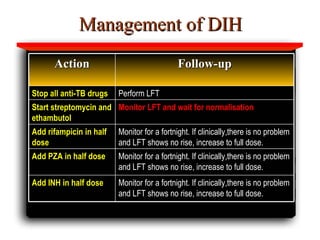
Management of DIH Monitor for a fortnight. If clinically,there is no problem and LFT shows no rise, increase to full dose. Add INH in half dose Monitor for a fortnight. If clinically,there is no problem and LFT shows no rise, increase to full dose. Add PZA in half dose Monitor for a fortnight. If clinically,there is no problem and LFT shows no rise, increase to full dose. Add rifampicin in half dose Monitor LFT and wait for normalisation Start streptomycin and ethambutol Perform LFT Stop all anti-TB drugs Follow-up Action
Thank you!

Hepatotoxicity

  • 1.
    Hepatotoxicity What isit? Dr. B. K. Iyer
  • 2.
    Liver: An IntroductionThe liver is an organ that is essential for life with unique architecture that is 5% of total body mass Liver has storage, filtration, excretory and metabolic functions. Location In the upper right quadrant of the abdominal cavity Can be traumatized and ruptured
  • 3.
    Blood Supply toThe Liver The venous blood from the majority of the gastrointestinal tract and peritoneum flows to the liver in the portal vein . Hepatic artery is small and supplies arterial blood to the liver Blood from the liver empties into the vena cava below the heart
  • 4.
    Major Cell TypesHepatocytes (parenchymal) 75% of lobule Endothelial Cells Line sinusoids – 25% of lobule Ito (stellate) Cells Store fat and synthesize collagen Kupffer Cells secrete cytokines .
  • 5.
    Liver Lobule: AnIntroduction Hexagonal in shape and consists of: Hepatocyte Central Vein Hepatic triad Portal vein Hepatic artery Bile duct Sinusoid
  • 6.
    Oxygenation Zones Zone1 – 9% to 13% Zone 2 – < zone 1 Zone 3 – 4% to 5% Zone 3 has most of the biotransformation enzymes especially CYP2E1 Most vulnerable is zone 3
  • 7.
    Hepatotoxicity: What isit? Hepatotoxicity is the effect of harmful, or poisonous or toxic substances on the liver. The toxicity mechanisms & manifestations can be of various types and are uusually not due to any one cause but result from a succession of unlikely events, a &quot;multihit&quot; process.
  • 8.
    Types of LiverInjury Fatty degeneration Canalicular cholestasis Hepatocellular death More Increased lipid content of the hepatocytes (liver parenchymal cells). Cause can be nutritional or it can be due to a toxic substance due to transport mechanism damage due to mitochondrial damage Next page Types of liver injury
  • 9.
    Types of LiverInjury Fatty degeneration Bile duct / Sinusoidal damage Liver architecture Damage Cirrhosis Excess supply of fatty acids (FA) Alteration of triglyceride cycle Increase FA synthesis Decrease aproprotein synthesis Microtubular “scaffolding” collapse leading to deformation of hepatocyte irreversible fibrosis of liver Types of liver injury
  • 10.
    Activation of apoptoticpathways by tumor necrosis factor  (TNF-  ) receptor or Fas may trigger the cascade of intercellular caspases (E), which results in programmed cell death with loss of nuclear chromatin. Certain drugs inhibit mitochondrial function and free fatty acids cannot be metabolized, resulting in accumulation of lactate and ROS
  • 11.
    Uptake of ToxicSubstances First Pass Effect Term used to describe the rapid uptake of some chemicals by the liver Repeated accumulation Bioactivation induction of cytochrome P450 isoenzymes such as CYP2E1 also promote oxidant stress and cell injury. Reactive intermediates Sinusoidal cell activation Kupffer cells and Ito cell activation Immune / inflammatory cell migration to injury sites
  • 12.
    Uptake of ToxicSubstances Many hepatocellular reactions are biotransformation processes This can result in the formation of new, nonfunctioning adducts — that is, drugs covalently bound to enzymes.
  • 13.
    Uptake of ToxicSubstances Adducts that are large enough to serve as immune targets may migrate to the surface of the hepatocyte, where they can: induce the formation of antibodies (antibody-mediated cytotoxicity) or induce direct cytolytic T-cell responses. The secondary cytokine response thus evoked may cause inflammation and additional neutrophil-mediated hepatotoxicity.
  • 14.
    Defining DIH dueto anti-TB drugs DIH is defined as normalization of liver function after withdrawal of all anti-TB drugs, and the presence of at least 1 of the following criteria: A rise of 5 times the upper limit of normal levels (50 IU/L) of serum aspartate aminotransferase (AST) and/or alanine aminotransferase (ALT); A rise in the level of serum total bilirubin > 1.5 mg/dl Any increase in AST and/or ALT above pretreatment levels together with anorexia, nausea, vomiting, and jaundice; Absence of serologic evidence of infection with hepatitis virus A, B, C, or E.
  • 15.
    Incidence of DIHPatients with extensive pulmonary tuberculosis develop DIH more commonly (38.8 %) than cases with minimal pulmonary disease 10-20% of adult patients on INH develop elevation of serum ALT and AST from 1-3 times the normal level during the first 2 months of therapy. Typically normalizes within 3-6 weeks after discontinuing the drug.
  • 16.
    DIH: Fatality ratesAbout 10% of patients who develop mild transaminase elevations (1-2% of all adults treated) progress to severe hepatitis and liver failure unless the drug is discontinued. fatality rate = approx. 10%
  • 17.
    Risks for DIHHigher risk of hepatotoxicity to the first-line antitubercular agents [DIH] has been reported in Indian patients; Risk of DIH is 4 times in alcohol drinkers than non-drinkers; INH hepatotoxicity is more common in females than males; Other risk factors include pre-existing liver disease, and advanced TB.
  • 18.
    Risks for DIHHCV and HIV infection also play an important role in the development of anti-TB medication DIH . A recent study in Hong Kong showed that among patients treated with anti-TB drugs, the incidences of liver dysfunction and symptomatic hepatitis were rather high among Hepatitis B carriers compared with non-carriers.
  • 19.
    Risks for DIHA genetic association of human leukocyte antigen (HLA)-DR2 with pulmonary TB in various populations is now established A genetic influence associated with the MHC class II region is also known to play an important role in the development of DIH
  • 20.
    RIF and DIHRIF does not commonly cause drug-induced hepatitis, although it might synergistically increase the risk of INH-induced hepatitis. Rifampicin does not exacerbate INH-induced hepatotoxicity in short term, due to down-regulation of CYP2E1. While the most common presentation of INH hepatotoxicity is hepatocellular damage, patients occasionally may present with true drug hypersensitivity characterized by skin rash, fever, and eosinophilia.
  • 21.
    PZA and DIHIn India,there does not appear to be a significant increase in hepatotoxicity when PZA is added to INH and RIF But, incidence of PZA-induced hepatotoxicity and rash during treatment for active TB is higher than previously recognized in countries other than India.
  • 22.
    INH and DIHMost of the INH is acetylated and then further hydrolyzed to isonicotinic acid and acetylhydrazine. This INH metabolism produces reactive metabolites that bind to and damage cellular macromolecules. The induction of CYP2E1 by hydrazine is involved in the hepatotoxicity of INH. Diversion of INH metabolism to an alternate (eg, cytochrome P-450–mediated) pathway that occurs when given along with rifampicin may theoretically produce a toxic metabolite.
  • 23.
    Signs / Symptomsof DIH Constitutional symptoms include fatigue, anorexia, nausea, myalgia and arthralgia and are there before the clinical symptoms of Weakness malaise and jaundice Nausea and vomiting Symptoms may also include right upper quadrant tenderness and gastrointestinal distress, dark urine, light-colored stools, bleeding diathesis, pruritus, confusion, and coma.
  • 24.
    High risk casesfor DIH Patients at high risk of developing DIH should be identified at the beginning of the treatment course & then monitored regularly. LFT should therefore be checked in such patients before the start of anti-TB treatment to monitor the progress of the potential DIH. Thereafter, in such patients, it would be desirable to monitor LFT once every 2 weeks during initial 2 months of therapy, or more often as clinically indicated during checkup.
  • 25.
    High risk casesfor DIH High risk patients who are severely affected may remain asymptomatic until potentially lethal liver damage has occurred. Thus, in patients at higher risk, the risk of death cannot be avoided by monitoring patient symptoms clinically but requires prospective monitoring of serum transaminase levels
  • 26.
    Diagnosis of DIHdue to anti-TB drugs Hepatotoxicity due to antitubercular agents [DIH] is revealed by clinical examination and abnormal liver function test results During periodic consultations in the course of anti-TB therapy, all pts. must be monitored clinically for S/S suggestive of DIH. Routine laboratory monitoring for DIH is not recommended in all but in high-risk cas es, where it must be performed monthly in the initial phase.
  • 27.
    Criteria of DIHTemporary changes in alanine transaminase and bilirubin levels are relatively common during anti-TB therapy and do not signify true hepatotoxicity. Progressive rise in alanine transaminase and bilirubin levels are suggestive.
  • 28.
    Criteria of DIHFor the alanine transaminase level, some recommend stopping the hepatotoxic drugs 3 times or above that of normal, while others recommend 5 times. Removal of the medications resulting in normalization or at least a 50% improvement of the abnormal liver chemistries.
  • 29.
    Management of DIHMonitor for a fortnight. If clinically,there is no problem and LFT shows no rise, increase to full dose. Add INH in half dose Monitor for a fortnight. If clinically,there is no problem and LFT shows no rise, increase to full dose. Add PZA in half dose Monitor for a fortnight. If clinically,there is no problem and LFT shows no rise, increase to full dose. Add rifampicin in half dose Monitor LFT and wait for normalisation Start streptomycin and ethambutol Perform LFT Stop all anti-TB drugs Follow-up Action
  • 30.

Editor's Notes

  • #16 These organisms can take advantage of the “opportunity” provided by the defective or weakened immune system that results from HIV/AIDS. The resulting illnesses are usually more severe in HIV/ AIDS patients than in people with normal immune systems. When a person is first found to be HIV positive, immunizations are given to help decrease the number of opportunistic infections. These immunizations include: Pneumovax Influenza vaccine Hepatitis B vaccine Tetanus-diphtheria
  • #17 This graph shows the direct correlation between the lowering of the CD4 count and the acquisition of opportunistic infections.
  • #18 These organisms can take advantage of the “opportunity” provided by the defective or weakened immune system that results from HIV/AIDS. The resulting illnesses are usually more severe in HIV/ AIDS patients than in people with normal immune systems. When a person is first found to be HIV positive, immunizations are given to help decrease the number of opportunistic infections. These immunizations include: Pneumovax Influenza vaccine Hepatitis B vaccine Tetanus-diphtheria
  • #19 These organisms can take advantage of the “opportunity” provided by the defective or weakened immune system that results from HIV/AIDS. The resulting illnesses are usually more severe in HIV/ AIDS patients than in people with normal immune systems. When a person is first found to be HIV positive, immunizations are given to help decrease the number of opportunistic infections. These immunizations include: Pneumovax Influenza vaccine Hepatitis B vaccine Tetanus-diphtheria
  • #20 These organisms can take advantage of the “opportunity” provided by the defective or weakened immune system that results from HIV/AIDS. The resulting illnesses are usually more severe in HIV/ AIDS patients than in people with normal immune systems. When a person is first found to be HIV positive, immunizations are given to help decrease the number of opportunistic infections. These immunizations include: Pneumovax Influenza vaccine Hepatitis B vaccine Tetanus-diphtheria
  • #22 These organisms can take advantage of the “opportunity” provided by the defective or weakened immune system that results from HIV/AIDS. The resulting illnesses are usually more severe in HIV/ AIDS patients than in people with normal immune systems. When a person is first found to be HIV positive, immunizations are given to help decrease the number of opportunistic infections. These immunizations include: Pneumovax Influenza vaccine Hepatitis B vaccine Tetanus-diphtheria
  • #24 These organisms can take advantage of the “opportunity” provided by the defective or weakened immune system that results from HIV/AIDS. The resulting illnesses are usually more severe in HIV/ AIDS patients than in people with normal immune systems. When a person is first found to be HIV positive, immunizations are given to help decrease the number of opportunistic infections. These immunizations include: Pneumovax Influenza vaccine Hepatitis B vaccine Tetanus-diphtheria
  • #25 These organisms can take advantage of the “opportunity” provided by the defective or weakened immune system that results from HIV/AIDS. The resulting illnesses are usually more severe in HIV/ AIDS patients than in people with normal immune systems. When a person is first found to be HIV positive, immunizations are given to help decrease the number of opportunistic infections. These immunizations include: Pneumovax Influenza vaccine Hepatitis B vaccine Tetanus-diphtheria
  • #26 These organisms can take advantage of the “opportunity” provided by the defective or weakened immune system that results from HIV/AIDS. The resulting illnesses are usually more severe in HIV/ AIDS patients than in people with normal immune systems. When a person is first found to be HIV positive, immunizations are given to help decrease the number of opportunistic infections. These immunizations include: Pneumovax Influenza vaccine Hepatitis B vaccine Tetanus-diphtheria
  • #27 These organisms can take advantage of the “opportunity” provided by the defective or weakened immune system that results from HIV/AIDS. The resulting illnesses are usually more severe in HIV/ AIDS patients than in people with normal immune systems. When a person is first found to be HIV positive, immunizations are given to help decrease the number of opportunistic infections. These immunizations include: Pneumovax Influenza vaccine Hepatitis B vaccine Tetanus-diphtheria
  • #28 These organisms can take advantage of the “opportunity” provided by the defective or weakened immune system that results from HIV/AIDS. The resulting illnesses are usually more severe in HIV/ AIDS patients than in people with normal immune systems. When a person is first found to be HIV positive, immunizations are given to help decrease the number of opportunistic infections. These immunizations include: Pneumovax Influenza vaccine Hepatitis B vaccine Tetanus-diphtheria
  • #29 These organisms can take advantage of the “opportunity” provided by the defective or weakened immune system that results from HIV/AIDS. The resulting illnesses are usually more severe in HIV/ AIDS patients than in people with normal immune systems. When a person is first found to be HIV positive, immunizations are given to help decrease the number of opportunistic infections. These immunizations include: Pneumovax Influenza vaccine Hepatitis B vaccine Tetanus-diphtheria
  • #30 This graph shows the direct correlation between the lowering of the CD4 count and the acquisition of opportunistic infections.