The document discusses various legal procedures in forensic or legal medicine in India. It describes different types of inquests like coroner's inquest, police inquest, and magistrate's inquest which are investigations into unnatural deaths. It also discusses courts like Supreme Court, High Courts, and Session Courts that deal with criminal cases. The Medical Examiner system prevalent in the US is described as the most superior form of investigation in cases of unnatural deaths.
Introduction to the concept of legal medicine and its relevance.
Defines forensic medicine, focusing on its role in legal justice through medical knowledge.
Explains medical jurisprudence and legal responsibilities of physicians, including medical ethics.
Discusses principles of medical ethics and conventional courtesy in the medical profession.
General overview of legal procedures, inquests, and their components.
Defines inquest, types (Coroner's, Police, Magistrate), and names involved in inquiries.
Describes instances necessitating Magistrate's inquest and rights involved.
Introduction to the Medical Examiner's system prevalent in the USA and its significance.
Discusses legal codes defining offenses, including the terminology used in inquests.
Examines various inquest types such as Police and Coroner’s inquest and applicable legal frameworks. Overview of different courts in India, including their jurisdictions and sentencing powers.
Details the procedure of court proceedings, including types of evidence and witness handling.
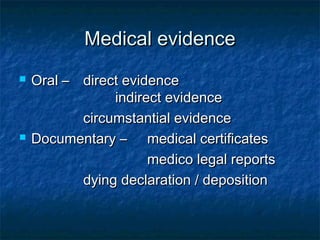
Examines types of witnesses and evidence types including oral and documentary evidence.
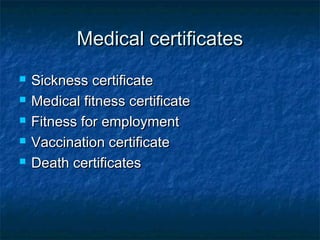
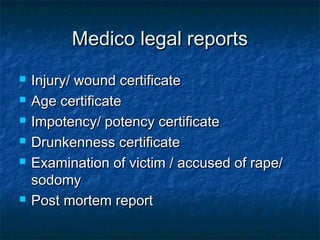
Types of medical certificates used as legal evidence, including medico-legal reports.
Defines primary, secondary, and hearsay evidence, emphasizing their roles in court.
Details the importance and legal standing of dying declarations as evidence.
Discusses the role of a witness in court, oaths taken, and legal consequences of perjury.
Current practices in recording evidence during trials, including examination procedures.
Explains common legal terms and concepts relevant to legal proceedings and criminal law.
Final thank you slide, concluding the presentation.
Forensic or LegalMedicineForensic or Legal Medicine
Forensic or Legal Medicine( forensic = of or used in courts of law)
deals with the application of medical knowledge to aid in the
administration of justice. It is used by the legal authorities for the
solution of legal problems. Some examples: are applying the medical
knowledge in deciding cases of injuries, asphyxial deaths, sexual
offences, infant deaths, poisoning, etc. In short it deals with the
medical aspects of law.
3.
Medical Jurisprudence.Medical Jurisprudence.
MedicalJurisprudence ( Juris = law; prudentia = knowledge).Deals
with legal responsibilities of the physician with particular reference
to those arising from physician – patient relationship such as,
medical negligence cases, consent, rights and duties of doctors,
infamous conduct, medical ethics etc. In short it deals with legal
aspects of the practice of medicine.
4.
Medical EthicsMedical Ethics
Medicalethics deals with the normal principles which should guide
members of the medical profession in their dealings with each other,
their patients and the state.
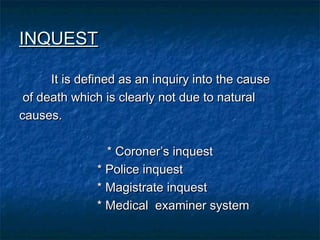
INQUESTINQUEST
It is definedas an inquiry into the causeIt is defined as an inquiry into the cause
of death which is clearly not due to naturalof death which is clearly not due to natural
causes.causes.
* Coroner’s inquest* Coroner’s inquest
* Police inquest* Police inquest
* Magistrate inquest* Magistrate inquest
* Medical examiner system* Medical examiner system
9.
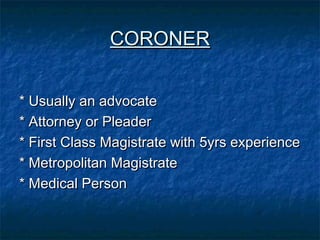
CORONERCORONER
* Usually anadvocate* Usually an advocate
* Attorney or Pleader* Attorney or Pleader
* First Class Magistrate with 5yrs experience* First Class Magistrate with 5yrs experience
* Metropolitan Magistrate* Metropolitan Magistrate
* Medical Person* Medical Person
10.
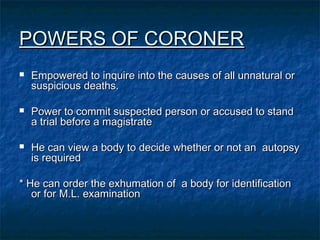
POWERS OF CORONERPOWERSOF CORONER
Empowered to inquire into the causes of all unnatural orEmpowered to inquire into the causes of all unnatural or
suspicious deaths.suspicious deaths.
Power to commit suspected person or accused to standPower to commit suspected person or accused to stand
a trial before a magistratea trial before a magistrate
He can view a body to decide whether or not an autopsyHe can view a body to decide whether or not an autopsy
is requiredis required
* He can order the exhumation of a body for identification* He can order the exhumation of a body for identification
or for M.L. examinationor for M.L. examination
11.
* He isauthorized to order any qualified R.M.P.* He is authorized to order any qualified R.M.P.
to do postmortem examination and summon himto do postmortem examination and summon him
as an expert witness to his court.as an expert witness to his court.
He can grant conduct moneyHe can grant conduct money
* He is empowered to appoint an in-charge* He is empowered to appoint an in-charge
coroner during his absence.coroner during his absence.
12.
CORONER’S COURT :CORONER’SCOURT :
** Court of inquiry into the causes of unnaturalCourt of inquiry into the causes of unnatural
deathsdeaths
* Presence of suspected or accused not* Presence of suspected or accused not
necessarynecessary
* It has no power to impose fines or* It has no power to impose fines or
sentence.sentence.
13.
Circumstances where Coroner’sCircumstanceswhere Coroner’s
Inquest is heldInquest is held
* Sudden death* Sudden death
* Murder, infanticide or suicide* Murder, infanticide or suicide
* Death by accident or poison* Death by accident or poison
* Death due to mishap by machinery* Death due to mishap by machinery
* Death occurring during operation or under* Death occurring during operation or under
anesthesiaanesthesia
* Deaths occurring in prison, police custody,* Deaths occurring in prison, police custody,
asylum, Brostal school etc.asylum, Brostal school etc.
14.
Police InquestPolice Inquest::
Inquiry should be held by police in all unnaturalInquiry should be held by police in all unnatural
or suspicious death.or suspicious death.
Not below the rank of head constableNot below the rank of head constable
The Police officer making the preliminary inquiryThe Police officer making the preliminary inquiry
is called the “ Investigating officer”is called the “ Investigating officer”
* Information to nearest area magistrate.* Information to nearest area magistrate.
15.
* He holdsinquiry in presence of two or* He holds inquiry in presence of two or
more respectable person of the locality;more respectable person of the locality;
PanchasPanchas
Panch WitnessesPanch Witnesses
PanchayatdarsPanchayatdars
* He prepares a report as judged by him and* He prepares a report as judged by him and
Panchas with signaturesPanchas with signatures
PanchanamaPanchanama
Inquest reportInquest report
16.
* If nofoul play is suspected, he can hand* If no foul play is suspected, he can hand
over the body for disposal to relativesover the body for disposal to relatives
* In case he suspects the doubt about the* In case he suspects the doubt about the
cause of death, he can order for autopsy.cause of death, he can order for autopsy.
* Inquiry and trial of the case will start with* Inquiry and trial of the case will start with
the production of entire case records tothe production of entire case records to
Magistrate.Magistrate.
17.
Magistrate’s InquestMagistrate’s Inquest
*Death of a convict in Jail* Death of a convict in Jail
* Death of a person in police custody or during* Death of a person in police custody or during
interrogationinterrogation
* Death as a result of police firing* Death as a result of police firing
* Exhumation cases* Exhumation cases
* Dowry deaths* Dowry deaths
18.
Reasons of Magistrate’sInquestReasons of Magistrate’s Inquest
* No person is deprived of his liberty and his rights* No person is deprived of his liberty and his rights
as a citizen.as a citizen.
* No person is allowed to die, deprived of his right* No person is allowed to die, deprived of his right
due to neglect or brutality by the people indue to neglect or brutality by the people in
whose charge he/she is.whose charge he/she is.
* Doubt about the identity, cause of death, or* Doubt about the identity, cause of death, or
manner of death of a person whomanner of death of a person who is already buried.is already buried.
19.
Medical Examiner’s systemMedicalExaminer’s system
Prevalent in the USAPrevalent in the USA
Forensic pathologistForensic pathologist
Superior to all other types of inquestSuperior to all other types of inquest
20.
1.1. The codethat defines offencesThe code that defines offences
andand prescribes punishment isprescribes punishment is
a) Indian Penal Code.a) Indian Penal Code.
b) Criminal Procedure Code.b) Criminal Procedure Code.
c) Indian Evidence Act.c) Indian Evidence Act.
d) Criminal Law Act.d) Criminal Law Act.
21.
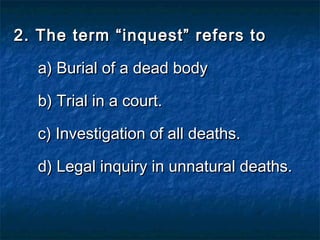
2. The term“inquest” refers to2. The term “inquest” refers to
a) Burial of a dead bodya) Burial of a dead body
b) Trial in a court.b) Trial in a court.
c) Investigation of all deaths.c) Investigation of all deaths.
d) Legal inquiry in unnatural deaths.d) Legal inquiry in unnatural deaths.
22.
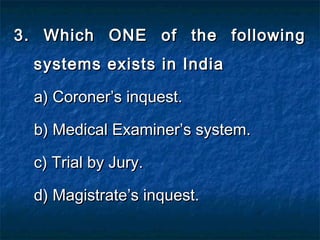
3. Which ONEof the following3. Which ONE of the following
systems exists in Indiasystems exists in India
a) Coroner’s inquest.a) Coroner’s inquest.
b) Medical Examiner’s system.b) Medical Examiner’s system.
c) Trial by Jury.c) Trial by Jury.
d) Magistrate’s inquest.d) Magistrate’s inquest.
23.
5. Police inquestis5. Police inquest is NOTNOT
applicable in one of theapplicable in one of the
following situations.following situations.
a) Suicide.a) Suicide.
b) Accidental death.b) Accidental death.
c) Homicide.c) Homicide.
d) Dowry-related death.d) Dowry-related death.
24.
6. Magistrate’s inquestis6. Magistrate’s inquest is
mandatory in which one of themandatory in which one of the
following cases.following cases.
a) Custodial death.a) Custodial death.
b) Exhumationb) Exhumation
c) Dowry deathc) Dowry death
d) All of the above.d) All of the above.
25.
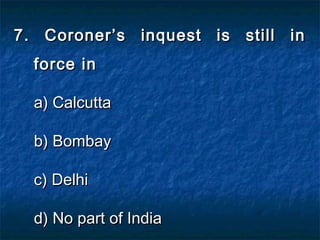
7. Coroner’s inquestis still in7. Coroner’s inquest is still in
force inforce in
a) Calcuttaa) Calcutta
b) Bombayb) Bombay
c) Delhic) Delhi
d) No part of Indiad) No part of India
26.
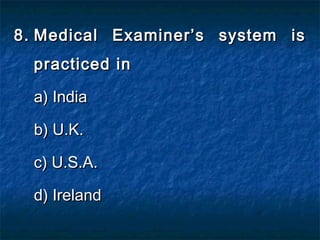
8.8. Medical Examiner’ssystem isMedical Examiner’s system is
practiced inpracticed in
a) Indiaa) India
b) U.K.b) U.K.
c) U.S.A.c) U.S.A.
d) Irelandd) Ireland
27.
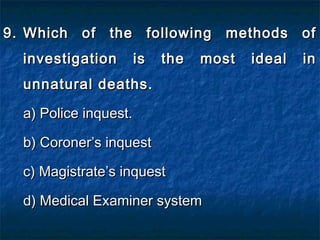
9.9. Which ofthe following methods ofWhich of the following methods of
investigation is the most ideal ininvestigation is the most ideal in
unnatural deaths.unnatural deaths.
a) Police inquest.a) Police inquest.
b) Coroner’s inquestb) Coroner’s inquest
c) Magistrate’s inquestc) Magistrate’s inquest
d) Medical Examiner systemd) Medical Examiner system
28.
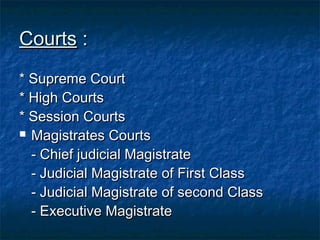
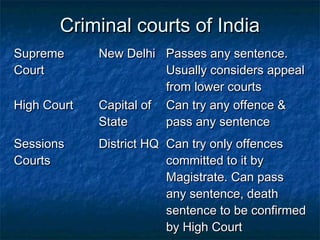
CourtsCourts ::
* SupremeCourt* Supreme Court
* High Courts* High Courts
* Session Courts* Session Courts
Magistrates CourtsMagistrates Courts
- Chief judicial Magistrate- Chief judicial Magistrate
- Judicial Magistrate of First Class- Judicial Magistrate of First Class
- Judicial Magistrate of second Class- Judicial Magistrate of second Class
- Executive Magistrate- Executive Magistrate
29.
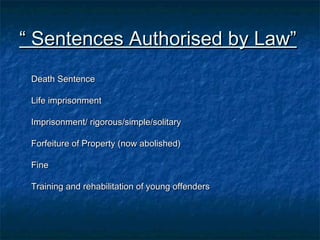
““ Sentences Authorisedby Law”Sentences Authorised by Law”
Death SentenceDeath Sentence
Life imprisonmentLife imprisonment
Imprisonment/ rigorous/simple/solitaryImprisonment/ rigorous/simple/solitary
Forfeiture of Property (now abolished)Forfeiture of Property (now abolished)
FineFine
Training and rehabilitation of young offendersTraining and rehabilitation of young offenders
30.
Criminal courts ofIndiaCriminal courts of India
SupremeSupreme
CourtCourt
New DelhiNew Delhi Passes any sentence.Passes any sentence.
Usually considers appealUsually considers appeal
from lower courtsfrom lower courts
High CourtHigh Court Capital ofCapital of
StateState
Can try any offence &Can try any offence &
pass any sentencepass any sentence
SessionsSessions
CourtsCourts
District HQDistrict HQ Can try only offencesCan try only offences
committed to it bycommitted to it by
Magistrate. Can passMagistrate. Can pass
any sentence, deathany sentence, death
sentence to be confirmedsentence to be confirmed
by High Courtby High Court
31.
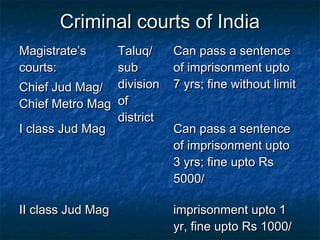
Criminal courts ofIndiaCriminal courts of India
Magistrate’sMagistrate’s
courts:courts:
Chief Jud Mag/Chief Jud Mag/
Chief Metro MagChief Metro Mag
Taluq/Taluq/
subsub
divisiondivision
ofof
districtdistrict
Can pass a sentenceCan pass a sentence
of imprisonment uptoof imprisonment upto
7 yrs; fine without limit7 yrs; fine without limit
I class Jud MagI class Jud Mag Can pass a sentenceCan pass a sentence
of imprisonment uptoof imprisonment upto
3 yrs; fine upto Rs3 yrs; fine upto Rs
5000/5000/
II class Jud MagII class Jud Mag imprisonment upto 1imprisonment upto 1
yr, fine upto Rs 1000/yr, fine upto Rs 1000/
32.
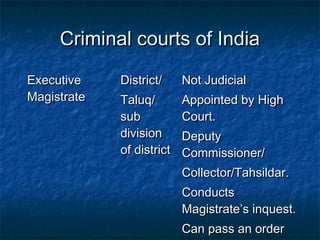
Criminal courts ofIndiaCriminal courts of India
ExecutiveExecutive
MagistrateMagistrate
District/District/
Taluq/Taluq/
subsub
divisiondivision
of districtof district
Not JudicialNot Judicial
Appointed by HighAppointed by High
Court.Court.
DeputyDeputy
Commissioner/Commissioner/
Collector/Tahsildar.Collector/Tahsildar.
ConductsConducts
Magistrate’s inquest.Magistrate’s inquest.
Can pass an orderCan pass an order
33.
Proceedings in Court:Proceedingsin Court:
* Subpoena* Subpoena
* Oath of Affirmation* Oath of Affirmation
* Recording of evidence / Proof* Recording of evidence / Proof
* Decision of Judge / Court* Decision of Judge / Court
* Execution of Court orders* Execution of Court orders
34.
““Subpoena / Summons”Subpoena/ Summons”
* It is a document commanding the* It is a document commanding the
attendance of a witness in a court of lawattendance of a witness in a court of law
under a penalty ( if not obeyed)under a penalty ( if not obeyed)
• It is issued by the court in writing, andIt is issued by the court in writing, and
signed by the presiding magistratesigned by the presiding magistrate
• Specific date & timeSpecific date & time
• It is served by a police officer or an officerIt is served by a police officer or an officer
of the courtof the court
* It is sent in duplicate* It is sent in duplicate
35.
* A summonsmust be implicitly obeyed,* A summons must be implicitly obeyed,
unless there are valid and urgent reasonsunless there are valid and urgent reasons
* If the summoned witness fails to attend the* If the summoned witness fails to attend the
court, he is punished for guilty of contemptcourt, he is punished for guilty of contempt
of courtof court
* Priority of attendance* Priority of attendance
* Conduct money* Conduct money
36.
Case on thesame day ?Case on the same day ?
Criminal courts have precedence over civilCriminal courts have precedence over civil
courtcourt
Higher courts gets preference over lowerHigher courts gets preference over lower
courtscourts
The court which served the summons firstThe court which served the summons first
receives preferencereceives preference
37.
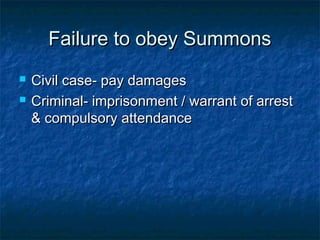
Failure to obeySummonsFailure to obey Summons
Civil case- pay damagesCivil case- pay damages
Criminal- imprisonment / warrant of arrestCriminal- imprisonment / warrant of arrest
& compulsory attendance& compulsory attendance
38.
Conduct moneyConduct money
In civil cases- a fee is tendered, to coverIn civil cases- a fee is tendered, to cover
the expenses of the witness to attendthe expenses of the witness to attend
court, at the time when the summons iscourt, at the time when the summons is
servedserved
Paid by the party that has called thePaid by the party that has called the
witnesswitness
In criminal cases no conduct money, butIn criminal cases no conduct money, but
court has made provision to paycourt has made provision to pay
reasonable expenses of witnessreasonable expenses of witness
39.
““ Witness”Witness”
A witnessis a person who gives aA witness is a person who gives a
statement or testimony under oath orstatement or testimony under oath or
solemn affirmation in the court of lawsolemn affirmation in the court of law
Common witnessCommon witness
* Expert or skilled* Expert or skilled
EVIDENCEEVIDENCE
Evidence means anystatement in relation toEvidence means any statement in relation to
a matter or fact under inquiry or aa matter or fact under inquiry or a
document or something for the inspectiondocument or something for the inspection
of the court.of the court.
* Oral Evidence* Oral Evidence
* Documentary evidence* Documentary evidence
42.
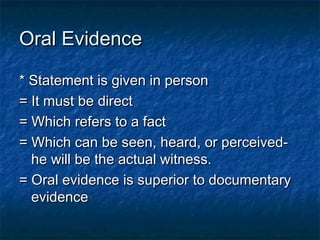
Oral EvidenceOral Evidence::
It is the evidence of a person who says he saw,It is the evidence of a person who says he saw,
heard or perceived it in other words actualheard or perceived it in other words actual
witness.witness.
Documentary EvidenceDocumentary Evidence
Any documents produced for the inspection of theAny documents produced for the inspection of the
court, in relation to matter of fact under inquiry.court, in relation to matter of fact under inquiry.
Medical certificatesMedical certificates
Sickness certificateSickness certificate
Medical fitness certificateMedical fitness certificate
Fitness for employmentFitness for employment
Vaccination certificateVaccination certificate
Death certificatesDeath certificates
45.
Medico legal reportsMedicolegal reports
Injury/ wound certificateInjury/ wound certificate
Age certificateAge certificate
Impotency/ potency certificateImpotency/ potency certificate
Drunkenness certificateDrunkenness certificate
Examination of victim / accused of rape/Examination of victim / accused of rape/
sodomysodomy
Post mortem reportPost mortem report
46.
Oral EvidenceOral Evidence
*Statement is given in person* Statement is given in person
= It must be direct= It must be direct
= Which refers to a fact= Which refers to a fact
= Which can be seen, heard, or perceived-= Which can be seen, heard, or perceived-
he will be the actual witness.he will be the actual witness.
= Oral evidence is superior to documentary= Oral evidence is superior to documentary
evidenceevidence
47.
Primary EvidencePrimary Evidence
Whendocuments are produced in the form ofWhen documents are produced in the form of
evidence is called primary evidence.evidence is called primary evidence.
Secondary EvidenceSecondary Evidence
When certified copy, photocopy or counterparts ofWhen certified copy, photocopy or counterparts of
original documents produced in the court calledoriginal documents produced in the court called
secondary evidence.secondary evidence.
48.
Hearsay EvidenceHearsay Evidence
Evidenceof a person who has no personalEvidence of a person who has no personal
knowledge of the facts, but just repeatsknowledge of the facts, but just repeats
what he/she heard others saywhat he/she heard others say
Circumstantial EvidenceCircumstantial Evidence
It is an evidence when something is foundIt is an evidence when something is found
Which gives clues about the offence.Which gives clues about the offence.
49.
Dying Declarations:Dying Declarations:
Arethe statements of a person who isAre the statements of a person who is
actually dying and who believes he isactually dying and who believes he is
dying, regarding the cause anddying, regarding the cause and
circumstance leading to his present state.circumstance leading to his present state.
It is admissible as an evidence where theIt is admissible as an evidence where the
cause of his death is under enquiry.cause of his death is under enquiry.
50.
Dying declarationDying declaration
Verbal/ written statementVerbal/ written statement
Compos mentisCompos mentis
2 Witnesses2 Witnesses
No leading questions to be askedNo leading questions to be asked
Signature/ thumb impression ofSignature/ thumb impression of
declarant, doctor, witnessesdeclarant, doctor, witnesses
Sent to Magistrate in sealed envelopeSent to Magistrate in sealed envelope
MLIMLI
51.
Dying depositionDying deposition
Itis a dying declaration made on Oath in theIt is a dying declaration made on Oath in the
presence of the accused or his legalpresence of the accused or his legal
representative who has the opportunity torepresentative who has the opportunity to
cross examine the dying person.cross examine the dying person.
This is recorded by the Magistrate, hence itThis is recorded by the Magistrate, hence it
carries more value than dying declaration.carries more value than dying declaration.
52.
In the Court:In the Court :
““ If the law has made you a witness, remainIf the law has made you a witness, remain
a man of science. You have no victim toa man of science. You have no victim to
avenge, or guilty or innocent person toavenge, or guilty or innocent person to
ruin or save. You must bear testimonyruin or save. You must bear testimony
within the limits of sciencewithin the limits of science
- Brouanrdel- Brouanrdel
53.
An ‘OathAn ‘Oath’’
Itis a declaration required by law, to beIt is a declaration required by law, to be
made before the court, by the witness.made before the court, by the witness.
He swears in the name of God, that he willHe swears in the name of God, that he will
tell the truth, the whole truth, and nothingtell the truth, the whole truth, and nothing
but the truth.but the truth.
If the witness has religious scruples againstIf the witness has religious scruples against
swearing, he will be permitted to make aswearing, he will be permitted to make a
solemn affirmation.solemn affirmation.
54.
Once a witnessis thus sworn, if he does notOnce a witness is thus sworn, if he does not
speak the truth, he is liable to bespeak the truth, he is liable to be
prosecuted for the guilty of the crime,prosecuted for the guilty of the crime,
called,called,
““ Perjury”Perjury”
““ Willful utterance of falsehood”Willful utterance of falsehood”
Section 193 I.P.C.Section 193 I.P.C.
55.
Recording of Evidence- PleadingRecording of Evidence - Pleading
Examination-in-chiefExamination-in-chief
Cross-examinationCross-examination
Re-examinationRe-examination
Question by JudgeQuestion by Judge
56.
Examination-in-chiefExamination-in-chief
Examination isdone by the counsel side,Examination is done by the counsel side,
which has summoned him.which has summoned him.
The object of the examination-in-chief is toThe object of the examination-in-chief is to
present all relevant facts of the casepresent all relevant facts of the case
before the court.before the court.
If witness is expert he may be asked toIf witness is expert he may be asked to
elicit his inference or interpretations fromelicit his inference or interpretations from
the facts.the facts.
57.
No leadingquestions are allowed.No leading questions are allowed.
( leading question is one that suggest its( leading question is one that suggest its
own answer)own answer)
Leading question can be asked whenLeading question can be asked when
witness become ‘ hostile’.witness become ‘ hostile’.
““Hostile witness is that witness who givesHostile witness is that witness who gives
evidence in the court of law under oath,evidence in the court of law under oath,
against the interest of the party who citesagainst the interest of the party who cites
him as witness.him as witness.
Common witness/ An expert witness.Common witness/ An expert witness.
58.
Cross Examination:Cross Examination:
*Followed by examination-in-chief* Followed by examination-in-chief
* Examined by counsel for opposite party* Examined by counsel for opposite party
* To bring out inaccuracies and* To bring out inaccuracies and
contradictions in his statements.contradictions in his statements.
* To extract any facts which may be* To extract any facts which may be
favorable to his Clientfavorable to his Client
* Leading questions are allowed.* Leading questions are allowed.
59.
* Cross examinationneed not be confined to* Cross examination need not be confined to
the statements;the statements;
= Qualification= Qualification
= Experience= Experience
= Professional knowledge= Professional knowledge
= Character= Character
* No time limit for cross examination.* No time limit for cross examination.
60.
Re-examination:Re-examination:
* After cross-examination, the witness can* After cross- examination, the witness can
be examined by the counsel who calledbe examined by the counsel who called
him.him.
* To remove any doubts that may have* To remove any doubts that may have
arisen during cross examinationarisen during cross examination
* Leading questions are not allowed.* Leading questions are not allowed.
61.
Court Question:Court Question:
*Presiding officer may /can ask question to* Presiding officer may /can ask question to
witness at any stage.witness at any stage.
* He can call witness again for his evidence,* He can call witness again for his evidence,
if needed by the court, related to the sameif needed by the court, related to the same
case.case.
62.
4.4. A government-appointedlawyer whoA government-appointed lawyer who
tries a case on behalf of the police istries a case on behalf of the police is
calledcalled
a) Defender lawyera) Defender lawyer
b) Public prosecutorb) Public prosecutor
c) District attorneyc) District attorney
d) Police lawyerd) Police lawyer
63.
11.11. The highestjudicial appellateThe highest judicial appellate
tribunal in India istribunal in India is
a) High Courta) High Court
b) Supreme Courtb) Supreme Court
c) Ministry of legal affairsc) Ministry of legal affairs
d) Parliamentd) Parliament
64.
1.1. A chiefjudicial magistrate can imposeA chief judicial magistrate can impose
punishment up topunishment up to
a) 7 years imprisonment and unlimited fine.a) 7 years imprisonment and unlimited fine.
b) 7 years imprisonment and fine up to Rs.b) 7 years imprisonment and fine up to Rs.
5000/-5000/-
c) 3 years imprisonment and fine up to Rs.c) 3 years imprisonment and fine up to Rs.
5000/-5000/-
d) 1 years imprisonment and fine up to Rs.d) 1 years imprisonment and fine up to Rs.
1000/-1000/-
65.
2.2. The methodpracticed in India toThe method practiced in India to
carry out a judicial sentence of deathcarry out a judicial sentence of death
isis
a) Hanginga) Hanging
b) Electrocutionb) Electrocution
c) Gassingc) Gassing
d) Lethal injection.d) Lethal injection.
66.
3.3. A juvenileoffender (male) is one whoA juvenile offender (male) is one who
is belowis below
a) 16 yearsa) 16 years
b) 14 yearsb) 14 years
c) 18 yearsc) 18 years
d) 21 yearsd) 21 years
67.
13.13. The term”Subpoena” is alsoThe term ”Subpoena” is also
referred to asreferred to as
a) Summonsa) Summons
b) Panchnamab) Panchnama
c) Warrantc) Warrant
d) Requisitiond) Requisition
68.
16.16. The literalmeaning of “Subpoena”The literal meaning of “Subpoena”
isis
a) Under penaltya) Under penalty
b) Under suspensionb) Under suspension
c) Under forcec) Under force
d) Under threatd) Under threat
69.
18.18. Regarding attendancein a court of law toRegarding attendance in a court of law to
give evidence, all of the following are true,give evidence, all of the following are true,
EXCEPTEXCEPT
a) Criminal cases have priority over civil casesa) Criminal cases have priority over civil cases
b) Higher courts have priority over lower courts.b) Higher courts have priority over lower courts.
c) If two separate summons are issued from thec) If two separate summons are issued from the
same court, the summons issued second shouldsame court, the summons issued second should
be given priority over the first.be given priority over the first.
d) In all cases, the witness should inform the otherd) In all cases, the witness should inform the other
court (which he is unable to attend), about thecourt (which he is unable to attend), about the
70.
20.20. A Coroneris empowered to do all ofA Coroner is empowered to do all of
the following EXCEPTthe following EXCEPT
a) He can summon witnesses.a) He can summon witnesses.
b) He can record evidence under oathb) He can record evidence under oath
c) He can order for an autopsyc) He can order for an autopsy
d) He can punish the guiltyd) He can punish the guilty
71.
21.21. Immediately onreceipt of informationImmediately on receipt of information
of an unnatural death, a policeof an unnatural death, a police
officer has to inform theofficer has to inform the
a) District collectora) District collector
b) Superintendent of Policeb) Superintendent of Police
c) Magistratec) Magistrate
d) District Health Officerd) District Health Officer
72.
22.22. The term“ Panchanama” refers toThe term “ Panchanama” refers to
a) Dead body challan.a) Dead body challan.
b) Inquest reportb) Inquest report
c) Post term reportc) Post term report
d) The final report submitted by the policed) The final report submitted by the police
to the courtto the court
73.
23.23. Non-compliance ofsummons in aNon-compliance of summons in a
civil court may render a person liablecivil court may render a person liable
forfor
a) Damages.a) Damages.
b) Fineb) Fine
c) Imprisonmentc) Imprisonment
d) None of the aboved) None of the above
74.
24.24. Police inquestis held as perPolice inquest is held as per
a) Sec 174 of the Criminal Procedure Code.a) Sec 174 of the Criminal Procedure Code.
b) Sec 174 of the Indian Penal Codeb) Sec 174 of the Indian Penal Code
c)c) Sec 174 of the Indian Evidence ActSec 174 of the Indian Evidence Act
d) Sec 174 of the Police Manuald) Sec 174 of the Police Manual
75.
5.5. Evidence givento the court whereEvidence given to the court where
the witness has not witnessed thethe witness has not witnessed the
act, but heard somebody talk aboutact, but heard somebody talk about
it, is calledit, is called
a) Secondary evidencea) Secondary evidence
b) Impersonal evidenceb) Impersonal evidence
c) Hearsay evidencec) Hearsay evidence
d) Circumstantial evidenced) Circumstantial evidence
76.
7.7. Dying declarationis a statementDying declaration is a statement
made bymade by
a) The accused in a criminal offence justa) The accused in a criminal offence just
beforebefore the victim’s deaththe victim’s death
b) A victim of a criminal offence just beforeb) A victim of a criminal offence just before
hishis deathdeath
c) A witness in a criminal offence just beforec) A witness in a criminal offence just before
thethe victim’s deathvictim’s death
d) Any person in his death bed.d) Any person in his death bed.
77.
8.8. When amagistrate is available toWhen a magistrate is available to
record a dying declaration, the rolerecord a dying declaration, the role
of a doctor isof a doctor is
a) Rendered superfluousa) Rendered superfluous
b) To act as a witnessb) To act as a witness
c) To attest the declarationc) To attest the declaration
d) To certify the victim’s mental status.d) To certify the victim’s mental status.
78.
WarrantWarrant
Written order-sign & seal of presidingWritten order- sign & seal of presiding
officer of courtofficer of court
Bears name & designation of person whoBears name & designation of person who
is to execute itis to execute it
Indicates name & add of accusedIndicates name & add of accused
Must state the offence, he is accused ofMust state the offence, he is accused of
Should indicate date of issueShould indicate date of issue
79.
Non-Cognizable offenceNon-Cognizable offence
Any offence for which the police officerAny offence for which the police officer
cannot arrest the accused without acannot arrest the accused without a
warrantwarrant
E.g. Bribery, defamation, perjury, causingE.g. Bribery, defamation, perjury, causing
simple hurt, buying/ selling person forsimple hurt, buying/ selling person for
slaveryslavery
80.
Cognizable offenceCognizable offence
Any offence for which the police officerAny offence for which the police officer
may arrest the accused without a warrantmay arrest the accused without a warrant
waging war against govt, counterfeitingwaging war against govt, counterfeiting
Indian currency, adulteration of food,Indian currency, adulteration of food,
destroying, damaging or defiling place ofdestroying, damaging or defiling place of
worship, theft, robbery, murder,worship, theft, robbery, murder,
kidnapping, rape, attempting suicide,kidnapping, rape, attempting suicide,
causing grievous hurt, dowry death, riotingcausing grievous hurt, dowry death, rioting
81.
Bailable & NonbailableBailable & Non bailable
offencesoffences
Bailable offenceBailable offence
attempting suicide, sale of obscene books,attempting suicide, sale of obscene books,
bribery, riotingbribery, rioting
Non bailable offences:Non bailable offences:
adulteration of food, murder, dowry death,adulteration of food, murder, dowry death,
counterfeiting Indian currency, destroying,counterfeiting Indian currency, destroying,
damaging or defiling place of worshipdamaging or defiling place of worship
82.
First Information Report(F.I.R.)First Information Report (F.I.R.)
Any information given to the Police Officer,Any information given to the Police Officer,
related to a cognizable offence, which isrelated to a cognizable offence, which is
first, in point of time and on the basis offirst, in point of time and on the basis of
which the investigation commenceswhich the investigation commences
Where is it lodged?Where is it lodged?
What is its objective?What is its objective?
What is its importance ?What is its importance ?
83.
Doctor in theWitness box:Doctor in the Witness box:
* Attending the court punctually with all* Attending the court punctually with all
documents required by the court.documents required by the court.
* Study of documents before attending the* Study of documents before attending the
court to refresh his memorycourt to refresh his memory
* Avoid any indiscriminate talk in the court* Avoid any indiscriminate talk in the court
premises about the case.premises about the case.
84.
* Evidence shouldbe given with a clear and* Evidence should be given with a clear and
loud voice.loud voice.
* Statements should be in simple words and* Statements should be in simple words and
avoid technical terms.avoid technical terms.
* He may demonstrate his evidence by* He may demonstrate his evidence by
documentary supportdocumentary support
eg: Photographs and diagrams.eg: Photographs and diagrams.
85.
Common legal termsCommonlegal terms
Accused- accused/ alleged to have committedAccused- accused/ alleged to have committed
crimecrime
Acquittal-accused not guiltyAcquittal-accused not guilty
Affidavit- voluntary written statement of factsAffidavit- voluntary written statement of facts
under oath before an officer of the court / notaryunder oath before an officer of the court / notary
publicpublic
Appeal- complaint made to superior courtAppeal- complaint made to superior court
Appellant- person who makes appealAppellant- person who makes appeal
Assailant- one who has committed an assaultAssailant- one who has committed an assault
86.
Common legal termsCommonlegal terms
Bail-security on behalf of accused person, onBail-security on behalf of accused person, on
giving which, he is released from custody,giving which, he is released from custody,
pending investigation/ court trialpending investigation/ court trial
Warrant case- relating to an offence punishableWarrant case- relating to an offence punishable
with death, life imprisonment or imprisonmentwith death, life imprisonment or imprisonment
exceeding 2 yrsexceeding 2 yrs
Summons case- relating to an offence, for whichSummons case- relating to an offence, for which
the punishment is less than 2yrs imprisonmentthe punishment is less than 2yrs imprisonment
87.
Common legal termsCommonlegal terms
Civil case- dispute between 2 private partiesCivil case- dispute between 2 private parties
(wealth, property etc)(wealth, property etc)
Criminal case- case between govt. and a privateCriminal case- case between govt. and a private
party concerning matters of public interest &party concerning matters of public interest &
safety (assault, robbery, murder, rape)safety (assault, robbery, murder, rape)
Contempt of court- intentional insult orContempt of court- intentional insult or
interruption to a court during judicial proceedinginterruption to a court during judicial proceeding
Conviction- accused proved guilty in court of lawConviction- accused proved guilty in court of law
Culpability- being at fault, deserving punishmentCulpability- being at fault, deserving punishment
88.
Common legal termsCommonlegal terms
Damage- injury suffered by a party as a result ofDamage- injury suffered by a party as a result of
action of anotheraction of another
Damages- compensation payable to a victim, asDamages- compensation payable to a victim, as
decided by the courtdecided by the court
Defendant- party against whom a complaint hasDefendant- party against whom a complaint has
been filed (accused)been filed (accused)
Defence counsel- legal practitioner who acts onDefence counsel- legal practitioner who acts on
behalf of accusedbehalf of accused
Public prosecutor- lawyer appointed by govt. forPublic prosecutor- lawyer appointed by govt. for
conducting prosecution on behalf of the stateconducting prosecution on behalf of the state
89.
Common legal termsCommonlegal terms
Search warrant- written authority issuedSearch warrant- written authority issued
by magistrate to police officer, for searchby magistrate to police officer, for search
of any general / specified thing/ documentof any general / specified thing/ document
Trial- legal process in accordance with theTrial- legal process in accordance with the
law, to determine guilt / innocencelaw, to determine guilt / innocence
Verdict- formal decision or finding madeVerdict- formal decision or finding made
by a judge / jury at the end of a trial.by a judge / jury at the end of a trial.
90.
Recommended BooksRecommended Books
1.Narayanareddy K.S., The Essentials of Forensic Medicine & Toxicology,
2. Apurbanandy, Principles of Forensic Medicine,
3. Parikh C.K., Parikh’s Textbook of Medical Jurisprudence & Toxicology,.
4. J. Magendran’s Forensic Medicine nothing beyond PGMEE