INPUT DEVICES
Presented by: Group-E (The Anonymous)
BSc.CSIT 1st Semester
1
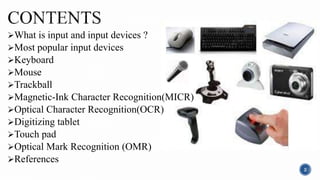
What is input and input devices ?
Most popular input devices
Keyboard
Mouse
Trackball
Magnetic-Ink Character Recognition(MICR)
Optical Character Recognition(OCR)
Digitizing tablet
Touch pad
Optical Mark Recognition (OMR)
References
2
What is taken in, or operated on by any process or system
Technically, giving command or instruction to the
computer
3
What is input?
Peripheral to provide data and signals to an information processing
system.
Used for entering data and program into the computer system for
processing.
Medium of communication between user and computer
4
What are input devices ?
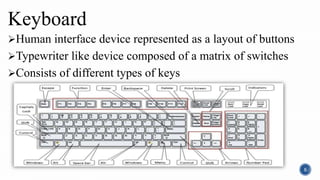
Human interface device represented as a layout of buttons
Typewriter like device composed of a matrix of switches
Consists of different types of keys
5
Keyboard
Alphanumeric keys
Modifier keys – shift, Ctrl, Alt
Numeric keys
Functional keys – F1 to F2
Cursor Movement keys - Home, End
Special purpose keys – Ins, Del, Esc
6
Types of keys in keyboard
Laptop keyboards
Gamming keyboards
Ergonomic keyboards
Laser / Infrared keyboards
Rollup keyboards
7
Types of keyboard
8
Mouse
9
About mouse
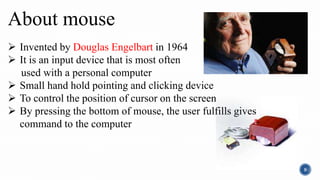
 Invented by Douglas Engelbart in 1964
 It is an input device that is most often
used with a personal computer
 Small hand hold pointing and clicking device
 To control the position of cursor on the screen
 By pressing the bottom of mouse, the user fulfills gives
command to the computer
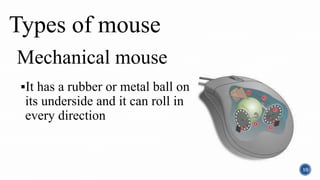
It has a rubber or metal ball on
its underside and it can roll in
every direction
Mechanical mouse
10
Types of mouse
It is same as mechanical mouse except that it
use optical sensors to the motion of ball
It demands a mouse pad under the mouse to run
on
Opto Mechanical mouse
11
With advance in mouse technology , now –
preferred device for pointing and clicking is
optical mouse
Optical Mechanical mouse
12
 A pointing input device like an upside down
mouse
 Contains sensors to detect a rotation of the ball
 User have to roll the ball with the thumb fingers or with the
palm of the hand to move a cursor
 Invented by tom Cranston and Fred Longstaff in 1952
 Eleven years before the mouse was invented
13
Track Ball
Advantage
● Doesn’t require much space
● Can be used in any type of surface or even in hand (like
remote)
● Disadvantage
● fatigue of the thumb
● Trackballs tend not to skip and flow more smoothly than
mice or touch pads
14
Advantage and Disadvantage
Allows computer to recognize characters printed using magnetic
ink.
Special purpose machine known as reader/sorter reads character
made of ink containing magnetic particle.
This technology is usually used in bank to read the number on the
bottom of cheque.
Some other related technology are magnetic strips used in credit
and debit cards of bank and ID card of students.
Magnetic Ink Character Recognition (MICR)
OCR refers to the branch of computer science involves reading
text from paper and translating the image into a form that the
computer can manipulate.
OCR system include optical scanner for reading text , and
advance software for analyzing image.
It is widely used in all sector enabling user to print documents.
Optical Character Recognition (OCR)
Also known as graphic tablet or drawing tablet or digital art
board
Enables a user to hand-draw images, animations and
graphics, with a special pen-like stylus, similar to the way a
person draw images with a pencil and paper.
Also popular for technical drawings and CAD (one can
typically put a piece of paper on them without interfering with their
function)
17
Digitizing tablet
Light pen or stylus pen
18
19
20
Touch pad
A pointing device featuring a tactile sensor with specialized surface
Can translate the motion and position of a user's fingers to a relative
position on the operating system that is outputted to the screen
Used as a substitute for a mouse
Works with a dedicated scanner device that shines a beam of light
onto the form paper
OMR software makes OMR device to work on the desktop
OMR software uses an Image scanner to process surveys, tests,
attendance sheets, checklists, and other plain-paper forms printed on
a laser printer
21
Optical Mark Recognition
www.google.com
www.Wikipedia.com
www.youtube.com
Course book (Introduction to Information and Technology-
Alexis Leon and Mathew Leon)
Teachers note
22
Preferences
Queries
23

Input Devices

  • 1.
    INPUT DEVICES Presented by:Group-E (The Anonymous) BSc.CSIT 1st Semester 1
  • 2.
    What is inputand input devices ? Most popular input devices Keyboard Mouse Trackball Magnetic-Ink Character Recognition(MICR) Optical Character Recognition(OCR) Digitizing tablet Touch pad Optical Mark Recognition (OMR) References 2
  • 3.
    What is takenin, or operated on by any process or system Technically, giving command or instruction to the computer 3 What is input?
  • 4.
    Peripheral to providedata and signals to an information processing system. Used for entering data and program into the computer system for processing. Medium of communication between user and computer 4 What are input devices ?
  • 5.
    Human interface devicerepresented as a layout of buttons Typewriter like device composed of a matrix of switches Consists of different types of keys 5 Keyboard
  • 6.
    Alphanumeric keys Modifier keys– shift, Ctrl, Alt Numeric keys Functional keys – F1 to F2 Cursor Movement keys - Home, End Special purpose keys – Ins, Del, Esc 6 Types of keys in keyboard
  • 7.
    Laptop keyboards Gamming keyboards Ergonomickeyboards Laser / Infrared keyboards Rollup keyboards 7 Types of keyboard
  • 8.
  • 9.
    9 About mouse  Inventedby Douglas Engelbart in 1964  It is an input device that is most often used with a personal computer  Small hand hold pointing and clicking device  To control the position of cursor on the screen  By pressing the bottom of mouse, the user fulfills gives command to the computer
  • 10.
    It has arubber or metal ball on its underside and it can roll in every direction Mechanical mouse 10 Types of mouse
  • 11.
    It is sameas mechanical mouse except that it use optical sensors to the motion of ball It demands a mouse pad under the mouse to run on Opto Mechanical mouse 11
  • 12.
    With advance inmouse technology , now – preferred device for pointing and clicking is optical mouse Optical Mechanical mouse 12
  • 13.
     A pointinginput device like an upside down mouse  Contains sensors to detect a rotation of the ball  User have to roll the ball with the thumb fingers or with the palm of the hand to move a cursor  Invented by tom Cranston and Fred Longstaff in 1952  Eleven years before the mouse was invented 13 Track Ball
  • 14.
    Advantage ● Doesn’t requiremuch space ● Can be used in any type of surface or even in hand (like remote) ● Disadvantage ● fatigue of the thumb ● Trackballs tend not to skip and flow more smoothly than mice or touch pads 14 Advantage and Disadvantage
  • 15.
    Allows computer torecognize characters printed using magnetic ink. Special purpose machine known as reader/sorter reads character made of ink containing magnetic particle. This technology is usually used in bank to read the number on the bottom of cheque. Some other related technology are magnetic strips used in credit and debit cards of bank and ID card of students. Magnetic Ink Character Recognition (MICR)
  • 16.
    OCR refers tothe branch of computer science involves reading text from paper and translating the image into a form that the computer can manipulate. OCR system include optical scanner for reading text , and advance software for analyzing image. It is widely used in all sector enabling user to print documents. Optical Character Recognition (OCR)
  • 17.
    Also known asgraphic tablet or drawing tablet or digital art board Enables a user to hand-draw images, animations and graphics, with a special pen-like stylus, similar to the way a person draw images with a pencil and paper. Also popular for technical drawings and CAD (one can typically put a piece of paper on them without interfering with their function) 17 Digitizing tablet
  • 18.
    Light pen orstylus pen 18
  • 19.
  • 20.
    20 Touch pad A pointingdevice featuring a tactile sensor with specialized surface Can translate the motion and position of a user's fingers to a relative position on the operating system that is outputted to the screen Used as a substitute for a mouse
  • 21.
    Works with adedicated scanner device that shines a beam of light onto the form paper OMR software makes OMR device to work on the desktop OMR software uses an Image scanner to process surveys, tests, attendance sheets, checklists, and other plain-paper forms printed on a laser printer 21 Optical Mark Recognition
  • 22.
    www.google.com www.Wikipedia.com www.youtube.com Course book (Introductionto Information and Technology- Alexis Leon and Mathew Leon) Teachers note 22 Preferences
  • 23.