Board of Education Workshop
          3/5/2012
Education Technology Plan
There are three core ideas our district views
with utmost importance in regard to the use of
technology and our resources, and they are the
essence of our technology and educational
technology plans:

                Inspiration
               Imagination
                Innovation
Education Technology Plan

  The inspiration to provide personalized
  student learning, also the heart and soul of
  the district’s 2010-2015 strategic plan, to
  help every student attain and put into daily
  practice, the skills necessary to move
  beyond the basics of digital-age learning.
Education Technology Plan

           The imagination to accurately
           envision a future that includes
           new and unique uses for current
           technology, or the use of
           technology unknown to us at this
           moment.
Education Technology Plan

  The innovation to understand that we
  cannot possibly teach our students how to
  use all technology that may exist in the
  future, and they will be better served if we
  provide them with foundational skills that
  build self-confidence, thus enabling them
  to explore and discover new ways to learn
  using technology.
Education Technology Plan

• Select a Starting Point
• Determine Assumptions
• Articulate the Outcomes
• Build the Timeline and the Shell
Education Technology Plan
Objective 1:
Identify, evaluate and implement innovative technologies
(hardware and software) for all curriculum content areas and
for all teaching and learning environments.

Indicator 1.1:
Increase the district’s capacity to implement innovative
technologies by implementing forecasting practices, piloting
and evaluating new technologies, and creating flexible
learning spaces.
Education Technology Plan
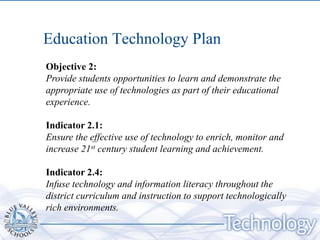
Objective 2:
Provide students opportunities to learn and demonstrate the
appropriate use of technologies as part of their educational
experience.

Indicator 2.1:
Ensure the effective use of technology to enrich, monitor and
increase 21st century student learning and achievement.

Indicator 2.4:
Infuse technology and information literacy throughout the
district curriculum and instruction to support technologically
rich environments.
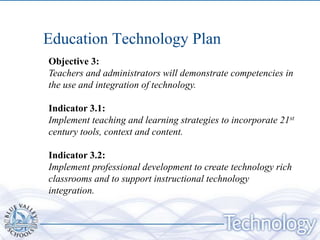
Education Technology Plan
Objective 3:
Teachers and administrators will demonstrate competencies in
the use and integration of technology.

Indicator 3.1:
Implement teaching and learning strategies to incorporate 21st
century tools, context and content.

Indicator 3.2:
Implement professional development to create technology rich
classrooms and to support instructional technology
integration.
Education Technology Plan
Objective 3:
Teachers and administrators will demonstrate competencies in
the use and integration of technology.

Indicator 3.1:
Implement teaching and learning strategies to incorporate 21st
century tools, context and content.

Indicator 3.2:
Implement professional development to create technology rich
classrooms and to support instructional technology
integration.
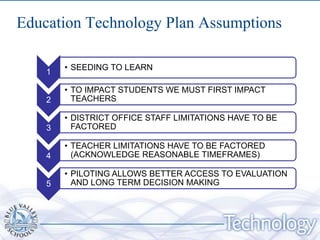
Education Technology Plan Assumptions

        • SEEDING TO LEARN
    1

        • TO IMPACT STUDENTS WE MUST FIRST IMPACT
    2     TEACHERS

        • DISTRICT OFFICE STAFF LIMITATIONS HAVE TO BE
    3     FACTORED

        • TEACHER LIMITATIONS HAVE TO BE FACTORED
    4     (ACKNOWLEDGE REASONABLE TIMEFRAMES)

        • PILOTING ALLOWS BETTER ACCESS TO EVALUATION
    5     AND LONG TERM DECISION MAKING
Education Technology Plan
What We Want to Explore

  HARDWARE

  SOFTWARE

  PROFESSIONAL DEVELOPMENT

  SUPPORTS
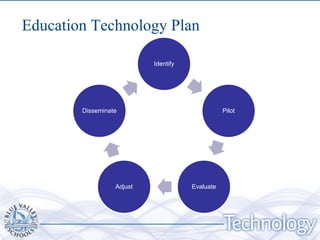
Education Technology Plan

                           Identify


        Disseminate                              Pilot


                  Adjust              Evaluate
K-5 Innovation Spaces
Purpose: To identify, support and provide classroom
teachers and students with technology-rich innovation
spaces where the technology is seamlessly integrated
into teaching and learning.
K-5 Innovation Spaces
• Create technology-rich classrooms where teachers
  demonstrate technology instructional strategies
  using an array of devices.
• Technology focused on student applications and
  implementation.
• Instructional strategies and framework will be
  inclusive of technology tools and resources.
• Professional development provided using a variety
  of delivery methods.
K-5 Innovation Spaces
Redefining the District Standard
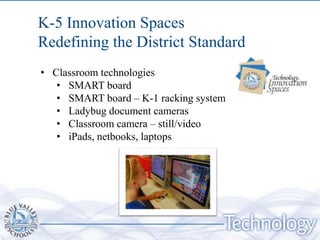
• Classroom technologies
   • SMART board
   • SMART board – K-1 racking system
   • Ladybug document cameras
   • Classroom camera – still/video
   • iPads, netbooks, laptops
K-5 Innovation Spaces
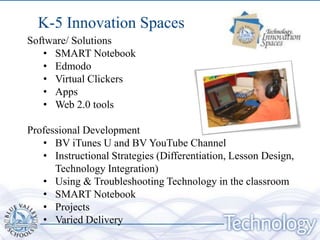
Software/ Solutions
   • SMART Notebook
   • Edmodo
   • Virtual Clickers
   • Apps
   • Web 2.0 tools

Professional Development
   • BV iTunes U and BV YouTube Channel
   • Instructional Strategies (Differentiation, Lesson Design,
      Technology Integration)
   • Using & Troubleshooting Technology in the classroom
   • SMART Notebook
   • Projects
   • Varied Delivery
K-5 Innovation Spaces
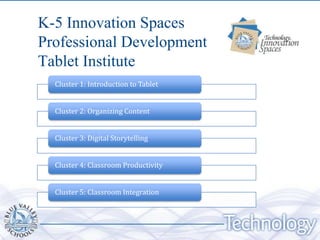
Professional Development
Tablet Institute
  Cluster 1: Introduction to Tablet


  Cluster 2: Organizing Content


  Cluster 3: Digital Storytelling


  Cluster 4: Classroom Productivity


  Cluster 5: Classroom Integration
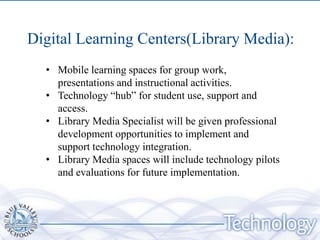
Digital Learning Centers(Library Media):
  • Mobile learning spaces for group work,
    presentations and instructional activities.
  • Technology “hub” for student use, support and
    access.
  • Library Media Specialist will be given professional
    development opportunities to implement and
    support technology integration.
  • Library Media spaces will include technology pilots
    and evaluations for future implementation.
6-12 Innovation Spaces
• Create technology-rich classrooms where teachers
  demonstrate technology instructional strategies
  using an array of devices.
• Technology focused lessons and materials that
  support instructional content available utilizing a
  variety of tools.
• Technology focused on student applications and
  implementation.
• Instructional strategies and framework will be
  inclusive of technology tools and resources.
• Professional development provided using a variety
  of delivery methods.
K-12 Learning Spaces
• Create technology-rich classrooms where teachers
  demonstrate technology instructional strategies using an
  array of devices.
• Technology focused lessons and materials that support
  instructional content available utilizing a variety of tools.
• Technology focused on student applications and
  implementation.
• Instructional strategies and framework will be inclusive of
  technology tools and resources.
• Professional development provided using a variety of
  delivery methods.
Presentation for the Board of Education

              Sue Dole
            Greg DeYoung
            Kristy Sailors

Innovation Spaces Presentation

  • 1.
    Board of EducationWorkshop 3/5/2012
  • 2.
    Education Technology Plan Thereare three core ideas our district views with utmost importance in regard to the use of technology and our resources, and they are the essence of our technology and educational technology plans: Inspiration Imagination Innovation
  • 3.
    Education Technology Plan The inspiration to provide personalized student learning, also the heart and soul of the district’s 2010-2015 strategic plan, to help every student attain and put into daily practice, the skills necessary to move beyond the basics of digital-age learning.
  • 4.
    Education Technology Plan The imagination to accurately envision a future that includes new and unique uses for current technology, or the use of technology unknown to us at this moment.
  • 5.
    Education Technology Plan The innovation to understand that we cannot possibly teach our students how to use all technology that may exist in the future, and they will be better served if we provide them with foundational skills that build self-confidence, thus enabling them to explore and discover new ways to learn using technology.
  • 6.
    Education Technology Plan •Select a Starting Point • Determine Assumptions • Articulate the Outcomes • Build the Timeline and the Shell
  • 7.
    Education Technology Plan Objective1: Identify, evaluate and implement innovative technologies (hardware and software) for all curriculum content areas and for all teaching and learning environments. Indicator 1.1: Increase the district’s capacity to implement innovative technologies by implementing forecasting practices, piloting and evaluating new technologies, and creating flexible learning spaces.
  • 8.
    Education Technology Plan Objective2: Provide students opportunities to learn and demonstrate the appropriate use of technologies as part of their educational experience. Indicator 2.1: Ensure the effective use of technology to enrich, monitor and increase 21st century student learning and achievement. Indicator 2.4: Infuse technology and information literacy throughout the district curriculum and instruction to support technologically rich environments.
  • 9.
    Education Technology Plan Objective3: Teachers and administrators will demonstrate competencies in the use and integration of technology. Indicator 3.1: Implement teaching and learning strategies to incorporate 21st century tools, context and content. Indicator 3.2: Implement professional development to create technology rich classrooms and to support instructional technology integration.
  • 10.
    Education Technology Plan Objective3: Teachers and administrators will demonstrate competencies in the use and integration of technology. Indicator 3.1: Implement teaching and learning strategies to incorporate 21st century tools, context and content. Indicator 3.2: Implement professional development to create technology rich classrooms and to support instructional technology integration.
  • 11.
    Education Technology PlanAssumptions • SEEDING TO LEARN 1 • TO IMPACT STUDENTS WE MUST FIRST IMPACT 2 TEACHERS • DISTRICT OFFICE STAFF LIMITATIONS HAVE TO BE 3 FACTORED • TEACHER LIMITATIONS HAVE TO BE FACTORED 4 (ACKNOWLEDGE REASONABLE TIMEFRAMES) • PILOTING ALLOWS BETTER ACCESS TO EVALUATION 5 AND LONG TERM DECISION MAKING
  • 12.
    Education Technology Plan WhatWe Want to Explore HARDWARE SOFTWARE PROFESSIONAL DEVELOPMENT SUPPORTS
  • 13.
    Education Technology Plan Identify Disseminate Pilot Adjust Evaluate
  • 14.
    K-5 Innovation Spaces Purpose:To identify, support and provide classroom teachers and students with technology-rich innovation spaces where the technology is seamlessly integrated into teaching and learning.
  • 15.
    K-5 Innovation Spaces •Create technology-rich classrooms where teachers demonstrate technology instructional strategies using an array of devices. • Technology focused on student applications and implementation. • Instructional strategies and framework will be inclusive of technology tools and resources. • Professional development provided using a variety of delivery methods.
  • 16.
    K-5 Innovation Spaces Redefiningthe District Standard • Classroom technologies • SMART board • SMART board – K-1 racking system • Ladybug document cameras • Classroom camera – still/video • iPads, netbooks, laptops
  • 17.
    K-5 Innovation Spaces Software/Solutions • SMART Notebook • Edmodo • Virtual Clickers • Apps • Web 2.0 tools Professional Development • BV iTunes U and BV YouTube Channel • Instructional Strategies (Differentiation, Lesson Design, Technology Integration) • Using & Troubleshooting Technology in the classroom • SMART Notebook • Projects • Varied Delivery
  • 18.
    K-5 Innovation Spaces ProfessionalDevelopment Tablet Institute Cluster 1: Introduction to Tablet Cluster 2: Organizing Content Cluster 3: Digital Storytelling Cluster 4: Classroom Productivity Cluster 5: Classroom Integration
  • 19.
    Digital Learning Centers(LibraryMedia): • Mobile learning spaces for group work, presentations and instructional activities. • Technology “hub” for student use, support and access. • Library Media Specialist will be given professional development opportunities to implement and support technology integration. • Library Media spaces will include technology pilots and evaluations for future implementation.
  • 20.
    6-12 Innovation Spaces •Create technology-rich classrooms where teachers demonstrate technology instructional strategies using an array of devices. • Technology focused lessons and materials that support instructional content available utilizing a variety of tools. • Technology focused on student applications and implementation. • Instructional strategies and framework will be inclusive of technology tools and resources. • Professional development provided using a variety of delivery methods.
  • 21.
    K-12 Learning Spaces •Create technology-rich classrooms where teachers demonstrate technology instructional strategies using an array of devices. • Technology focused lessons and materials that support instructional content available utilizing a variety of tools. • Technology focused on student applications and implementation. • Instructional strategies and framework will be inclusive of technology tools and resources. • Professional development provided using a variety of delivery methods.
  • 22.
    Presentation for theBoard of Education Sue Dole Greg DeYoung Kristy Sailors