INFRARED REFLECTIVE PIGMENTS
Saket Mulge
Dhawal Unune
INTRODUCTION
Pigments are inorganic or organic substances that are insoluble in
water or the organic medium in which they are used as dispersions.
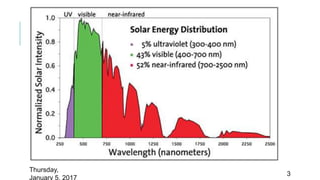
Forty-five percent of the total solar energy is in the non-visible
infrared region.
Heat is a direct consequence of infrared radiation incident on an
object.
 Infrared radiations range from 700 - 2500 nm wavelength. The
heat-producing region of the infrared radiations ranges from 700 -
1100 nm.
Excessive exposure may also lead to degradation of the materials.
Thursday, January
2
Thursday,
January 5, 2017
3
CHARACTERISTICS
Infrared reflective pigments are complex pigments, which reflect the
wavelengths in infrared region.
The reflectivity and absorptivity of the pigment are independent of each
other. Thus an IR reflective pigment may have any color.
These pigments are highly stable and chemically inert, also stable to high
temperatures.
They even remain colorfast in the presence of strong acids, bases,
oxidizing or reducing agents.
 Because of these properties, these pigments last as long as 30 years in
outdoors.
 The most expensive component of the formulation is the IR reflective
pigment.Thursday, January
5, 2017 4
MECHANISM
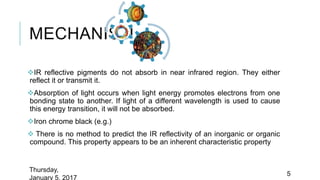
IR reflective pigments do not absorb in near infrared region. They either
reflect it or transmit it.
Absorption of light occurs when light energy promotes electrons from one
bonding state to another. If light of a different wavelength is used to cause
this energy transition, it will not be absorbed.
Iron chrome black (e.g.)
 There is no method to predict the IR reflectivity of an inorganic or organic
compound. This property appears to be an inherent characteristic property
Thursday,
January 5, 2017
5
FACTORS AFFECTING
INFRARED REFLECTIVITY
Individual pigment selection.
Dispersion.
Blending pigments.
Opacity.
Contamination.
Particle Size.
Thursday,
January 5, 2017
6
SYNTHESIS
Various attempts have been made to synthesize IR reflective pigments and
coatings. The synthesis strategies can be roughly divided in three parts.
1. Coating a thin film of glass or mica with an infra red reflecting substance
and holding it there by physical forces.
2. Coating a thin film of glass or mica with a metallic surface. Metals are
known to reflect almost entire visible and near IR radiations.
3. Synthesize inorganic crystalline substances, which have good
pigmentary properties and find out if these are also IR reflective.
 The pigments are synthesized by subjecting mixtures of metal hydroxides,
nitrates, acetates or even oxides, to very high temperatures in a process
called calcination. Metal and oxygen ions in the solids rearrange to form new,
more stable crystal structures such as spinel or rutile structures.(Temp-
+1000°C)
Thursday,
January 5, 2017 7
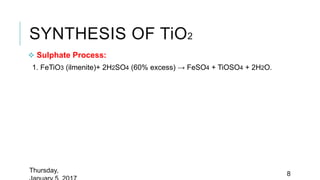
SYNTHESIS OF TiO2
 Sulphate Process:
1. FeTiO3 (ilmenite)+ 2H2SO4 (60% excess) → FeSO4 + TiOSO4 + 2H2O.
Thursday,
8
Thursday, January
5, 2017 9
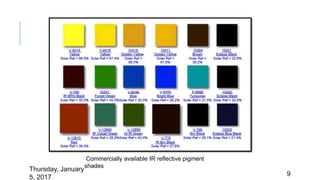
Commercially available IR reflective pigment
shades
TOTAL SOLAR REFLECTANCE
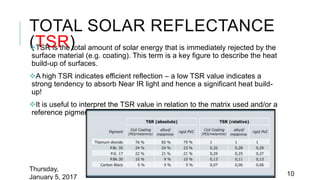
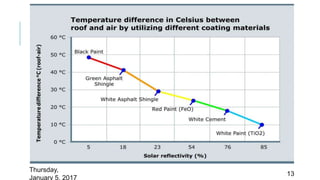
(TSR)TSR is the total amount of solar energy that is immediately rejected by the
surface material (e.g. coating). This term is a key figure to describe the heat
build-up of surfaces.
A high TSR indicates efficient reflection – a low TSR value indicates a
strong tendency to absorb Near IR light and hence a significant heat build-
up!
It is useful to interpret the TSR value in relation to the matrix used and/or a
reference pigment (e.g. titanium dioxide).
Thursday,
January 5, 2017 10
25,0
30,0
35,0
40,0
45,0
50,0
55,0
60,0
65,0
0 10 20 30 40 50 60
Irradiation time [min]
Temperature[°C]
Titaniumdioxide; max 43°C
P.Br. 29 (1); max 49°C
P.Bk. 30; max 55 °C
Carbon Black; max 63°C
Paint characteristic : Heat build-upThursday,
January 5, 2017
11
Paint characteristic : Total Solar Reflectance
0
10
20
30
40
50
60
70
80
90
100
300 800 1300 1800 2300
Wavelength [nm]
Reflectance[%] Titaniumdioxide; TSR 85%
Chromium Iron Oxide P.Br. 29 (1);
TSR 21%
Chrome Iron Nickel Black Spinel P.Bk.30;
TSR 9%
Carbon Black; TSR 5%
Thursday,
January 5, 2017 12
Thursday,
January 5, 2017
13
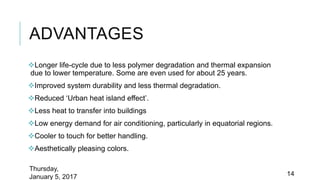
ADVANTAGES
Longer life-cycle due to less polymer degradation and thermal expansion
due to lower temperature. Some are even used for about 25 years.
Improved system durability and less thermal degradation.
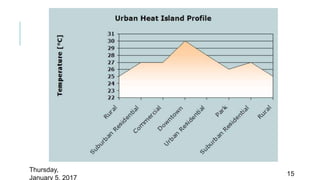
Reduced ‘Urban heat island effect’.
Less heat to transfer into buildings
Low energy demand for air conditioning, particularly in equatorial regions.
Cooler to touch for better handling.
Aesthetically pleasing colors.
Thursday,
January 5, 2017 14
Thursday,
January 5, 2017
15
APPLICATIONS
Coatings.
Vinyl window and sliding.
Cement, concrete and pavers.
Automotive applications.
Military applications.
Infrared reflection from fire.
a.Coatings that do not burn when exposed to fire, generally referred to as
"fire resistant“.
b.Coatings that insulate the flammable substrate, keeping its temperature
lower than the combustion point, generally referred to as "intumescent".
Thursday,
January 5, 2017
16
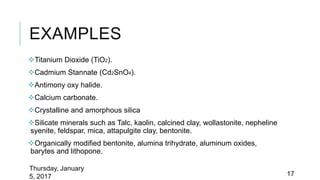
EXAMPLES
Titanium Dioxide (TiO2).
Cadmium Stannate (Cd2SnO4).
Antimony oxy halide.
Calcium carbonate.
Crystalline and amorphous silica
Silicate minerals such as Talc, kaolin, calcined clay, wollastonite, nepheline
syenite, feldspar, mica, attapulgite clay, bentonite.
Organically modified bentonite, alumina trihydrate, aluminum oxides,
barytes and lithopone.
Thursday, January
5, 2017 17
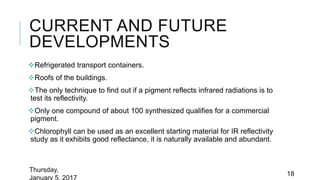
CURRENT AND FUTURE
DEVELOPMENTS
Refrigerated transport containers.
Roofs of the buildings.
The only technique to find out if a pigment reflects infrared radiations is to
test its reflectivity.
Only one compound of about 100 synthesized qualifies for a commercial
pigment.
Chlorophyll can be used as an excellent starting material for IR reflectivity
study as it exhibits good reflectance, it is naturally available and abundant.
Thursday,
January 5, 2017
18
TOP MANUFACTURERS
Thursday,
January 5, 2017 19
Thursday,
January 5, 2017
20

Infrared reflective pigments

  • 1.
  • 2.
    INTRODUCTION Pigments are inorganicor organic substances that are insoluble in water or the organic medium in which they are used as dispersions. Forty-five percent of the total solar energy is in the non-visible infrared region. Heat is a direct consequence of infrared radiation incident on an object.  Infrared radiations range from 700 - 2500 nm wavelength. The heat-producing region of the infrared radiations ranges from 700 - 1100 nm. Excessive exposure may also lead to degradation of the materials. Thursday, January 2
  • 3.
  • 4.
    CHARACTERISTICS Infrared reflective pigmentsare complex pigments, which reflect the wavelengths in infrared region. The reflectivity and absorptivity of the pigment are independent of each other. Thus an IR reflective pigment may have any color. These pigments are highly stable and chemically inert, also stable to high temperatures. They even remain colorfast in the presence of strong acids, bases, oxidizing or reducing agents.  Because of these properties, these pigments last as long as 30 years in outdoors.  The most expensive component of the formulation is the IR reflective pigment.Thursday, January 5, 2017 4
  • 5.
    MECHANISM IR reflective pigmentsdo not absorb in near infrared region. They either reflect it or transmit it. Absorption of light occurs when light energy promotes electrons from one bonding state to another. If light of a different wavelength is used to cause this energy transition, it will not be absorbed. Iron chrome black (e.g.)  There is no method to predict the IR reflectivity of an inorganic or organic compound. This property appears to be an inherent characteristic property Thursday, January 5, 2017 5
  • 6.
    FACTORS AFFECTING INFRARED REFLECTIVITY Individualpigment selection. Dispersion. Blending pigments. Opacity. Contamination. Particle Size. Thursday, January 5, 2017 6
  • 7.
    SYNTHESIS Various attempts havebeen made to synthesize IR reflective pigments and coatings. The synthesis strategies can be roughly divided in three parts. 1. Coating a thin film of glass or mica with an infra red reflecting substance and holding it there by physical forces. 2. Coating a thin film of glass or mica with a metallic surface. Metals are known to reflect almost entire visible and near IR radiations. 3. Synthesize inorganic crystalline substances, which have good pigmentary properties and find out if these are also IR reflective.  The pigments are synthesized by subjecting mixtures of metal hydroxides, nitrates, acetates or even oxides, to very high temperatures in a process called calcination. Metal and oxygen ions in the solids rearrange to form new, more stable crystal structures such as spinel or rutile structures.(Temp- +1000°C) Thursday, January 5, 2017 7
  • 8.
    SYNTHESIS OF TiO2 Sulphate Process: 1. FeTiO3 (ilmenite)+ 2H2SO4 (60% excess) → FeSO4 + TiOSO4 + 2H2O. Thursday, 8
  • 9.
    Thursday, January 5, 20179 Commercially available IR reflective pigment shades
  • 10.
    TOTAL SOLAR REFLECTANCE (TSR)TSRis the total amount of solar energy that is immediately rejected by the surface material (e.g. coating). This term is a key figure to describe the heat build-up of surfaces. A high TSR indicates efficient reflection – a low TSR value indicates a strong tendency to absorb Near IR light and hence a significant heat build- up! It is useful to interpret the TSR value in relation to the matrix used and/or a reference pigment (e.g. titanium dioxide). Thursday, January 5, 2017 10
  • 11.
    25,0 30,0 35,0 40,0 45,0 50,0 55,0 60,0 65,0 0 10 2030 40 50 60 Irradiation time [min] Temperature[°C] Titaniumdioxide; max 43°C P.Br. 29 (1); max 49°C P.Bk. 30; max 55 °C Carbon Black; max 63°C Paint characteristic : Heat build-upThursday, January 5, 2017 11
  • 12.
    Paint characteristic :Total Solar Reflectance 0 10 20 30 40 50 60 70 80 90 100 300 800 1300 1800 2300 Wavelength [nm] Reflectance[%] Titaniumdioxide; TSR 85% Chromium Iron Oxide P.Br. 29 (1); TSR 21% Chrome Iron Nickel Black Spinel P.Bk.30; TSR 9% Carbon Black; TSR 5% Thursday, January 5, 2017 12
  • 13.
  • 14.
    ADVANTAGES Longer life-cycle dueto less polymer degradation and thermal expansion due to lower temperature. Some are even used for about 25 years. Improved system durability and less thermal degradation. Reduced ‘Urban heat island effect’. Less heat to transfer into buildings Low energy demand for air conditioning, particularly in equatorial regions. Cooler to touch for better handling. Aesthetically pleasing colors. Thursday, January 5, 2017 14
  • 15.
  • 16.
    APPLICATIONS Coatings. Vinyl window andsliding. Cement, concrete and pavers. Automotive applications. Military applications. Infrared reflection from fire. a.Coatings that do not burn when exposed to fire, generally referred to as "fire resistant“. b.Coatings that insulate the flammable substrate, keeping its temperature lower than the combustion point, generally referred to as "intumescent". Thursday, January 5, 2017 16
  • 17.
    EXAMPLES Titanium Dioxide (TiO2). CadmiumStannate (Cd2SnO4). Antimony oxy halide. Calcium carbonate. Crystalline and amorphous silica Silicate minerals such as Talc, kaolin, calcined clay, wollastonite, nepheline syenite, feldspar, mica, attapulgite clay, bentonite. Organically modified bentonite, alumina trihydrate, aluminum oxides, barytes and lithopone. Thursday, January 5, 2017 17
  • 18.
    CURRENT AND FUTURE DEVELOPMENTS Refrigeratedtransport containers. Roofs of the buildings. The only technique to find out if a pigment reflects infrared radiations is to test its reflectivity. Only one compound of about 100 synthesized qualifies for a commercial pigment. Chlorophyll can be used as an excellent starting material for IR reflectivity study as it exhibits good reflectance, it is naturally available and abundant. Thursday, January 5, 2017 18
  • 19.
  • 20.