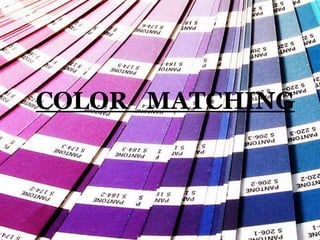



COLOR MATCHING
SUDIPTA DAS
Bangladesh University Of
Textiles
TEXTILE ENGINEERING COLLEGE,
ZORARGONJ Affiliated by
44th faculty selection of GREEN
UNIVERSITY
Roll no.80441005
Color is an aspect of visual perception dependent on the
spectral composition of observed radiant energy. Color is
physical impression of human mind. It is impossible to
measure.
• Color is the general name for all sensations arising
from the activity of the retina of the eye and its
attached nervous mechanism, this activity being in
nearly every case in the normal individual, a specific
response to radiant energy of certain wavelength and
intensity
Color Matching
The process of assuring that a color on one medium
remains the same when converted to another medium.
Color matching is the process of transferring a
particular color across different technologies or
platforms. This may be difficult when the two different
technologies use different color modeling tools. Such as
some technologies use RGB as the color model whether
some use pantone box as the color model.
Important of color matching in textile:
To provide required shade.
To avoid metamerism.
Cost effectiveness.
Comparing color difference.
Color matching
Factors:
o Light source
o Observer Difference
o Size Difference
o Background Difference
o Directional difference
Computer color matching system is one of the most used color matching
system. Computer Color Matching (CCM) is the instrumental color formulation
based on recipe calculation using the spectrophotometric properties of dyestuff
and fibers. Pantone color chart also used for color matching for textile. But
computer color matching system is more accurate.
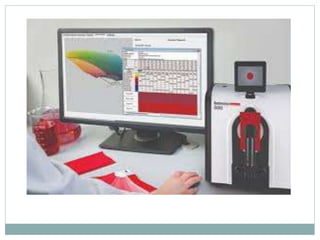
A computer color matching system comprises of,
 A spectrophotometer.
 A personal computer.
 A color matching software.
the basic three things are important in CCMS:
 Color measurement Instrument (Spectrophotometers).
 Reflectance (R%) from a mixture of Dyes or Pigments applied in a
specific way.
 Optical model of color vision to closeness of the color matching (CIE
L*A*B).
The spectrophotometer is a physical tool which is eminently
suited to measure the most important variable of all ,the
shade and strength of the dyestuffs themselves, whether they
be in solution or on the fiber. It is used by dyeing factory and
colorant manufacturers all over the world .Normally Color
lab manager analysis the color of swatch with the help of
spectrophotometer.
Parts of spectrophotometer
o A Stable and cheap radiant energy source
o A monochromator, to break the polychromatic
radiation into component wavelength (or) bands of
wavelengths.
o Transport vessels (cuvettes), to hold the sample
o A Photosensitive detector and an associated readout
system
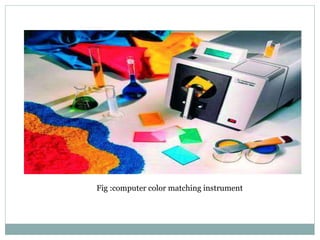
Fig :computer color matching instrument
Functions of Computer Color Matching
System:
The following works can be done by using CCMS –
1. Color match prediction.
2. Color difference calculation.
3. Determine metamerism.
4. Pass/Fail option.
5. Color fastness rating.
6. Cost Comparison.
7. Strength evaluation of dyes.
8. Whiteness indices.
9. Reflectance curve and K/S curve.
10. Production of Shade library.
11. Color strength
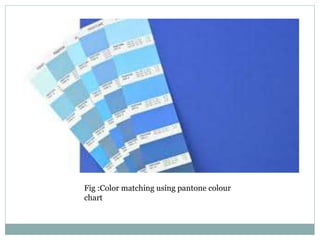
Fig :Color matching using pantone colour
chart
Advantages of Computer Color Matching
System (CCMS) :
Computer Color Matching System (CCMS) has lots of great
advantages in Textile Industry. See some examples below –
Customers get the exact shade wanted with his knowledge of
degree of metamerism.
 Customers often have a choice of 10-20 formulation that
will match color. By taking costing, availability of dyes,
and auxiliaries into account, one can choose a best
swatch.
 3 to 300 times faster than manual color matching.
 Limited range of stock color needed.
THANK YOU

Color matching

  • 1.
  • 2.
    SUDIPTA DAS Bangladesh UniversityOf Textiles TEXTILE ENGINEERING COLLEGE, ZORARGONJ Affiliated by 44th faculty selection of GREEN UNIVERSITY Roll no.80441005
  • 3.
    Color is anaspect of visual perception dependent on the spectral composition of observed radiant energy. Color is physical impression of human mind. It is impossible to measure. • Color is the general name for all sensations arising from the activity of the retina of the eye and its attached nervous mechanism, this activity being in nearly every case in the normal individual, a specific response to radiant energy of certain wavelength and intensity
  • 4.
    Color Matching The processof assuring that a color on one medium remains the same when converted to another medium. Color matching is the process of transferring a particular color across different technologies or platforms. This may be difficult when the two different technologies use different color modeling tools. Such as some technologies use RGB as the color model whether some use pantone box as the color model.
  • 5.
    Important of colormatching in textile: To provide required shade. To avoid metamerism. Cost effectiveness. Comparing color difference. Color matching Factors: o Light source o Observer Difference o Size Difference o Background Difference o Directional difference
  • 6.
    Computer color matchingsystem is one of the most used color matching system. Computer Color Matching (CCM) is the instrumental color formulation based on recipe calculation using the spectrophotometric properties of dyestuff and fibers. Pantone color chart also used for color matching for textile. But computer color matching system is more accurate. A computer color matching system comprises of,  A spectrophotometer.  A personal computer.  A color matching software. the basic three things are important in CCMS:  Color measurement Instrument (Spectrophotometers).  Reflectance (R%) from a mixture of Dyes or Pigments applied in a specific way.  Optical model of color vision to closeness of the color matching (CIE L*A*B).
  • 7.
    The spectrophotometer isa physical tool which is eminently suited to measure the most important variable of all ,the shade and strength of the dyestuffs themselves, whether they be in solution or on the fiber. It is used by dyeing factory and colorant manufacturers all over the world .Normally Color lab manager analysis the color of swatch with the help of spectrophotometer. Parts of spectrophotometer o A Stable and cheap radiant energy source o A monochromator, to break the polychromatic radiation into component wavelength (or) bands of wavelengths. o Transport vessels (cuvettes), to hold the sample o A Photosensitive detector and an associated readout system
  • 8.
    Fig :computer colormatching instrument
  • 9.
    Functions of ComputerColor Matching System: The following works can be done by using CCMS – 1. Color match prediction. 2. Color difference calculation. 3. Determine metamerism. 4. Pass/Fail option. 5. Color fastness rating. 6. Cost Comparison. 7. Strength evaluation of dyes. 8. Whiteness indices. 9. Reflectance curve and K/S curve. 10. Production of Shade library. 11. Color strength
  • 11.
    Fig :Color matchingusing pantone colour chart
  • 12.
    Advantages of ComputerColor Matching System (CCMS) : Computer Color Matching System (CCMS) has lots of great advantages in Textile Industry. See some examples below – Customers get the exact shade wanted with his knowledge of degree of metamerism.  Customers often have a choice of 10-20 formulation that will match color. By taking costing, availability of dyes, and auxiliaries into account, one can choose a best swatch.  3 to 300 times faster than manual color matching.  Limited range of stock color needed.
  • 13.