JIMMA UNIVERSITY
JIMMA INSTITUTE OF TECHNOLOGY
SCHOOL OF CHEMICAL ENGINEERING
PROCESS ENGINEERING-(ChEg3214)
GROUP ASSIGNMENT AND PRESENTATION
Surface Coating Industry
PREPARED BY- THIRD YEAR-GROUP II STUDENTS
SUBMITED TO-MR YASIN M.(MSC.)
SUBMITTION DATE APRIL 25-2024
2
GROUP TWO
GROUP MEMBERS ID NO.
1. NATNAEL ALEMAYEHU………………………………………RU1439/14
2. SEADA MOHAMMEDNUR………………………………….RU0390/14
3. NYOK ADHALLA…………………………………………………Ru4772/14
3
CONTENTS
I. Surface Coating Industry
 Paints, pigments, varnishes
 Industrial Coatings
 printing inks, and industrial Polishes
4
 SURFACE-COATING SUBSTANCES –MIXTURE OF FILM-FORMING
MATERIALS WITH THE ADDITION OF PIGMENTS, SOLVENTS, AND
OTHER ADDITIVES, WHICH WHEN APPLIED TO A SURFACE AND THEN
DRIED, WILL YIELD A THIN FILM THAT IS FUNCTIONAL AND
DECORATIVE IN SENSE.
SURFACE-COATING SUBSTANCES:
RAW MATERIALS THERE ARE FOUR BASIC RAW MATERIALS
NECESSARY FOR THE PRODUCTION OF COATING SUBSTANCES:
1.PIGMENT 2. RESIN
3. SOLVENT 4. ADDITIVE
Surface Coating
Industries
5
Pigments
Pigments are colored, organic and inorganic substances that are widely
used in coating industries as well as in ink, plastic, rubber, ceramic and
paper industries whose main function is to impart color of desired tint
and shade.
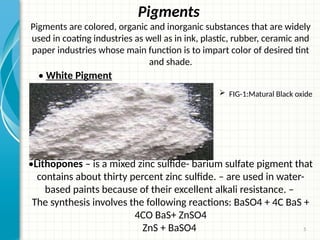
•Lithopones – is a mixed zinc sulfide- barium sulfate pigment that
contains about thirty percent zinc sulfide. – are used in water-
based paints because of their excellent alkali resistance. –
The synthesis involves the following reactions: BaSO4 + 4C BaS +
4CO BaS+ ZnSO4
ZnS + BaSO4
• White Pigment
 FIG-1:Matural Black oxide
6
•Titanium Dioxide – is regarded as the most important
white pigment being utilized by majority of industries
today – is marketed in two crystalline forms, anatase
and the more stable rutile.
Anatase can be converted to rutile by heating to 700-
950°C. TiO2 is widely employed in exterior paints and
also in enamels and lacquers.
Titanium Dioxide – It is manufactured via the following
processes:
Chloride Process in TiO2 making
Sulfate Process in TiO2 making
7
• Natural Black Oxide - This contains 94- 95% Fe2O3. It’s a
cheap pigment used in primers for metals. It can absorb about
10-15 kg of linseed oil per 100 kg of pigment.
Precipitated Black Iron Oxide - It has blue-black color and
manufactured from a solution of- FeCl2. The solution is taken in
wooden tanks and ample amount of lime water is added to it in
order to precipitate iron. Black Iron Oxide
 FIG-2:Matural Black oxide
8
Cont’d…..
Lampblack can be prepared by heating heavy mineral oils in a
limited supply of air. The soot is collected then from multi-
compartment chambers at regular intervals
 FIG-3: Precipitated Black Iron Oxide
 FIG-4: Lampblack
9
 FIG-5: ULTRAMARIRE BLUE
FIG-6: PHTHALOCYANINE BLUE
FIG-7:FERROCYANIDE BLUE
10
 FIG-8:RED LEAD
 FIG-9:
 FIG-11:
 FIG-10:
11
Cont’d…….
Cadmium Reds – a synthetic, inorganic pigment mostly made up
of cadmium sulfoselenide. – Cadmium red is low in oil absorption
with slow drying rate. It is suitable for all media except for exterior
designs.
Cadmium Red
Ochre Ochre
Chrome Yellows
Chromium Oxide Green
Phthalocyanine Green
Phthalo Green
12
Industrial Resin
these are synthetic polymers that have adhesive, film-forming and
useful reactive properties. - bind with pigments in order to form a
continuous film that is important for aesthetic and protective
purposes.
Industrial Resin
• Shellac • Phenolic Resin • Alkyd Resins • Unsaturated Polyester
resins. • Formaldehyde resins • Amino Resins • Epoxy Resins
A. Paint
• are stable mechanical mixtures of one or more pigments.
• Pigments and extenders are carried or suspended in dryings oils
or solvents.
• solvent serves as the drying material to which other ingredients
might be added
13
Types of Paint
• Solvent based 1. Emulsion based
• Water based 2. Latex based
GRAPH:1
14
Manufacturing
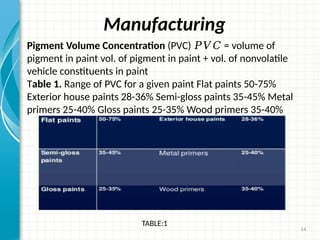
Pigment Volume Concentration (PVC) = volume of
𝑃𝑉𝐶
pigment in paint vol. of pigment in paint + vol. of nonvolatile
vehicle constituents in paint
Table 1. Range of PVC for a given paint Flat paints 50-75%
Exterior house paints 28-36% Semi-gloss paints 35-45% Metal
primers 25-40% Gloss paints 25-35% Wood primers 35-40%
TABLE:1
15
It is desired to make an exterior house paint of color blue with a
reddish undertone. The manufacturer decided to use a mass ratio of 2:3, a
combination of pigment to resin (polyvinyl acetate, PVA). Solvent will then
be added to about 25% utilized PVA at a flow rate of 100kg/h.
Determine if this combination will qualify as an exterior house paint.
The following empirical data are available as follows.
TABLE:2
16
Sample Problem
1.0 Substance SG, @ 25 Ultramarine Blue 2.35
℃
Phthalocyanine Blue 1.62 Prussian Blue 1.8 Polyvinyl Acetate 1.19
17
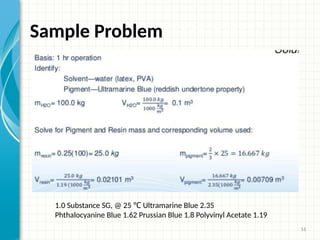
Solution Basis:
1 hr operation Identify: Solvent—water (latex, PVA) Pigment-
Ultramarine Blue (reddish undertone property) mH2O=
100.0 kg VH2O= 100.0 1000 3 = 0.1 m3 Solve for
𝑘𝑔 𝑘𝑔 𝑚
Pigment and Resin mass and corresponding volume used: mresin=
0.25(100)= 25.0kg mpigment= 2 3 × 25 = 16.667 Vresin=
𝑘𝑔
25.0 1.19 (1000 / 3 = 0.02101 m3 Vpigment= 16.667
𝑘𝑔 𝑘𝑔 𝑚 𝑘
2.35(1000 3 = 0.00709m3 PVC= 0.00709
𝑘𝑔 𝑚
0.02101+0.00709+0.1 × 100= 5.54%
B. Varnish - refers to a preparation consisting of resinous matter
such as copal or lac, dissolved in an oil or in alcohol or other
volatile liquid
18
Examples
• Spirit Varnishes • Oleoresinous Varnishes • Japans
C. Lacquers - defined as those non-convertible coatings and
principally as a coating composition based on a synthetic,
thermoplastic, film- forming material dissolved in organic solvents that
dries by solvent evaporation or a curing process that produces a hard,
durable finish.
D. Enamels - It is used to get a good gloss because after drying, the
enamels will form a very good lustrous and glossy finish.
Brushing - This is the simplest method and also the slowest and most
expensive. - Promotes better wetting of the surface and can be used in
restricted spaces, be useful for small areas, with less wastage and
contamination of surroundings.
Roller
Air Spray
Airless Spray
Electrostatic Spraying
19
FIG:12
20
THANKYOU!!!
APPRIL 25/2024
JIMMA,ETHIOPIA

Surface coating industry eng ppt.pptx

  • 1.
    JIMMA UNIVERSITY JIMMA INSTITUTEOF TECHNOLOGY SCHOOL OF CHEMICAL ENGINEERING PROCESS ENGINEERING-(ChEg3214) GROUP ASSIGNMENT AND PRESENTATION Surface Coating Industry PREPARED BY- THIRD YEAR-GROUP II STUDENTS SUBMITED TO-MR YASIN M.(MSC.) SUBMITTION DATE APRIL 25-2024
  • 2.
    2 GROUP TWO GROUP MEMBERSID NO. 1. NATNAEL ALEMAYEHU………………………………………RU1439/14 2. SEADA MOHAMMEDNUR………………………………….RU0390/14 3. NYOK ADHALLA…………………………………………………Ru4772/14
  • 3.
    3 CONTENTS I. Surface CoatingIndustry  Paints, pigments, varnishes  Industrial Coatings  printing inks, and industrial Polishes
  • 4.
    4  SURFACE-COATING SUBSTANCES–MIXTURE OF FILM-FORMING MATERIALS WITH THE ADDITION OF PIGMENTS, SOLVENTS, AND OTHER ADDITIVES, WHICH WHEN APPLIED TO A SURFACE AND THEN DRIED, WILL YIELD A THIN FILM THAT IS FUNCTIONAL AND DECORATIVE IN SENSE. SURFACE-COATING SUBSTANCES: RAW MATERIALS THERE ARE FOUR BASIC RAW MATERIALS NECESSARY FOR THE PRODUCTION OF COATING SUBSTANCES: 1.PIGMENT 2. RESIN 3. SOLVENT 4. ADDITIVE Surface Coating Industries
  • 5.
    5 Pigments Pigments are colored,organic and inorganic substances that are widely used in coating industries as well as in ink, plastic, rubber, ceramic and paper industries whose main function is to impart color of desired tint and shade. •Lithopones – is a mixed zinc sulfide- barium sulfate pigment that contains about thirty percent zinc sulfide. – are used in water- based paints because of their excellent alkali resistance. – The synthesis involves the following reactions: BaSO4 + 4C BaS + 4CO BaS+ ZnSO4 ZnS + BaSO4 • White Pigment  FIG-1:Matural Black oxide
  • 6.
    6 •Titanium Dioxide –is regarded as the most important white pigment being utilized by majority of industries today – is marketed in two crystalline forms, anatase and the more stable rutile. Anatase can be converted to rutile by heating to 700- 950°C. TiO2 is widely employed in exterior paints and also in enamels and lacquers. Titanium Dioxide – It is manufactured via the following processes: Chloride Process in TiO2 making Sulfate Process in TiO2 making
  • 7.
    7 • Natural BlackOxide - This contains 94- 95% Fe2O3. It’s a cheap pigment used in primers for metals. It can absorb about 10-15 kg of linseed oil per 100 kg of pigment. Precipitated Black Iron Oxide - It has blue-black color and manufactured from a solution of- FeCl2. The solution is taken in wooden tanks and ample amount of lime water is added to it in order to precipitate iron. Black Iron Oxide  FIG-2:Matural Black oxide
  • 8.
    8 Cont’d….. Lampblack can beprepared by heating heavy mineral oils in a limited supply of air. The soot is collected then from multi- compartment chambers at regular intervals  FIG-3: Precipitated Black Iron Oxide  FIG-4: Lampblack
  • 9.
    9  FIG-5: ULTRAMARIREBLUE FIG-6: PHTHALOCYANINE BLUE FIG-7:FERROCYANIDE BLUE
  • 10.
    10  FIG-8:RED LEAD FIG-9:  FIG-11:  FIG-10:
  • 11.
    11 Cont’d……. Cadmium Reds –a synthetic, inorganic pigment mostly made up of cadmium sulfoselenide. – Cadmium red is low in oil absorption with slow drying rate. It is suitable for all media except for exterior designs. Cadmium Red Ochre Ochre Chrome Yellows Chromium Oxide Green Phthalocyanine Green Phthalo Green
  • 12.
    12 Industrial Resin these aresynthetic polymers that have adhesive, film-forming and useful reactive properties. - bind with pigments in order to form a continuous film that is important for aesthetic and protective purposes. Industrial Resin • Shellac • Phenolic Resin • Alkyd Resins • Unsaturated Polyester resins. • Formaldehyde resins • Amino Resins • Epoxy Resins A. Paint • are stable mechanical mixtures of one or more pigments. • Pigments and extenders are carried or suspended in dryings oils or solvents. • solvent serves as the drying material to which other ingredients might be added
  • 13.
    13 Types of Paint •Solvent based 1. Emulsion based • Water based 2. Latex based GRAPH:1
  • 14.
    14 Manufacturing Pigment Volume Concentration(PVC) = volume of 𝑃𝑉𝐶 pigment in paint vol. of pigment in paint + vol. of nonvolatile vehicle constituents in paint Table 1. Range of PVC for a given paint Flat paints 50-75% Exterior house paints 28-36% Semi-gloss paints 35-45% Metal primers 25-40% Gloss paints 25-35% Wood primers 35-40% TABLE:1
  • 15.
    15 It is desiredto make an exterior house paint of color blue with a reddish undertone. The manufacturer decided to use a mass ratio of 2:3, a combination of pigment to resin (polyvinyl acetate, PVA). Solvent will then be added to about 25% utilized PVA at a flow rate of 100kg/h. Determine if this combination will qualify as an exterior house paint. The following empirical data are available as follows. TABLE:2
  • 16.
    16 Sample Problem 1.0 SubstanceSG, @ 25 Ultramarine Blue 2.35 ℃ Phthalocyanine Blue 1.62 Prussian Blue 1.8 Polyvinyl Acetate 1.19
  • 17.
    17 Solution Basis: 1 hroperation Identify: Solvent—water (latex, PVA) Pigment- Ultramarine Blue (reddish undertone property) mH2O= 100.0 kg VH2O= 100.0 1000 3 = 0.1 m3 Solve for 𝑘𝑔 𝑘𝑔 𝑚 Pigment and Resin mass and corresponding volume used: mresin= 0.25(100)= 25.0kg mpigment= 2 3 × 25 = 16.667 Vresin= 𝑘𝑔 25.0 1.19 (1000 / 3 = 0.02101 m3 Vpigment= 16.667 𝑘𝑔 𝑘𝑔 𝑚 𝑘 2.35(1000 3 = 0.00709m3 PVC= 0.00709 𝑘𝑔 𝑚 0.02101+0.00709+0.1 × 100= 5.54% B. Varnish - refers to a preparation consisting of resinous matter such as copal or lac, dissolved in an oil or in alcohol or other volatile liquid
  • 18.
    18 Examples • Spirit Varnishes• Oleoresinous Varnishes • Japans C. Lacquers - defined as those non-convertible coatings and principally as a coating composition based on a synthetic, thermoplastic, film- forming material dissolved in organic solvents that dries by solvent evaporation or a curing process that produces a hard, durable finish. D. Enamels - It is used to get a good gloss because after drying, the enamels will form a very good lustrous and glossy finish. Brushing - This is the simplest method and also the slowest and most expensive. - Promotes better wetting of the surface and can be used in restricted spaces, be useful for small areas, with less wastage and contamination of surroundings. Roller Air Spray Airless Spray Electrostatic Spraying
  • 19.
  • 20.