INTRODUCTION OF POLYESTER
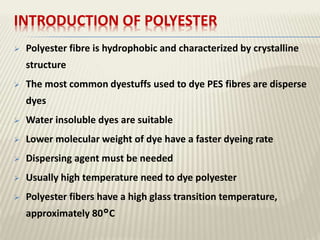
 Polyester fibre is hydrophobic and characterized by crystalline
structure
 The most common dyestuffs used to dye PES fibres are disperse
dyes
 Water insoluble dyes are suitable
 Lower molecular weight of dye have a faster dyeing rate
 Dispersing agent must be needed
 Usually high temperature need to dye polyester
 Polyester fibers have a high glass transition temperature,
approximately 80°C
DYEING at LOW TEMPERATURE (≤40°C)
Method
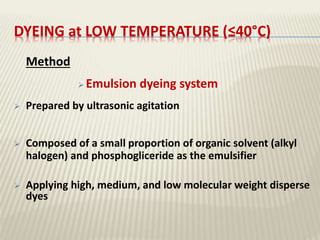
 Emulsion dyeing system
 Prepared by ultrasonic agitation
 Composed of a small proportion of organic solvent (alkyl
halogen) and phosphogliceride as the emulsifier
 Applying high, medium, and low molecular weight disperse
dyes
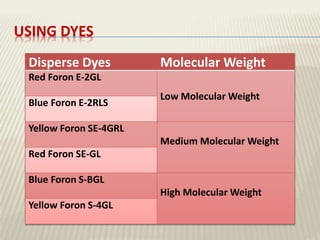
USING DYES
Disperse Dyes Molecular Weight
Red Foron E-2GL
Low Molecular Weight
Blue Foron E-2RLS
Yellow Foron SE-4GRL
Medium Molecular Weight
Red Foron SE-GL
Blue Foron S-BGL
High Molecular Weight
Yellow Foron S-4GL
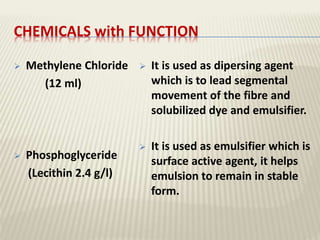
CHEMICALS with FUNCTION
 Methylene Chloride
(12 ml)
 Phosphoglyceride
(Lecithin 2.4 g/l)
 It is used as dipersing agent
which is to lead segmental
movement of the fibre and
solubilized dye and emulsifier.
 It is used as emulsifier which is
surface active agent, it helps
emulsion to remain in stable
form.
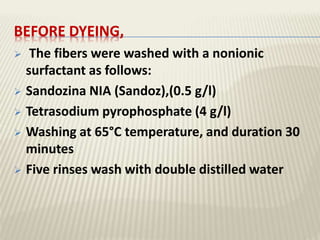
BEFORE DYEING,
 The fibers were washed with a nonionic
surfactant as follows:
 Sandozina NIA (Sandoz),(0.5 g/l)
 Tetrasodium pyrophosphate (4 g/l)
 Washing at 65°C temperature, and duration 30
minutes
 Five rinses wash with double distilled water
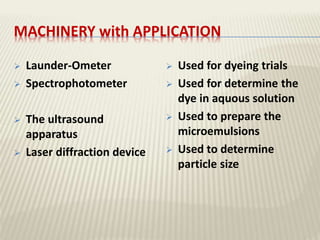
MACHINERY with APPLICATION
 Launder-Ometer
 Spectrophotometer
 The ultrasound
apparatus
 Laser diffraction device
 Used for dyeing trials
 Used for determine the
dye in aquous solution
 Used to prepare the
microemulsions
 Used to determine
particle size
DYEING KINETICS and RATE CONSTANT
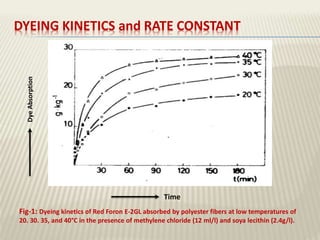
Fig-1: Dyeing kinetics of Red Foron E-2GL absorbed by polyester fibers at low temperatures of
20. 30. 35, and 40°C in the presence of methylene chloride (12 ml/l) and soya lecithin (2.4g/l).
DyeAbsorption
Time
DyeAbsorption
Time
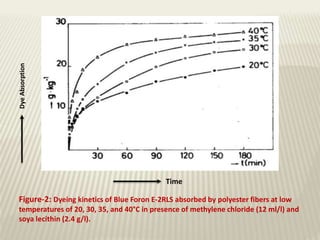
Figure-2: Dyeing kinetics of Blue Foron E-2RLS absorbed by polyester fibers at low
temperatures of 20, 30, 35, and 40°C in presence of methylene chloride (12 ml/l) and
soya lecithin (2.4 g/l).
DyeAbsorption
Time
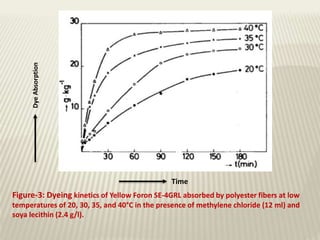
Figure-3: Dyeing kinetics of Yellow Foron SE-4GRL absorbed by polyester fibers at low
temperatures of 20, 30, 35, and 40°C in the presence of methylene chloride (12 ml) and
soya lecithin (2.4 g/l).
DyeAbsorption
Time
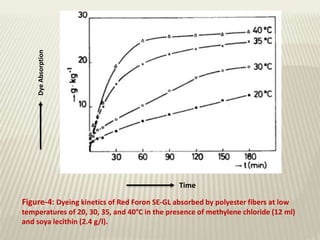
Figure-4: Dyeing kinetics of Red Foron SE-GL absorbed by polyester fibers at low
temperatures of 20, 30, 35, and 40°C in the presence of methylene chloride (12 ml)
and soya lecithin (2.4 g/l).
DyeAbsorption
Time
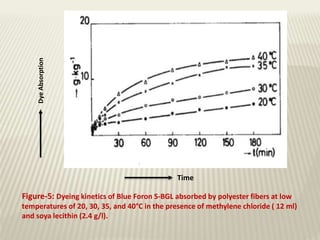
Figure-5: Dyeing kinetics of Blue Foron S-BGL absorbed by polyester fibers at low
temperatures of 20, 30, 35, and 40°C in the presence of methylene chloride ( 12 ml)
and soya lecithin (2.4 g/l).
DyeAbsorption
Time
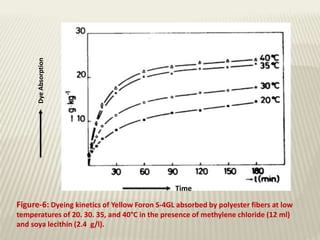
Figure-6: Dyeing kinetics of Yellow Foron S-4GL absorbed by polyester fibers at low
temperatures of 20. 30. 35, and 40°C in the presence of methylene chloride (12 ml)
and soya lecithin (2.4 g/l).
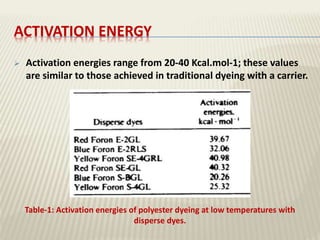
ACTIVATION ENERGY
 Activation energies range from 20-40 Kcal.mol-1; these values
are similar to those achieved in traditional dyeing with a carrier.
Table-1: Activation energies of polyester dyeing at low temperatures with
disperse dyes.
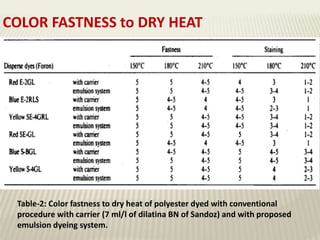
Table-2: Color fastness to dry heat of polyester dyed with conventional
procedure with carrier (7 ml/l of dilatina BN of Sandoz) and with proposed
emulsion dyeing system.
COLOR FASTNESS to DRY HEAT
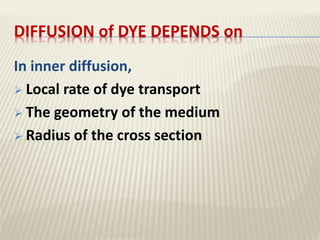
DIFFUSION of DYE DEPENDS on
In inner diffusion,
 Local rate of dye transport
 The geometry of the medium
 Radius of the cross section
DIFFERENCE between CARRIER and EMULSION
DYEING SYSTEM
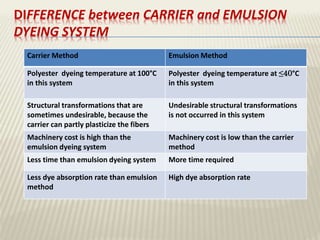
Carrier Method Emulsion Method
Polyester dyeing temperature at 100°C
in this system
Polyester dyeing temperature at ≤40°C
in this system
Structural transformations that are
sometimes undesirable, because the
carrier can partly plasticize the fibers
Undesirable structural transformations
is not occurred in this system
Machinery cost is high than the
emulsion dyeing system
Machinery cost is low than the carrier
method
Less time than emulsion dyeing system More time required
Less dye absorption rate than emulsion
method
High dye absorption rate
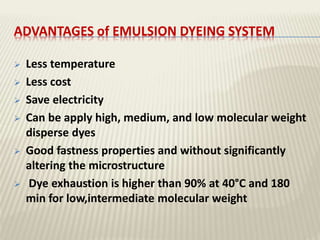
ADVANTAGES of EMULSION DYEING SYSTEM
 Less temperature
 Less cost
 Save electricity
 Can be apply high, medium, and low molecular weight
disperse dyes
 Good fastness properties and without significantly
altering the microstructure
 Dye exhaustion is higher than 90% at 40°C and 180
min for low,intermediate molecular weight
SHORT SUMMARY
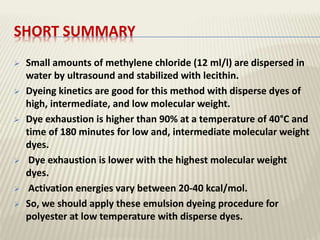
 Small amounts of methylene chloride (12 ml/l) are dispersed in
water by ultrasound and stabilized with lecithin.
 Dyeing kinetics are good for this method with disperse dyes of
high, intermediate, and low molecular weight.
 Dye exhaustion is higher than 90% at a temperature of 40°C and
time of 180 minutes for low and, intermediate molecular weight
dyes.
 Dye exhaustion is lower with the highest molecular weight
dyes.
 Activation energies vary between 20-40 kcal/mol.
 So, we should apply these emulsion dyeing procedure for
polyester at low temperature with disperse dyes.

Dyeing of polyester at low temperature

  • 3.
    INTRODUCTION OF POLYESTER Polyester fibre is hydrophobic and characterized by crystalline structure  The most common dyestuffs used to dye PES fibres are disperse dyes  Water insoluble dyes are suitable  Lower molecular weight of dye have a faster dyeing rate  Dispersing agent must be needed  Usually high temperature need to dye polyester  Polyester fibers have a high glass transition temperature, approximately 80°C
  • 4.
    DYEING at LOWTEMPERATURE (≤40°C) Method  Emulsion dyeing system  Prepared by ultrasonic agitation  Composed of a small proportion of organic solvent (alkyl halogen) and phosphogliceride as the emulsifier  Applying high, medium, and low molecular weight disperse dyes
  • 5.
    USING DYES Disperse DyesMolecular Weight Red Foron E-2GL Low Molecular Weight Blue Foron E-2RLS Yellow Foron SE-4GRL Medium Molecular Weight Red Foron SE-GL Blue Foron S-BGL High Molecular Weight Yellow Foron S-4GL
  • 6.
    CHEMICALS with FUNCTION Methylene Chloride (12 ml)  Phosphoglyceride (Lecithin 2.4 g/l)  It is used as dipersing agent which is to lead segmental movement of the fibre and solubilized dye and emulsifier.  It is used as emulsifier which is surface active agent, it helps emulsion to remain in stable form.
  • 7.
    BEFORE DYEING,  Thefibers were washed with a nonionic surfactant as follows:  Sandozina NIA (Sandoz),(0.5 g/l)  Tetrasodium pyrophosphate (4 g/l)  Washing at 65°C temperature, and duration 30 minutes  Five rinses wash with double distilled water
  • 8.
    MACHINERY with APPLICATION Launder-Ometer  Spectrophotometer  The ultrasound apparatus  Laser diffraction device  Used for dyeing trials  Used for determine the dye in aquous solution  Used to prepare the microemulsions  Used to determine particle size
  • 9.
    DYEING KINETICS andRATE CONSTANT Fig-1: Dyeing kinetics of Red Foron E-2GL absorbed by polyester fibers at low temperatures of 20. 30. 35, and 40°C in the presence of methylene chloride (12 ml/l) and soya lecithin (2.4g/l). DyeAbsorption Time
  • 10.
    DyeAbsorption Time Figure-2: Dyeing kineticsof Blue Foron E-2RLS absorbed by polyester fibers at low temperatures of 20, 30, 35, and 40°C in presence of methylene chloride (12 ml/l) and soya lecithin (2.4 g/l).
  • 11.
    DyeAbsorption Time Figure-3: Dyeing kineticsof Yellow Foron SE-4GRL absorbed by polyester fibers at low temperatures of 20, 30, 35, and 40°C in the presence of methylene chloride (12 ml) and soya lecithin (2.4 g/l).
  • 12.
    DyeAbsorption Time Figure-4: Dyeing kineticsof Red Foron SE-GL absorbed by polyester fibers at low temperatures of 20, 30, 35, and 40°C in the presence of methylene chloride (12 ml) and soya lecithin (2.4 g/l).
  • 13.
    DyeAbsorption Time Figure-5: Dyeing kineticsof Blue Foron S-BGL absorbed by polyester fibers at low temperatures of 20, 30, 35, and 40°C in the presence of methylene chloride ( 12 ml) and soya lecithin (2.4 g/l).
  • 14.
    DyeAbsorption Time Figure-6: Dyeing kineticsof Yellow Foron S-4GL absorbed by polyester fibers at low temperatures of 20. 30. 35, and 40°C in the presence of methylene chloride (12 ml) and soya lecithin (2.4 g/l).
  • 15.
    ACTIVATION ENERGY  Activationenergies range from 20-40 Kcal.mol-1; these values are similar to those achieved in traditional dyeing with a carrier. Table-1: Activation energies of polyester dyeing at low temperatures with disperse dyes.
  • 16.
    Table-2: Color fastnessto dry heat of polyester dyed with conventional procedure with carrier (7 ml/l of dilatina BN of Sandoz) and with proposed emulsion dyeing system. COLOR FASTNESS to DRY HEAT
  • 17.
    DIFFUSION of DYEDEPENDS on In inner diffusion,  Local rate of dye transport  The geometry of the medium  Radius of the cross section
  • 18.
    DIFFERENCE between CARRIERand EMULSION DYEING SYSTEM Carrier Method Emulsion Method Polyester dyeing temperature at 100°C in this system Polyester dyeing temperature at ≤40°C in this system Structural transformations that are sometimes undesirable, because the carrier can partly plasticize the fibers Undesirable structural transformations is not occurred in this system Machinery cost is high than the emulsion dyeing system Machinery cost is low than the carrier method Less time than emulsion dyeing system More time required Less dye absorption rate than emulsion method High dye absorption rate
  • 19.
    ADVANTAGES of EMULSIONDYEING SYSTEM  Less temperature  Less cost  Save electricity  Can be apply high, medium, and low molecular weight disperse dyes  Good fastness properties and without significantly altering the microstructure  Dye exhaustion is higher than 90% at 40°C and 180 min for low,intermediate molecular weight
  • 20.
    SHORT SUMMARY  Smallamounts of methylene chloride (12 ml/l) are dispersed in water by ultrasound and stabilized with lecithin.  Dyeing kinetics are good for this method with disperse dyes of high, intermediate, and low molecular weight.  Dye exhaustion is higher than 90% at a temperature of 40°C and time of 180 minutes for low and, intermediate molecular weight dyes.  Dye exhaustion is lower with the highest molecular weight dyes.  Activation energies vary between 20-40 kcal/mol.  So, we should apply these emulsion dyeing procedure for polyester at low temperature with disperse dyes.