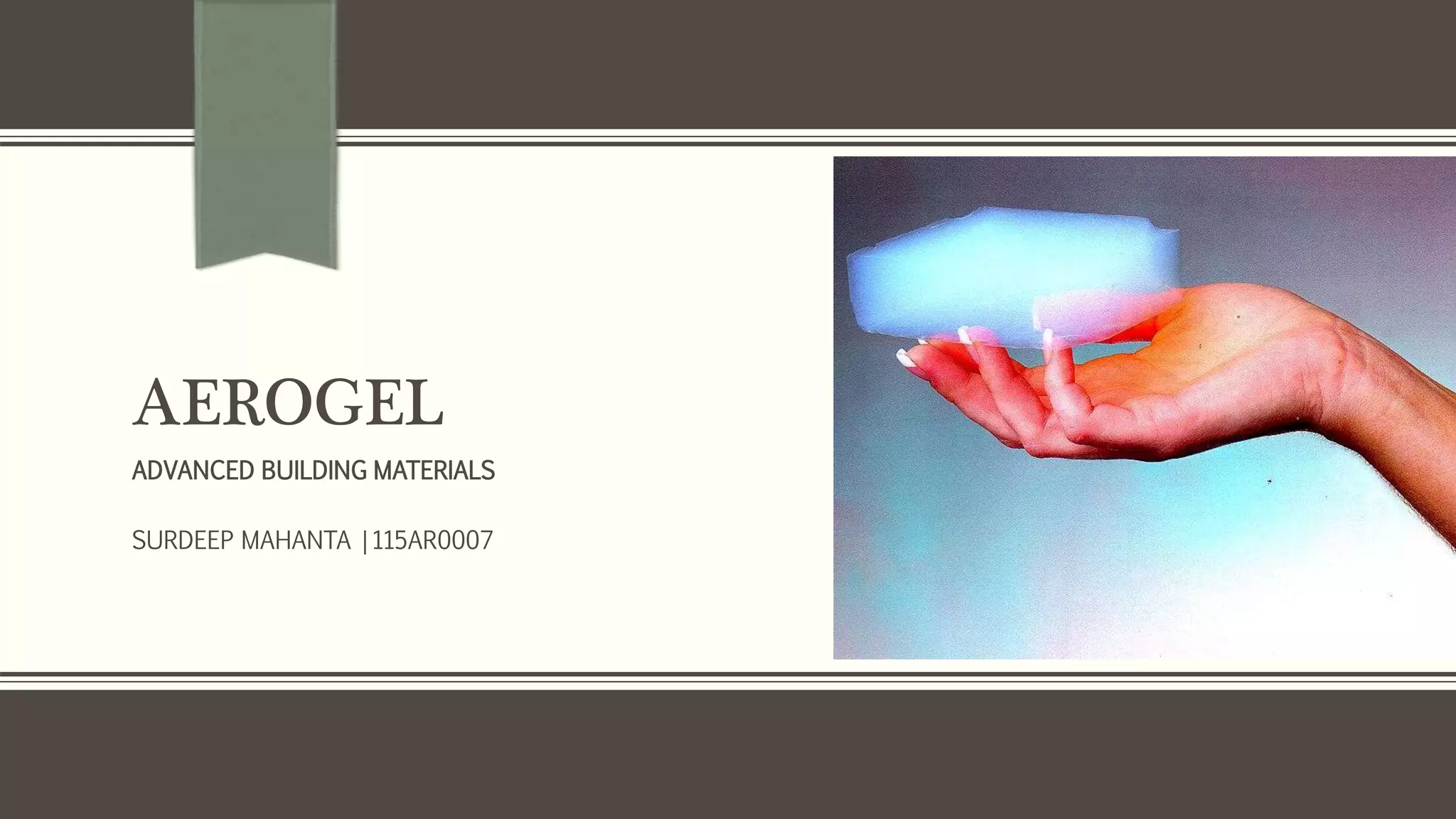
AEROGEL
ADVANCED BUILDING MATERIALS
SURDEEP MAHANTA |115AR0007
INTRODUCTION
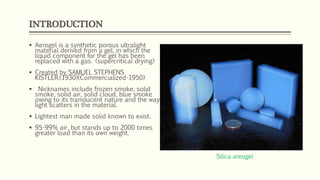
 Aerogel is a synthetic porous ultralight
material derived from a gel, in which the
liquid component for the gel has been
replaced with a gas. (supercritical drying)
 Created by SAMUEL STEPHENS
KISTLER.(1930)(Commercialized-1950)
 Nicknames include frozen smoke, solid
smoke, solid air, solid cloud, blue smoke
owing to its translucent nature and the way
light scatters in the material.
 Lightest man made solid known to exist.
 95-99% air, but stands up to 2000 times
greater load than its own weight.
Silica areogel
TYPES OF AEROGEL
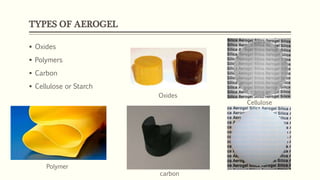
 Oxides
 Polymers
 Carbon
 Cellulose or Starch
Polymer
Cellulose
Oxides
carbon
SYNTHESIS OF AEROGEL
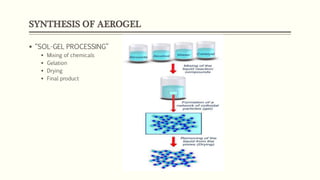
 “SOL-GEL PROCESSING”
 Mixing of chemicals
 Gelation
 Drying
 Final product
PROPERTIES
 Low density , High porosity. light weight
 Large sound absorption , Low sound velocity.
 Low thermal conductivity.
 Variable refractive index.
 Flexibility
 No reaction with metallic melts up to 950°C.
 Surface can be functionalized.
 Fracture strength
 Hardness
 high internal surface area makes it an excellent
thermal insulator
 Air cavities give aerogels high absorption properties.
 Hydrophobic
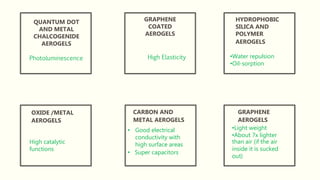
•Water repulsion
•Oil-sorption
QUANTUM DOT
AND METAL
CHALCOGENIDE
AEROGELS
Photoluminescence
GRAPHENE
COATED
AEROGELS
High Elasticity
HYDROPHOBIC
SILICA AND
POLYMER
AEROGELS
•Water repulsion
•Oil-sorption
OXIDE /METAL
AEROGELS
High catalytic
functions
CARBON AND
METAL AEROGELS
• Good electrical
conductivity with
high surface areas
• Super capacitors
GRAPHENE
AEROGELS
•Light weight
•About 7x lighter
than air (if the air
inside it is sucked
out)
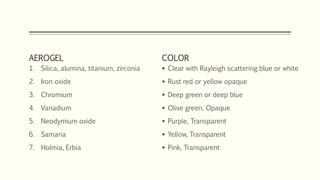
AEROGEL
1. Silica, alumina, titanium, zirconia
2. Iron oxide
3. Chromium
4. Vanadium
5. Neodymium oxide
6. Samaria
7. Holmia, Erbia
COLOR
 Clear with Rayleigh scattering blue or white
 Rust red or yellow opaque
 Deep green or deep blue
 Olive green, Opaque
 Purple, Transparent
 Yellow, Transparent
 Pink, Transparent
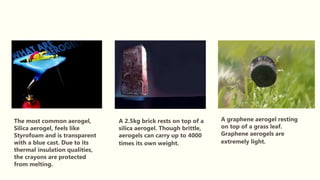
The most common aerogel,
Silica aerogel, feels like
Styrofoam and is transparent
with a blue cast. Due to its
thermal insulation qualities,
the crayons are protected
from melting.
A 2.5kg brick rests on top of a
silica aerogel. Though brittle,
aerogels can carry up to 4000
times its own weight.
A graphene aerogel resting
on top of a grass leaf.
Graphene aerogels are
extremely light.
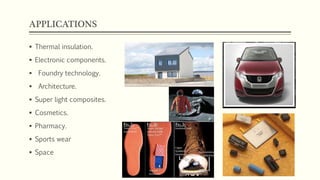
APPLICATIONS
 Thermal insulation.
 Electronic components.
 Foundry technology.
 Architecture.
 Super light composites.
 Cosmetics.
 Pharmacy.
 Sports wear
 Space
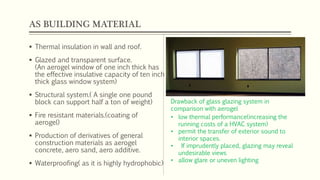
AS BUILDING MATERIAL
 Thermal insulation in wall and roof.
 Glazed and transparent surface.
(An aerogel window of one inch thick has
the effective insulative capacity of ten inch
thick glass window system)
 Structural system.( A single one pound
block can support half a ton of weight)
 Fire resistant materials.(coating of
aerogel)
 Production of derivatives of general
construction materials as aerogel
concrete, aero sand, aero additive.
 Waterproofing( as it is highly hydrophobic)
• low thermal performance(increasing the
running costs of a HVAC system)
• permit the transfer of exterior sound to
interior spaces.
• If imprudently placed, glazing may reveal
undesirable views
• allow glare or uneven lighting
Drawback of glass glazing system in
comparison with aerogel
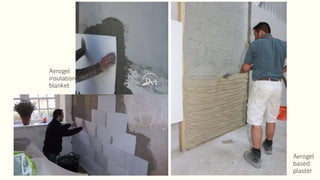
Aerogel
based
plaster
Aerogel
insulation
blanket
ADVANTAGES AS INSULATING MATERIALS
 Energy savings.
 Regulation of indoor climate.
 Light-weight material.
 High fire protection.
 Natural construction materials.
 No colonization by fungi.
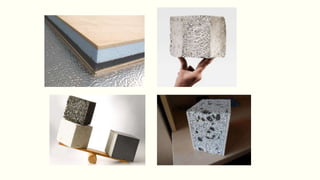
AEROGEL CONCRETE
 Composite made from
Hydrophobic aerogel granulate.
Inorganic binder/matrix.
 Binder/Matrix materials
Gypsum or plaster.
Cement.
 Technical challenges
Extreme density difference.
Bonding strength aerogel matrix interface.
FEATURES
• Lowest density.
• Fire protection.
• Thermal conductivity.
AEROGEL
CONTENT(Vol %)
HEAT
CONDUCTION(W/mK)
65%(+10% sand) .16
75%(+10% sand) .11
70%(without sand) .13
DERIVATIVES
AERO SAND
 Easy core removal
 Thermal conductivity 0.3 - 2 W/Km
 High strength 100 to 600 N/cm2
 Smooth surfaces
 No shrinkage
 No gas release during casting
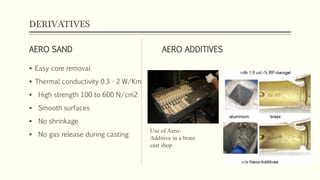
AERO ADDITIVES
Use of Aero-
Additive in a brass
cast shop
Disadvantages
Widespread uses of aerogel materials are restricted at present mainly due to their
 High production costs- Supercritical drying is the most expensive and risky aspect of
aerogel making process
 Poor mechanical properties-
 Health issues- Aerogels are a mechanical irritant to the eyes, skin, respiratory tract,
and digestive system. Protective gear including respiratory protection, gloves, and
eye goggles must be worn while handling aerogels
CONCLUSION
 Paints and coatings can be used for thermal insulation of buildings and work has
been done also in CSIR-CBRI . But aerogels are fast becoming alternate material of
choice for thermal insulation due to their ultralow thermal conductivity.
 In the preparation of aerogels supercritical drying is the most effective process.
 Futuristic.
REFERENCES
 Anjali Acharya, Vasudha A Gokhale, Deepa Joshi,”AEROGEL – A Promising Building
Material for Sustainable Buildings”, Chemical and Process Engineering Research
ISSN 2224-7467 (Paper) Vol.9,2013.
 C. Buratti , E. Moretti, ”Experimental performance evaluation of aerogel glazing
systems” Department of Industrial Engineering, University of Perugia, Via G.Duranti
67, 06125 Perugia, Italy
 Erdem Cuce, Pinar Mert Cuce, Christopher J. Wood, Saffa B. Riffat, Cinzia Buratti ,
Elisa Moretti , Elisa Belloni , and Fabrizio Agosti, “Development of Innovative Aerogel
Based Plasters: Preliminary Thermal and Acoustic Performance Evaluation”
 Optimizing insulation thickness and analyzing environmental impacts of aerogel-
based thermal super insulation in buildings – SCIENCE DIRECT.

Aerogel

  • 1.
  • 2.
    INTRODUCTION  Aerogel isa synthetic porous ultralight material derived from a gel, in which the liquid component for the gel has been replaced with a gas. (supercritical drying)  Created by SAMUEL STEPHENS KISTLER.(1930)(Commercialized-1950)  Nicknames include frozen smoke, solid smoke, solid air, solid cloud, blue smoke owing to its translucent nature and the way light scatters in the material.  Lightest man made solid known to exist.  95-99% air, but stands up to 2000 times greater load than its own weight. Silica areogel
  • 3.
    TYPES OF AEROGEL Oxides  Polymers  Carbon  Cellulose or Starch Polymer Cellulose Oxides carbon
  • 4.
    SYNTHESIS OF AEROGEL “SOL-GEL PROCESSING”  Mixing of chemicals  Gelation  Drying  Final product
  • 5.
    PROPERTIES  Low density, High porosity. light weight  Large sound absorption , Low sound velocity.  Low thermal conductivity.  Variable refractive index.  Flexibility  No reaction with metallic melts up to 950°C.  Surface can be functionalized.  Fracture strength  Hardness  high internal surface area makes it an excellent thermal insulator  Air cavities give aerogels high absorption properties.  Hydrophobic
  • 6.
    •Water repulsion •Oil-sorption QUANTUM DOT ANDMETAL CHALCOGENIDE AEROGELS Photoluminescence GRAPHENE COATED AEROGELS High Elasticity HYDROPHOBIC SILICA AND POLYMER AEROGELS •Water repulsion •Oil-sorption OXIDE /METAL AEROGELS High catalytic functions CARBON AND METAL AEROGELS • Good electrical conductivity with high surface areas • Super capacitors GRAPHENE AEROGELS •Light weight •About 7x lighter than air (if the air inside it is sucked out)
  • 7.
    AEROGEL 1. Silica, alumina,titanium, zirconia 2. Iron oxide 3. Chromium 4. Vanadium 5. Neodymium oxide 6. Samaria 7. Holmia, Erbia COLOR  Clear with Rayleigh scattering blue or white  Rust red or yellow opaque  Deep green or deep blue  Olive green, Opaque  Purple, Transparent  Yellow, Transparent  Pink, Transparent
  • 8.
    The most commonaerogel, Silica aerogel, feels like Styrofoam and is transparent with a blue cast. Due to its thermal insulation qualities, the crayons are protected from melting. A 2.5kg brick rests on top of a silica aerogel. Though brittle, aerogels can carry up to 4000 times its own weight. A graphene aerogel resting on top of a grass leaf. Graphene aerogels are extremely light.
  • 9.
    APPLICATIONS  Thermal insulation. Electronic components.  Foundry technology.  Architecture.  Super light composites.  Cosmetics.  Pharmacy.  Sports wear  Space
  • 10.
    AS BUILDING MATERIAL Thermal insulation in wall and roof.  Glazed and transparent surface. (An aerogel window of one inch thick has the effective insulative capacity of ten inch thick glass window system)  Structural system.( A single one pound block can support half a ton of weight)  Fire resistant materials.(coating of aerogel)  Production of derivatives of general construction materials as aerogel concrete, aero sand, aero additive.  Waterproofing( as it is highly hydrophobic) • low thermal performance(increasing the running costs of a HVAC system) • permit the transfer of exterior sound to interior spaces. • If imprudently placed, glazing may reveal undesirable views • allow glare or uneven lighting Drawback of glass glazing system in comparison with aerogel
  • 11.
  • 12.
    ADVANTAGES AS INSULATINGMATERIALS  Energy savings.  Regulation of indoor climate.  Light-weight material.  High fire protection.  Natural construction materials.  No colonization by fungi.
  • 13.
    AEROGEL CONCRETE  Compositemade from Hydrophobic aerogel granulate. Inorganic binder/matrix.  Binder/Matrix materials Gypsum or plaster. Cement.  Technical challenges Extreme density difference. Bonding strength aerogel matrix interface. FEATURES • Lowest density. • Fire protection. • Thermal conductivity. AEROGEL CONTENT(Vol %) HEAT CONDUCTION(W/mK) 65%(+10% sand) .16 75%(+10% sand) .11 70%(without sand) .13
  • 15.
    DERIVATIVES AERO SAND  Easycore removal  Thermal conductivity 0.3 - 2 W/Km  High strength 100 to 600 N/cm2  Smooth surfaces  No shrinkage  No gas release during casting AERO ADDITIVES Use of Aero- Additive in a brass cast shop
  • 16.
    Disadvantages Widespread uses ofaerogel materials are restricted at present mainly due to their  High production costs- Supercritical drying is the most expensive and risky aspect of aerogel making process  Poor mechanical properties-  Health issues- Aerogels are a mechanical irritant to the eyes, skin, respiratory tract, and digestive system. Protective gear including respiratory protection, gloves, and eye goggles must be worn while handling aerogels
  • 17.
    CONCLUSION  Paints andcoatings can be used for thermal insulation of buildings and work has been done also in CSIR-CBRI . But aerogels are fast becoming alternate material of choice for thermal insulation due to their ultralow thermal conductivity.  In the preparation of aerogels supercritical drying is the most effective process.  Futuristic.
  • 18.
    REFERENCES  Anjali Acharya,Vasudha A Gokhale, Deepa Joshi,”AEROGEL – A Promising Building Material for Sustainable Buildings”, Chemical and Process Engineering Research ISSN 2224-7467 (Paper) Vol.9,2013.  C. Buratti , E. Moretti, ”Experimental performance evaluation of aerogel glazing systems” Department of Industrial Engineering, University of Perugia, Via G.Duranti 67, 06125 Perugia, Italy  Erdem Cuce, Pinar Mert Cuce, Christopher J. Wood, Saffa B. Riffat, Cinzia Buratti , Elisa Moretti , Elisa Belloni , and Fabrizio Agosti, “Development of Innovative Aerogel Based Plasters: Preliminary Thermal and Acoustic Performance Evaluation”  Optimizing insulation thickness and analyzing environmental impacts of aerogel- based thermal super insulation in buildings – SCIENCE DIRECT.