HIGH VOLTAGE PULSED
GALVANIC STIMULATION
Prof. Dr. M. Rajesh, PT, M.P.T(cardio), BCRC
TRINITY MISSION AND MEDICAL
FOUNDATION
MADURAI
INTRODUCTION
 This form of currents was originally developed in the USA and
given this name. That twin pulse waveform has almost
instantaneous arises with exponential Falls.
HVPGS PARAMETERS
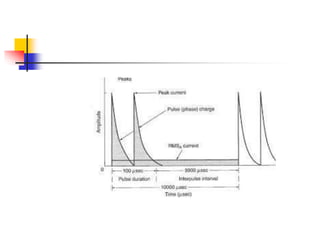
 The pair of pulses last for only 0.1 millisecond and each peak
lasts for only few microseconds; the shape and duration are
normally fixed. The frequency of the double pulse can be varied
usually from 2 - 100Hz. With search shorts peaks very high
voltages are needed to provide enough currents to stimulate
nerve fibers. Peak currents of 2 - 2.5A maybe generated during
the few microseconds of peak voltage, but of course the total
average current is very low at around 1.2 to 1.5 milliamp.
 Such pulsed current will pass easily through the tissues,
because they are so brief and will be relatively comfortable due
to their wide discrimination between sensory, motor and
nociceptor nerve fibers.
HVPGS GENERATOR
 As well as the frequency the intensity can be varies 0 to 500
volts and the polarity altered. The pattern of currents can be
changed by mode switch. In continuous mode the train of Twin
pulses is delivered continuously. Reciprocate mode refers to the
alternate application of trains of pulses to one or other of to
active pads and does not mean that's the current direction is
reversed. Surge mode gives a train of pulses. A meter to
indicate peak currents may be provided. On some machines the
interval between the two peaks may be altered; this is called
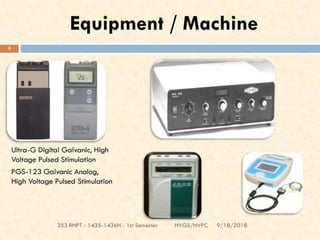
the interpulse interval. The current is applied by flexible
electrodes and sponges. The electrodes are usually small
and are sometimes mounted on a handle. Various special
electrodes are available.
USES OF HVPGS
WOUND HEALING
Since a direct current albeit of very low total intensity is being
applied. There seems to be e evidence that low-intensity
currents lead to tissue healing.
MUSCLE STIMULATION
 HVPGS is used for the stimulation of innervated muscle and due
to the short pulses and hence good transmission in the tissues it
is an efficient way of doing so. Consider the strength duration
curve which shows that short pulses at high intensities will be
more selective insulating motor, rather than pain nerves. HVPGS
has therefore been used for muscle strengthening and the
reduction of disuse atrophy of innervated muscle. Frequency of
around 30 Hz has been suggested with long intervals between
bouts of tetanic contraction as the optimum schedule.
PAIN MODULATION
 How pain may controlled by electrical stimulation already been
discussed since both the frequency and intensity of HVPGS can
be controlled it is possible to apply both high frequency, low
frequency stimulation for pain gate control and low frequency
high frequency stimulation for encephalin type pain control.
HVPGS has been recommended for controlling all kinds of pain
success acute, chronic, Neurogenic pain from many sources.
OTHER USES
 Effects on vascular system are claimed in that rhythmical
muscle contraction and relaxation due to HVPGS of motor
nerves will have a pumping effects, increasing blood flow in
muscle and surrounding tissues as considered earlier. This
effects can aid in the relation of tissue edema. Fish et al found
that anodal high voltage pulsed current did not curb edema
formation in frog Hind Limbs. This contrast markedly with
significant treatment effects found with cathodal HVPGS. Direct
effects on autonomic nerve leading to local vasodilation
increasing fluid exchange in the tissues and other beneficial
effects have been claimed.
 Consequent upon its ability to stimulate innervated muscle
HVPGS has been recommended in the treatment of muscle
spasm and to increase joint mobility. Some uncertainty exist
over the advantages of the Twin peaks waveform which is what
makes this current unique. It has been suggested that's a single
pulse could be just as effective.
THANK YOU
Prof. Dr. M. RAJESH, PT,M.P.T(cardio),B.C.R.C
TRINITY MISSIOIN AND MEDICAL
FOUNDATION
MADURAI.
Visit:
www.skpfc.wordpress.com

Hvpgs

  • 1.
    HIGH VOLTAGE PULSED GALVANICSTIMULATION Prof. Dr. M. Rajesh, PT, M.P.T(cardio), BCRC TRINITY MISSION AND MEDICAL FOUNDATION MADURAI
  • 2.
    INTRODUCTION  This formof currents was originally developed in the USA and given this name. That twin pulse waveform has almost instantaneous arises with exponential Falls.
  • 3.
    HVPGS PARAMETERS  Thepair of pulses last for only 0.1 millisecond and each peak lasts for only few microseconds; the shape and duration are normally fixed. The frequency of the double pulse can be varied usually from 2 - 100Hz. With search shorts peaks very high voltages are needed to provide enough currents to stimulate nerve fibers. Peak currents of 2 - 2.5A maybe generated during the few microseconds of peak voltage, but of course the total average current is very low at around 1.2 to 1.5 milliamp.
  • 5.
     Such pulsedcurrent will pass easily through the tissues, because they are so brief and will be relatively comfortable due to their wide discrimination between sensory, motor and nociceptor nerve fibers.
  • 6.
    HVPGS GENERATOR  Aswell as the frequency the intensity can be varies 0 to 500 volts and the polarity altered. The pattern of currents can be changed by mode switch. In continuous mode the train of Twin pulses is delivered continuously. Reciprocate mode refers to the alternate application of trains of pulses to one or other of to active pads and does not mean that's the current direction is reversed. Surge mode gives a train of pulses. A meter to indicate peak currents may be provided. On some machines the interval between the two peaks may be altered; this is called the interpulse interval. The current is applied by flexible electrodes and sponges. The electrodes are usually small and are sometimes mounted on a handle. Various special electrodes are available.
  • 8.
    USES OF HVPGS WOUNDHEALING Since a direct current albeit of very low total intensity is being applied. There seems to be e evidence that low-intensity currents lead to tissue healing.
  • 9.
    MUSCLE STIMULATION  HVPGSis used for the stimulation of innervated muscle and due to the short pulses and hence good transmission in the tissues it is an efficient way of doing so. Consider the strength duration curve which shows that short pulses at high intensities will be more selective insulating motor, rather than pain nerves. HVPGS has therefore been used for muscle strengthening and the reduction of disuse atrophy of innervated muscle. Frequency of around 30 Hz has been suggested with long intervals between bouts of tetanic contraction as the optimum schedule.
  • 10.
    PAIN MODULATION  Howpain may controlled by electrical stimulation already been discussed since both the frequency and intensity of HVPGS can be controlled it is possible to apply both high frequency, low frequency stimulation for pain gate control and low frequency high frequency stimulation for encephalin type pain control. HVPGS has been recommended for controlling all kinds of pain success acute, chronic, Neurogenic pain from many sources.
  • 11.
    OTHER USES  Effectson vascular system are claimed in that rhythmical muscle contraction and relaxation due to HVPGS of motor nerves will have a pumping effects, increasing blood flow in muscle and surrounding tissues as considered earlier. This effects can aid in the relation of tissue edema. Fish et al found that anodal high voltage pulsed current did not curb edema formation in frog Hind Limbs. This contrast markedly with significant treatment effects found with cathodal HVPGS. Direct effects on autonomic nerve leading to local vasodilation increasing fluid exchange in the tissues and other beneficial effects have been claimed.
  • 12.
     Consequent uponits ability to stimulate innervated muscle HVPGS has been recommended in the treatment of muscle spasm and to increase joint mobility. Some uncertainty exist over the advantages of the Twin peaks waveform which is what makes this current unique. It has been suggested that's a single pulse could be just as effective.
  • 13.
    THANK YOU Prof. Dr.M. RAJESH, PT,M.P.T(cardio),B.C.R.C TRINITY MISSIOIN AND MEDICAL FOUNDATION MADURAI. Visit: www.skpfc.wordpress.com