Information Systems,
Organizations,
Management, and
Strategy
OBJECTIVES
• Identify and describe important features of
organizations that managers need to know about
in order to build and use information systems
successfully
• Evaluate the impact of information systems on
organizations
• Assess how information systems support the
activities of managers in organizations
• Analyze how information systems support
various business strategies for competitive
advantage
• Assess the challenges posed by strategic
information systems and management solutions
OBJECTIVES
(Continued)
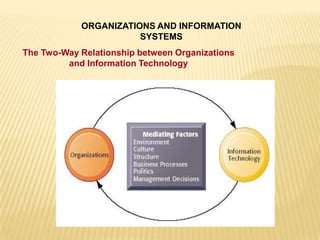
ORGANIZATIONS AND INFORMATION
SYSTEMS
The Two-Way Relationship between Organizations
and Information Technology
ORGANIZATIONS AND INFORMATION
SYSTEMS
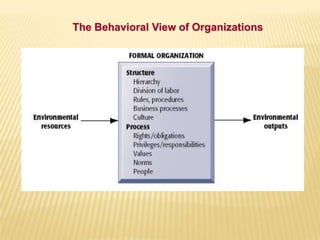
What Is an Organization?
Organization:
• Stable, formal social structure
• Takes resources from the environment and processes them
to produce outputs
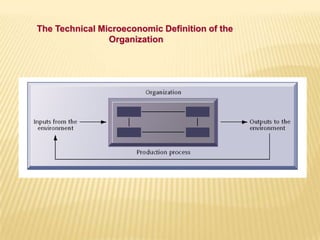
The Technical Microeconomic Definition of the
Organization
• Collection of rights, privileges, obligations, and
responsibilities
• Delicately balanced over a period of time through
conflict
• Conflict resolution
Behavioral Definition of Organization:
The Behavioral View of Organizations
• All organizations have some similar “structural”
features.
Common Features of Organizations
• Clear division of labor
• Hierarchy
• Explicit rules and procedures
• Impartial judgments
Shared Features of all Organizations:
• Technical qualifications for positions
• Maximum organizational efficiency
Shared Features of all Organizations: (Continued)
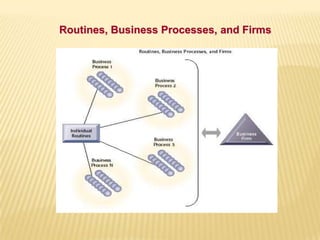
• Routines are patterns of individual behavior.
• Business processes are a collection of routines.
• Business firms are a collection of business
processes.
• Business processes enable organizations to cope
with all recurring expected situations.
Routines and Business Processes
Routines, Business Processes, and Firms
• Divergent viewpoints lead to political struggle,
competition, and conflict.
• Hamper organizational change
Organizational Politics
• What products the organization should produce
• How and where it should be produced
• For whom the products should be produced
Organizational Culture
• Structures
• Goals
• Constituencies
• Leadership styles
• Tasks
• Surrounding environments
Unique Features of Organizations
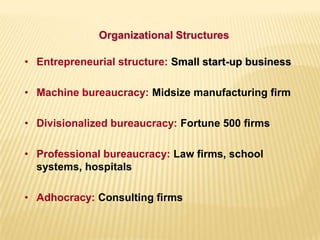
• Entrepreneurial structure: Small start-up business
• Machine bureaucracy: Midsize manufacturing firm
• Divisionalized bureaucracy: Fortune 500 firms
• Professional bureaucracy: Law firms, school
systems, hospitals
• Adhocracy: Consulting firms
Organizational Structures
• Organizations and environments have a
reciprocal relationship.
• Organizations are open to, and dependent on, the
social and physical environment.
• Organizations can influence their environments.
Organizations and Environments:
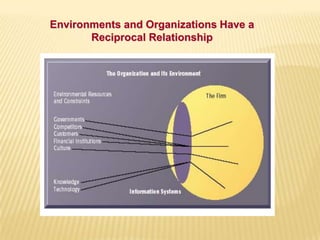
Environments and Organizations Have a
Reciprocal Relationship
• Ultimate goals
• Different groups and constituencies
• Nature of leadership
• Tasks and technology
Other Differences Among Organizations:
Organizing the IT Function
• Hardware
• Software
• Data storage
• Networks
The information systems department is
responsible for maintaining:
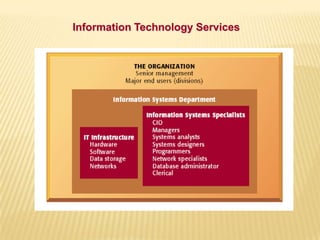
Information Technology Services
Includes Specialists:
• Programmers: Highly trained, writers of the
software instructions for computers
• Systems analysts: Translate business problems
into solutions, act as liaisons between the
information systems department and rest of the
organization
• Information system managers: Leaders of various
specialists
• Chief Information Officer (CIO): Senior manager in
charge of information systems function in the firm
• End users: Department representatives outside
the information system department for whom
applications are developed
Includes Specialists: (Continued)
• IT changes both the relative costs of capital and
the costs of information.
• Information systems technology is a factor of
production, like capital and labor.
Economic Impacts:
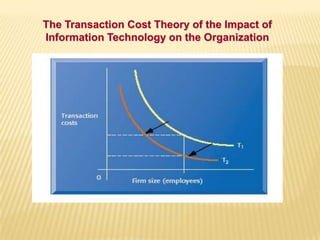
• Transaction cost theory: Firms seek to
economize on the cost of participating in markets
(transaction costs).
• IT lowers market transaction costs for firm,
making it worthwhile for firms to transact with
other firms rather than grow the number of
employees.
Economic Impacts: (Continued)
The Transaction Cost Theory of the Impact of
Information Technology on the Organization
• Agency theory: Firm is nexus of contracts among
self-interested parties requiring supervision.
• Firms experience agency costs (the cost of
managing and supervising).
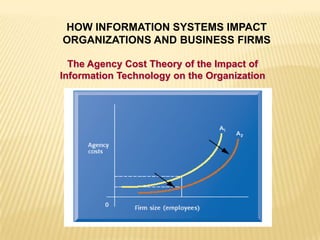
• IT can reduce agency costs, making it possible
for firms to grow without adding to the costs of
supervising, and without adding employees.
HOW INFORMATION SYSTEMS IMPACT
ORGANIZATIONS AND BUSINESS FIRMS
The Agency Cost Theory of the Impact of
Information Technology on the Organization
HOW INFORMATION SYSTEMS IMPACT
ORGANIZATIONS AND BUSINESS FIRMS
Organizational and Behavioral Impacts
IT Flattens Organizations:
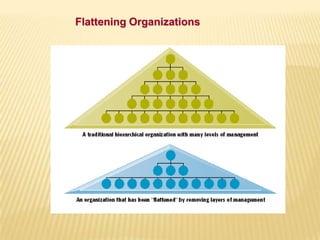
• Facilitates flattening of hierarchies
• Broadens the distribution of timely information
• Increases the speed of decision making
• Empowers lower-level employees to make
decisions without supervision and increase
management efficiency
• Management span of control (the number of
employees supervised by each manager) will
also grow
IT Flattens Organizations: (Continued)
Flattening Organizations
Postindustrial Organizations and Virtual Firms
Postindustrial Organizations:
• Authority increasingly relies on knowledge and
competence.
• Information technology encourages task
force-networked organizations.
Virtual Firms:
• Use networks to link people, assets, and ideas
• Can ally with suppliers, customers to create
and distribute new products and services
• Not limited to traditional organizational boundaries
or physical locations
• Information systems give both large and small
organizations additional flexibility to overcome the
limitations posed by their size.
• Small organizations use information systems to
acquire some of the muscle and reach of larger
organizations.
Increasing Flexibility of Organizations:
• Large organizations use information technology to
achieve some of the agility and responsiveness of
small organizations.
• Customization and personalization: IT makes it
possible to tailor products and services to
individuals.
Increasing Flexibility of Organizations: (Continued)
• Information systems become bound up in
organizational politics because they influence access
to a key resource.
• Information systems potentially change an
organization’s structure, culture, politics, and work.
• Most common reason for failure of large projects is due
to organizational and political resistance to change.
Understanding Organizational Resistance to Change:
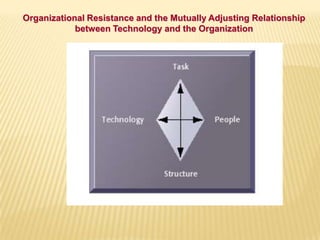
Organizational Resistance and the Mutually Adjusting Relationship
between Technology and the Organization
• The Internet increases the accessibility, storage,
distribution of information and knowledge for business
firms.
• The Internet lowers the transaction and agency costs
of firms.
• Businesses are rapidly rebuilding their key business
processes based on Internet technology. Example:
online order entry, customer service, and fulfillment of
orders.
The Internet and Organizations
The Role of Managers in Organizations
Classical Descriptions of Management:
• Traditional description of management
• Focuses on formal functions: Plan, organize,
coordinate, decide, control
THE IMPACT OF IT ON MANAGEMENT DECISION
MAKING
Behavioral Models:
• Describes management based on observations of what
managers actually do on the job
Managerial Roles:
• Expectation of activities that managers should perform
in an organization
• Interpersonal: Managers act as figureheads and
leaders.
• Informational: Managers receive and disseminate
critical information, nerve centers.
• Decisional: Managers initiate activities, allocate
resources, and negotiate conflicts.
Management Roles:
• Rational model: An individual manager identifies
goals, ranks all possible alternative actions and
chooses the alternative that contributes most to
those goals
• Organizational model: Considers the structural
and political characteristics of an organization
• Bureaucratic model: Whatever organizations do is
the result of routines and existing business
processes honed over years of active use
Models of Decision Making
• Political model: What an organization does is a
result of political bargains struck among key
leaders and interest groups
Models of Decision Making (Continued)
• Organizational environment
• Organizational structure, hierarchy, specialization,
routines, and business processes
• The organization’s culture and politics
Factors to consider while planning a new system:
Implications for the Design and Understanding of
Information Systems
• The type of organization and its style of leadership
• Groups affected by the system and the attitudes of
workers who will be using the system
• The kinds of tasks, decisions, and business processes
that the information system is designed to assist
Implications for the Design and Understanding of
Information Systems (Continued)
• Flexibility and multiple options for handling data and
evaluating information
• Capability to support a variety of management styles,
skills, and knowledge
Characteristics to be kept in mind while Designing
Systems:
• Capability to keep track of many alternatives and
consequences
• Sensitivity to the organization’s bureaucratic and
political requirements
Characteristics to be kept in mind while Designing
Systems: (Continued)
Business strategy decisions of the firms will
determine the following:
• The products and services a firm produces
• The industries in which the firm competes
• Competitors, suppliers, and customers of the firm
• Long-term goals of the firm
Business-Level Strategy: The Value Chain Model
The most common generic business level strategies are:
• Become the low-cost producer
• Differentiate your product from competitors’ products
• Change the scope of competition by enlarging the
market or narrowing it to a specialized niche
Value Chain Model:
• Highlights the primary or support activities that add
business value
• A good tool for understanding strategy at the business
firm level
Primary Activities:
• Directly related to the production and distribution of a
firm’s products or services
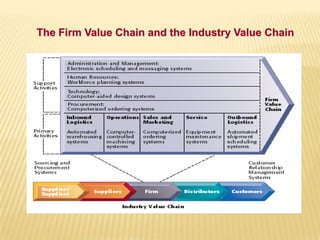
Support Activities:
• Make the delivery of primary activities possible
• Consist of the organization’s infrastructure, human
resources, technology, and procurement
The Firm Value Chain and the Industry Value Chain
• How can IT be used at each point in the value chain to
lower costs, differentiate products, and change the
scope of competition?
Strategic question:
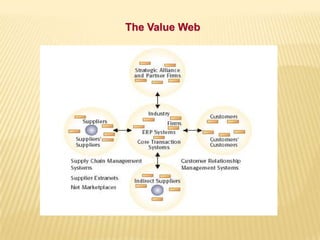
Internet-enabled Web of cooperating firms
• Customer-driven network of independent firms
• Uses information technology to coordinate value
chains of separate firms for collectively producing a
product or service
Value Web:
The Value Web
Systems that Create Product Differentiation:
• Firms can use IT to develop differentiated products.
• Create brand loyalty by developing new and unique
products and services
• Product and services not easily duplicated by
competitors
Information Systems Products and Services
• Uses intensive analysis of customer data to support
new ways of contacting and serving the customer
• Enables development of new market niches for
specialized products or services
Systems that Support Focused Differentiation:
• Link your firm’s value chain to the value chains of your
suppliers and customers
• Directly links consumer behavior back to distribution,
production, and supply chains
• Example: Wal-Mart directly links customer purchases
to suppliers in nearly real time. It is the suppliers’ job
to ensure products are shipped to the store to replace
purchased products
Supply Chain Management and Efficient Customer
Response Systems:
• IT is used at the firm level to discourage customers
from switching to other suppliers, and “locking” them
into a firm’s channels.
• Switching cost is the expense incurred by a customer
or company for changing from one supplier or system
to another.
Switching Costs and Lock-in Effects
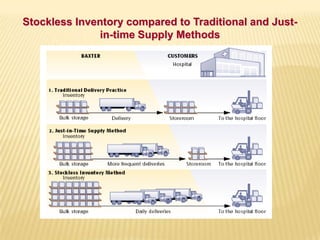
Stockless Inventory compared to Traditional and Just-
in-time Supply Methods
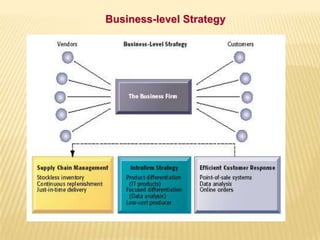
Business-level Strategy
Firm-Level Strategy and Information Technology
Core Competency:
• Activity at which a firm excels as a world-class leader
• Information systems encourage the sharing of
knowledge across business units and therefore
enhance firm competency
Firms operate in a larger environment composed of
other firms, governments, and nations
Information partnership:
• Cooperative alliance formed between two or more
corporations for sharing information to gain strategic
advantage
• Help firms gain access to new customers, creating new
opportunities for cross-selling and targeting products
Industry-Level Strategy and Information Systems:
Competitive Forces and Network Economics
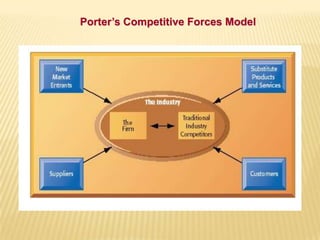
In the larger environment, there are five main forces or
threats:
• New market entrants
• Substitute products and services
• Suppliers
• Customers
• Other firms competing directly
Porter’s Five Forces Model
Porter’s Competitive Forces Model
• Encourage new entrants. Example: NetFlix vs.
Blockbuster
• Increase customer bargaining power.
IT and the Internet can greatly change the strength of
these competitive forces:
• Decrease in supplier power. Example: eCampus.com
increases the efficiency of used textbook market,
reducing publisher profits
• Substitute products. Example: online music lowers
value of record stores
IT and the Internet can greatly change the strength of
these competitive forces: (Continued)
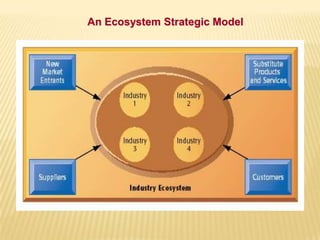
• Business ecosystems are interdependent networks of
suppliers, distributors, outsourcing firms,
transportation service firms, and technology
manufacturers.
IT plays a powerful role in creating new forms of
business ecosystems.
Business Ecosystems:
An Ecosystem Strategic Model
• IT products and services exhibit powerful network
effects and create potential “winner take all” situations.
• Network effects occur when adding more resources to
a process incurs little or zero cost, but large gains in
output.
• Contrary to the law of diminishing returns typical of
industrial and agricultural products
Network Economics:
• Example: Value of the Internet grows exponentially
with the linear increase in users.
• Example: Because certain software can become a
standard (like Windows operating systems or Windows
Office), people can get locked into that standard and
the value of Windows grows as more and more people
use it.
• Good strategy: Use IT to build products and services
that exhibit network effects.
Network Economics: (Continued)
• Firms face a continuing stream of IT-based
opportunities to achieve strategic advantages
Management Opportunities:
• Some firms face big hurdles in implementing
contemporary systems.
• Once an advantage is achieved, there are difficulties in
sustaining the advantage.
• Organizations often cannot change fast enough to
accommodate new technologies.
Management Challenges:

Information systems in organizations - Unitedworld School of Business

  • 1.
  • 2.
    OBJECTIVES • Identify anddescribe important features of organizations that managers need to know about in order to build and use information systems successfully • Evaluate the impact of information systems on organizations • Assess how information systems support the activities of managers in organizations
  • 3.
    • Analyze howinformation systems support various business strategies for competitive advantage • Assess the challenges posed by strategic information systems and management solutions OBJECTIVES (Continued)
  • 4.
    ORGANIZATIONS AND INFORMATION SYSTEMS TheTwo-Way Relationship between Organizations and Information Technology
  • 5.
    ORGANIZATIONS AND INFORMATION SYSTEMS WhatIs an Organization? Organization: • Stable, formal social structure • Takes resources from the environment and processes them to produce outputs
  • 6.
    The Technical MicroeconomicDefinition of the Organization
  • 7.
    • Collection ofrights, privileges, obligations, and responsibilities • Delicately balanced over a period of time through conflict • Conflict resolution Behavioral Definition of Organization:
  • 8.
    The Behavioral Viewof Organizations
  • 9.
    • All organizationshave some similar “structural” features. Common Features of Organizations
  • 10.
    • Clear divisionof labor • Hierarchy • Explicit rules and procedures • Impartial judgments Shared Features of all Organizations:
  • 11.
    • Technical qualificationsfor positions • Maximum organizational efficiency Shared Features of all Organizations: (Continued)
  • 12.
    • Routines arepatterns of individual behavior. • Business processes are a collection of routines. • Business firms are a collection of business processes. • Business processes enable organizations to cope with all recurring expected situations. Routines and Business Processes
  • 13.
  • 14.
    • Divergent viewpointslead to political struggle, competition, and conflict. • Hamper organizational change Organizational Politics
  • 15.
    • What productsthe organization should produce • How and where it should be produced • For whom the products should be produced Organizational Culture
  • 16.
    • Structures • Goals •Constituencies • Leadership styles • Tasks • Surrounding environments Unique Features of Organizations
  • 17.
    • Entrepreneurial structure:Small start-up business • Machine bureaucracy: Midsize manufacturing firm • Divisionalized bureaucracy: Fortune 500 firms • Professional bureaucracy: Law firms, school systems, hospitals • Adhocracy: Consulting firms Organizational Structures
  • 18.
    • Organizations andenvironments have a reciprocal relationship. • Organizations are open to, and dependent on, the social and physical environment. • Organizations can influence their environments. Organizations and Environments:
  • 19.
    Environments and OrganizationsHave a Reciprocal Relationship
  • 20.
    • Ultimate goals •Different groups and constituencies • Nature of leadership • Tasks and technology Other Differences Among Organizations:
  • 21.
    Organizing the ITFunction • Hardware • Software • Data storage • Networks The information systems department is responsible for maintaining:
  • 22.
  • 23.
    Includes Specialists: • Programmers:Highly trained, writers of the software instructions for computers • Systems analysts: Translate business problems into solutions, act as liaisons between the information systems department and rest of the organization • Information system managers: Leaders of various specialists
  • 24.
    • Chief InformationOfficer (CIO): Senior manager in charge of information systems function in the firm • End users: Department representatives outside the information system department for whom applications are developed Includes Specialists: (Continued)
  • 25.
    • IT changesboth the relative costs of capital and the costs of information. • Information systems technology is a factor of production, like capital and labor. Economic Impacts:
  • 26.
    • Transaction costtheory: Firms seek to economize on the cost of participating in markets (transaction costs). • IT lowers market transaction costs for firm, making it worthwhile for firms to transact with other firms rather than grow the number of employees. Economic Impacts: (Continued)
  • 27.
    The Transaction CostTheory of the Impact of Information Technology on the Organization
  • 28.
    • Agency theory:Firm is nexus of contracts among self-interested parties requiring supervision. • Firms experience agency costs (the cost of managing and supervising). • IT can reduce agency costs, making it possible for firms to grow without adding to the costs of supervising, and without adding employees. HOW INFORMATION SYSTEMS IMPACT ORGANIZATIONS AND BUSINESS FIRMS
  • 29.
    The Agency CostTheory of the Impact of Information Technology on the Organization HOW INFORMATION SYSTEMS IMPACT ORGANIZATIONS AND BUSINESS FIRMS
  • 30.
    Organizational and BehavioralImpacts IT Flattens Organizations: • Facilitates flattening of hierarchies • Broadens the distribution of timely information • Increases the speed of decision making
  • 31.
    • Empowers lower-levelemployees to make decisions without supervision and increase management efficiency • Management span of control (the number of employees supervised by each manager) will also grow IT Flattens Organizations: (Continued)
  • 32.
  • 33.
    Postindustrial Organizations andVirtual Firms Postindustrial Organizations: • Authority increasingly relies on knowledge and competence. • Information technology encourages task force-networked organizations.
  • 34.
    Virtual Firms: • Usenetworks to link people, assets, and ideas • Can ally with suppliers, customers to create and distribute new products and services • Not limited to traditional organizational boundaries or physical locations
  • 35.
    • Information systemsgive both large and small organizations additional flexibility to overcome the limitations posed by their size. • Small organizations use information systems to acquire some of the muscle and reach of larger organizations. Increasing Flexibility of Organizations:
  • 36.
    • Large organizationsuse information technology to achieve some of the agility and responsiveness of small organizations. • Customization and personalization: IT makes it possible to tailor products and services to individuals. Increasing Flexibility of Organizations: (Continued)
  • 37.
    • Information systemsbecome bound up in organizational politics because they influence access to a key resource. • Information systems potentially change an organization’s structure, culture, politics, and work. • Most common reason for failure of large projects is due to organizational and political resistance to change. Understanding Organizational Resistance to Change:
  • 38.
    Organizational Resistance andthe Mutually Adjusting Relationship between Technology and the Organization
  • 39.
    • The Internetincreases the accessibility, storage, distribution of information and knowledge for business firms. • The Internet lowers the transaction and agency costs of firms. • Businesses are rapidly rebuilding their key business processes based on Internet technology. Example: online order entry, customer service, and fulfillment of orders. The Internet and Organizations
  • 40.
    The Role ofManagers in Organizations Classical Descriptions of Management: • Traditional description of management • Focuses on formal functions: Plan, organize, coordinate, decide, control
  • 41.
    THE IMPACT OFIT ON MANAGEMENT DECISION MAKING Behavioral Models: • Describes management based on observations of what managers actually do on the job Managerial Roles: • Expectation of activities that managers should perform in an organization
  • 42.
    • Interpersonal: Managersact as figureheads and leaders. • Informational: Managers receive and disseminate critical information, nerve centers. • Decisional: Managers initiate activities, allocate resources, and negotiate conflicts. Management Roles:
  • 43.
    • Rational model:An individual manager identifies goals, ranks all possible alternative actions and chooses the alternative that contributes most to those goals • Organizational model: Considers the structural and political characteristics of an organization • Bureaucratic model: Whatever organizations do is the result of routines and existing business processes honed over years of active use Models of Decision Making
  • 44.
    • Political model:What an organization does is a result of political bargains struck among key leaders and interest groups Models of Decision Making (Continued)
  • 45.
    • Organizational environment •Organizational structure, hierarchy, specialization, routines, and business processes • The organization’s culture and politics Factors to consider while planning a new system: Implications for the Design and Understanding of Information Systems
  • 46.
    • The typeof organization and its style of leadership • Groups affected by the system and the attitudes of workers who will be using the system • The kinds of tasks, decisions, and business processes that the information system is designed to assist Implications for the Design and Understanding of Information Systems (Continued)
  • 47.
    • Flexibility andmultiple options for handling data and evaluating information • Capability to support a variety of management styles, skills, and knowledge Characteristics to be kept in mind while Designing Systems:
  • 48.
    • Capability tokeep track of many alternatives and consequences • Sensitivity to the organization’s bureaucratic and political requirements Characteristics to be kept in mind while Designing Systems: (Continued)
  • 49.
    Business strategy decisionsof the firms will determine the following: • The products and services a firm produces • The industries in which the firm competes • Competitors, suppliers, and customers of the firm • Long-term goals of the firm
  • 50.
    Business-Level Strategy: TheValue Chain Model The most common generic business level strategies are: • Become the low-cost producer • Differentiate your product from competitors’ products • Change the scope of competition by enlarging the market or narrowing it to a specialized niche
  • 51.
    Value Chain Model: •Highlights the primary or support activities that add business value • A good tool for understanding strategy at the business firm level Primary Activities: • Directly related to the production and distribution of a firm’s products or services
  • 52.
    Support Activities: • Makethe delivery of primary activities possible • Consist of the organization’s infrastructure, human resources, technology, and procurement
  • 53.
    The Firm ValueChain and the Industry Value Chain
  • 54.
    • How canIT be used at each point in the value chain to lower costs, differentiate products, and change the scope of competition? Strategic question:
  • 55.
    Internet-enabled Web ofcooperating firms • Customer-driven network of independent firms • Uses information technology to coordinate value chains of separate firms for collectively producing a product or service Value Web:
  • 56.
  • 57.
    Systems that CreateProduct Differentiation: • Firms can use IT to develop differentiated products. • Create brand loyalty by developing new and unique products and services • Product and services not easily duplicated by competitors Information Systems Products and Services
  • 58.
    • Uses intensiveanalysis of customer data to support new ways of contacting and serving the customer • Enables development of new market niches for specialized products or services Systems that Support Focused Differentiation:
  • 59.
    • Link yourfirm’s value chain to the value chains of your suppliers and customers • Directly links consumer behavior back to distribution, production, and supply chains • Example: Wal-Mart directly links customer purchases to suppliers in nearly real time. It is the suppliers’ job to ensure products are shipped to the store to replace purchased products Supply Chain Management and Efficient Customer Response Systems:
  • 60.
    • IT isused at the firm level to discourage customers from switching to other suppliers, and “locking” them into a firm’s channels. • Switching cost is the expense incurred by a customer or company for changing from one supplier or system to another. Switching Costs and Lock-in Effects
  • 61.
    Stockless Inventory comparedto Traditional and Just- in-time Supply Methods
  • 62.
  • 63.
    Firm-Level Strategy andInformation Technology Core Competency: • Activity at which a firm excels as a world-class leader • Information systems encourage the sharing of knowledge across business units and therefore enhance firm competency
  • 64.
    Firms operate ina larger environment composed of other firms, governments, and nations Information partnership: • Cooperative alliance formed between two or more corporations for sharing information to gain strategic advantage • Help firms gain access to new customers, creating new opportunities for cross-selling and targeting products Industry-Level Strategy and Information Systems: Competitive Forces and Network Economics
  • 65.
    In the largerenvironment, there are five main forces or threats: • New market entrants • Substitute products and services • Suppliers • Customers • Other firms competing directly Porter’s Five Forces Model
  • 66.
  • 67.
    • Encourage newentrants. Example: NetFlix vs. Blockbuster • Increase customer bargaining power. IT and the Internet can greatly change the strength of these competitive forces:
  • 68.
    • Decrease insupplier power. Example: eCampus.com increases the efficiency of used textbook market, reducing publisher profits • Substitute products. Example: online music lowers value of record stores IT and the Internet can greatly change the strength of these competitive forces: (Continued)
  • 69.
    • Business ecosystemsare interdependent networks of suppliers, distributors, outsourcing firms, transportation service firms, and technology manufacturers. IT plays a powerful role in creating new forms of business ecosystems. Business Ecosystems:
  • 70.
  • 71.
    • IT productsand services exhibit powerful network effects and create potential “winner take all” situations. • Network effects occur when adding more resources to a process incurs little or zero cost, but large gains in output. • Contrary to the law of diminishing returns typical of industrial and agricultural products Network Economics:
  • 72.
    • Example: Valueof the Internet grows exponentially with the linear increase in users. • Example: Because certain software can become a standard (like Windows operating systems or Windows Office), people can get locked into that standard and the value of Windows grows as more and more people use it. • Good strategy: Use IT to build products and services that exhibit network effects. Network Economics: (Continued)
  • 73.
    • Firms facea continuing stream of IT-based opportunities to achieve strategic advantages Management Opportunities:
  • 74.
    • Some firmsface big hurdles in implementing contemporary systems. • Once an advantage is achieved, there are difficulties in sustaining the advantage. • Organizations often cannot change fast enough to accommodate new technologies. Management Challenges: