Role and
Functions
PREPARED BY FAIZAN ALI
Management
Information System
Role of management information
system
 A management information system (MIS) is a computer-based system that provides
managers with the tools to organize, evaluate, and manage departments within an
organization. The primary role of an MIS is to support the management of an
organization by providing timely, relevant, and accurate information to decision
makers. This information can be used to improve efficiency, make better decisions,
and increase competitiveness.
There are several key functions of an
MIS:
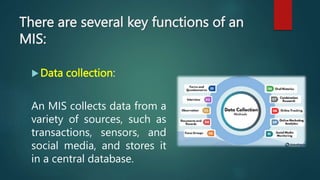
Data collection:
An MIS collects data from a
variety of sources, such as
transactions, sensors, and
social media, and stores it
in a central database.
Data processing:
The system processes the
data to convert it into usable
usable information, such as
reports, charts, and
dashboards.
 Data dissemination:
The system distributes
the processed
information to the
appropriate people
within the
organization,suchas
managers, employees,
and customers.
Decision support
The system provides
tools and resources to
help managers make
informed
decisions,such as
predictive analytics,
simulation, and
optimization.
 Communication and collaboration: An MIS
can facilitate communication and
collaboration within an organization by
providing tools such as email, instant
messaging, and video conferencing.
 Overall, the role of an MIS is to provide
managers with the information and tools
they need to make informed decisions and
effectively manage their departments.
Role and Functions.pptx

Role and Functions.pptx

  • 1.
    Role and Functions PREPARED BYFAIZAN ALI Management Information System
  • 2.
    Role of managementinformation system  A management information system (MIS) is a computer-based system that provides managers with the tools to organize, evaluate, and manage departments within an organization. The primary role of an MIS is to support the management of an organization by providing timely, relevant, and accurate information to decision makers. This information can be used to improve efficiency, make better decisions, and increase competitiveness.
  • 3.
    There are severalkey functions of an MIS: Data collection: An MIS collects data from a variety of sources, such as transactions, sensors, and social media, and stores it in a central database.
  • 4.
    Data processing: The systemprocesses the data to convert it into usable usable information, such as reports, charts, and dashboards.
  • 5.
     Data dissemination: Thesystem distributes the processed information to the appropriate people within the organization,suchas managers, employees, and customers.
  • 6.
    Decision support The systemprovides tools and resources to help managers make informed decisions,such as predictive analytics, simulation, and optimization.
  • 7.
     Communication andcollaboration: An MIS can facilitate communication and collaboration within an organization by providing tools such as email, instant messaging, and video conferencing.  Overall, the role of an MIS is to provide managers with the information and tools they need to make informed decisions and effectively manage their departments.