
Group Members:
Nayanajith, Sachith, Kavinda, Ayesha, Navinda,
Lakmi, Thilini
1
2
 What are Information Sources?
 Types of Information Sources
◦ Internal
◦ External
 Dynamic Nature of Data
 Characteristics of Information
◦ Top Level Information
◦ Operational Level Information
◦ Formal Information
◦ Informal Information
3
Data and information come from
both internal sources and external
sources of any organization. An
Information System should be able
to accommodate these information
collected for effective use.
4
Information
Sources
Internal External
5
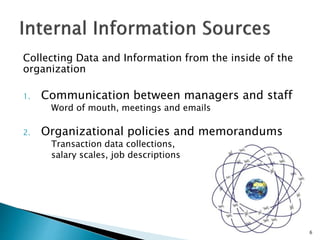
Collecting Data and Information from the inside of the
organization
1. Communication between managers and staff
Word of mouth, meetings and emails
2. Organizational policies and memorandums
Transaction data collections,
salary scales, job descriptions
6
Collecting Information from outside of the
organization
1. Government Policies
2. Information About Competitors
3. Research & Development Results
4. Marketing Information
5. Tax Rules
 Government legislations, invoices, advertisements,
letters from customers or suppliers
7
Organizational Data and Information
does not remain static i.e. it changes
over time. Organizations further
process information in information
systems to generate knowledge.
Therefore the Information Systems
must always verify the quality of
Information.
8
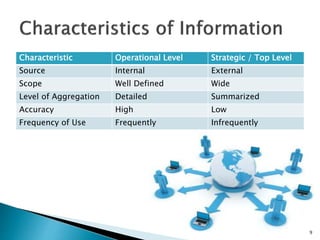
Characteristic Operational Level Strategic / Top Level
Source Internal External
Scope Well Defined Wide
Level of Aggregation Detailed Summarized
Accuracy High Low
Frequency of Use Frequently Infrequently
9
Feature Formal Informal
Flow Vertical Horizontal
Content Standardized Personal & Biased
Orientation To a Job To a Person
Flexibility Inflexible Flexible
10
11

Information sources

  • 1.
    Group Members: Nayanajith, Sachith,Kavinda, Ayesha, Navinda, Lakmi, Thilini 1
  • 2.
  • 3.
     What areInformation Sources?  Types of Information Sources ◦ Internal ◦ External  Dynamic Nature of Data  Characteristics of Information ◦ Top Level Information ◦ Operational Level Information ◦ Formal Information ◦ Informal Information 3
  • 4.
    Data and informationcome from both internal sources and external sources of any organization. An Information System should be able to accommodate these information collected for effective use. 4
  • 5.
  • 6.
    Collecting Data andInformation from the inside of the organization 1. Communication between managers and staff Word of mouth, meetings and emails 2. Organizational policies and memorandums Transaction data collections, salary scales, job descriptions 6
  • 7.
    Collecting Information fromoutside of the organization 1. Government Policies 2. Information About Competitors 3. Research & Development Results 4. Marketing Information 5. Tax Rules  Government legislations, invoices, advertisements, letters from customers or suppliers 7
  • 8.
    Organizational Data andInformation does not remain static i.e. it changes over time. Organizations further process information in information systems to generate knowledge. Therefore the Information Systems must always verify the quality of Information. 8
  • 9.
    Characteristic Operational LevelStrategic / Top Level Source Internal External Scope Well Defined Wide Level of Aggregation Detailed Summarized Accuracy High Low Frequency of Use Frequently Infrequently 9
  • 10.
    Feature Formal Informal FlowVertical Horizontal Content Standardized Personal & Biased Orientation To a Job To a Person Flexibility Inflexible Flexible 10
  • 11.