JUST DO IT.
Porter’s five forces | Group 05
About Nike
• Multinational American corporation
• Manufactures, designs, develops and markets footwear, clothing,
equipment, accessories and related services
• World’s largest supplier of footwear and clothing
• Brand value of $19 billion in 2014
History and origin
• Nike, originally known as Blue Ribbon Sports (BRS), was founded
by University of Oregon track athlete Philip Knight and his coach Bill
Bowerman in January 1964
• The company initially operated as a distributor for Japanese shoe
maker Onitsuka Tiger (now ASICS), making most sales at track meets
out of Knight's automobile
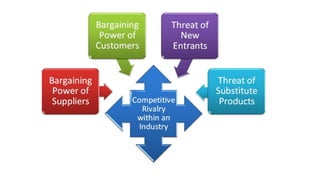
Porter’s five forces
• Rivalry of competitors within its industry
• Threat of new entrants into an industry and its market
• Threat posed by substitute products which might capture market
share
• Bargaining power of customers
• Bargaining power of suppliers
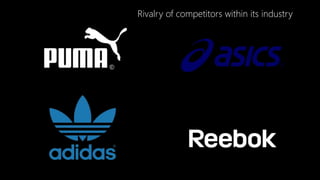
Rivalry of competitors within its industry
Threat of new entrants into an industry and
its market
• Significant capital resources are required for creating a new brand
• Nike enjoys a great degree of brand recognition and loyalty
• Having said that, we believe in more rising internet companies
• Rising competition from emerging players such as Under Armour and
Lululemon Athletica
nike.com
Just do it.
Threat posed by substitute products which
might capture market share
• The worldwide demand for athletic footwear, apparel and equipment
is expected to grow in the future as customers cannot substitute
these products
• However, the problem of counterfeit products is an area to watch
• As the quality of counterfeit products has been improving over the
recent past, we believe this could threaten the company’s sales in
emerging markets and could also potentially dilute Nike’s brand value
nike.com
Just do it.
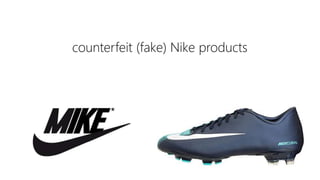
counterfeit (fake) Nike products
Bargaining power of customers
• Nike caters to its customers through both the wholesale and direct-
to-consumer channels
• Direct-to-consumer sales rose by 23%, as compared to 6% growth in
the wholesale channel
• Certain big wholesale customers hold bargaining power
• Bargaining power of end-customers is low
• Customers could also choose other brands
nike.com
Just do it.
Bargaining power of suppliers
• Nike’s footwear and apparel products are manufactured by third-
party contract manufacturers outside the U.S.
• Nike’s footwear production is largely conducted in Vietnam, China
and Indonesia as contract factories
• No single footwear factory or apparel factory accounted for more
than 6% of total Nike brand footwear production
• The switching costs in changing suppliers is significant
• Suppliers generally share the inflationary pressure with Nike through
manufacturing service pricing
nike.com
Just do it.
Recommendations
• Nike should re-evaluate the monitoring services performed by Ernst and Young, and demand
more comprehensive reviews of Code of Conduct compliance, performed by trained industrial
hygienists, in future audits
• Nike should hold regular meetings with workers and/or elected worker representatives to explain
the findings and detail the steps being taken to remedy problems found by Ernst and Young auditors
• Nike should initiate the pooling of resources by the Apparel Industry Partnership to establish a
fund for independent monitoring
• When enforcing its Code of Conduct, Nike should strive to minimize any detrimental effects to
workers resulting from noncompliance
• Nike should seek to do business with suppliers who not only meet, but also exceed the
stipulations of the Code of Conduct
thank you.

Porter’s Five Forces Analysis for NIke Inc.

  • 1.
    JUST DO IT. Porter’sfive forces | Group 05
  • 2.
    About Nike • MultinationalAmerican corporation • Manufactures, designs, develops and markets footwear, clothing, equipment, accessories and related services • World’s largest supplier of footwear and clothing • Brand value of $19 billion in 2014
  • 3.
    History and origin •Nike, originally known as Blue Ribbon Sports (BRS), was founded by University of Oregon track athlete Philip Knight and his coach Bill Bowerman in January 1964 • The company initially operated as a distributor for Japanese shoe maker Onitsuka Tiger (now ASICS), making most sales at track meets out of Knight's automobile
  • 6.
    Porter’s five forces •Rivalry of competitors within its industry • Threat of new entrants into an industry and its market • Threat posed by substitute products which might capture market share • Bargaining power of customers • Bargaining power of suppliers
  • 8.
    Rivalry of competitorswithin its industry
  • 9.
    Threat of newentrants into an industry and its market • Significant capital resources are required for creating a new brand • Nike enjoys a great degree of brand recognition and loyalty • Having said that, we believe in more rising internet companies • Rising competition from emerging players such as Under Armour and Lululemon Athletica nike.com Just do it.
  • 11.
    Threat posed bysubstitute products which might capture market share • The worldwide demand for athletic footwear, apparel and equipment is expected to grow in the future as customers cannot substitute these products • However, the problem of counterfeit products is an area to watch • As the quality of counterfeit products has been improving over the recent past, we believe this could threaten the company’s sales in emerging markets and could also potentially dilute Nike’s brand value nike.com Just do it.
  • 12.
  • 13.
    Bargaining power ofcustomers • Nike caters to its customers through both the wholesale and direct- to-consumer channels • Direct-to-consumer sales rose by 23%, as compared to 6% growth in the wholesale channel • Certain big wholesale customers hold bargaining power • Bargaining power of end-customers is low • Customers could also choose other brands nike.com Just do it.
  • 14.
    Bargaining power ofsuppliers • Nike’s footwear and apparel products are manufactured by third- party contract manufacturers outside the U.S. • Nike’s footwear production is largely conducted in Vietnam, China and Indonesia as contract factories • No single footwear factory or apparel factory accounted for more than 6% of total Nike brand footwear production • The switching costs in changing suppliers is significant • Suppliers generally share the inflationary pressure with Nike through manufacturing service pricing nike.com Just do it.
  • 15.
    Recommendations • Nike shouldre-evaluate the monitoring services performed by Ernst and Young, and demand more comprehensive reviews of Code of Conduct compliance, performed by trained industrial hygienists, in future audits • Nike should hold regular meetings with workers and/or elected worker representatives to explain the findings and detail the steps being taken to remedy problems found by Ernst and Young auditors • Nike should initiate the pooling of resources by the Apparel Industry Partnership to establish a fund for independent monitoring • When enforcing its Code of Conduct, Nike should strive to minimize any detrimental effects to workers resulting from noncompliance • Nike should seek to do business with suppliers who not only meet, but also exceed the stipulations of the Code of Conduct
  • 17.