PRACTICAL ENTERPRISE INFORMATION MANAGEMENT
 Rajesh Nadipalli (rajesh.nadipalli@gmail.com)
 Mar 2012, rev 3


                                                 rajesh.nadipalli@gmail.com
About this Presentation

 Most organizations today lack a bridge between the data architect who
 is proud of the physical data model (ER Diagram) and the Enterprise
 architect who is trying to transform the business based on priorities set
 by the CIO at a higher level via architectural blue prints.

 In this presentation I talk about models and approaches to build this
 bridge and enable organization to have an architecture driven
 information management

 In today’s atmosphere there is a mix of Cloud based services (externally
 hosted), NOSQL databases and custom relational databases, a successful
 EIM will enable an organization to be really “agile” to meet their
 business needs


                                  rajesh.nadipalli@gmail.com
Agenda

 • EIM - Basics
 • EIM - Approach
 • EIM - Tools
 • References


                    rajesh.nadipalli@gmail.com
EIM - BASICS


               rajesh.nadipalli@gmail.com
EIM - Basics


                                                                          EIM - BASICS
 Enterprise Information Management (EIM) is an initiative to mange data
 in all forms and treat them as a strategic asset.

 A good EIM program will result in an integrated, accurate, timely data
 across your enterprise.

 A good EIM program will have policies, frameworks, technologies &
 process to address:
     • Data models
     • Data lineage
     • Data quality
     • Data profiling
     • Stewardship


                                 rajesh.nadipalli@gmail.com
EIM – What’s the need?


                                                                                EIM - BASICS
 View of the Enterprise based on 2 roles:

 Business Architect perspective:
     • What is the system of record for customers? Should that be the Sales,
       Customer Support, Accounts Receivable system OR a combination?
     • If a Master Data system is defined, how is this data being propagated?
     • How fresh is my Data Mart that get data from a Cloud hosted service?


 IT technology Architecture perspective:
     • What’s the best way to integrate with cloud services which can be
       private or public
     • How do I model NOSQL databases with little formal structure
     • How to integrate Social Feeds (Tweeter, Facebook)
     • How to combine this with Legacy and traditional relational databases


 EIM will address these questions by process, tools and frameworks
                                    rajesh.nadipalli@gmail.com
EIM – what’s the value?


                                                                               EIM - BASICS
 To put a direct $ figure on the value of EIM is a challenge.

 Couple of Examples on what if you don’t have an EIM:
     • If your Cloud hosted CRM calls a customer “Bill Adams” but your
       Accounts system calls him “William Adams Junior” and now your
       marketing system has no clue that they are the same customer and
       sends him 2 separate communications. What is the cost of annoying
       your customer or sending him multiple mails?

     • Your company recently went through an acquisition and you want your
       sales team to include current products and the newly acquired company
       product as a bundle offer. Who can identify all the systems that need
       to be updated? How long and whom do you need to pull in? Are you
       confident that your dashboards will reflect these changes by next
       quarterly results?


                                  rajesh.nadipalli@gmail.com
EIM –APPROACH


                rajesh.nadipalli@gmail.com
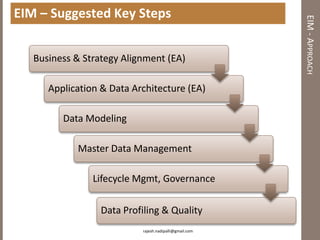
EIM – Suggested Key Steps


                                                        EIM - APPROACH
   Business & Strategy Alignment (EA)

      Application & Data Architecture (EA)

         Data Modeling

            Master Data Management

                Lifecycle Mgmt, Governance

                  Data Profiling & Quality
                           rajesh.nadipalli@gmail.com
http://www.togaf.org/

EIM – Enterprise Architecture Alignment


                                                                                                  EIM - APPROACH
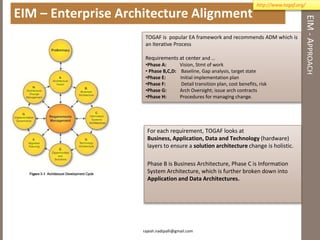
                      TOGAF is popular EA framework and recommends ADM which is
                      an Iterative Process

                      Requirements at center and …
                      •Phase A:         Vision, Stmt of work
                      • Phase B,C,D:     Baseline, Gap analysis, target state
                      •Phase E:         Initial implementation plan
                      •Phase F:          Detail transition plan, cost benefits, risk
                      •Phase G:         Arch Oversight; issue arch contracts
                      •Phase H:         Procedures for managing change.


                       For each requirement, TOGAF looks at
                       Business, Application, Data and Technology (hardware)
                       layers to ensure a solution architecture change is holistic.

                       Phase B is Business Architecture, Phase C is Information
                       System Architecture, which is further broken down into
                       Application and Data Architectures.


                     rajesh.nadipalli@gmail.com
EIM – EA Alignment (contd)


                                                                                  EIM - APPROACH
Business Architecture (Phase B)
   • What are the new goals for the organization
   • What business requirements need to address by these goals
   • What business functions, process and services will be changed/added


Application & Data Architecture (Phase C)
   • What Applications (IT Systems) serve the business functions (as identified
     in Phase B); which ones will need revisions
   • What application functions will be impacted
   • What enterprise data entitles will need to created/updated/stored to
     meet these changes
   • What data transformations, interfaces (like ETL, web services) need to be
     built/changed


                                   rajesh.nadipalli@gmail.com
EIM – EA Alignment - Example


                                                                                                        EIM - APPROACH
Business Architecture (Phase B)
   • Goal: Improve conversion rate leveraging social network of our customers
   • Process Changes:
         • Customer registration (currently only has email), add facebook, twitter, linkedin, account
           information
         • Ad campaign team should use social networks for new leads and advertising


Application & Data Architecture (Phase C)
    • Application Architecture:
          • Customer Registration change for new fields
          • Integration changes to Marketing systems to push this new fields.
          • Automated ad’s to customer’s social network. (might suggest this to Biz Architect)
    • Data Architecture:
          • Additional Columns / Tables to capture new content
          • Consider a flexible model to accommodate other social media sites


 This example shows, how the different architects can work together and be effective
                                               rajesh.nadipalli@gmail.com
EIM – EA Data Model – 3 layers


                                                                                      EIM - APPROACH
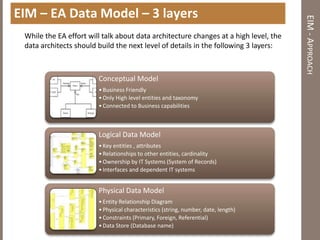
 While the EA effort will talk about data architecture changes at a high level, the
 data architects should build the next level of details in the following 3 layers:


                        Conceptual Model
                        • Business Friendly
                        • Only High level entities and taxonomy
                        • Connected to Business capabilities


                        Logical Data Model
                        • Key entities , attributes
                        • Relationships to other entities, cardinality
                        • Ownership by IT Systems (System of Records)
                        • Interfaces and dependent IT systems


                        Physical Data Model
                        • Entity Relationship Diagram
                        • Physical characteristics (string, number, date, length)
                        • Constraints (Primary, Foreign, Referential)
                        • Data Store (Database name)
                                          rajesh.nadipalli@gmail.com
EIM – Data Model – Example


                                                                                                                   EIM - APPROACH
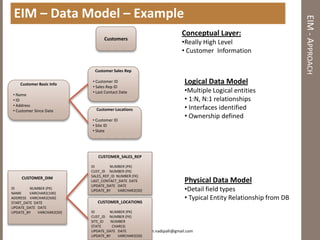
                                                                          Conceptual Layer:
                                  Customers
                                                                          •Really High Level
                                                                          • Customer Information

                              Customer Sales Rep


    Customer Basic Info
                            • Customer ID                                  Logical Data Model
                            • Sales Rep ID
                            • Last Contact Date                            •Multiple Logical entities
• Name
• ID                                                                       • 1:N, N:1 relationships
• Address
• Customer Since Date         Customer Locations                           • Interfaces identified
                            • Customer ID
                                                                           • Ownership defined
                            • Site ID
                            • State


                               CUSTOMER_SALES_REP

                            ID       NUMBER (PK)
                            CUST_ID NUMBER (FK)
                            SALES_REP_ID NUMBER (FK)
     CUSTOMER_DIM
                            LAST_CONTACT_DATE DATE                         Physical Data Model
                            UPDATE_DATE DATE
ID
NAME
         NUMBER (PK)
         VARCHAR2(100)
                            UPDATE_BY     VARCHAR2(50)                     •Detail field types
ADDRESS VARCHAR2(500)                                                      • Typical Entity Relationship from DB
START_DATE DATE                CUSTOMER_LOCATIONS
UPDATE_DATE DATE
UPDATE_BY    VARCHAR2(50)   ID       NUMBER (PK)
                            CUST_ID NUMBER (FK)
                            SITE_ID  NUMBER
                            STATE     CHAR(3)
                            UPDATE_DATE DATE          rajesh.nadipalli@gmail.com
                            UPDATE_BY    VARCHAR2(50)
EIM – Data Model – how to scale


                                                                                              EIM - APPROACH
 To have a successfully Data Model, enable scaling on both
 directions:
     •   Vertically: all layers of stack (Conceptual, Logical & Physical)
     •   Horizontally: segmented by line of business (Finance, HR, Marketing..)
     •   This will help you assign data stewards by domain and layer


 For example say, lets’ take “Customer” and suppose your Company-A
 just made a recent acquisition of Company-B which has it’s own set of
 customers
     •   Conceptual Layer: Customer will be one entity for enterprise
     •   Logically Layer:    You can have 2 entities “Customer-A” and “Customer-B”, both
         linked to the same conceptual entity but having different data due to the separate
         Line of business.
     •   The architecture target state should recommend a consolidation of the two
         Customer Entities if there is an overlap.


                                        rajesh.nadipalli@gmail.com
EIM – Master Data Management (MDM)


                                                                        EIM - APPROACH
 MDM is for list (like Customer, Product)

 Key aspects for a successful MDM:

     •   Agree on the System of Records
     •   Define Data Stewards
     •   Adoption of MDM data (integrate/sync with dependent systems)
     •   Ability to identify and merge duplicates
     •   Ability to fix (case sensitivity, renames)
     •   Add versioning (type 2 / type 3)
     •   Hierarchies
     •   Reporting


                                     rajesh.nadipalli@gmail.com
EIM – Lifecycle Management, Governance


                                                                                 EIM - APPROACH
Lifecycle Management
   • Defines the business processes linked to “Data Entity” at all phases -
     Creation, Consumption and Archival
   • What is the impact to data integrity; for example in a SOA based
     environment System A would rely on System B for details of a related
     entity; if System B archives the entity, the business users might have an
     impact.


Governance
   • Identify data stewards
   • Establish guidelines for process, documentation, permissions &
     communications.
   • Data stewards should work with EA to ensure alignment


                                    rajesh.nadipalli@gmail.com
EIM – Data Profiling, Data Quality


                                                                                            EIM - APPROACH
 Data Profiling
    •   A mature source should be profiled and this sample can then be used as a basis to
        detect bad data before it gets reported in dashboards.
    •   Quality issues should be proactively be emailed and reviewed by appropriate
        analyst who can fix the same.
    •   Data correction can also be automated to reduce the manual overhead.


                                       rajesh.nadipalli@gmail.com
EIM – TOOLS


              rajesh.nadipalli@gmail.com
Tools


                                                                 EIM - TOOLS
 I plan to add some screenshots of tools in later revisions of
 this presentation


                             rajesh.nadipalli@gmail.com
REFERENCES


             rajesh.nadipalli@gmail.com
References


                                                                                        REFERENCES
 EIM & EA
    •    http://msdn.microsoft.com/en-us/library/bb266338.aspx
    •    http://www.togaf.org/
    •    http://www.kimballgroup.com/
    •    http://www.sap.com/solutions/sapbusinessobjects/large/eim/index.epx
    •    http://www.troux.com/products/troux_information/


 MDM
    •http://www.talend.com/download_form.php?cont=mdm&src=HomePage
    •http://www.oracle.com/us/products/applications/master-data-management/index.html


 Data Profiling
    •    http://www.informatica.com/us/data-profiling/
    •    http://www.sas.com/data-quality/index.html


                                                 rajesh.nadipalli@gmail.com

Information management and enterprise architecture

  • 1.
    PRACTICAL ENTERPRISE INFORMATIONMANAGEMENT Rajesh Nadipalli (rajesh.nadipalli@gmail.com) Mar 2012, rev 3 rajesh.nadipalli@gmail.com
  • 2.
    About this Presentation Most organizations today lack a bridge between the data architect who is proud of the physical data model (ER Diagram) and the Enterprise architect who is trying to transform the business based on priorities set by the CIO at a higher level via architectural blue prints. In this presentation I talk about models and approaches to build this bridge and enable organization to have an architecture driven information management In today’s atmosphere there is a mix of Cloud based services (externally hosted), NOSQL databases and custom relational databases, a successful EIM will enable an organization to be really “agile” to meet their business needs rajesh.nadipalli@gmail.com
  • 3.
    Agenda • EIM- Basics • EIM - Approach • EIM - Tools • References rajesh.nadipalli@gmail.com
  • 4.
    EIM - BASICS rajesh.nadipalli@gmail.com
  • 5.
    EIM - Basics EIM - BASICS Enterprise Information Management (EIM) is an initiative to mange data in all forms and treat them as a strategic asset. A good EIM program will result in an integrated, accurate, timely data across your enterprise. A good EIM program will have policies, frameworks, technologies & process to address: • Data models • Data lineage • Data quality • Data profiling • Stewardship rajesh.nadipalli@gmail.com
  • 6.
    EIM – What’sthe need? EIM - BASICS View of the Enterprise based on 2 roles: Business Architect perspective: • What is the system of record for customers? Should that be the Sales, Customer Support, Accounts Receivable system OR a combination? • If a Master Data system is defined, how is this data being propagated? • How fresh is my Data Mart that get data from a Cloud hosted service? IT technology Architecture perspective: • What’s the best way to integrate with cloud services which can be private or public • How do I model NOSQL databases with little formal structure • How to integrate Social Feeds (Tweeter, Facebook) • How to combine this with Legacy and traditional relational databases EIM will address these questions by process, tools and frameworks rajesh.nadipalli@gmail.com
  • 7.
    EIM – what’sthe value? EIM - BASICS To put a direct $ figure on the value of EIM is a challenge. Couple of Examples on what if you don’t have an EIM: • If your Cloud hosted CRM calls a customer “Bill Adams” but your Accounts system calls him “William Adams Junior” and now your marketing system has no clue that they are the same customer and sends him 2 separate communications. What is the cost of annoying your customer or sending him multiple mails? • Your company recently went through an acquisition and you want your sales team to include current products and the newly acquired company product as a bundle offer. Who can identify all the systems that need to be updated? How long and whom do you need to pull in? Are you confident that your dashboards will reflect these changes by next quarterly results? rajesh.nadipalli@gmail.com
  • 8.
    EIM –APPROACH rajesh.nadipalli@gmail.com
  • 9.
    EIM – SuggestedKey Steps EIM - APPROACH Business & Strategy Alignment (EA) Application & Data Architecture (EA) Data Modeling Master Data Management Lifecycle Mgmt, Governance Data Profiling & Quality rajesh.nadipalli@gmail.com
  • 10.
    http://www.togaf.org/ EIM – EnterpriseArchitecture Alignment EIM - APPROACH TOGAF is popular EA framework and recommends ADM which is an Iterative Process Requirements at center and … •Phase A: Vision, Stmt of work • Phase B,C,D: Baseline, Gap analysis, target state •Phase E: Initial implementation plan •Phase F: Detail transition plan, cost benefits, risk •Phase G: Arch Oversight; issue arch contracts •Phase H: Procedures for managing change. For each requirement, TOGAF looks at Business, Application, Data and Technology (hardware) layers to ensure a solution architecture change is holistic. Phase B is Business Architecture, Phase C is Information System Architecture, which is further broken down into Application and Data Architectures. rajesh.nadipalli@gmail.com
  • 11.
    EIM – EAAlignment (contd) EIM - APPROACH Business Architecture (Phase B) • What are the new goals for the organization • What business requirements need to address by these goals • What business functions, process and services will be changed/added Application & Data Architecture (Phase C) • What Applications (IT Systems) serve the business functions (as identified in Phase B); which ones will need revisions • What application functions will be impacted • What enterprise data entitles will need to created/updated/stored to meet these changes • What data transformations, interfaces (like ETL, web services) need to be built/changed rajesh.nadipalli@gmail.com
  • 12.
    EIM – EAAlignment - Example EIM - APPROACH Business Architecture (Phase B) • Goal: Improve conversion rate leveraging social network of our customers • Process Changes: • Customer registration (currently only has email), add facebook, twitter, linkedin, account information • Ad campaign team should use social networks for new leads and advertising Application & Data Architecture (Phase C) • Application Architecture: • Customer Registration change for new fields • Integration changes to Marketing systems to push this new fields. • Automated ad’s to customer’s social network. (might suggest this to Biz Architect) • Data Architecture: • Additional Columns / Tables to capture new content • Consider a flexible model to accommodate other social media sites This example shows, how the different architects can work together and be effective rajesh.nadipalli@gmail.com
  • 13.
    EIM – EAData Model – 3 layers EIM - APPROACH While the EA effort will talk about data architecture changes at a high level, the data architects should build the next level of details in the following 3 layers: Conceptual Model • Business Friendly • Only High level entities and taxonomy • Connected to Business capabilities Logical Data Model • Key entities , attributes • Relationships to other entities, cardinality • Ownership by IT Systems (System of Records) • Interfaces and dependent IT systems Physical Data Model • Entity Relationship Diagram • Physical characteristics (string, number, date, length) • Constraints (Primary, Foreign, Referential) • Data Store (Database name) rajesh.nadipalli@gmail.com
  • 14.
    EIM – DataModel – Example EIM - APPROACH Conceptual Layer: Customers •Really High Level • Customer Information Customer Sales Rep Customer Basic Info • Customer ID Logical Data Model • Sales Rep ID • Last Contact Date •Multiple Logical entities • Name • ID • 1:N, N:1 relationships • Address • Customer Since Date Customer Locations • Interfaces identified • Customer ID • Ownership defined • Site ID • State CUSTOMER_SALES_REP ID NUMBER (PK) CUST_ID NUMBER (FK) SALES_REP_ID NUMBER (FK) CUSTOMER_DIM LAST_CONTACT_DATE DATE Physical Data Model UPDATE_DATE DATE ID NAME NUMBER (PK) VARCHAR2(100) UPDATE_BY VARCHAR2(50) •Detail field types ADDRESS VARCHAR2(500) • Typical Entity Relationship from DB START_DATE DATE CUSTOMER_LOCATIONS UPDATE_DATE DATE UPDATE_BY VARCHAR2(50) ID NUMBER (PK) CUST_ID NUMBER (FK) SITE_ID NUMBER STATE CHAR(3) UPDATE_DATE DATE rajesh.nadipalli@gmail.com UPDATE_BY VARCHAR2(50)
  • 15.
    EIM – DataModel – how to scale EIM - APPROACH To have a successfully Data Model, enable scaling on both directions: • Vertically: all layers of stack (Conceptual, Logical & Physical) • Horizontally: segmented by line of business (Finance, HR, Marketing..) • This will help you assign data stewards by domain and layer For example say, lets’ take “Customer” and suppose your Company-A just made a recent acquisition of Company-B which has it’s own set of customers • Conceptual Layer: Customer will be one entity for enterprise • Logically Layer: You can have 2 entities “Customer-A” and “Customer-B”, both linked to the same conceptual entity but having different data due to the separate Line of business. • The architecture target state should recommend a consolidation of the two Customer Entities if there is an overlap. rajesh.nadipalli@gmail.com
  • 16.
    EIM – MasterData Management (MDM) EIM - APPROACH MDM is for list (like Customer, Product) Key aspects for a successful MDM: • Agree on the System of Records • Define Data Stewards • Adoption of MDM data (integrate/sync with dependent systems) • Ability to identify and merge duplicates • Ability to fix (case sensitivity, renames) • Add versioning (type 2 / type 3) • Hierarchies • Reporting rajesh.nadipalli@gmail.com
  • 17.
    EIM – LifecycleManagement, Governance EIM - APPROACH Lifecycle Management • Defines the business processes linked to “Data Entity” at all phases - Creation, Consumption and Archival • What is the impact to data integrity; for example in a SOA based environment System A would rely on System B for details of a related entity; if System B archives the entity, the business users might have an impact. Governance • Identify data stewards • Establish guidelines for process, documentation, permissions & communications. • Data stewards should work with EA to ensure alignment rajesh.nadipalli@gmail.com
  • 18.
    EIM – DataProfiling, Data Quality EIM - APPROACH Data Profiling • A mature source should be profiled and this sample can then be used as a basis to detect bad data before it gets reported in dashboards. • Quality issues should be proactively be emailed and reviewed by appropriate analyst who can fix the same. • Data correction can also be automated to reduce the manual overhead. rajesh.nadipalli@gmail.com
  • 19.
    EIM – TOOLS rajesh.nadipalli@gmail.com
  • 20.
    Tools EIM - TOOLS I plan to add some screenshots of tools in later revisions of this presentation rajesh.nadipalli@gmail.com
  • 21.
    REFERENCES rajesh.nadipalli@gmail.com
  • 22.
    References REFERENCES EIM & EA • http://msdn.microsoft.com/en-us/library/bb266338.aspx • http://www.togaf.org/ • http://www.kimballgroup.com/ • http://www.sap.com/solutions/sapbusinessobjects/large/eim/index.epx • http://www.troux.com/products/troux_information/ MDM •http://www.talend.com/download_form.php?cont=mdm&src=HomePage •http://www.oracle.com/us/products/applications/master-data-management/index.html Data Profiling • http://www.informatica.com/us/data-profiling/ • http://www.sas.com/data-quality/index.html rajesh.nadipalli@gmail.com