Approaching Information
Management from a Framework
Perspective
Exploring Value in Information
Part 2 in a Series on Information Management
© 2014 RMG Consulting All rights reserved. 12/04/20141
The use of frameworks have a long, well established
place in the IT industry enabling an enterprise to
understand the inter-relationships and inter-
operability issues that need to be considered when
introducing a new concept or solution approach. This
presentation will provide a perspective on how
frameworks can be adopted by the Records and
Information Management industry as
communications and planning tools.
Background
© 2014 RMG Consulting All rights reserved. 12/04/20142
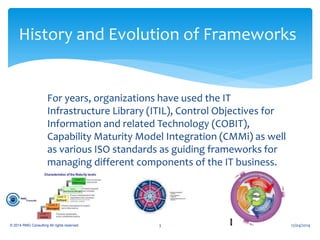
For years, organizations have used the IT
Infrastructure Library (ITIL), Control Objectives for
Information and related Technology (COBIT),
Capability Maturity Model Integration (CMMi) as well
as various ISO standards as guiding frameworks for
managing different components of the IT business.
12/04/2014© 2014 RMG Consulting All rights reserved. 3
History and Evolution of Frameworks
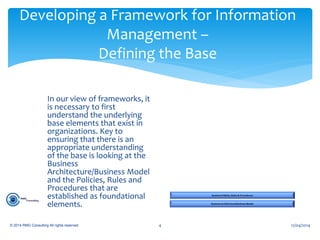
In our view of frameworks, it
is necessary to first
understand the underlying
base elements that exist in
organizations. Key to
ensuring that there is an
appropriate understanding
of the base is looking at the
Business
Architecture/Business Model
and the Policies, Rules and
Procedures that are
established as foundational
elements.
12/04/2014© 2014 RMG Consulting All rights reserved. 4
Developing a Framework for Information
Management –
Defining the Base
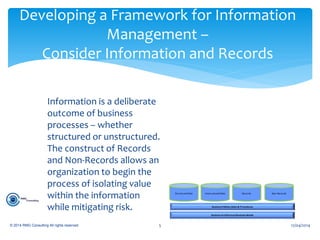
Information is a deliberate
outcome of business
processes – whether
structured or unstructured.
The construct of Records
and Non-Records allows an
organization to begin the
process of isolating value
within the information
while mitigating risk.
12/04/2014© 2014 RMG Consulting All rights reserved. 5
Developing a Framework for Information
Management –
Consider Information and Records
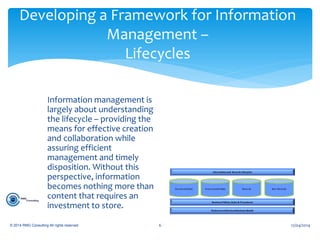
Information management is
largely about understanding
the lifecycle – providing the
means for effective creation
and collaboration while
assuring efficient
management and timely
disposition. Without this
perspective, information
becomes nothing more than
content that requires an
investment to store.
12/04/2014© 2014 RMG Consulting All rights reserved. 6
Developing a Framework for Information
Management –
Lifecycles
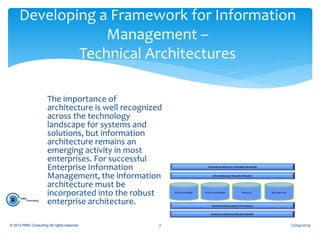
The importance of
architecture is well recognized
across the technology
landscape for systems and
solutions, but information
architecture remains an
emerging activity in most
enterprises. For successful
Enterprise Information
Management, the information
architecture must be
incorporated into the robust
enterprise architecture.
12/04/2014© 2014 RMG Consulting All rights reserved. 7
Developing a Framework for Information
Management –
Technical Architectures
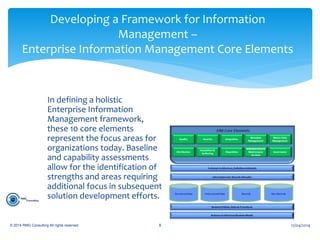
In defining a holistic
Enterprise Information
Management framework,
these 10 core elements
represent the focus areas for
organizations today. Baseline
and capability assessments
allow for the identification of
strengths and areas requiring
additional focus in subsequent
solution development efforts.
12/04/2014© 2014 RMG Consulting All rights reserved. 8
Developing a Framework for Information
Management –
Enterprise Information Management Core Elements
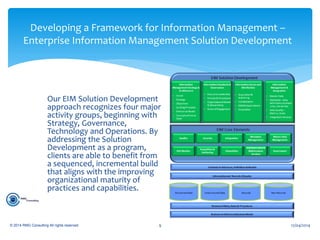
Our EIM Solution Development
approach recognizes four major
activity groups, beginning with
Strategy, Governance,
Technology and Operations. By
addressing the Solution
Development as a program,
clients are able to benefit from
a sequenced, incremental build
that aligns with the improving
organizational maturity of
practices and capabilities.
12/04/2014© 2014 RMG Consulting All rights reserved. 9
Developing a Framework for Information Management –
Enterprise Information Management Solution Development
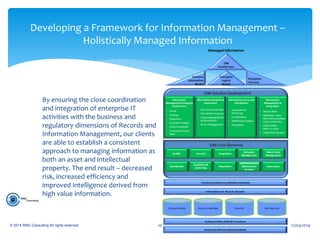
By ensuring the close coordination
and integration of enterprise IT
activities with the business and
regulatory dimensions of Records and
Information Management, our clients
are able to establish a consistent
approach to managing information as
both an asset and intellectual
property. The end result – decreased
risk, increased efficiency and
improved intelligence derived from
high value information.
12/04/2014© 2014 RMG Consulting All rights reserved. 10
Developing a Framework for Information Management –
Holistically Managed Information
Information volume will continue to increase at
accelerated rates in all organizations while risks
associated with regulation and litigation continue to
grow. By approaching Information Management from an
enterprise perspective through a framework based lens,
organizations will be able to:
 Gain high value intelligence from information;
 Reduce unnecessary expenditures managing volumes
of redundant information; and
 Improve information risk profiles.
12/04/2014© 2014 RMG Consulting All rights reserved. 11
Conclusion
Contact Us
Rob.gerbrandt@rmgim.ca
705-229-6710
www.rmgim.ca
© 2014 RMG Consulting All rights reserved. 12/04/201412

Approaching Information Management from a Framework Perspective

  • 1.
    Approaching Information Management froma Framework Perspective Exploring Value in Information Part 2 in a Series on Information Management © 2014 RMG Consulting All rights reserved. 12/04/20141
  • 2.
    The use offrameworks have a long, well established place in the IT industry enabling an enterprise to understand the inter-relationships and inter- operability issues that need to be considered when introducing a new concept or solution approach. This presentation will provide a perspective on how frameworks can be adopted by the Records and Information Management industry as communications and planning tools. Background © 2014 RMG Consulting All rights reserved. 12/04/20142
  • 3.
    For years, organizationshave used the IT Infrastructure Library (ITIL), Control Objectives for Information and related Technology (COBIT), Capability Maturity Model Integration (CMMi) as well as various ISO standards as guiding frameworks for managing different components of the IT business. 12/04/2014© 2014 RMG Consulting All rights reserved. 3 History and Evolution of Frameworks
  • 4.
    In our viewof frameworks, it is necessary to first understand the underlying base elements that exist in organizations. Key to ensuring that there is an appropriate understanding of the base is looking at the Business Architecture/Business Model and the Policies, Rules and Procedures that are established as foundational elements. 12/04/2014© 2014 RMG Consulting All rights reserved. 4 Developing a Framework for Information Management – Defining the Base
  • 5.
    Information is adeliberate outcome of business processes – whether structured or unstructured. The construct of Records and Non-Records allows an organization to begin the process of isolating value within the information while mitigating risk. 12/04/2014© 2014 RMG Consulting All rights reserved. 5 Developing a Framework for Information Management – Consider Information and Records
  • 6.
    Information management is largelyabout understanding the lifecycle – providing the means for effective creation and collaboration while assuring efficient management and timely disposition. Without this perspective, information becomes nothing more than content that requires an investment to store. 12/04/2014© 2014 RMG Consulting All rights reserved. 6 Developing a Framework for Information Management – Lifecycles
  • 7.
    The importance of architectureis well recognized across the technology landscape for systems and solutions, but information architecture remains an emerging activity in most enterprises. For successful Enterprise Information Management, the information architecture must be incorporated into the robust enterprise architecture. 12/04/2014© 2014 RMG Consulting All rights reserved. 7 Developing a Framework for Information Management – Technical Architectures
  • 8.
    In defining aholistic Enterprise Information Management framework, these 10 core elements represent the focus areas for organizations today. Baseline and capability assessments allow for the identification of strengths and areas requiring additional focus in subsequent solution development efforts. 12/04/2014© 2014 RMG Consulting All rights reserved. 8 Developing a Framework for Information Management – Enterprise Information Management Core Elements
  • 9.
    Our EIM SolutionDevelopment approach recognizes four major activity groups, beginning with Strategy, Governance, Technology and Operations. By addressing the Solution Development as a program, clients are able to benefit from a sequenced, incremental build that aligns with the improving organizational maturity of practices and capabilities. 12/04/2014© 2014 RMG Consulting All rights reserved. 9 Developing a Framework for Information Management – Enterprise Information Management Solution Development
  • 10.
    By ensuring theclose coordination and integration of enterprise IT activities with the business and regulatory dimensions of Records and Information Management, our clients are able to establish a consistent approach to managing information as both an asset and intellectual property. The end result – decreased risk, increased efficiency and improved intelligence derived from high value information. 12/04/2014© 2014 RMG Consulting All rights reserved. 10 Developing a Framework for Information Management – Holistically Managed Information
  • 11.
    Information volume willcontinue to increase at accelerated rates in all organizations while risks associated with regulation and litigation continue to grow. By approaching Information Management from an enterprise perspective through a framework based lens, organizations will be able to:  Gain high value intelligence from information;  Reduce unnecessary expenditures managing volumes of redundant information; and  Improve information risk profiles. 12/04/2014© 2014 RMG Consulting All rights reserved. 11 Conclusion
  • 12.
    Contact Us Rob.gerbrandt@rmgim.ca 705-229-6710 www.rmgim.ca © 2014RMG Consulting All rights reserved. 12/04/201412