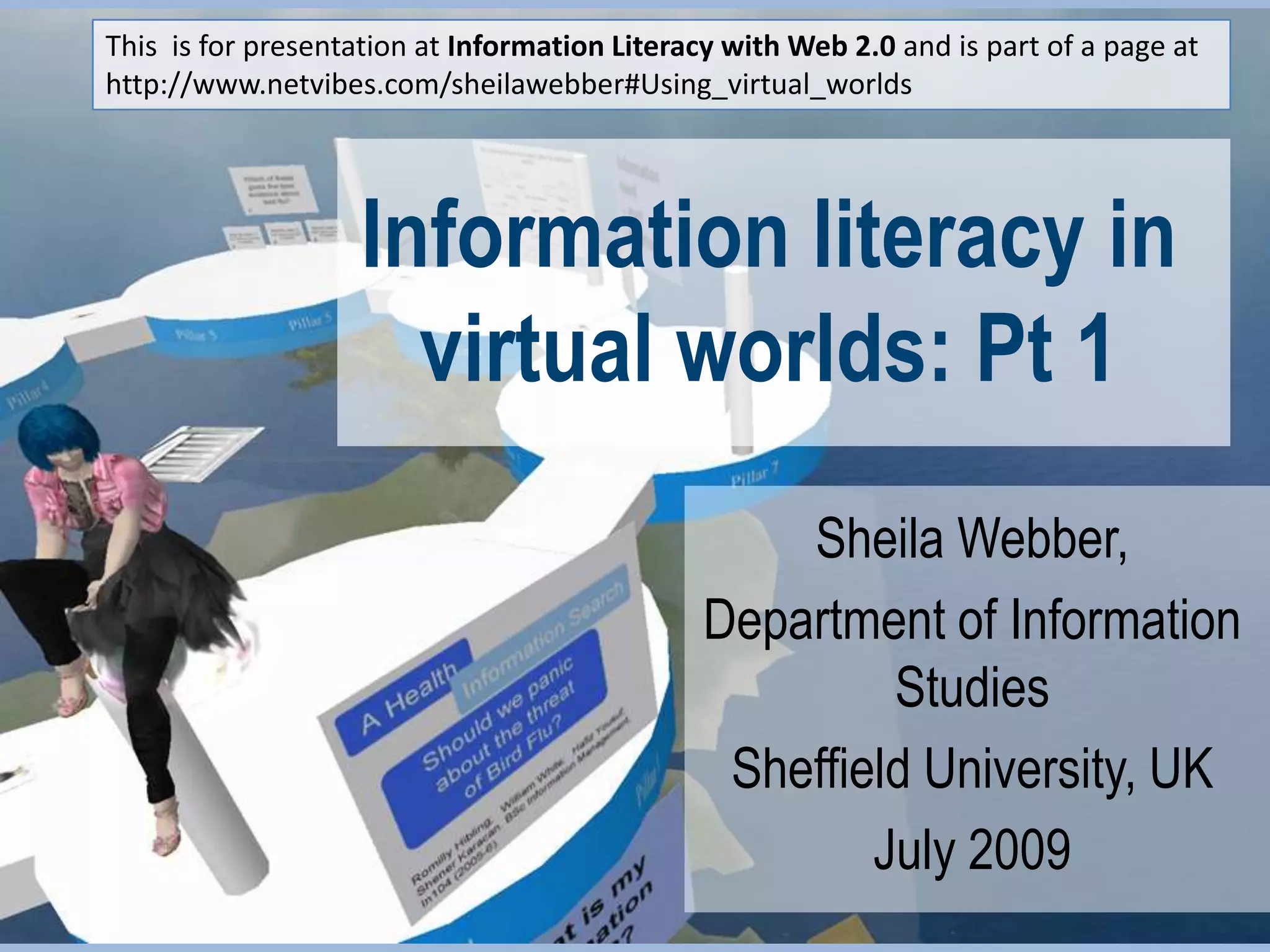
This  is for presentation at Information Literacy with Web 2.0 and is part of a page at http://www.netvibes.com/sheilawebber#Using_virtual_worldsInformation literacy in virtual worlds: Pt 1Sheila Webber, Department of Information StudiesSheffield University, UKJuly 2009
Who I am& Part 1: What are virtual worlds and what is Second Life Sheila Webber, July 2009
Characteristics of virtual worlds“persistence of the in-world environment“a shared space allowing multiple users to participate simultaneously“virtual embodiment in the form of an avatar (a personisable 3-D representation of the self)“interactions that occur between users and objects in a 3-D environment“an immediacy of action such that interactions occur in real time“similarities to the real world such as topography, movement and physics that provide the illusion of being there.”(Smart, Cascio & Paffendof: cited in Warburton, 2009: 415)Sheila Webber, July 2009
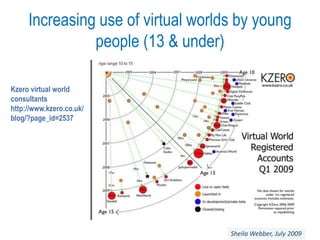
Increasing use of virtual worlds by young people (13 & under)Kzero virtual world consultantshttp://www.kzero.co.uk/blog/?page_id=2537Sheila Webber, July 2009
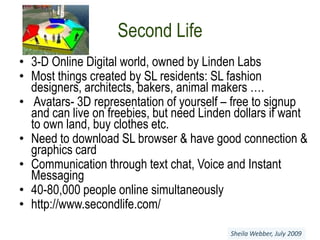
Second Life3-D Online Digital world, owned by Linden LabsMost things created by SL residents: SL fashion designers, architects, bakers, animal makers …. Avatars- 3D representation of yourself – free to signup and can live on freebies, but need Linden dollars if want to own land, buy clothes etc.Need to download SL browser & have good connection & graphics cardCommunication through text chat, Voice and Instant Messaging40-80,000 people online simultaneouslyhttp://www.secondlife.com/Sheila Webber, July 2009
EducationVirtual HajjOnly 18+ on main grid: separate Teen grid90% UK universities with some presenceMany disciplines: English, Psychology, Chemistry, Biology etc. etc.Role play, simulationsDiscussion, communicationProblem solving, inquirySheila Webber, July 2009
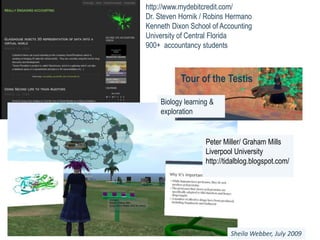
http://www.mydebitcredit.com/Dr. Steven Hornik / Robins HermanoKenneth Dixon School of AccountingUniversity of Central Florida900+  accountancy studentsTour of the TestisBiology learning & explorationPeter Miller/ Graham MillsLiverpool Universityhttp://tidalblog.blogspot.com/Sheila Webber, July 2009
Problems I know people have with virtual worlds and schoolsBlocked by firewallsSeen as too riskyComputers not good enoughBroadband connection not good enoughIf only have access during school hours, miss out on interesting events in evening/ at night
But, if you can …Enjoyment of being able to fly/ build/ drive a car/ change “the world”Connection with schools internationallyAppeals to multiple intelligences … visual, aural … new ways of seeing things … things not possible in real lifeAct out poems, plays, try and build models of difficult concepts(etc.)
Librarians in SL are…Providing “reference” servicesProviding links to “real life” web resources Providing help in using SLWorking with educators … and sometimes educating on their ownDoing reader development (e.g. through exhibitions, recreations, reenactments)Sheila Webber, July 2009
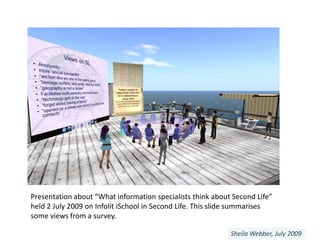
Presentation about “What information specialists think about Second Life” held 2 July 2009 on InfolitiSchool in Second Life. This slide summarises some views from a survey. Sheila Webber, July 2009
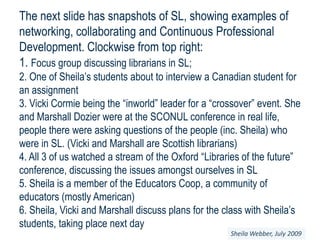
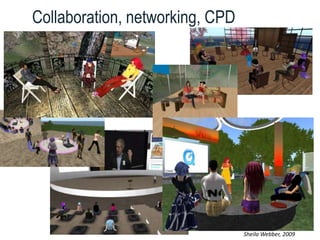
The next slide has snapshots of SL, showing examples of networking, collaborating and Continuous Professional Development. Clockwise from top right:1. Focus group discussing librarians in SL;2. One of Sheila’s students about to interview a Canadian student for an assignment3. Vicki Cormie being the “inworld” leader for a “crossover” event. She and Marshall Dozier were at the SCONUL conference in real life, people there were asking questions of the people (inc. Sheila) who were in SL. (Vicki and Marshall are Scottish librarians) 4. All 3 of us watched a stream of the Oxford “Libraries of the future” conference, discussing the issues amongst ourselves in SL5. Sheila is a member of the Educators Coop, a community of educators (mostly American)6. Sheila, Vicki and Marshall discuss plans for the class with Sheila’s students, taking place next daySheila Webber, July 2009
Collaboration, networking, CPDSheila Webber, 2009
How have I used it?First year (18/19 years old) students learning to do interviews in Second Life and carrying out research interviews into information behaviourMasters students, learning about educational technologyOrganising a discussion series & involved in organising conferencesAttending conferences, networking, learning about teachingSeveral ppts at http://www.slideshare.net/sheilawebber/Sheila Webber, July 2009
Links to websites, articles, tutorials, videos, and places in Second Life: http://delicious.com/LILACSL (Topics: Education in SL and Libraries/Librarians in SL: all the other links will be found there)Warburton, S. (2009) “Second Life in higher education: Assessing the potential for and the barriers to deploying virtual worlds in learning and teaching.” British journal of educational technology, 40 (3), 414–426.Sheila Webber, July 2009
Now!Look at some of the videos and websites on the Netvibes page, to get a better idea of what Second Life is and to hear about how a few people have used them in schoolsYou can also get an avatar free & download the SL browser free – but it is a good idea to go in for a particular event and/or to identify a mentorThere is a PowerPoint Part 2 – in which I talk about information literacy and Second LifeSheila Webber, July 2009

Information Literacy in virtual worlds Part 1

  • 1.
    This isfor presentation at Information Literacy with Web 2.0 and is part of a page at http://www.netvibes.com/sheilawebber#Using_virtual_worldsInformation literacy in virtual worlds: Pt 1Sheila Webber, Department of Information StudiesSheffield University, UKJuly 2009
  • 2.
    Who I am&Part 1: What are virtual worlds and what is Second Life Sheila Webber, July 2009
  • 3.
    Characteristics of virtualworlds“persistence of the in-world environment“a shared space allowing multiple users to participate simultaneously“virtual embodiment in the form of an avatar (a personisable 3-D representation of the self)“interactions that occur between users and objects in a 3-D environment“an immediacy of action such that interactions occur in real time“similarities to the real world such as topography, movement and physics that provide the illusion of being there.”(Smart, Cascio & Paffendof: cited in Warburton, 2009: 415)Sheila Webber, July 2009
  • 4.
    Increasing use ofvirtual worlds by young people (13 & under)Kzero virtual world consultantshttp://www.kzero.co.uk/blog/?page_id=2537Sheila Webber, July 2009
  • 5.
    Second Life3-D OnlineDigital world, owned by Linden LabsMost things created by SL residents: SL fashion designers, architects, bakers, animal makers …. Avatars- 3D representation of yourself – free to signup and can live on freebies, but need Linden dollars if want to own land, buy clothes etc.Need to download SL browser & have good connection & graphics cardCommunication through text chat, Voice and Instant Messaging40-80,000 people online simultaneouslyhttp://www.secondlife.com/Sheila Webber, July 2009
  • 6.
    EducationVirtual HajjOnly 18+on main grid: separate Teen grid90% UK universities with some presenceMany disciplines: English, Psychology, Chemistry, Biology etc. etc.Role play, simulationsDiscussion, communicationProblem solving, inquirySheila Webber, July 2009
  • 7.
    http://www.mydebitcredit.com/Dr. Steven Hornik/ Robins HermanoKenneth Dixon School of AccountingUniversity of Central Florida900+ accountancy studentsTour of the TestisBiology learning & explorationPeter Miller/ Graham MillsLiverpool Universityhttp://tidalblog.blogspot.com/Sheila Webber, July 2009
  • 8.
    Problems I knowpeople have with virtual worlds and schoolsBlocked by firewallsSeen as too riskyComputers not good enoughBroadband connection not good enoughIf only have access during school hours, miss out on interesting events in evening/ at night
  • 9.
    But, if youcan …Enjoyment of being able to fly/ build/ drive a car/ change “the world”Connection with schools internationallyAppeals to multiple intelligences … visual, aural … new ways of seeing things … things not possible in real lifeAct out poems, plays, try and build models of difficult concepts(etc.)
  • 10.
    Librarians in SLare…Providing “reference” servicesProviding links to “real life” web resources Providing help in using SLWorking with educators … and sometimes educating on their ownDoing reader development (e.g. through exhibitions, recreations, reenactments)Sheila Webber, July 2009
  • 11.
    Presentation about “Whatinformation specialists think about Second Life” held 2 July 2009 on InfolitiSchool in Second Life. This slide summarises some views from a survey. Sheila Webber, July 2009
  • 12.
    The next slidehas snapshots of SL, showing examples of networking, collaborating and Continuous Professional Development. Clockwise from top right:1. Focus group discussing librarians in SL;2. One of Sheila’s students about to interview a Canadian student for an assignment3. Vicki Cormie being the “inworld” leader for a “crossover” event. She and Marshall Dozier were at the SCONUL conference in real life, people there were asking questions of the people (inc. Sheila) who were in SL. (Vicki and Marshall are Scottish librarians) 4. All 3 of us watched a stream of the Oxford “Libraries of the future” conference, discussing the issues amongst ourselves in SL5. Sheila is a member of the Educators Coop, a community of educators (mostly American)6. Sheila, Vicki and Marshall discuss plans for the class with Sheila’s students, taking place next daySheila Webber, July 2009
  • 13.
  • 14.
    How have Iused it?First year (18/19 years old) students learning to do interviews in Second Life and carrying out research interviews into information behaviourMasters students, learning about educational technologyOrganising a discussion series & involved in organising conferencesAttending conferences, networking, learning about teachingSeveral ppts at http://www.slideshare.net/sheilawebber/Sheila Webber, July 2009
  • 15.
    Links to websites,articles, tutorials, videos, and places in Second Life: http://delicious.com/LILACSL (Topics: Education in SL and Libraries/Librarians in SL: all the other links will be found there)Warburton, S. (2009) “Second Life in higher education: Assessing the potential for and the barriers to deploying virtual worlds in learning and teaching.” British journal of educational technology, 40 (3), 414–426.Sheila Webber, July 2009
  • 16.
    Now!Look at someof the videos and websites on the Netvibes page, to get a better idea of what Second Life is and to hear about how a few people have used them in schoolsYou can also get an avatar free & download the SL browser free – but it is a good idea to go in for a particular event and/or to identify a mentorThere is a PowerPoint Part 2 – in which I talk about information literacy and Second LifeSheila Webber, July 2009