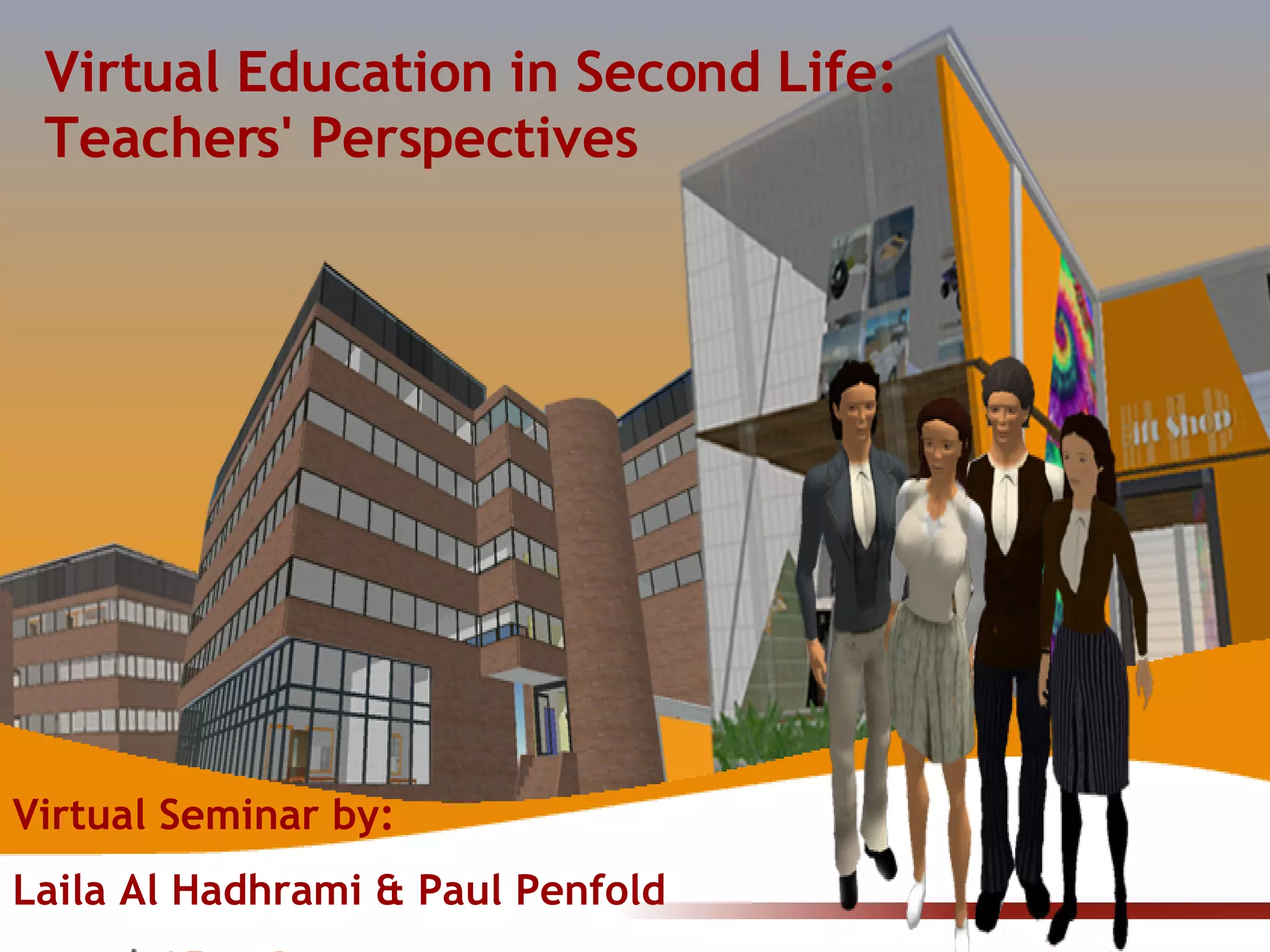
Laila AL-Hadrahmani  &  Paul Penfold Virtual Education in Second Life: Teachers' Perspectives Virtual Seminar by:  Laila Al Hadhrami & Paul Penfold
Introduction 20 minute presentation - please leave your comments on Slidecast From: LAILA AL HADHRAMI   Instructional & Learning Technologies Department, Sultan Qaboos University, Oman   Email:  [email_address]   PAUL PENFOLD  School of Hotel & Tourism Management,  The Hong Kong Polytechnic University, HK Email:  [email_address]
Seminar Content  Introducing virtual worlds & Second Life (SL)  Teaching & learning in SL New roles of instructors in SL. Advantages & disadvantages of using SL. Teachers experience of teaching in SL Challenges and opportunities Conclusions & recommendations References/Bibliography.
What are Virtual Worlds? “ A virtual world is a computer-based simulated environment intended for its users to inhabit and interact using avatars. Virtual worlds are also called "digital worlds," "simulated worlds," and “MUVE’s.” Not Simulations  Not games  Open ended – users choose the outcome and the activity
Common Features Shared Space Graphical User Interface Immediacy Interactivity Persistence Socialization/Community
Virtual Worlds - Data Population of USA  =  301 Million   (July 2007 est.) Population of virtual worlds =  238 Million  & rising daily
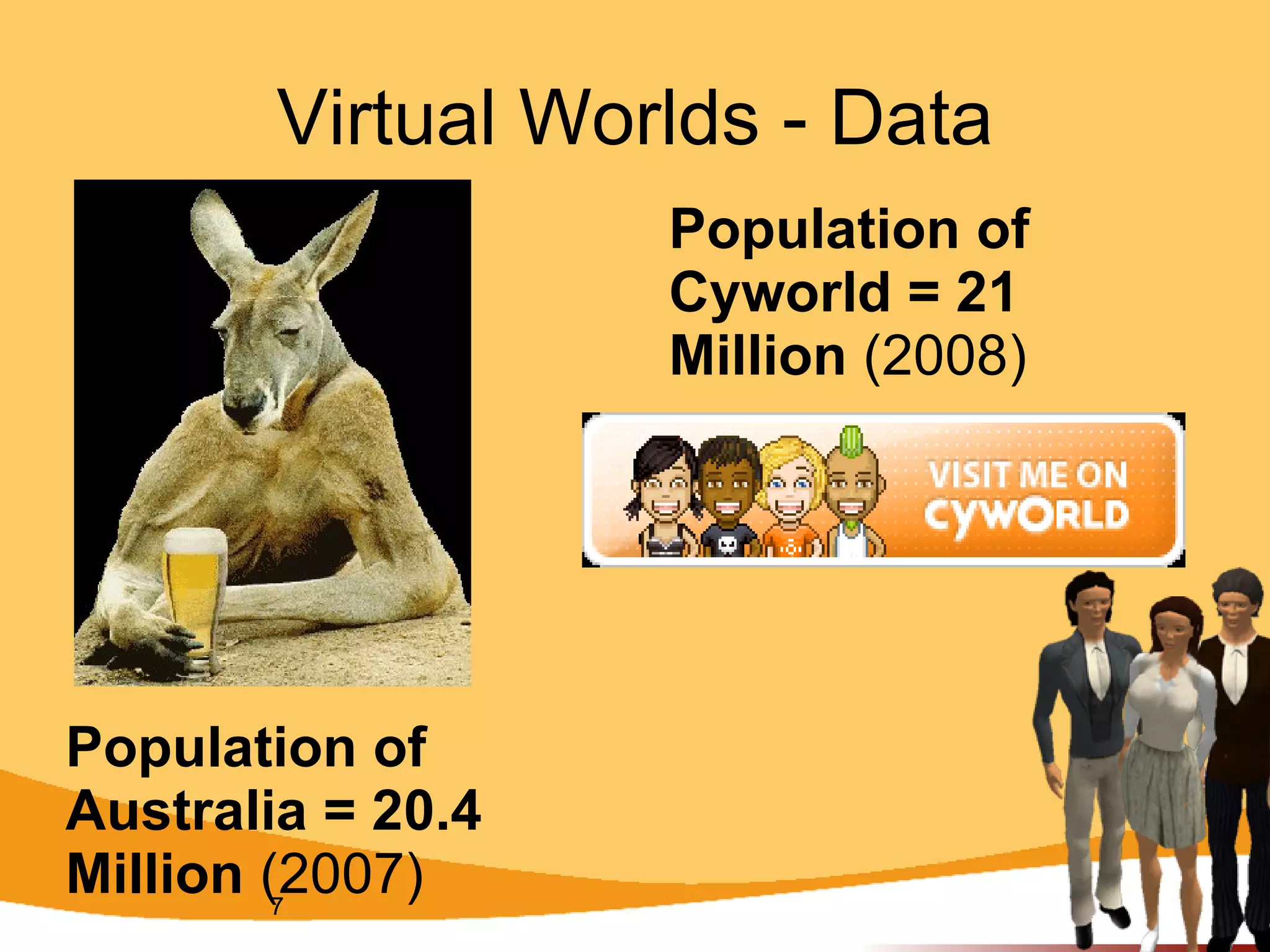
Virtual Worlds - Data Population of Australia = 20.4 Million  (2007) Population of Cyworld = 21 Million  (2008)
60 Million +
238 Million + 160 Million +
20 Million +
Total User Accounts 238M+
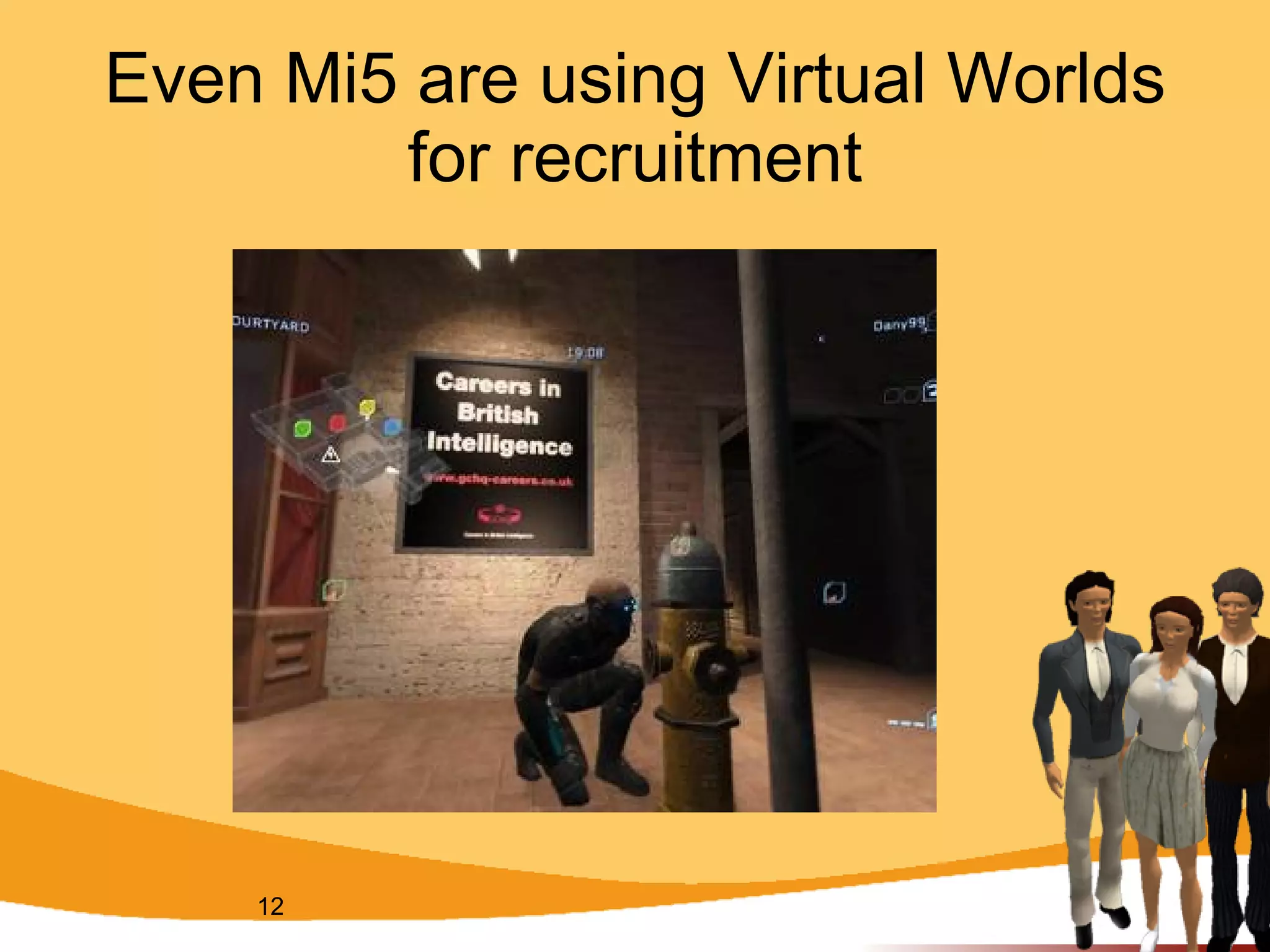
Even Mi5 are using Virtual Worlds for recruitment
Major Brands  Big brands are embracing Virtual Worlds:  AOL, BMW, Cisco, Dell, Intel, IBM, Mercedes and Sears etc Second LIfe theme park operated by Samsung and Softbank
What is Second Life? Launched in 2003,  Second Life  is an online 3D virtual world created by Linden Labs.  Second Life  provides an immersive environment for users to play and interact in.   Second Life is the size of a small city, with thousands of servers (called simulators)
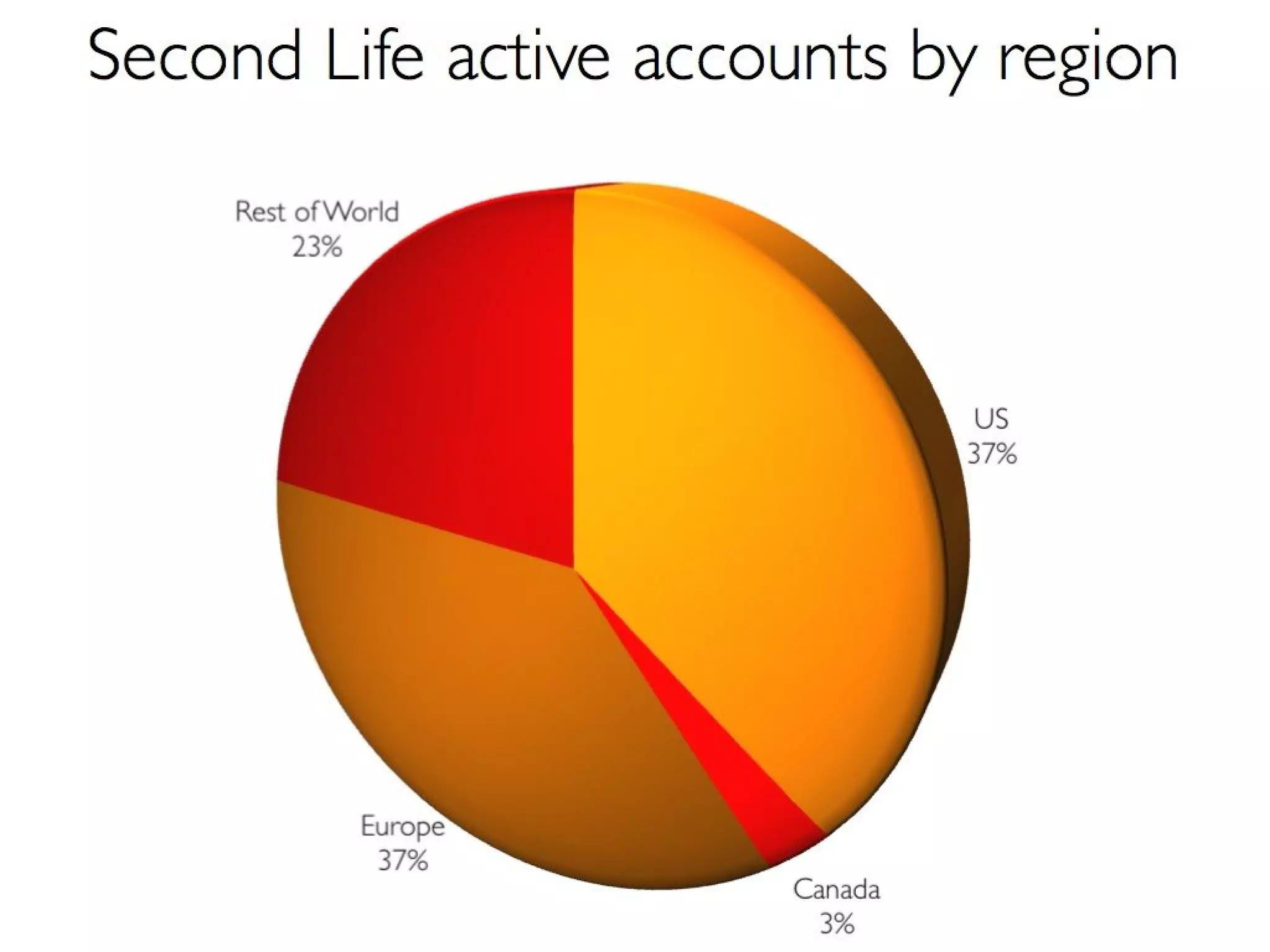
Who is using Second Life? Registered population of over 13 Million (not all live).  From over 100 countries  60% are men, 40% are women  Aged from 18 - 85. Also a teen-SL for under 18s
The Basics Your own avatar Behaviour Engaged, but not constrained Interaction  All objects can be scripted No material costs
Communication chat IM group IM IM <-> email voice Skype integration
Moving around walking flying teleporting locally via scripted objects longer distances via ‘landmarks’ in-world search engine Directly from the Web
Land & Building rent or buy needed for permanent buildings shops, galleries, universities mainland areas private islands  objects made out of basic building blocks – prims (cubes, spheres,  etc )
Teaching & Learning in SL 500 educational institutions 4,000 teachers (on SL Ed mailing list) Two models Working campus (functional – no walls) Reflective campus (like the real world)
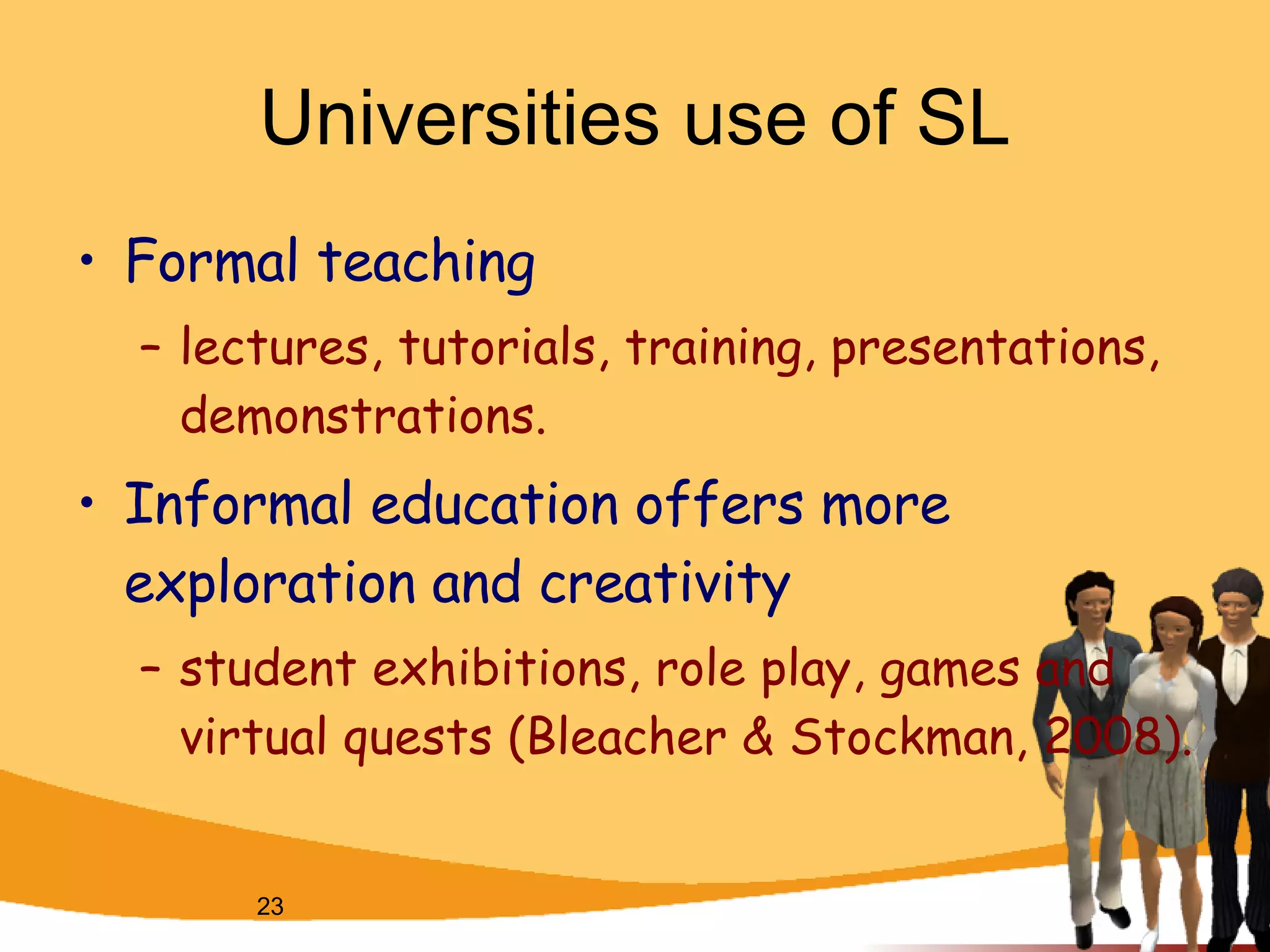
Universities use of SL Formal teaching  lectures, tutorials, training, presentations, demonstrations.  Informal education offers more exploration and creativity  student exhibitions, role play, games and virtual quests (Bleacher & Stockman, 2008).
Subject Areas The most common uses of Second Life seem to be in:  computer studies, science subjects and humanities (Livingstone & Kemp, 2007),  architectural studies, urban planning, graphic design, anatomy, natural sciences, law, languages, programming, literature, art and tourism. Dickey (2005)
Second Health Hospital Nursing/Medical The Heart Murmur Sim Second Life Hospital Imperial College London
Libraries Info Island  (built by librarians) is  a cluster of islands bustling with activities that explore roles libraries and librarians may play in 3D virtual worlds
Languages Also: SL Islands for Chinese, Japanese & many European languages Instructors at the English Village use “holoteaching,” using classrooms where you can completely change scenes with the touch of a button, like the holodeck in the TV show  Star Trek. English  Village
Building & Real Estate Urban planning, collaborative architecture, building design, real estate practice & law etc
Computing Computer programming
Tourism & Travel Virtual Field trip - Morocco Hotel visits
Clothing, textiles, design
New Roles of Instructors in SL A new learning environment – many challenges Need for more collaboration. Rather than competing, faculty are pushed towards innovative collaboration across disciplines and national boundaries.
New roles Instructors realize that familiar ways of delivering knowledge and information may not be as effective in a 3D multi-user space.  Most educators try traditional ways of teaching first, and then move them towards more student-centred pedagogies.
New strategies for teaching From expert to a facilitator Assessment challenges in SL  How to balance in-world and out-world instructional experiences.  How to create greater levels of interactivity between learners, the internet, Web 2.0 tools and virtual worlds.
Research with Teachers Survey with 5 teachers who used SL in Spring Semester 2008
What were the main challenges? KEY A) Setting up Second Life B) Not enough time for the session or tutorial C) Technical issues  D) Lack of experience in using Second Life E) Other Other: Lack of computing facilities for students. Need to spend extra time to get the students familiar SL Should've been more prepared, had to rely on technicians.  One of my groups had technical problems with the voice chat
What went well in using SL? KEY A) Students enjoyed using it B) It was an interactive experience for students C) It was a good learning experience for students D) It provided a new dimension for my subject E) It gave some variety to the subject F) Other Other: New learning / teaching experience for students & teachers.
Would you use SL again?
What would you do differently? More time for students' hands-on experience Schedule tutorials in a computer lab and guide students into SL personally during initial sessions. Need to give students more time to learn the system.  Have all computers ready before students arrive.
What would you do differently? Spend more time using SL, so that I am able to assist students more. Select some year 1 subjects to kick off first. So, when the students move to year 2 and 3, they will be well prepared for any SL activity  Use SL in a more operations-based class
What can we do to improve the use of Second Life in the classroom? Promote to the students about SL Include it as default install on all university computers. Include university IT in planning.
What can we do to improve the use of Second Life in the classroom? Video a few online sessions and present the video to senior management, other staff and students. Continue to let faculty know how it can be used as a teaching tool.  Make them aware of the facilities that have already been built, and suggest ideas for interactive sessions.
Problems Technical hurdles – graphic cards, speed  Learning curve User expectations Crime, sex, money & politics Most problems in real world exist in SL!
Challenges & Difficulties Many educators are excited about the potential of virtual worlds, others are wary or sceptical.  Some consider them as upmarket games, while others are afraid they will degrade student learning.  Virtual worlds present many challenges for students, teachers, and administrators.
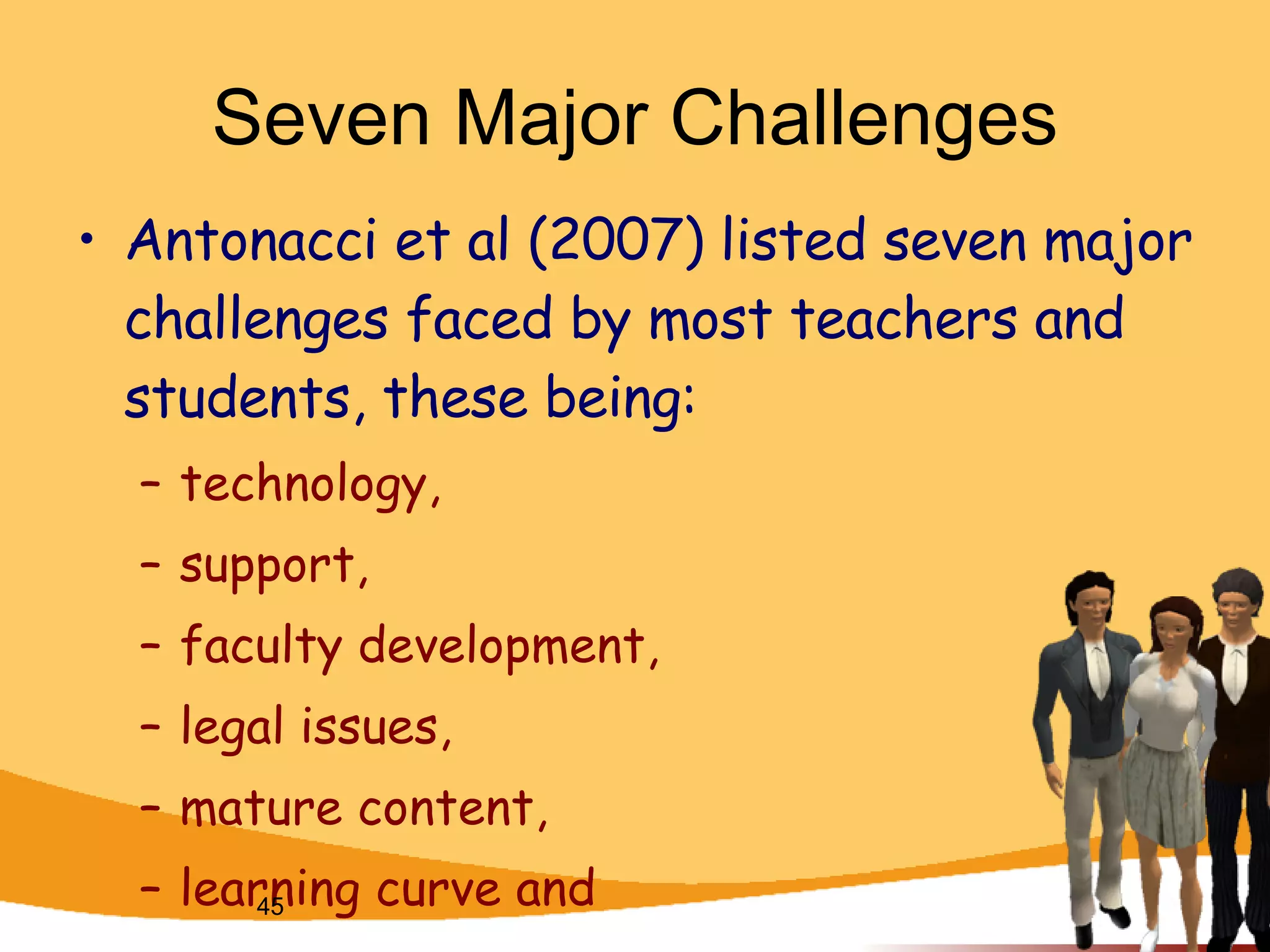
Seven Major Challenges Antonacci et al  ( 2007)  listed seven major challenges faced by most teachers and students, these being:  technology,  support,  faculty development,  legal issues,  mature content,  learning curve and  cost.
Technology Most university campuses do not have technical infrastructure to support large-scale implementation of virtual worlds
Faculty support Need to support faculty in their teaching
Legal issues Intellectual property issues, security, data protection and personal safety of students are also big concerns to universities.
Mature content Concerns about adult content  These threats can be minimized Under-18s are banned from SL Teachers have to get special permission to enter and teach in the SLTeen Grid
Learning curve It takes time to learn Not many faculty are willing to devote time to learning a new piece of software.
Financial cost Cost may be a deterrent for some universities
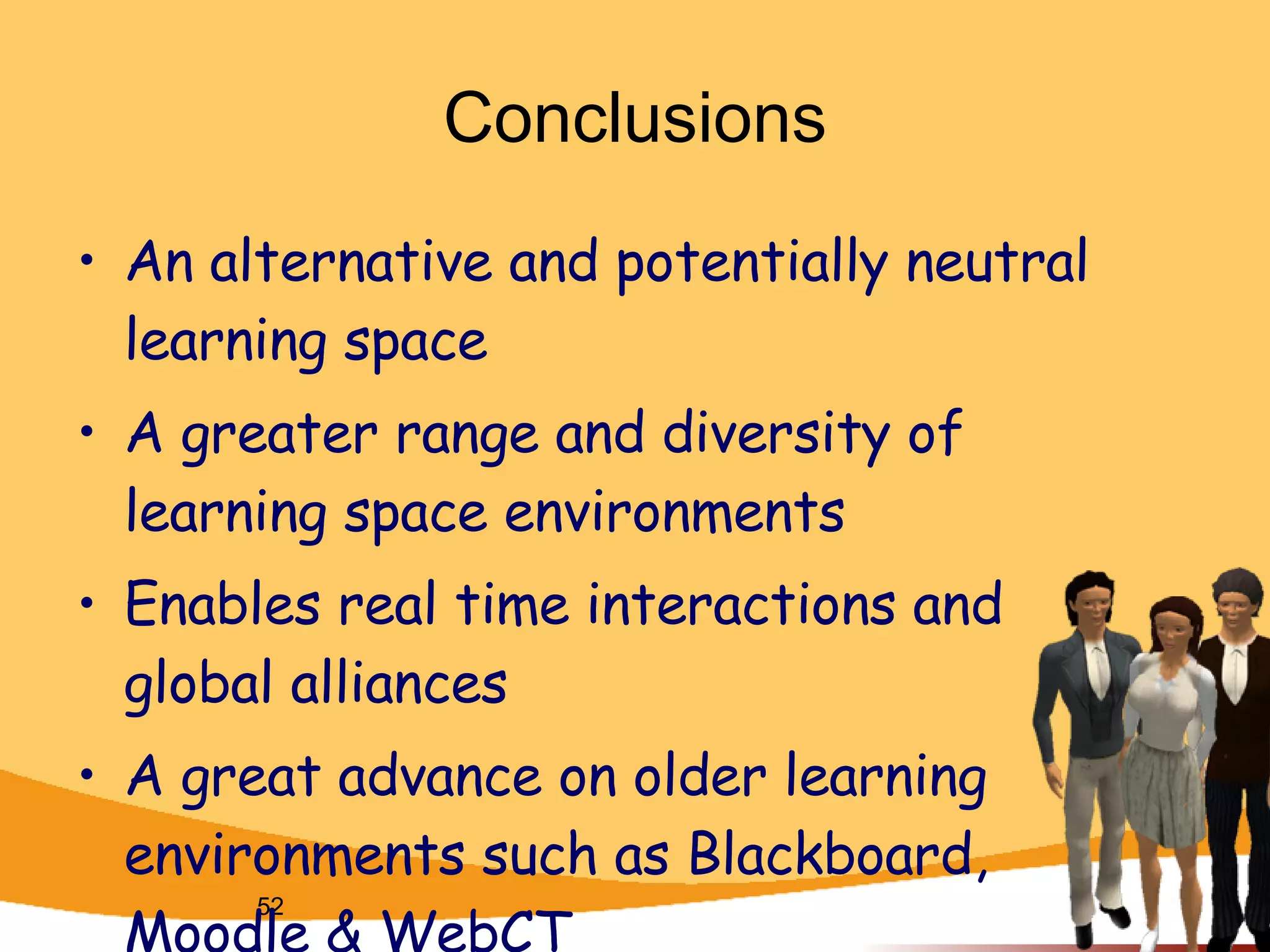
Conclusions An alternative and potentially neutral learning space A greater range and diversity of learning space environments Enables real time interactions and global alliances A great advance on older learning environments such as Blackboard, Moodle & WebCT
Conclusions A greater variety of teaching and learning styles  Different opportunity for greater range of interactions with teacher  Traditional role of the teacher changes More personal interactions possible
SL Conclusions  Usefuleaching, learning, research, performance, construction, demonstration The key advantage of SL - the student must be an active learner.  The student has to develop ‘stuff,’ collaborate and participate.  Learning by participating & doing than by listening and absorbing.
Recommendations  Go slow – experiment, pilot test, evaluate Try and get buy-in from Management and ITS Demonstrate what can be done Disseminate and show successes
Recommendations  Find appropriate topics or courses Use the media appropriately – e.g. not necessarily lectures but exploration, design or socialization Involve the innovators and pioneers Recognize the limitations and challenges Overcome the technical issues
References
Useful Links
Get creative – get a Second Life

Second Life: Teachers' Perceptions

  • 1.
    Laila AL-Hadrahmani & Paul Penfold Virtual Education in Second Life: Teachers' Perspectives Virtual Seminar by: Laila Al Hadhrami & Paul Penfold
  • 2.
    Introduction 20 minutepresentation - please leave your comments on Slidecast From: LAILA AL HADHRAMI Instructional & Learning Technologies Department, Sultan Qaboos University, Oman Email: [email_address] PAUL PENFOLD School of Hotel & Tourism Management, The Hong Kong Polytechnic University, HK Email: [email_address]
  • 3.
    Seminar Content Introducing virtual worlds & Second Life (SL) Teaching & learning in SL New roles of instructors in SL. Advantages & disadvantages of using SL. Teachers experience of teaching in SL Challenges and opportunities Conclusions & recommendations References/Bibliography.
  • 4.
    What are VirtualWorlds? “ A virtual world is a computer-based simulated environment intended for its users to inhabit and interact using avatars. Virtual worlds are also called &quot;digital worlds,&quot; &quot;simulated worlds,&quot; and “MUVE’s.” Not Simulations Not games Open ended – users choose the outcome and the activity
  • 5.
    Common Features SharedSpace Graphical User Interface Immediacy Interactivity Persistence Socialization/Community
  • 6.
    Virtual Worlds -Data Population of USA = 301 Million (July 2007 est.) Population of virtual worlds = 238 Million & rising daily
  • 7.
    Virtual Worlds -Data Population of Australia = 20.4 Million (2007) Population of Cyworld = 21 Million (2008)
  • 8.
  • 9.
    238 Million +160 Million +
  • 10.
  • 11.
  • 12.
    Even Mi5 areusing Virtual Worlds for recruitment
  • 13.
    Major Brands Big brands are embracing Virtual Worlds: AOL, BMW, Cisco, Dell, Intel, IBM, Mercedes and Sears etc Second LIfe theme park operated by Samsung and Softbank
  • 14.
    What is SecondLife? Launched in 2003, Second Life is an online 3D virtual world created by Linden Labs. Second Life provides an immersive environment for users to play and interact in.   Second Life is the size of a small city, with thousands of servers (called simulators)
  • 15.
    Who is usingSecond Life? Registered population of over 13 Million (not all live). From over 100 countries 60% are men, 40% are women Aged from 18 - 85. Also a teen-SL for under 18s
  • 18.
    The Basics Yourown avatar Behaviour Engaged, but not constrained Interaction All objects can be scripted No material costs
  • 19.
    Communication chat IMgroup IM IM <-> email voice Skype integration
  • 20.
    Moving around walkingflying teleporting locally via scripted objects longer distances via ‘landmarks’ in-world search engine Directly from the Web
  • 21.
    Land & Buildingrent or buy needed for permanent buildings shops, galleries, universities mainland areas private islands objects made out of basic building blocks – prims (cubes, spheres, etc )
  • 22.
    Teaching & Learningin SL 500 educational institutions 4,000 teachers (on SL Ed mailing list) Two models Working campus (functional – no walls) Reflective campus (like the real world)
  • 23.
    Universities use ofSL Formal teaching lectures, tutorials, training, presentations, demonstrations. Informal education offers more exploration and creativity student exhibitions, role play, games and virtual quests (Bleacher & Stockman, 2008).
  • 24.
    Subject Areas Themost common uses of Second Life seem to be in: computer studies, science subjects and humanities (Livingstone & Kemp, 2007), architectural studies, urban planning, graphic design, anatomy, natural sciences, law, languages, programming, literature, art and tourism. Dickey (2005)
  • 25.
    Second Health HospitalNursing/Medical The Heart Murmur Sim Second Life Hospital Imperial College London
  • 26.
    Libraries Info Island (built by librarians) is a cluster of islands bustling with activities that explore roles libraries and librarians may play in 3D virtual worlds
  • 27.
    Languages Also: SLIslands for Chinese, Japanese & many European languages Instructors at the English Village use “holoteaching,” using classrooms where you can completely change scenes with the touch of a button, like the holodeck in the TV show Star Trek. English Village
  • 28.
    Building & RealEstate Urban planning, collaborative architecture, building design, real estate practice & law etc
  • 29.
  • 30.
    Tourism & TravelVirtual Field trip - Morocco Hotel visits
  • 31.
  • 32.
    New Roles ofInstructors in SL A new learning environment – many challenges Need for more collaboration. Rather than competing, faculty are pushed towards innovative collaboration across disciplines and national boundaries.
  • 33.
    New roles Instructorsrealize that familiar ways of delivering knowledge and information may not be as effective in a 3D multi-user space. Most educators try traditional ways of teaching first, and then move them towards more student-centred pedagogies.
  • 34.
    New strategies forteaching From expert to a facilitator Assessment challenges in SL How to balance in-world and out-world instructional experiences. How to create greater levels of interactivity between learners, the internet, Web 2.0 tools and virtual worlds.
  • 35.
    Research with TeachersSurvey with 5 teachers who used SL in Spring Semester 2008
  • 36.
    What were themain challenges? KEY A) Setting up Second Life B) Not enough time for the session or tutorial C) Technical issues D) Lack of experience in using Second Life E) Other Other: Lack of computing facilities for students. Need to spend extra time to get the students familiar SL Should've been more prepared, had to rely on technicians. One of my groups had technical problems with the voice chat
  • 37.
    What went wellin using SL? KEY A) Students enjoyed using it B) It was an interactive experience for students C) It was a good learning experience for students D) It provided a new dimension for my subject E) It gave some variety to the subject F) Other Other: New learning / teaching experience for students & teachers.
  • 38.
    Would you useSL again?
  • 39.
    What would youdo differently? More time for students' hands-on experience Schedule tutorials in a computer lab and guide students into SL personally during initial sessions. Need to give students more time to learn the system. Have all computers ready before students arrive.
  • 40.
    What would youdo differently? Spend more time using SL, so that I am able to assist students more. Select some year 1 subjects to kick off first. So, when the students move to year 2 and 3, they will be well prepared for any SL activity Use SL in a more operations-based class
  • 41.
    What can wedo to improve the use of Second Life in the classroom? Promote to the students about SL Include it as default install on all university computers. Include university IT in planning.
  • 42.
    What can wedo to improve the use of Second Life in the classroom? Video a few online sessions and present the video to senior management, other staff and students. Continue to let faculty know how it can be used as a teaching tool. Make them aware of the facilities that have already been built, and suggest ideas for interactive sessions.
  • 43.
    Problems Technical hurdles– graphic cards, speed Learning curve User expectations Crime, sex, money & politics Most problems in real world exist in SL!
  • 44.
    Challenges & DifficultiesMany educators are excited about the potential of virtual worlds, others are wary or sceptical. Some consider them as upmarket games, while others are afraid they will degrade student learning. Virtual worlds present many challenges for students, teachers, and administrators.
  • 45.
    Seven Major ChallengesAntonacci et al ( 2007) listed seven major challenges faced by most teachers and students, these being: technology, support, faculty development, legal issues, mature content, learning curve and cost.
  • 46.
    Technology Most universitycampuses do not have technical infrastructure to support large-scale implementation of virtual worlds
  • 47.
    Faculty support Needto support faculty in their teaching
  • 48.
    Legal issues Intellectualproperty issues, security, data protection and personal safety of students are also big concerns to universities.
  • 49.
    Mature content Concernsabout adult content These threats can be minimized Under-18s are banned from SL Teachers have to get special permission to enter and teach in the SLTeen Grid
  • 50.
    Learning curve Ittakes time to learn Not many faculty are willing to devote time to learning a new piece of software.
  • 51.
    Financial cost Costmay be a deterrent for some universities
  • 52.
    Conclusions An alternativeand potentially neutral learning space A greater range and diversity of learning space environments Enables real time interactions and global alliances A great advance on older learning environments such as Blackboard, Moodle & WebCT
  • 53.
    Conclusions A greatervariety of teaching and learning styles Different opportunity for greater range of interactions with teacher Traditional role of the teacher changes More personal interactions possible
  • 54.
    SL Conclusions Usefuleaching, learning, research, performance, construction, demonstration The key advantage of SL - the student must be an active learner. The student has to develop ‘stuff,’ collaborate and participate. Learning by participating & doing than by listening and absorbing.
  • 55.
    Recommendations Goslow – experiment, pilot test, evaluate Try and get buy-in from Management and ITS Demonstrate what can be done Disseminate and show successes
  • 56.
    Recommendations Findappropriate topics or courses Use the media appropriately – e.g. not necessarily lectures but exploration, design or socialization Involve the innovators and pioneers Recognize the limitations and challenges Overcome the technical issues
  • 57.
  • 58.
  • 59.
    Get creative –get a Second Life