Information School,
University of Sheffield, UK
22 March 2019
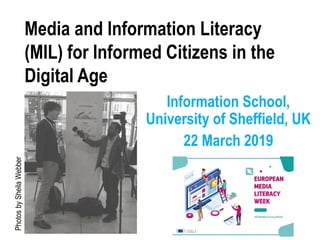
Media and Information Literacy
(MIL) for Informed Citizens in the
Digital Age
PhotosbySheilaWebber
Outline
• Introductions
• Reflections on the EU Media
Literacy Week Conference
• Why do we think MIL is important to
support and empower informed
citizens?
• What do we think information and
library professionals can contribute
to supporting and empowering
informed citizens’ MIL?
Introductions
•Sheila Webber
•Dr Pam McKinney
•Dr Sophie Rutter
•Dr Laura Sbaffi
Introductions: MIL a “composite concept”
MIL “provides answers to the questions that we all ask
ourselves at some point. How can we access, search,
critically assess, use and contribute content wisely, both
online and offline? What are our rights online and offline?
What are the ethical issues surrounding the access and
use of information? How can we engage with media and
ICTs to promote equality, intercultural and interreligious
dialogue, peace, freedom of expression and access to
information?”
https://en.unesco.org/themes/media-and-information-literacy
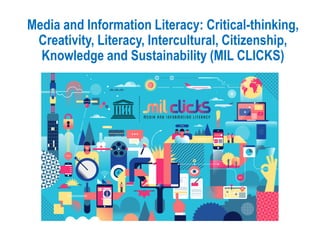
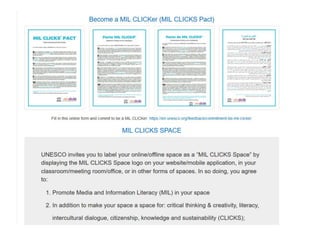
Media and Information Literacy: Critical-thinking,
Creativity, Literacy, Intercultural, Citizenship,
Knowledge and Sustainability (MIL CLICKS)
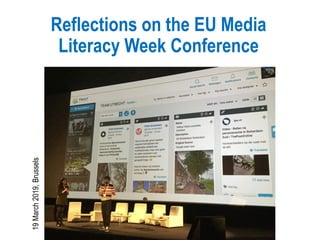
Reflections on the EU Media
Literacy Week Conference
19March2019,Brussels
Themes and features
Policy initiatives on Media Literacy, particularly relating to
misinformation, violence and hate speech e.g.
• Revised EU directive on Audiovisual Media Services
“In order to enable citizens to access information and to use, critically
assess and create media content responsibly and safely, citizens need to
possess advanced media literacy skills. Media literacy should not be
limited to learning about tools and technologies, but should aim to equip
citizens with the critical thinking skills required to exercise judgment,
analyse complex realities and recognise the difference between opinion
and fact. It is therefore necessary that both media service providers and
video-sharing platforms providers, in cooperation with all relevant
stakeholders, promote the development of media literacy in all sections
of society, for citizens of all ages, and for all media and that progress in
that regard is followed closely.”
• Communication/ Report from the High-Level Expert Group Tackling
online disinformation: a European approach adopted in April 2018 by the
European Commission
Themes and features
• Concerns about misinformation and citizens’ critical
engagement with advertising, news and content
• Concerns about manipulation, clickbait & impact of
algorithms
• Particular focus on impact on voters’ decisions, with EU
elections in May 2019 and other national elections
• Numerous practical initiatives, funded by the EU, by
countries/regions, by platforms (e.g. Facebook, Google)
etc.
• Emphasis on value of quality, ethical journalism, and need
for transparency
Winners of Media Literacy prize
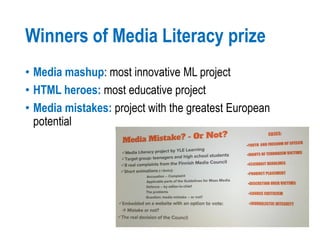
• Media mashup: most innovative ML project
• HTML heroes: most educative project
• Media mistakes: project with the greatest European
potential
What wasn’t at the conference ...
• Still most focus on youth, though it is shifting - but references to
older people’s ML rather patronising
• Information Literacy and librarians were missing in the
conversation
• Teachers were also not given prominence: speakers were
journalists; media literacy experts; media literacy & fact-checking
project leaders; representatives of media companies (e.g.
Facebook, Mediengruppe RTL), regulators, government etc.
• Media and Information Literacy was (I think) only mentioned by
the UNESCO representative
• Focus on media: not information in other aspects of people’s
lives e.g. not mentioning health information, scholarly
information, business information, information from government
etc.
Why do we think MIL is important to
support and empower informed
citizens?
What do we think information and
library professionals can contribute
to supporting and empowering
informed citizens’ MIL?
Sheila Webber
Information School
University of Sheffield
s.webber@sheffield.ac.uk
Twitter : @SheilaYoshikawa
http://information-literacy.blogspot.com/
Pamela McKinney
Information School
University of Sheffield
p.mickinney@sheffield.ac.uk
Twitter : @ischoolpam
Laura Sbaffi
Information School
University of Sheffield
l.sbaffi@sheffield.ac.uk
University of Sheffield Information School https://www.sheffield.ac.uk/is
Sophie Rutter
Information School
University of Sheffield
s.rutter@sheffield.ac.uk
Twitter : @sophiearutter
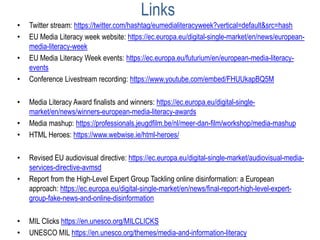
Links
• Twitter stream: https://twitter.com/hashtag/eumedialiteracyweek?vertical=default&src=hash
• EU Media Literacy week website: https://ec.europa.eu/digital-single-market/en/news/european-
media-literacy-week
• EU Media Literacy Week events: https://ec.europa.eu/futurium/en/european-media-literacy-
events
• Conference Livestream recording: https://www.youtube.com/embed/FHUUkapBQ5M
• Media Literacy Award finalists and winners: https://ec.europa.eu/digital-single-
market/en/news/winners-european-media-literacy-awards
• Media mashup: https://professionals.jeugdfilm.be/nl/meer-dan-film/workshop/media-mashup
• HTML Heroes: https://www.webwise.ie/html-heroes/
• Revised EU audiovisual directive: https://ec.europa.eu/digital-single-market/audiovisual-media-
services-directive-avmsd
• Report from the High-Level Expert Group Tackling online disinformation: a European
approach: https://ec.europa.eu/digital-single-market/en/news/final-report-high-level-expert-
group-fake-news-and-online-disinformation
• MIL Clicks https://en.unesco.org/MILCLICKS
• UNESCO MIL https://en.unesco.org/themes/media-and-information-literacy

Media and Information Literacy for Informed Citizens in the Digital Age

  • 1.
    Information School, University ofSheffield, UK 22 March 2019 Media and Information Literacy (MIL) for Informed Citizens in the Digital Age PhotosbySheilaWebber
  • 2.
    Outline • Introductions • Reflectionson the EU Media Literacy Week Conference • Why do we think MIL is important to support and empower informed citizens? • What do we think information and library professionals can contribute to supporting and empowering informed citizens’ MIL?
  • 3.
    Introductions •Sheila Webber •Dr PamMcKinney •Dr Sophie Rutter •Dr Laura Sbaffi
  • 4.
    Introductions: MIL a“composite concept” MIL “provides answers to the questions that we all ask ourselves at some point. How can we access, search, critically assess, use and contribute content wisely, both online and offline? What are our rights online and offline? What are the ethical issues surrounding the access and use of information? How can we engage with media and ICTs to promote equality, intercultural and interreligious dialogue, peace, freedom of expression and access to information?” https://en.unesco.org/themes/media-and-information-literacy
  • 5.
    Media and InformationLiteracy: Critical-thinking, Creativity, Literacy, Intercultural, Citizenship, Knowledge and Sustainability (MIL CLICKS)
  • 7.
    Reflections on theEU Media Literacy Week Conference 19March2019,Brussels
  • 8.
    Themes and features Policyinitiatives on Media Literacy, particularly relating to misinformation, violence and hate speech e.g. • Revised EU directive on Audiovisual Media Services “In order to enable citizens to access information and to use, critically assess and create media content responsibly and safely, citizens need to possess advanced media literacy skills. Media literacy should not be limited to learning about tools and technologies, but should aim to equip citizens with the critical thinking skills required to exercise judgment, analyse complex realities and recognise the difference between opinion and fact. It is therefore necessary that both media service providers and video-sharing platforms providers, in cooperation with all relevant stakeholders, promote the development of media literacy in all sections of society, for citizens of all ages, and for all media and that progress in that regard is followed closely.” • Communication/ Report from the High-Level Expert Group Tackling online disinformation: a European approach adopted in April 2018 by the European Commission
  • 9.
    Themes and features •Concerns about misinformation and citizens’ critical engagement with advertising, news and content • Concerns about manipulation, clickbait & impact of algorithms • Particular focus on impact on voters’ decisions, with EU elections in May 2019 and other national elections • Numerous practical initiatives, funded by the EU, by countries/regions, by platforms (e.g. Facebook, Google) etc. • Emphasis on value of quality, ethical journalism, and need for transparency
  • 10.
    Winners of MediaLiteracy prize • Media mashup: most innovative ML project • HTML heroes: most educative project • Media mistakes: project with the greatest European potential
  • 11.
    What wasn’t atthe conference ... • Still most focus on youth, though it is shifting - but references to older people’s ML rather patronising • Information Literacy and librarians were missing in the conversation • Teachers were also not given prominence: speakers were journalists; media literacy experts; media literacy & fact-checking project leaders; representatives of media companies (e.g. Facebook, Mediengruppe RTL), regulators, government etc. • Media and Information Literacy was (I think) only mentioned by the UNESCO representative • Focus on media: not information in other aspects of people’s lives e.g. not mentioning health information, scholarly information, business information, information from government etc.
  • 12.
    Why do wethink MIL is important to support and empower informed citizens?
  • 13.
    What do wethink information and library professionals can contribute to supporting and empowering informed citizens’ MIL?
  • 14.
    Sheila Webber Information School Universityof Sheffield s.webber@sheffield.ac.uk Twitter : @SheilaYoshikawa http://information-literacy.blogspot.com/ Pamela McKinney Information School University of Sheffield p.mickinney@sheffield.ac.uk Twitter : @ischoolpam Laura Sbaffi Information School University of Sheffield l.sbaffi@sheffield.ac.uk University of Sheffield Information School https://www.sheffield.ac.uk/is Sophie Rutter Information School University of Sheffield s.rutter@sheffield.ac.uk Twitter : @sophiearutter
  • 15.
    Links • Twitter stream:https://twitter.com/hashtag/eumedialiteracyweek?vertical=default&src=hash • EU Media Literacy week website: https://ec.europa.eu/digital-single-market/en/news/european- media-literacy-week • EU Media Literacy Week events: https://ec.europa.eu/futurium/en/european-media-literacy- events • Conference Livestream recording: https://www.youtube.com/embed/FHUUkapBQ5M • Media Literacy Award finalists and winners: https://ec.europa.eu/digital-single- market/en/news/winners-european-media-literacy-awards • Media mashup: https://professionals.jeugdfilm.be/nl/meer-dan-film/workshop/media-mashup • HTML Heroes: https://www.webwise.ie/html-heroes/ • Revised EU audiovisual directive: https://ec.europa.eu/digital-single-market/audiovisual-media- services-directive-avmsd • Report from the High-Level Expert Group Tackling online disinformation: a European approach: https://ec.europa.eu/digital-single-market/en/news/final-report-high-level-expert- group-fake-news-and-online-disinformation • MIL Clicks https://en.unesco.org/MILCLICKS • UNESCO MIL https://en.unesco.org/themes/media-and-information-literacy