Submitted by : Rafa Zubair NV
I M.Pharm
Pharmacology
Subject: Biochemical and
molecular pharmacology
1
Mediators of inflammation
 Definition: Any messenger that acts on
blood vessels, inflammatory cells, or other
cells to contribute to an inflammatory
response.
2
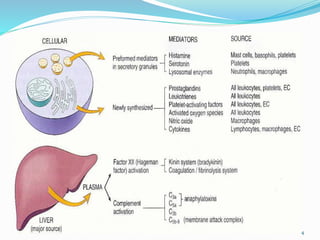
Classification
Cell derived mediators
Plasma derived mediators
3
4
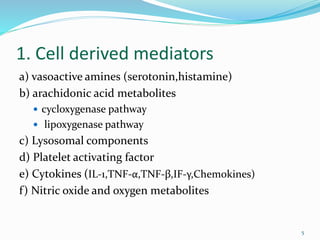
1. Cell derived mediators
a) vasoactive amines (serotonin,histamine)
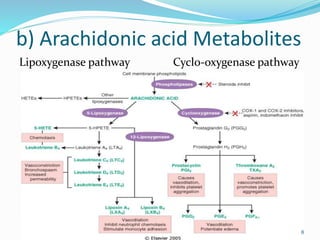
b) arachidonic acid metabolites
 cycloxygenase pathway
 lipoxygenase pathway
c) Lysosomal components
d) Platelet activating factor
e) Cytokines (IL-1,TNF-α,TNF-β,IF-γ,Chemokines)
f) Nitric oxide and oxygen metabolites
5
a) Vasoactive amines
Histamine :-
Stored in granuls of mast cells, basophiles and
platelets.
Released by the stimuli of various agents like Heat,
Cold, Irradiation, Irritant chemicals, Anaphilatoxins,
Interleukins,.. etc.
Actions ; Vasodilation
Vascular permeability
Itching and pain
6
Serotonin/5-hydroxy tryptamine :-
Present in chromafin cells of GIT, Spleen, Nervous
tissue, Mast cells, Platelets.
Actions ; Similar to Histamine, but less potent
Vasodilation
Vascular permeability
7
b) Arachidonic acid Metabolites
Lipoxygenase pathway Cyclo-oxygenase pathway
8
c) Lysosomal comonents
Source :- Neutrophiles and monocytes
Potent mediators
Degredation of bacterial and extracellular components
Chemotaxis
Realease of acid proteases, collagenase, elastase,
plasminogen activator
9
10
d) Platelet activating factor
 Phospholipid derived mediator
 Released from :- Platelets, basophil, mast cells,
neutrophils macrophages, endothelial cells
 Actions :-
Vascular permeability
Vasoconstriction
Vasodilatation
Bronchoconstriction
Adhesion of leukocytes to endothelium
Chemotaxis, degranulation
e) Cytokines
“Cytokines are a diverse group of small protein
molecules with potent biological activity whose main
function is in the regulation of immune responses.”
Main Cytokines are :-
 Interleukins
 Interferons
 Tumor necrosis factor
 Chemokines
 Transforming growth factor-beta
 Adipokines- leptin & adiponectin
11
Actions :-
 Adhesion of leucocytes to endothelium
 Synthesis of Prostacyclin, which is a vasodilator and
anti aggregator of platelets
 Synthesis of PAF and thrombogenic effect on
endothelial surface
12
f) Nitric oxide and oxygen metabolites
 Endothelium derived relaxing factor
 Macrophages, endothelial cells, neurons
Actions :-
Vasodilation
Anti-platelet activating agent
Microbicidal action
 H2O2 , Superoxide, Toxic NO products produced by
activated neutrophiles and microphages
Actions :-
Endothelial cell damage, tissue damage and vascular
permeability
13
2.Plasma derived mediators
a) The kinin system
b) The clotting system
c) The fibrinolytic system
d) The complement system
14
 4 interlinked systems
 Hageman factor(factor XII)
 End product of clotting ,fibrinolytic ,kinin system will
activate complement system.
15
a) The kinin system
factor XII
contact
factor XIIa
prekallikrein activator
Plasma prekallikrein kallikrein
kininogen bradykinin
16
Actions :-
Smooth muscle contraction
Vasodilation
 vascular permeability
pain
17
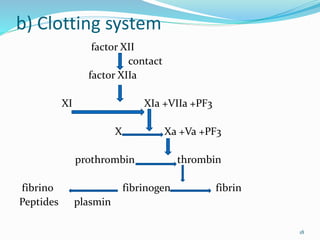
b) Clotting system
factor XII
contact
factor XIIa
XI XIa +VIIa +PF3
X Xa +Va +PF3
prothrombin thrombin
fibrino fibrinogen fibrin
Peptides plasmin
18
Actions :-
Increase vascular permeability
Chemotaxis for leucocytes
Anticoagulant activity
19
C) Fibrinolytic system
20
Actions :-
 Activation of factor XII to form prekallikrein activator
that stimulates kinin system to generate bradykinin
 Splits off complement c3 to form c3a,which is
permeability factor
 Degrades fibrin to split products, they increase
vascular permeability
21
D) Complement system
 Product of complement system is anaphylatoxins c3a
and c5a.
 Potency is c3a>c5a>c4a
 Actions:- release histamine from mast cells and
basophils
 C5a is chemotactic for leucocytes.
 Membrane attack complex cause pores in cell of
invading microbes.
22

Inflammatory mediators

  • 1.
    Submitted by :Rafa Zubair NV I M.Pharm Pharmacology Subject: Biochemical and molecular pharmacology 1
  • 2.
    Mediators of inflammation Definition: Any messenger that acts on blood vessels, inflammatory cells, or other cells to contribute to an inflammatory response. 2
  • 3.
  • 4.
  • 5.
    1. Cell derivedmediators a) vasoactive amines (serotonin,histamine) b) arachidonic acid metabolites  cycloxygenase pathway  lipoxygenase pathway c) Lysosomal components d) Platelet activating factor e) Cytokines (IL-1,TNF-α,TNF-β,IF-γ,Chemokines) f) Nitric oxide and oxygen metabolites 5
  • 6.
    a) Vasoactive amines Histamine:- Stored in granuls of mast cells, basophiles and platelets. Released by the stimuli of various agents like Heat, Cold, Irradiation, Irritant chemicals, Anaphilatoxins, Interleukins,.. etc. Actions ; Vasodilation Vascular permeability Itching and pain 6
  • 7.
    Serotonin/5-hydroxy tryptamine :- Presentin chromafin cells of GIT, Spleen, Nervous tissue, Mast cells, Platelets. Actions ; Similar to Histamine, but less potent Vasodilation Vascular permeability 7
  • 8.
    b) Arachidonic acidMetabolites Lipoxygenase pathway Cyclo-oxygenase pathway 8
  • 9.
    c) Lysosomal comonents Source:- Neutrophiles and monocytes Potent mediators Degredation of bacterial and extracellular components Chemotaxis Realease of acid proteases, collagenase, elastase, plasminogen activator 9
  • 10.
    10 d) Platelet activatingfactor  Phospholipid derived mediator  Released from :- Platelets, basophil, mast cells, neutrophils macrophages, endothelial cells  Actions :- Vascular permeability Vasoconstriction Vasodilatation Bronchoconstriction Adhesion of leukocytes to endothelium Chemotaxis, degranulation
  • 11.
    e) Cytokines “Cytokines area diverse group of small protein molecules with potent biological activity whose main function is in the regulation of immune responses.” Main Cytokines are :-  Interleukins  Interferons  Tumor necrosis factor  Chemokines  Transforming growth factor-beta  Adipokines- leptin & adiponectin 11
  • 12.
    Actions :-  Adhesionof leucocytes to endothelium  Synthesis of Prostacyclin, which is a vasodilator and anti aggregator of platelets  Synthesis of PAF and thrombogenic effect on endothelial surface 12
  • 13.
    f) Nitric oxideand oxygen metabolites  Endothelium derived relaxing factor  Macrophages, endothelial cells, neurons Actions :- Vasodilation Anti-platelet activating agent Microbicidal action  H2O2 , Superoxide, Toxic NO products produced by activated neutrophiles and microphages Actions :- Endothelial cell damage, tissue damage and vascular permeability 13
  • 14.
    2.Plasma derived mediators a)The kinin system b) The clotting system c) The fibrinolytic system d) The complement system 14
  • 15.
     4 interlinkedsystems  Hageman factor(factor XII)  End product of clotting ,fibrinolytic ,kinin system will activate complement system. 15
  • 16.
    a) The kininsystem factor XII contact factor XIIa prekallikrein activator Plasma prekallikrein kallikrein kininogen bradykinin 16
  • 17.
    Actions :- Smooth musclecontraction Vasodilation  vascular permeability pain 17
  • 18.
    b) Clotting system factorXII contact factor XIIa XI XIa +VIIa +PF3 X Xa +Va +PF3 prothrombin thrombin fibrino fibrinogen fibrin Peptides plasmin 18
  • 19.
    Actions :- Increase vascularpermeability Chemotaxis for leucocytes Anticoagulant activity 19
  • 20.
  • 21.
    Actions :-  Activationof factor XII to form prekallikrein activator that stimulates kinin system to generate bradykinin  Splits off complement c3 to form c3a,which is permeability factor  Degrades fibrin to split products, they increase vascular permeability 21
  • 22.
    D) Complement system Product of complement system is anaphylatoxins c3a and c5a.  Potency is c3a>c5a>c4a  Actions:- release histamine from mast cells and basophils  C5a is chemotactic for leucocytes.  Membrane attack complex cause pores in cell of invading microbes. 22