Grammar Unit II:  Lesson 5 Using Indefinite Pronouns Correctly
Definition Indefinite pronoun:  a pronoun that does not refer to a specific person, place, or thing.  Each  thinks about the story.
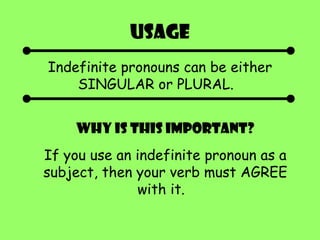
Usage Indefinite pronouns can be either SINGULAR or PLURAL.  Why is this important? If you use an indefinite pronoun as a subject, then your verb must AGREE with it.
Subject/verb agreement Each  thinks about the story.  Singular indefinite pronoun Singular verb SO, how can we determine which indefinite pronouns are SINGULAR and WHICH are plural? Unfortunately for most, you can’t.  You have to memorize them.    So here they are. . .
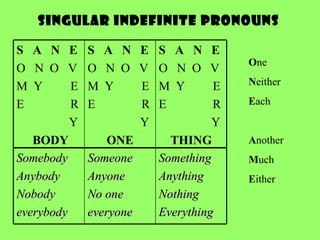
SINGULAR INDEFINITE PRONOUNS O ne N either E ach A nother M uch E ither Something Anything Nothing Everything Someone Anyone No one everyone Somebody Anybody Nobody everybody S  A  N  E O  N  O  V M  Y  E E  R Y THING S  A  N  E O  N  O  V M  Y  E E  R Y ONE S  A  N  E O  N  O  V M  Y  E E  R Y BODY
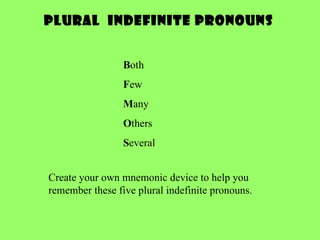
Plural  INDEFINITE PRONOUNS B oth F ew M any O thers S everal Create your own mnemonic device to help you remember these five plural indefinite pronouns.
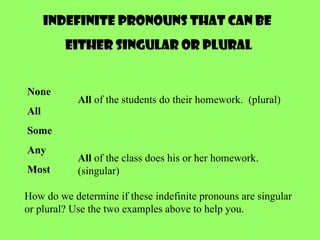
INDEFINITE PRONOUNS that can be  Either  Singular or plural N one A ll  S ome A ny M ost All  of the students do their homework.  (plural) All  of the class does his or her homework.  (singular) How do we determine if these indefinite pronouns are singular or plural? Use the two examples above to help you.
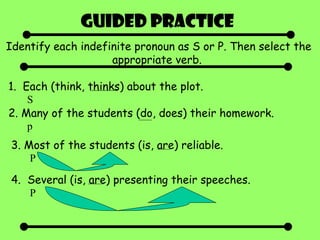
Guided Practice Identify each indefinite pronoun as S or P. Then select the appropriate verb.  1.  Each (think, thinks) about the plot. S 2. Many of the students (do, does) their homework.  p 3. Most of the students (is, are) reliable.  P 4.  Several (is, are) presenting their speeches.  P
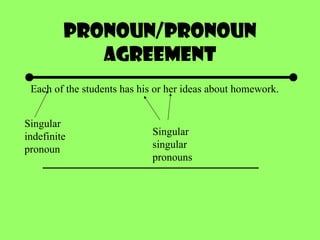
Pronoun/pronoun agreement Each of the students has his or her ideas about homework.  Singular indefinite pronoun Singular singular pronouns
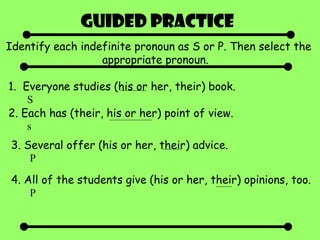
Guided Practice Identify each indefinite pronoun as S or P. Then select the appropriate pronoun.  1.  Everyone studies (his or her, their) book.  S 2. Each has (their, his or her) point of view.  s 3. Several offer (his or her, their) advice.  P 4. All of the students give (his or her, their) opinions, too.  P

Indefinite Pronouns

  • 1.
    Grammar Unit II: Lesson 5 Using Indefinite Pronouns Correctly
  • 2.
    Definition Indefinite pronoun: a pronoun that does not refer to a specific person, place, or thing. Each thinks about the story.
  • 3.
    Usage Indefinite pronounscan be either SINGULAR or PLURAL. Why is this important? If you use an indefinite pronoun as a subject, then your verb must AGREE with it.
  • 4.
    Subject/verb agreement Each thinks about the story. Singular indefinite pronoun Singular verb SO, how can we determine which indefinite pronouns are SINGULAR and WHICH are plural? Unfortunately for most, you can’t. You have to memorize them.  So here they are. . .
  • 5.
    SINGULAR INDEFINITE PRONOUNSO ne N either E ach A nother M uch E ither Something Anything Nothing Everything Someone Anyone No one everyone Somebody Anybody Nobody everybody S A N E O N O V M Y E E R Y THING S A N E O N O V M Y E E R Y ONE S A N E O N O V M Y E E R Y BODY
  • 6.
    Plural INDEFINITEPRONOUNS B oth F ew M any O thers S everal Create your own mnemonic device to help you remember these five plural indefinite pronouns.
  • 7.
    INDEFINITE PRONOUNS thatcan be Either Singular or plural N one A ll S ome A ny M ost All of the students do their homework. (plural) All of the class does his or her homework. (singular) How do we determine if these indefinite pronouns are singular or plural? Use the two examples above to help you.
  • 8.
    Guided Practice Identifyeach indefinite pronoun as S or P. Then select the appropriate verb. 1. Each (think, thinks) about the plot. S 2. Many of the students (do, does) their homework. p 3. Most of the students (is, are) reliable. P 4. Several (is, are) presenting their speeches. P
  • 9.
    Pronoun/pronoun agreement Eachof the students has his or her ideas about homework. Singular indefinite pronoun Singular singular pronouns
  • 10.
    Guided Practice Identifyeach indefinite pronoun as S or P. Then select the appropriate pronoun. 1. Everyone studies (his or her, their) book. S 2. Each has (their, his or her) point of view. s 3. Several offer (his or her, their) advice. P 4. All of the students give (his or her, their) opinions, too. P