




GerundsGerunds
andand
InfinitivesInfinitives
Gerunds and infinitivesGerunds and infinitives
can function as:can function as:
NOUNSNOUNS
((subjects, objects, subjectsubjects, objects, subject
complements)complements)
As subjects, they take a singularAs subjects, they take a singular
verb.verb.
Only Gerunds can beOnly Gerunds can be object of theobject of the
preposition.preposition.
To formTo form gerundsgerunds, use, use
thethe basebase form +form + inging
(don’t’ forget the rules for spelling of ing form of verbs)(don’t’ forget the rules for spelling of ing form of verbs)
I enjoy learning EnglishI enjoy learning English
To form negative gerunds, useTo form negative gerunds, use
not + gerundnot + gerund
Not speakingNot speaking English well is myEnglish well is my
biggest problem in this country.biggest problem in this country.
GerundsGerunds used as subjectused as subject
of the sentence.of the sentence.
DancingDancing is fun.is fun.
GerundsGerunds used as objectsused as objects
He enjoysHe enjoys workingworking withwith
children.children.
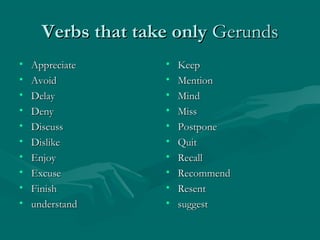
Verbs that take onlyVerbs that take only GerundsGerunds
• AppreciateAppreciate
• AvoidAvoid
• DelayDelay
• DenyDeny
• DiscussDiscuss
• DislikeDislike
• EnjoyEnjoy
• ExcuseExcuse
• FinishFinish
• understandunderstand
• KeepKeep
• MentionMention
• MindMind
• MissMiss
• PostponePostpone
• QuitQuit
• RecallRecall
• RecommendRecommend
• ResentResent
• suggestsuggest
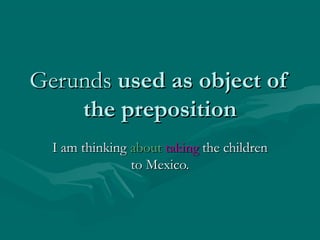
GerundsGerunds used as object ofused as object of
the prepositionthe preposition
I am thinkingI am thinking aboutabout takingtaking the childrenthe children
to Mexico.to Mexico.
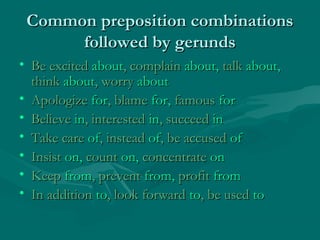
Common preposition combinationsCommon preposition combinations
followed by gerundsfollowed by gerunds
• Be excitedBe excited aboutabout, complain, complain about,about, talktalk about,about,
thinkthink aboutabout, worry, worry aboutabout
• ApologizeApologize forfor, blame, blame for,for, famousfamous forfor
• BelieveBelieve inin, interested, interested inin, succeed, succeed inin
• Take careTake care ofof, instead, instead ofof, be accused, be accused ofof
• InsistInsist on,on, countcount on,on, concentrateconcentrate onon
• KeepKeep fromfrom, prevent, prevent from,from, profitprofit fromfrom
• In additionIn addition toto, look forward, look forward toto, be used, be used toto
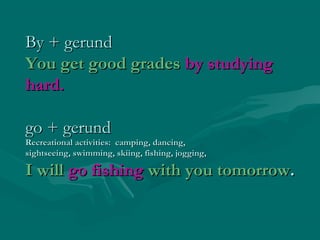
By + gerundBy + gerund
You get good gradesYou get good grades by studyingby studying
hard.hard.
go + gerundgo + gerund
Recreational activities: camping, dancing,Recreational activities: camping, dancing,
sightseeing, swimming, skiing, fishing, jogging,sightseeing, swimming, skiing, fishing, jogging,
I willI will go fishinggo fishing with you tomorrowwith you tomorrow..
Some expressions areSome expressions are
used withused with gerundsgerunds
Be busy, can’t help, have fun,Be busy, can’t help, have fun,
it’s no use, it’s not worthit’s no use, it’s not worth
To formTo form infinitivesinfinitives useuse
to + base form of the verbto + base form of the verb
I wantI want to danceto dance
To form negativeTo form negative infinitivesinfinitives useuse
Not + infinitiveNot + infinitive
He decidedHe decided not to gonot to go to the party.to the party.
InfinitivesInfinitives in the subjectin the subject
positionposition
To liveTo live in the United States is my dreamin the United States is my dream
It isIt is my dreammy dream to liveto live in the United States.in the United States.
Verbs that takeVerbs that take infinitivesinfinitives
Verb + infinitivesVerb + infinitives –– agree, appear, decideagree, appear, decide
hope, intend, learn, offer, plan, seem, tend, wait,hope, intend, learn, offer, plan, seem, tend, wait,
can affordcan afford
Verb + Noun phrase + infinitiveVerb + Noun phrase + infinitive –– cause,cause,
convince, force, invite, order, persuade, remind,convince, force, invite, order, persuade, remind,
tell, trust, warn, advise, encouragetell, trust, warn, advise, encourage
Verbs that come directly after the infinitive orVerbs that come directly after the infinitive or
have a noun phrasehave a noun phrase –– ask, beg, choose, expect,ask, beg, choose, expect,
need, want, would like, promiseneed, want, would like, promise
Adjectives followed byAdjectives followed by
infinitivesinfinitives
Afraid, amazed, anxious, ashamed, careful,Afraid, amazed, anxious, ashamed, careful,
delighted, eager, fortunate, glad, happy, lucky,delighted, eager, fortunate, glad, happy, lucky,
pleased, ready, sad, sorrypleased, ready, sad, sorry,,
Infinitive of purposeInfinitive of purpose
In order toIn order to
I came hereI came here in order toin order to learn.learn.
InfinitiveInfinitive withwith tootoo andand enoughenough
too + adjective or adverb + infinitivetoo + adjective or adverb + infinitive
She isShe is too youngtoo young to vote.to vote.
Adjective or adverb + enough +Adjective or adverb + enough +
infinitiveinfinitive
They areThey are old enoughold enough to vote.to vote.
GerundsGerunds often follow verbs thatoften follow verbs that
indicate that an action is happeningindicate that an action is happening
or has happened.or has happened.
The action expressed by the verbThe action expressed by the verb
comes at the same time or after thecomes at the same time or after the
action expressed by the gerund.action expressed by the gerund.
We enjoy going to concertsWe enjoy going to concerts..
(you can only enjoy things you are doing or have done –(you can only enjoy things you are doing or have done –
not things you haven’t done yet.)not things you haven’t done yet.)
InfinitivesInfinitives often follow verbs thatoften follow verbs that
indicate that an action will or couldindicate that an action will or could
happen.happen.
The action expressed by the verbThe action expressed by the verb
comes before the action expressed bycomes before the action expressed by
the infinitive.the infinitive.
We hope to go to the concert.We hope to go to the concert.
(You can hope for things that could happen(You can hope for things that could happen
not things that have already happened)not things that have already happened)
Verbs that are followed byVerbs that are followed by
a noun phrase + infinitivea noun phrase + infinitive
can also be followed bycan also be followed by a gerunda gerund..
The gerund makes it general and theThe gerund makes it general and the
infinitive make specific the personinfinitive make specific the person
indicated.indicated.
TheyThey allow smokingallow smoking in this building.in this building.
TheyThey allowed me to smokeallowed me to smoke in thein the
house.house.
These verbs are:These verbs are:
adviseadvise
allowallow
encourageencourage
permitpermit
requirerequire
urgeurge
Some verbs can be followed by bothSome verbs can be followed by both
gerundgerund oror infinitiveinfinitive with no changewith no change
in meaning.in meaning.
Begin, hate, like,Begin, hate, like,
start, love, prefer, continuestart, love, prefer, continue
I likeI like cooking.cooking.
I likeI like to cook.to cook.
She startedShe started losinglosing weightweight
She startedShe started to loseto lose weight.weight.
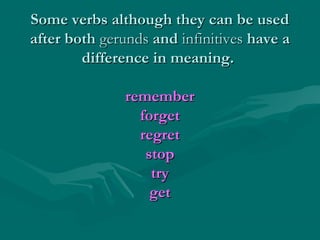
Some verbs although they can be usedSome verbs although they can be used
after bothafter both gerundsgerunds andand infinitivesinfinitives have ahave a
difference in meaning.difference in meaning.
rememberremember
forgetforget
regretregret
stopstop
trytry
getget
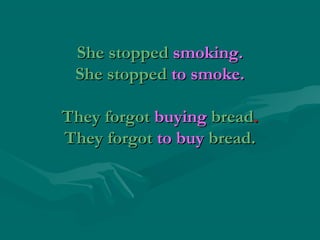
She stoppedShe stopped smoking.smoking.
She stoppedShe stopped to smoke.to smoke.
They forgotThey forgot buyingbuying breadbread..
They forgotThey forgot to buyto buy bread.bread.
Used toUsed to
Be used toBe used to
Get used toGet used to
Used to + base formUsed to + base form
Be used to + gerundBe used to + gerund
Get used to + gerundGet used to + gerund
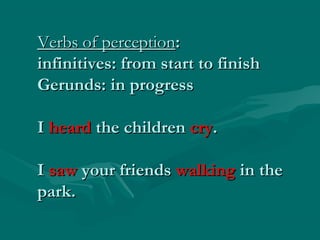
Verbs of perceptionVerbs of perception::
infinitives: from start to finishinfinitives: from start to finish
Gerunds: in progressGerunds: in progress
II heardheard the childrenthe children crycry..
II sawsaw your friendsyour friends walkingwalking in thein the
park.park.
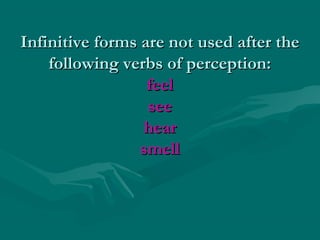
Infinitive forms are not used after theInfinitive forms are not used after the
following verbs of perception:following verbs of perception:
feelfeel
seesee
hearhear
smellsmell
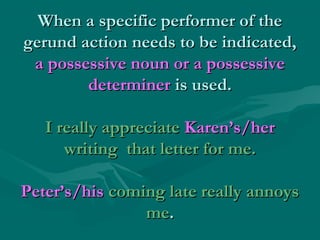
When a specific performer of theWhen a specific performer of the
gerund action needs to be indicated,gerund action needs to be indicated,
a possessive noun or a possessivea possessive noun or a possessive
determinerdeterminer is used.is used.
I really appreciateI really appreciate Karen’s/herKaren’s/her
writing that letter for me.writing that letter for me.
Peter’s/hisPeter’s/his coming late really annoyscoming late really annoys
meme..
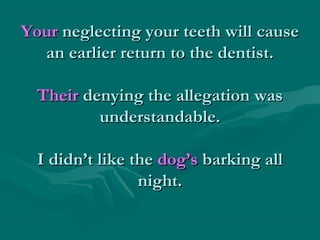
YourYour neglecting your teeth will causeneglecting your teeth will cause
an earlier return to the dentist.an earlier return to the dentist.
TheirTheir denying the allegation wasdenying the allegation was
understandable.understandable.
I didn’t like theI didn’t like the dog’sdog’s barking allbarking all
night.night.
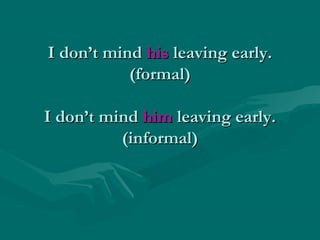
I don’t mindI don’t mind hishis leaving early.leaving early.
(formal)(formal)
I don’t mindI don’t mind himhim leaving early.leaving early.
(informal)(informal)
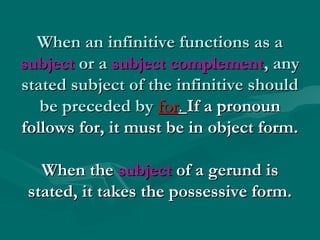
When an infinitive functions as aWhen an infinitive functions as a
subjectsubject or aor a subject complementsubject complement, any, any
stated subject of the infinitive shouldstated subject of the infinitive should
be preceded bybe preceded by forfor.. If a pronounIf a pronoun
follows for, it must be in object form.follows for, it must be in object form.
When theWhen the subjectsubject of a gerund isof a gerund is
stated, it takes the possessive form.stated, it takes the possessive form.
For peopleFor people to see is a wonderful gift.to see is a wonderful gift.
Her desire wasHer desire was for themfor them to take a tripto take a trip
around the worldaround the world
They hopedThey hoped for herfor her to be able toto be able to
attend the concert.attend the concert.
InfinitivesInfinitives can occur in thecan occur in the
progressive butprogressive but gerundsgerunds cannot.cannot.
To be doingTo be doing
It is used to indicate an activity inIt is used to indicate an activity in
progress or ongoingprogress or ongoing
She had hoped to be workingShe had hoped to be working
BothBoth gerunds and infinitivesgerunds and infinitives cancan
occur in the perfect formoccur in the perfect form
having donehaving done
to have doneto have done
It is used to indicate that the activityIt is used to indicate that the activity
is in the pastis in the past
We appreciate having heard her sing.We appreciate having heard her sing.
We’re fortunate to have heard herWe’re fortunate to have heard her
singsing
A gerund can be used in the passiveA gerund can be used in the passive
formform
I dislike being told a lie.I dislike being told a lie.
HaveHave
makemake
letlet
are causative verbs. They causeare causative verbs. They cause
someone to do something.someone to do something.
They are always followed by a nounThey are always followed by a noun
phrase + base form of verb.phrase + base form of verb.
Do not use an infinitive after theseDo not use an infinitive after these
verbs.verbs.
She madeShe made meme fallfall..
SheShe mademade her daughterher daughter gogo to theto the
party.party.
SheShe letlet himhim taketake the camera.the camera.
SheShe hadhad meme prepareprepare breakfastbreakfast
yesterday.yesterday.
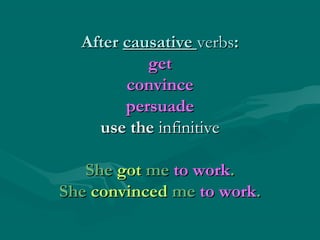
AfterAfter causativecausative verbsverbs::
getget
convinceconvince
persuadepersuade
use theuse the infinitiveinfinitive
SheShe gotgot meme to workto work..
SheShe convincedconvinced meme to workto work..
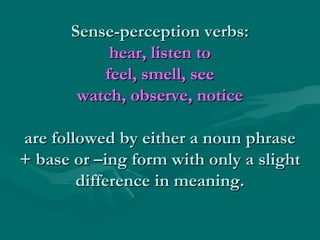
Sense-perception verbs:Sense-perception verbs:
hear, listen tohear, listen to
feel, smell, seefeel, smell, see
watch, observe, noticewatch, observe, notice
are followed by either a noun phraseare followed by either a noun phrase
+ base or –ing form with only a slight+ base or –ing form with only a slight
difference in meaning.difference in meaning.
We saw peopleWe saw people livingliving in poverty.in poverty.
We sawWe saw them performthem perform
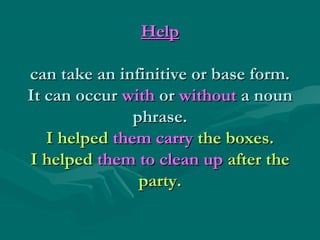
HelpHelp
can take an infinitive or base form.can take an infinitive or base form.
It can occurIt can occur withwith oror withoutwithout a nouna noun
phrase.phrase.
I helpedI helped them carrythem carry the boxes.the boxes.
I helpedI helped them to clean upthem to clean up after theafter the
party.party.
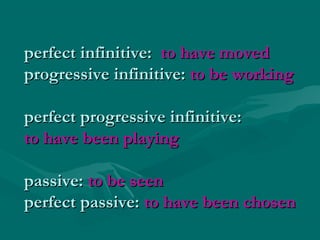
perfect infinitive:perfect infinitive: to have movedto have moved
progressive infinitive:progressive infinitive: to be workingto be working
perfect progressive infinitive:perfect progressive infinitive:
to have been playingto have been playing
passive:passive: to be seento be seen
perfect passive:perfect passive: to have been chosento have been chosen
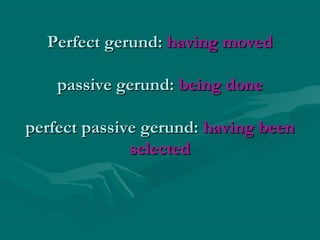
Perfect gerund:Perfect gerund: having movedhaving moved
passive gerund:passive gerund: being donebeing done
perfect passive gerund:perfect passive gerund: having beenhaving been
selectedselected
The End!The End!

Gerunds and infinitives

  • 1.
  • 2.
    Gerunds and infinitivesGerundsand infinitives can function as:can function as: NOUNSNOUNS ((subjects, objects, subjectsubjects, objects, subject complements)complements) As subjects, they take a singularAs subjects, they take a singular verb.verb. Only Gerunds can beOnly Gerunds can be object of theobject of the preposition.preposition.
  • 3.
    To formTo formgerundsgerunds, use, use thethe basebase form +form + inging (don’t’ forget the rules for spelling of ing form of verbs)(don’t’ forget the rules for spelling of ing form of verbs) I enjoy learning EnglishI enjoy learning English To form negative gerunds, useTo form negative gerunds, use not + gerundnot + gerund Not speakingNot speaking English well is myEnglish well is my biggest problem in this country.biggest problem in this country.
  • 4.
    GerundsGerunds used assubjectused as subject of the sentence.of the sentence. DancingDancing is fun.is fun.
  • 5.
    GerundsGerunds used asobjectsused as objects He enjoysHe enjoys workingworking withwith children.children.
  • 6.
    Verbs that takeonlyVerbs that take only GerundsGerunds • AppreciateAppreciate • AvoidAvoid • DelayDelay • DenyDeny • DiscussDiscuss • DislikeDislike • EnjoyEnjoy • ExcuseExcuse • FinishFinish • understandunderstand • KeepKeep • MentionMention • MindMind • MissMiss • PostponePostpone • QuitQuit • RecallRecall • RecommendRecommend • ResentResent • suggestsuggest
  • 7.
    GerundsGerunds used asobject ofused as object of the prepositionthe preposition I am thinkingI am thinking aboutabout takingtaking the childrenthe children to Mexico.to Mexico.
  • 8.
    Common preposition combinationsCommonpreposition combinations followed by gerundsfollowed by gerunds • Be excitedBe excited aboutabout, complain, complain about,about, talktalk about,about, thinkthink aboutabout, worry, worry aboutabout • ApologizeApologize forfor, blame, blame for,for, famousfamous forfor • BelieveBelieve inin, interested, interested inin, succeed, succeed inin • Take careTake care ofof, instead, instead ofof, be accused, be accused ofof • InsistInsist on,on, countcount on,on, concentrateconcentrate onon • KeepKeep fromfrom, prevent, prevent from,from, profitprofit fromfrom • In additionIn addition toto, look forward, look forward toto, be used, be used toto
  • 9.
    By + gerundBy+ gerund You get good gradesYou get good grades by studyingby studying hard.hard. go + gerundgo + gerund Recreational activities: camping, dancing,Recreational activities: camping, dancing, sightseeing, swimming, skiing, fishing, jogging,sightseeing, swimming, skiing, fishing, jogging, I willI will go fishinggo fishing with you tomorrowwith you tomorrow..
  • 10.
    Some expressions areSomeexpressions are used withused with gerundsgerunds Be busy, can’t help, have fun,Be busy, can’t help, have fun, it’s no use, it’s not worthit’s no use, it’s not worth
  • 11.
    To formTo forminfinitivesinfinitives useuse to + base form of the verbto + base form of the verb I wantI want to danceto dance To form negativeTo form negative infinitivesinfinitives useuse Not + infinitiveNot + infinitive He decidedHe decided not to gonot to go to the party.to the party.
  • 12.
    InfinitivesInfinitives in thesubjectin the subject positionposition To liveTo live in the United States is my dreamin the United States is my dream It isIt is my dreammy dream to liveto live in the United States.in the United States.
  • 13.
    Verbs that takeVerbsthat take infinitivesinfinitives Verb + infinitivesVerb + infinitives –– agree, appear, decideagree, appear, decide hope, intend, learn, offer, plan, seem, tend, wait,hope, intend, learn, offer, plan, seem, tend, wait, can affordcan afford Verb + Noun phrase + infinitiveVerb + Noun phrase + infinitive –– cause,cause, convince, force, invite, order, persuade, remind,convince, force, invite, order, persuade, remind, tell, trust, warn, advise, encouragetell, trust, warn, advise, encourage Verbs that come directly after the infinitive orVerbs that come directly after the infinitive or have a noun phrasehave a noun phrase –– ask, beg, choose, expect,ask, beg, choose, expect, need, want, would like, promiseneed, want, would like, promise
  • 14.
    Adjectives followed byAdjectivesfollowed by infinitivesinfinitives Afraid, amazed, anxious, ashamed, careful,Afraid, amazed, anxious, ashamed, careful, delighted, eager, fortunate, glad, happy, lucky,delighted, eager, fortunate, glad, happy, lucky, pleased, ready, sad, sorrypleased, ready, sad, sorry,,
  • 15.
    Infinitive of purposeInfinitiveof purpose In order toIn order to I came hereI came here in order toin order to learn.learn.
  • 16.
    InfinitiveInfinitive withwith tootooandand enoughenough too + adjective or adverb + infinitivetoo + adjective or adverb + infinitive She isShe is too youngtoo young to vote.to vote. Adjective or adverb + enough +Adjective or adverb + enough + infinitiveinfinitive They areThey are old enoughold enough to vote.to vote.
  • 17.
    GerundsGerunds often followverbs thatoften follow verbs that indicate that an action is happeningindicate that an action is happening or has happened.or has happened. The action expressed by the verbThe action expressed by the verb comes at the same time or after thecomes at the same time or after the action expressed by the gerund.action expressed by the gerund. We enjoy going to concertsWe enjoy going to concerts.. (you can only enjoy things you are doing or have done –(you can only enjoy things you are doing or have done – not things you haven’t done yet.)not things you haven’t done yet.)
  • 18.
    InfinitivesInfinitives often followverbs thatoften follow verbs that indicate that an action will or couldindicate that an action will or could happen.happen. The action expressed by the verbThe action expressed by the verb comes before the action expressed bycomes before the action expressed by the infinitive.the infinitive. We hope to go to the concert.We hope to go to the concert. (You can hope for things that could happen(You can hope for things that could happen not things that have already happened)not things that have already happened)
  • 19.
    Verbs that arefollowed byVerbs that are followed by a noun phrase + infinitivea noun phrase + infinitive can also be followed bycan also be followed by a gerunda gerund.. The gerund makes it general and theThe gerund makes it general and the infinitive make specific the personinfinitive make specific the person indicated.indicated. TheyThey allow smokingallow smoking in this building.in this building. TheyThey allowed me to smokeallowed me to smoke in thein the house.house.
  • 20.
    These verbs are:Theseverbs are: adviseadvise allowallow encourageencourage permitpermit requirerequire urgeurge
  • 21.
    Some verbs canbe followed by bothSome verbs can be followed by both gerundgerund oror infinitiveinfinitive with no changewith no change in meaning.in meaning. Begin, hate, like,Begin, hate, like, start, love, prefer, continuestart, love, prefer, continue
  • 22.
    I likeI likecooking.cooking. I likeI like to cook.to cook. She startedShe started losinglosing weightweight She startedShe started to loseto lose weight.weight.
  • 23.
    Some verbs althoughthey can be usedSome verbs although they can be used after bothafter both gerundsgerunds andand infinitivesinfinitives have ahave a difference in meaning.difference in meaning. rememberremember forgetforget regretregret stopstop trytry getget
  • 24.
    She stoppedShe stoppedsmoking.smoking. She stoppedShe stopped to smoke.to smoke. They forgotThey forgot buyingbuying breadbread.. They forgotThey forgot to buyto buy bread.bread.
  • 25.
    Used toUsed to Beused toBe used to Get used toGet used to Used to + base formUsed to + base form Be used to + gerundBe used to + gerund Get used to + gerundGet used to + gerund
  • 26.
    Verbs of perceptionVerbsof perception:: infinitives: from start to finishinfinitives: from start to finish Gerunds: in progressGerunds: in progress II heardheard the childrenthe children crycry.. II sawsaw your friendsyour friends walkingwalking in thein the park.park.
  • 27.
    Infinitive forms arenot used after theInfinitive forms are not used after the following verbs of perception:following verbs of perception: feelfeel seesee hearhear smellsmell
  • 28.
    When a specificperformer of theWhen a specific performer of the gerund action needs to be indicated,gerund action needs to be indicated, a possessive noun or a possessivea possessive noun or a possessive determinerdeterminer is used.is used. I really appreciateI really appreciate Karen’s/herKaren’s/her writing that letter for me.writing that letter for me. Peter’s/hisPeter’s/his coming late really annoyscoming late really annoys meme..
  • 29.
    YourYour neglecting yourteeth will causeneglecting your teeth will cause an earlier return to the dentist.an earlier return to the dentist. TheirTheir denying the allegation wasdenying the allegation was understandable.understandable. I didn’t like theI didn’t like the dog’sdog’s barking allbarking all night.night.
  • 30.
    I don’t mindIdon’t mind hishis leaving early.leaving early. (formal)(formal) I don’t mindI don’t mind himhim leaving early.leaving early. (informal)(informal)
  • 31.
    When an infinitivefunctions as aWhen an infinitive functions as a subjectsubject or aor a subject complementsubject complement, any, any stated subject of the infinitive shouldstated subject of the infinitive should be preceded bybe preceded by forfor.. If a pronounIf a pronoun follows for, it must be in object form.follows for, it must be in object form. When theWhen the subjectsubject of a gerund isof a gerund is stated, it takes the possessive form.stated, it takes the possessive form.
  • 32.
    For peopleFor peopleto see is a wonderful gift.to see is a wonderful gift. Her desire wasHer desire was for themfor them to take a tripto take a trip around the worldaround the world They hopedThey hoped for herfor her to be able toto be able to attend the concert.attend the concert.
  • 33.
    InfinitivesInfinitives can occurin thecan occur in the progressive butprogressive but gerundsgerunds cannot.cannot. To be doingTo be doing It is used to indicate an activity inIt is used to indicate an activity in progress or ongoingprogress or ongoing She had hoped to be workingShe had hoped to be working
  • 34.
    BothBoth gerunds andinfinitivesgerunds and infinitives cancan occur in the perfect formoccur in the perfect form having donehaving done to have doneto have done It is used to indicate that the activityIt is used to indicate that the activity is in the pastis in the past We appreciate having heard her sing.We appreciate having heard her sing. We’re fortunate to have heard herWe’re fortunate to have heard her singsing
  • 35.
    A gerund canbe used in the passiveA gerund can be used in the passive formform I dislike being told a lie.I dislike being told a lie.
  • 36.
    HaveHave makemake letlet are causative verbs.They causeare causative verbs. They cause someone to do something.someone to do something. They are always followed by a nounThey are always followed by a noun phrase + base form of verb.phrase + base form of verb. Do not use an infinitive after theseDo not use an infinitive after these verbs.verbs. She madeShe made meme fallfall..
  • 37.
    SheShe mademade herdaughterher daughter gogo to theto the party.party. SheShe letlet himhim taketake the camera.the camera. SheShe hadhad meme prepareprepare breakfastbreakfast yesterday.yesterday.
  • 38.
    AfterAfter causativecausative verbsverbs:: getget convinceconvince persuadepersuade usetheuse the infinitiveinfinitive SheShe gotgot meme to workto work.. SheShe convincedconvinced meme to workto work..
  • 39.
    Sense-perception verbs:Sense-perception verbs: hear,listen tohear, listen to feel, smell, seefeel, smell, see watch, observe, noticewatch, observe, notice are followed by either a noun phraseare followed by either a noun phrase + base or –ing form with only a slight+ base or –ing form with only a slight difference in meaning.difference in meaning.
  • 40.
    We saw peopleWesaw people livingliving in poverty.in poverty. We sawWe saw them performthem perform
  • 41.
    HelpHelp can take aninfinitive or base form.can take an infinitive or base form. It can occurIt can occur withwith oror withoutwithout a nouna noun phrase.phrase. I helpedI helped them carrythem carry the boxes.the boxes. I helpedI helped them to clean upthem to clean up after theafter the party.party.
  • 42.
    perfect infinitive:perfect infinitive:to have movedto have moved progressive infinitive:progressive infinitive: to be workingto be working perfect progressive infinitive:perfect progressive infinitive: to have been playingto have been playing passive:passive: to be seento be seen perfect passive:perfect passive: to have been chosento have been chosen
  • 43.
    Perfect gerund:Perfect gerund:having movedhaving moved passive gerund:passive gerund: being donebeing done perfect passive gerund:perfect passive gerund: having beenhaving been selectedselected
  • 44.