Gerunds
and
Infinitives
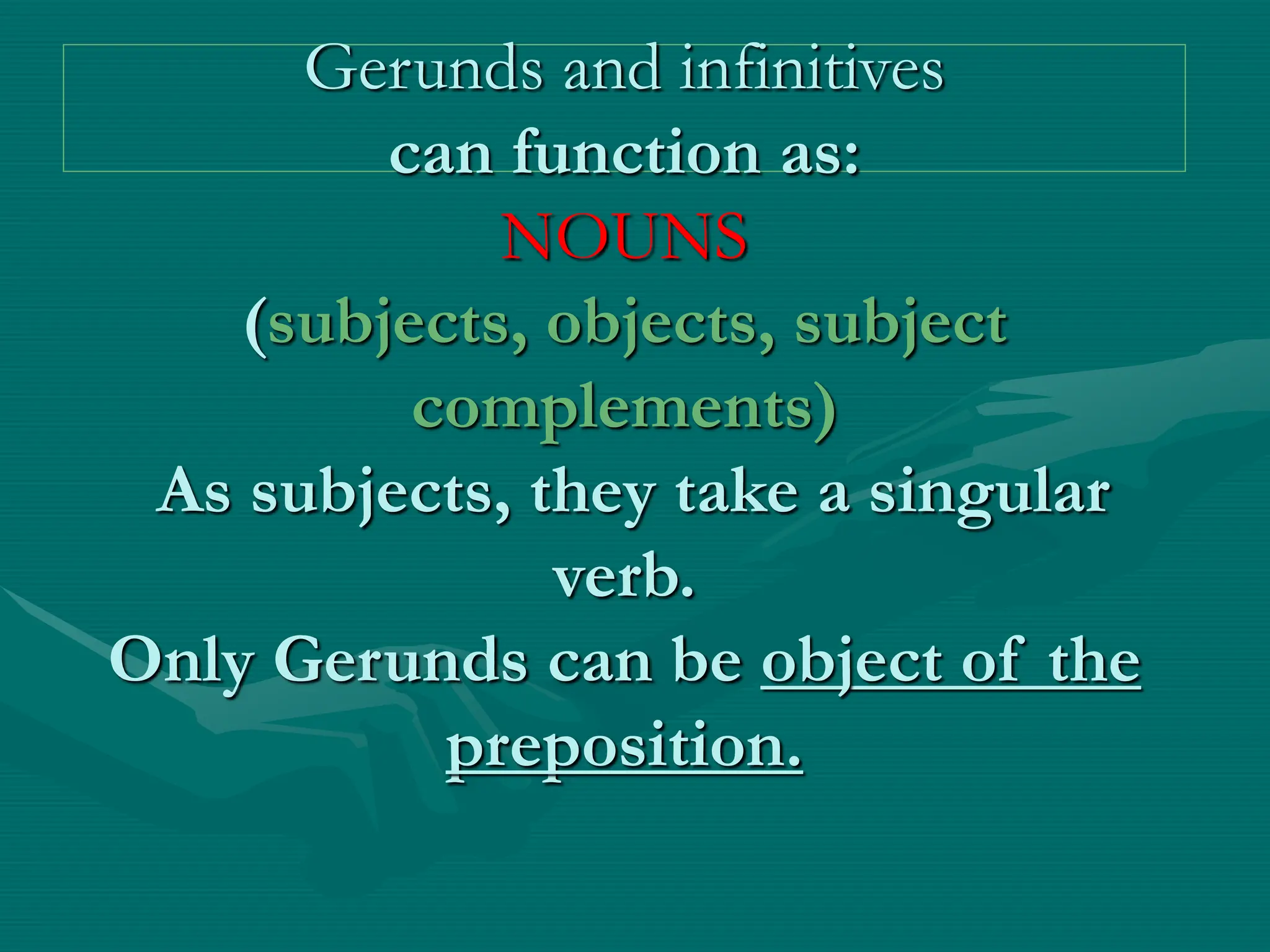
Gerunds and infinitives
can function as:
NOUNS
(subjects, objects, subject
complements)
As subjects, they take a singular
verb.
Only Gerunds can be object of the
preposition.
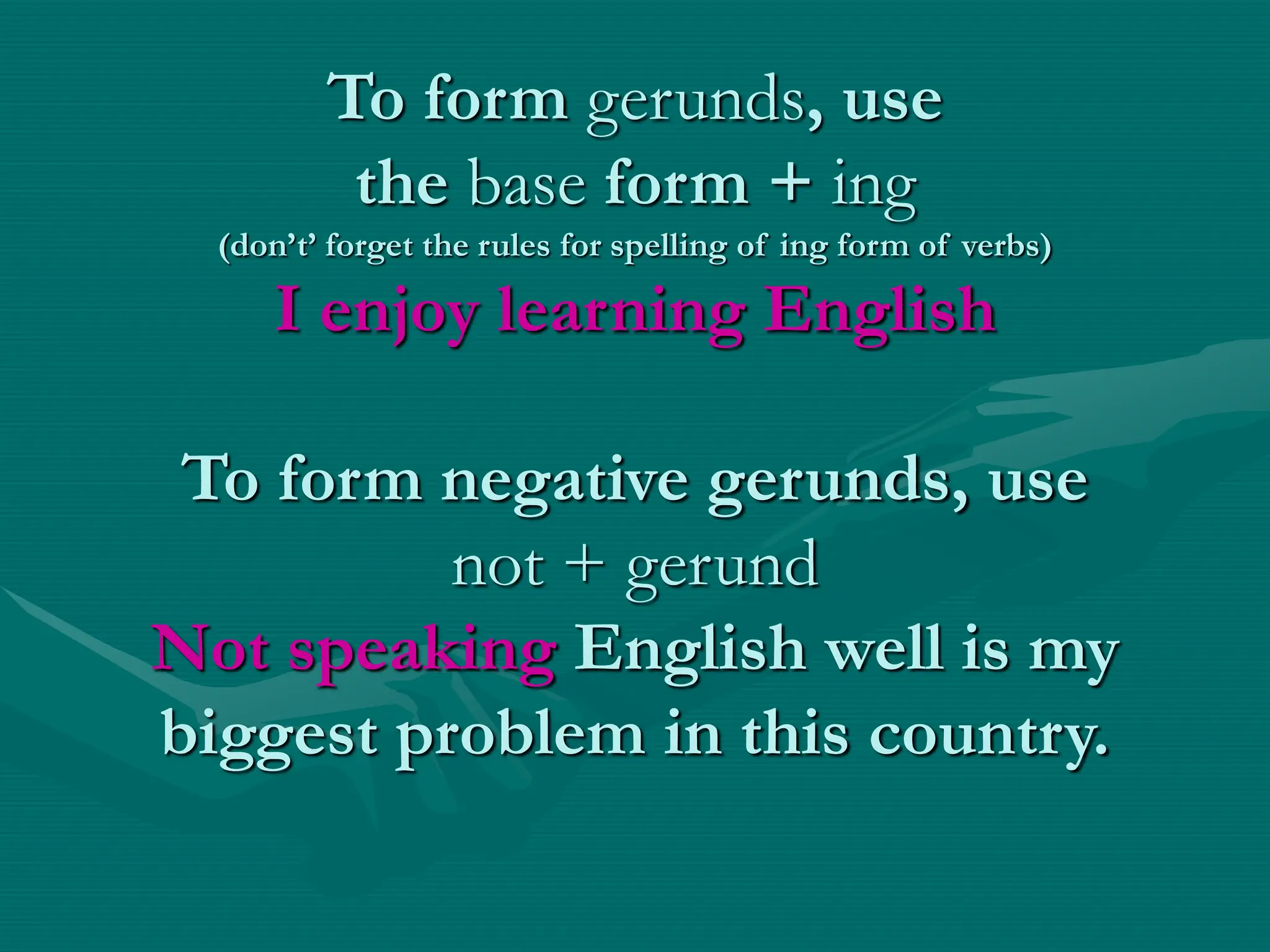
To form gerunds, use
the base form + ing
(don’t’ forget the rules for spelling of ing form of verbs)
I enjoy learning English
To form negative gerunds, use
not + gerund
Not speaking English well is my
biggest problem in this country.
Gerunds used as subject
of the sentence.
Dancing is fun.
Gerunds used as objects
He enjoys working with
children.
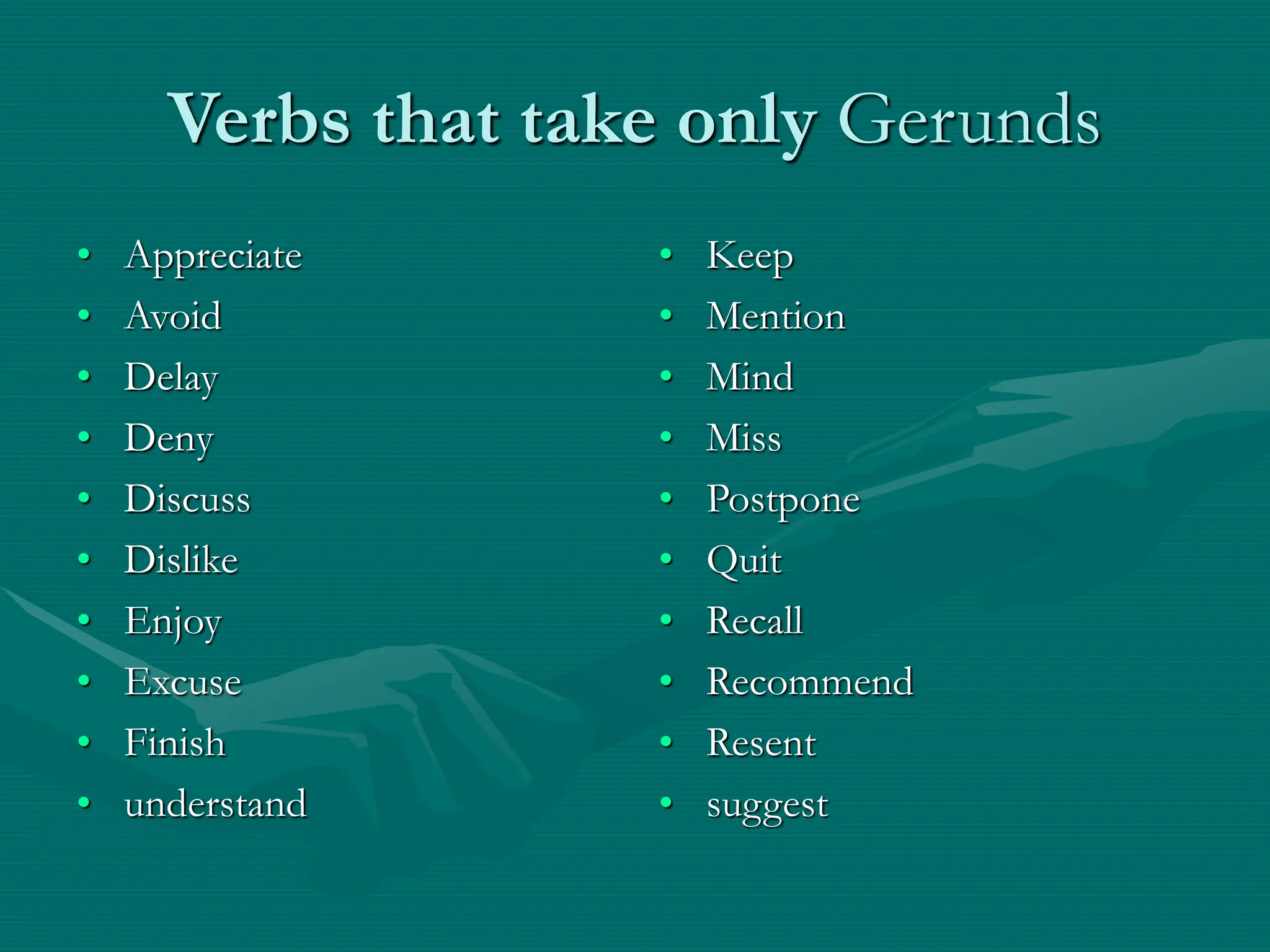
Verbs that take only Gerunds
• Appreciate
• Avoid
• Delay
• Deny
• Discuss
• Dislike
• Enjoy
• Excuse
• Finish
• understand
• Keep
• Mention
• Mind
• Miss
• Postpone
• Quit
• Recall
• Recommend
• Resent
• suggest
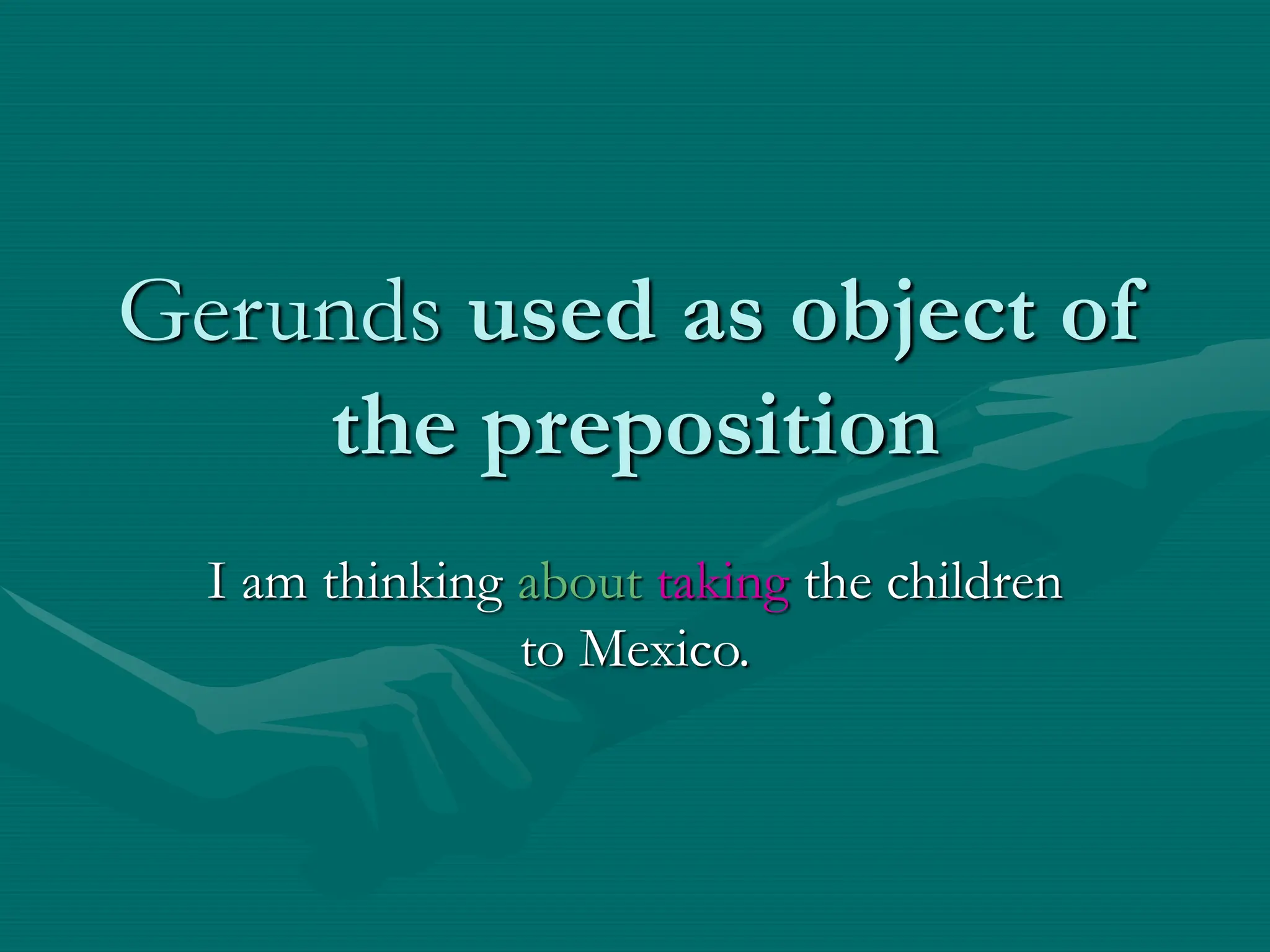
Gerunds used as object of
the preposition
I am thinking about taking the children
to Mexico.
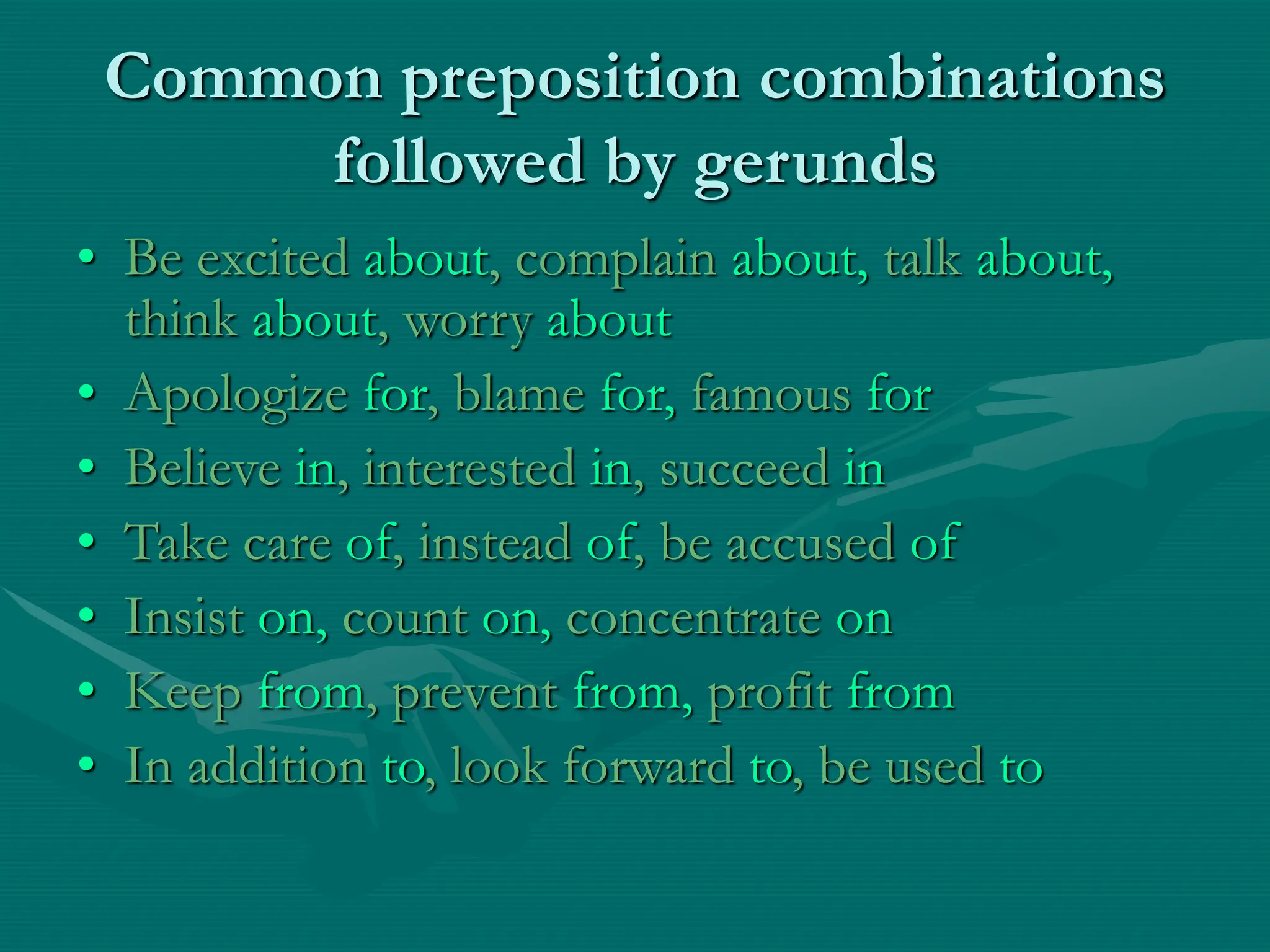
Common preposition combinations
followed by gerunds
• Be excited about, complain about, talk about,
think about, worry about
• Apologize for, blame for, famous for
• Believe in, interested in, succeed in
• Take care of, instead of, be accused of
• Insist on, count on, concentrate on
• Keep from, prevent from, profit from
• In addition to, look forward to, be used to
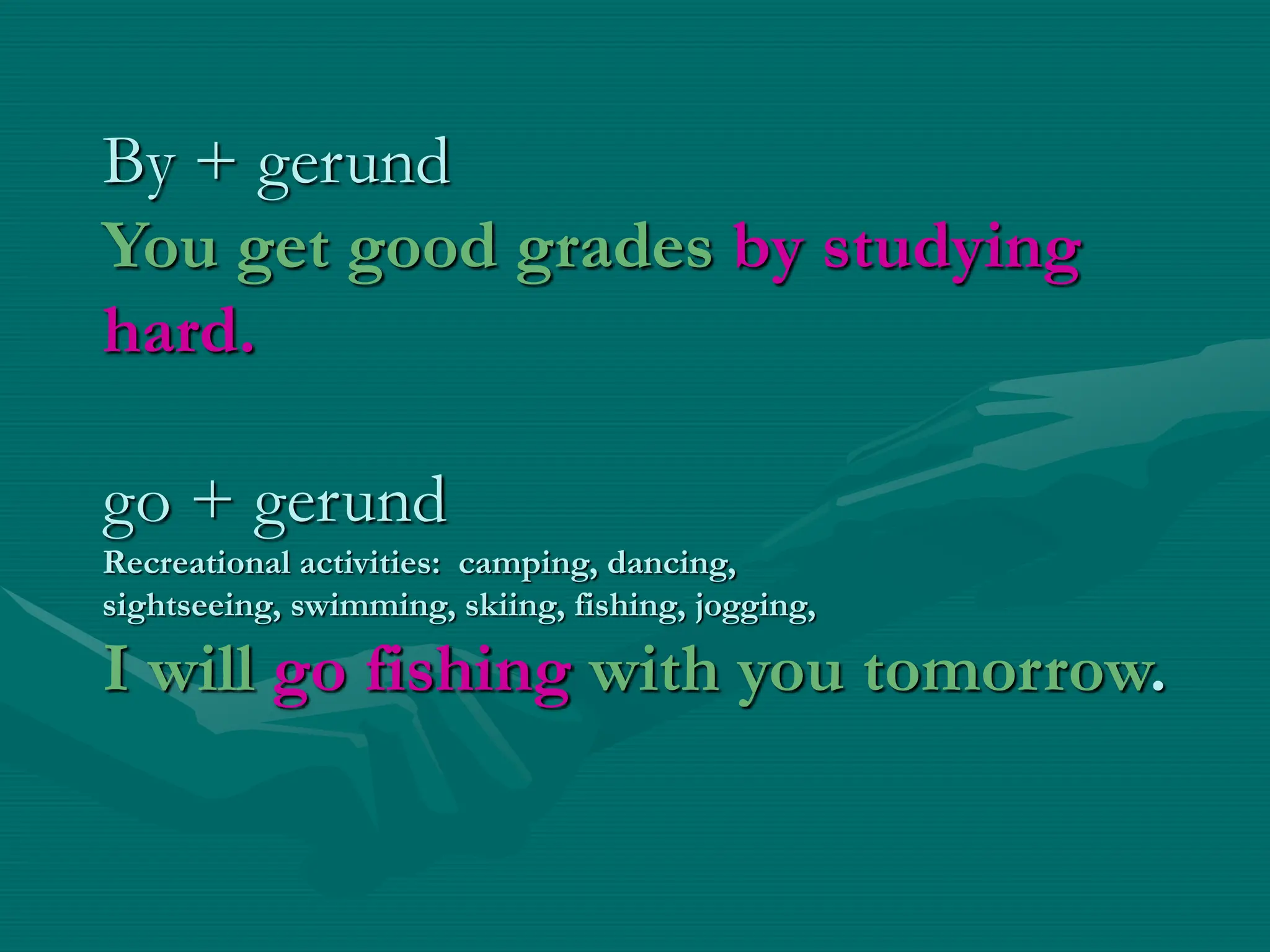
By + gerund
You get good grades by studying
hard.
go + gerund
Recreational activities: camping, dancing,
sightseeing, swimming, skiing, fishing, jogging,
I will go fishing with you tomorrow.
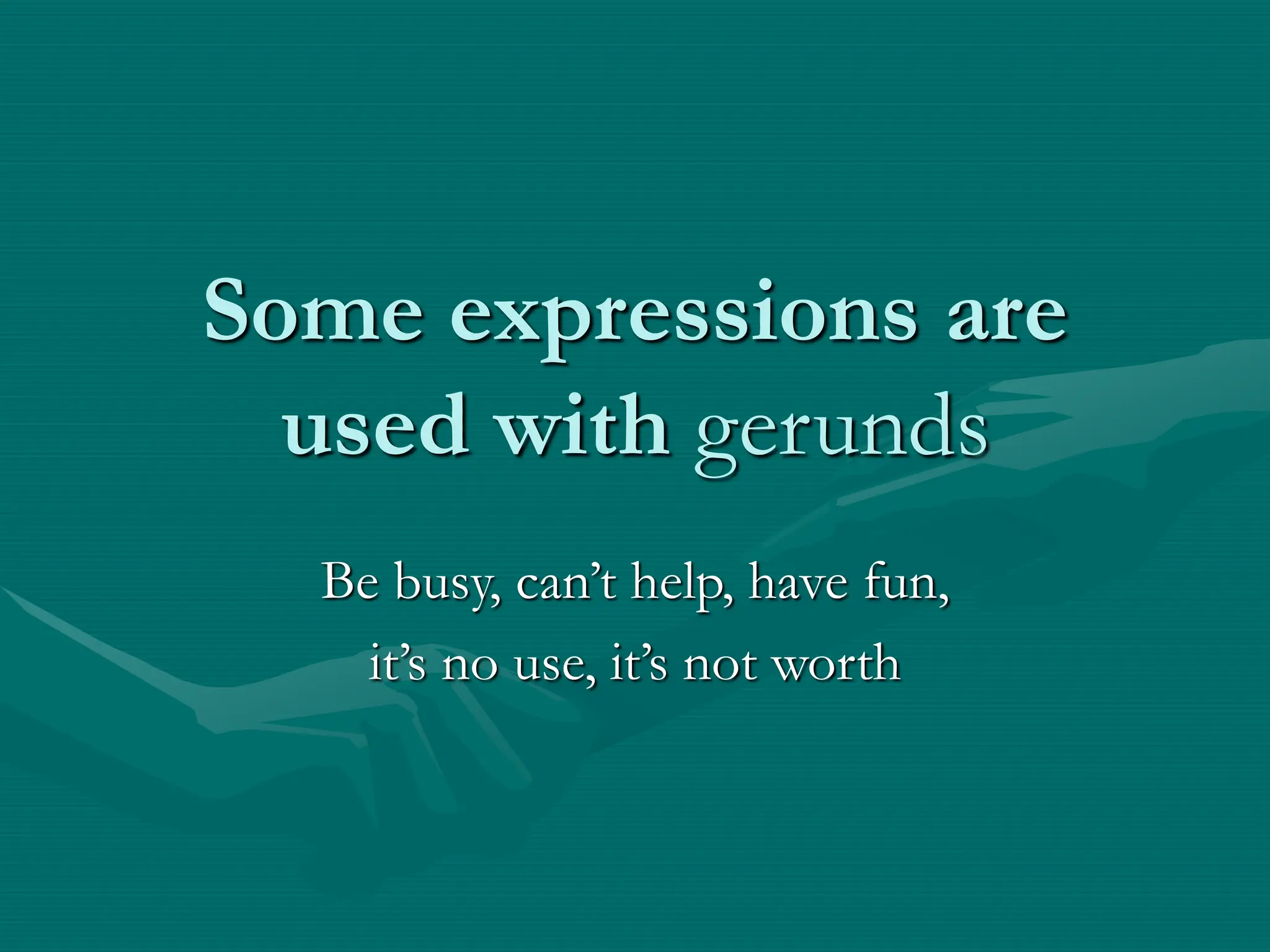
Some expressions are
used with gerunds
Be busy, can’t help, have fun,
it’s no use, it’s not worth
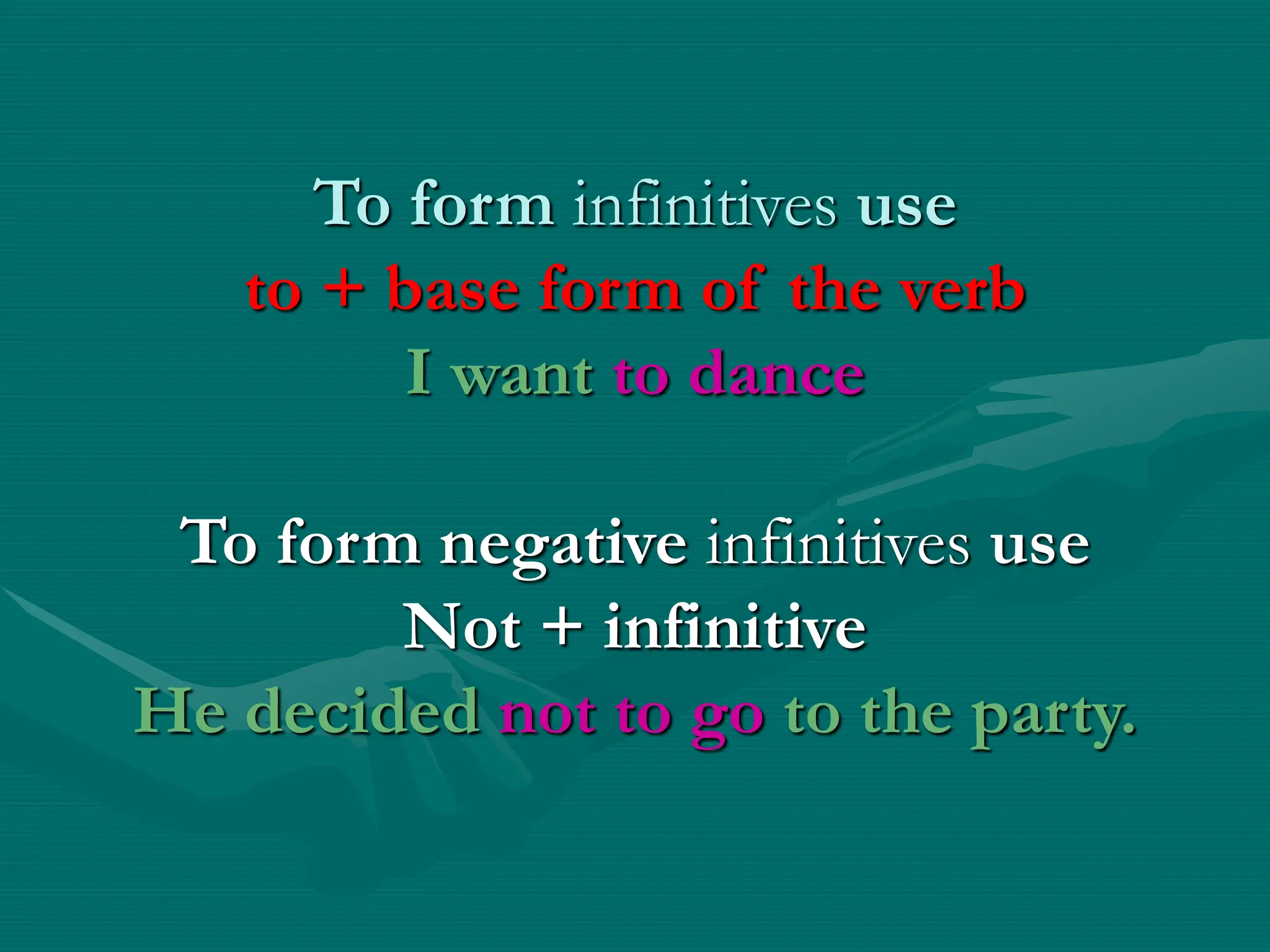
To form infinitives use
to + base form of the verb
I want to dance
To form negative infinitives use
Not + infinitive
He decided not to go to the party.
Infinitives in the subject
position
To live in the United States is my dream
It is my dream to live in the United States.
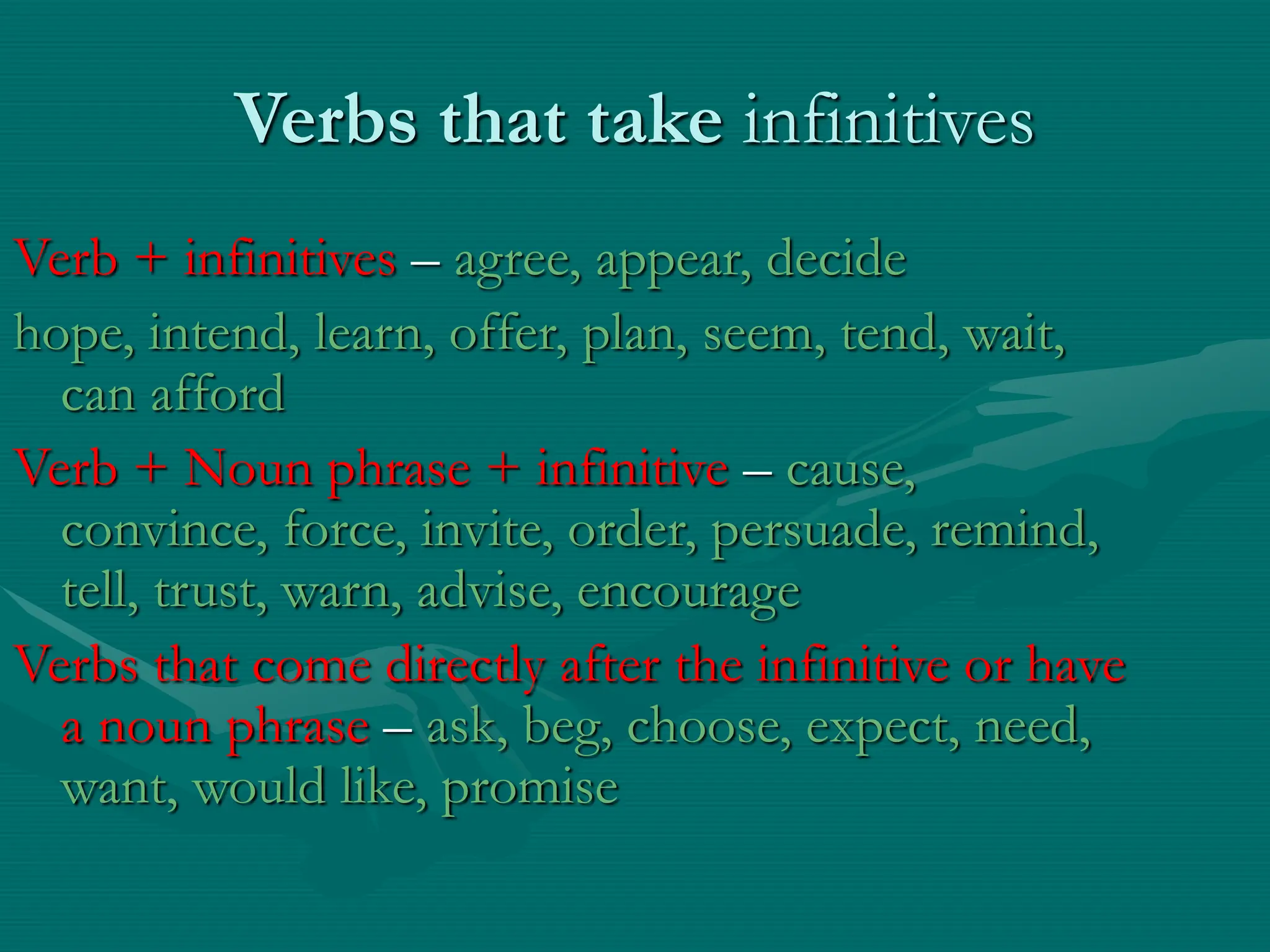
Verbs that take infinitives
Verb + infinitives – agree, appear, decide
hope, intend, learn, offer, plan, seem, tend, wait,
can afford
Verb + Noun phrase + infinitive – cause,
convince, force, invite, order, persuade, remind,
tell, trust, warn, advise, encourage
Verbs that come directly after the infinitive or have
a noun phrase – ask, beg, choose, expect, need,
want, would like, promise
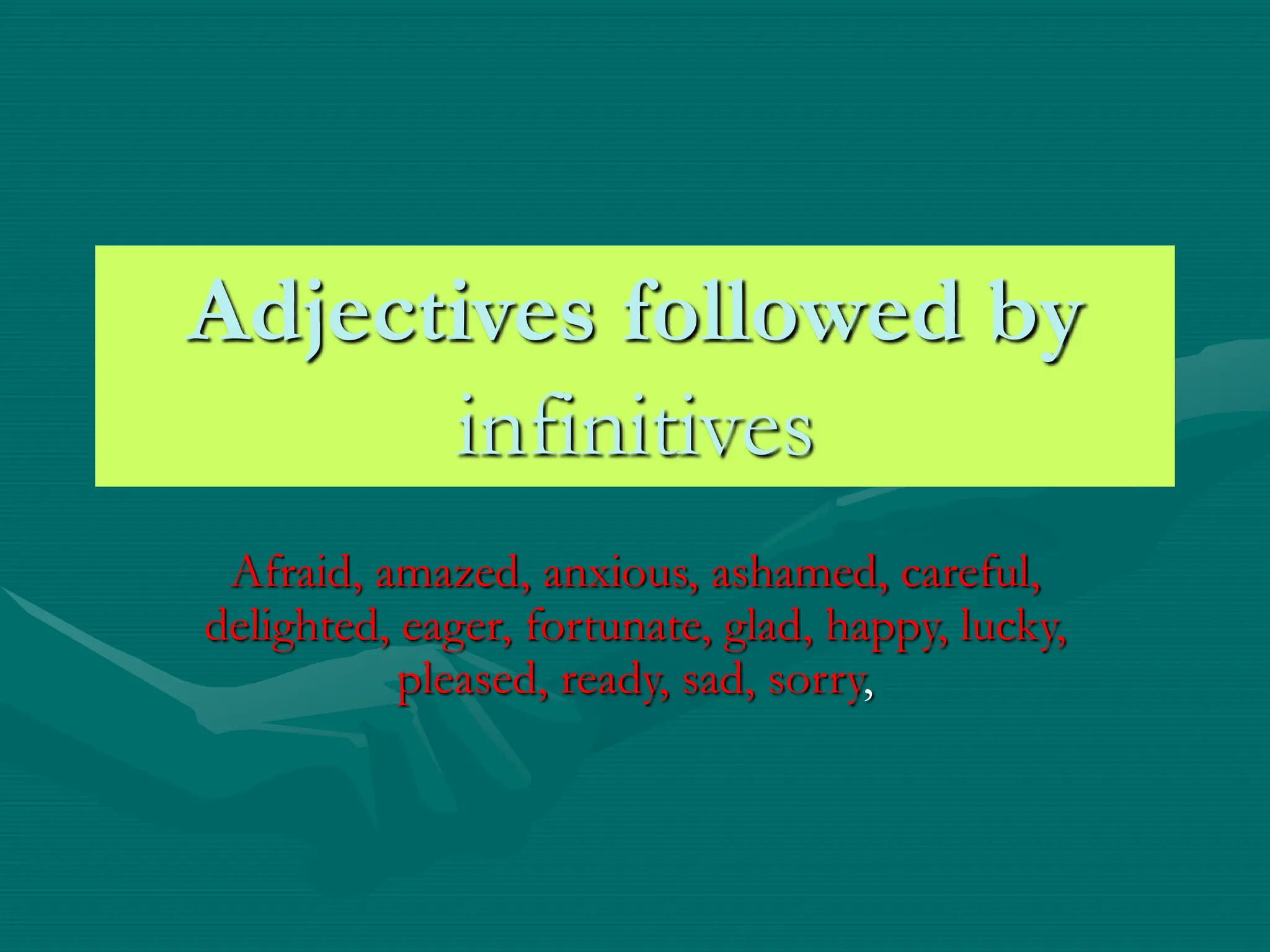
Adjectives followed by
infinitives
Afraid, amazed, anxious, ashamed, careful,
delighted, eager, fortunate, glad, happy, lucky,
pleased, ready, sad, sorry,
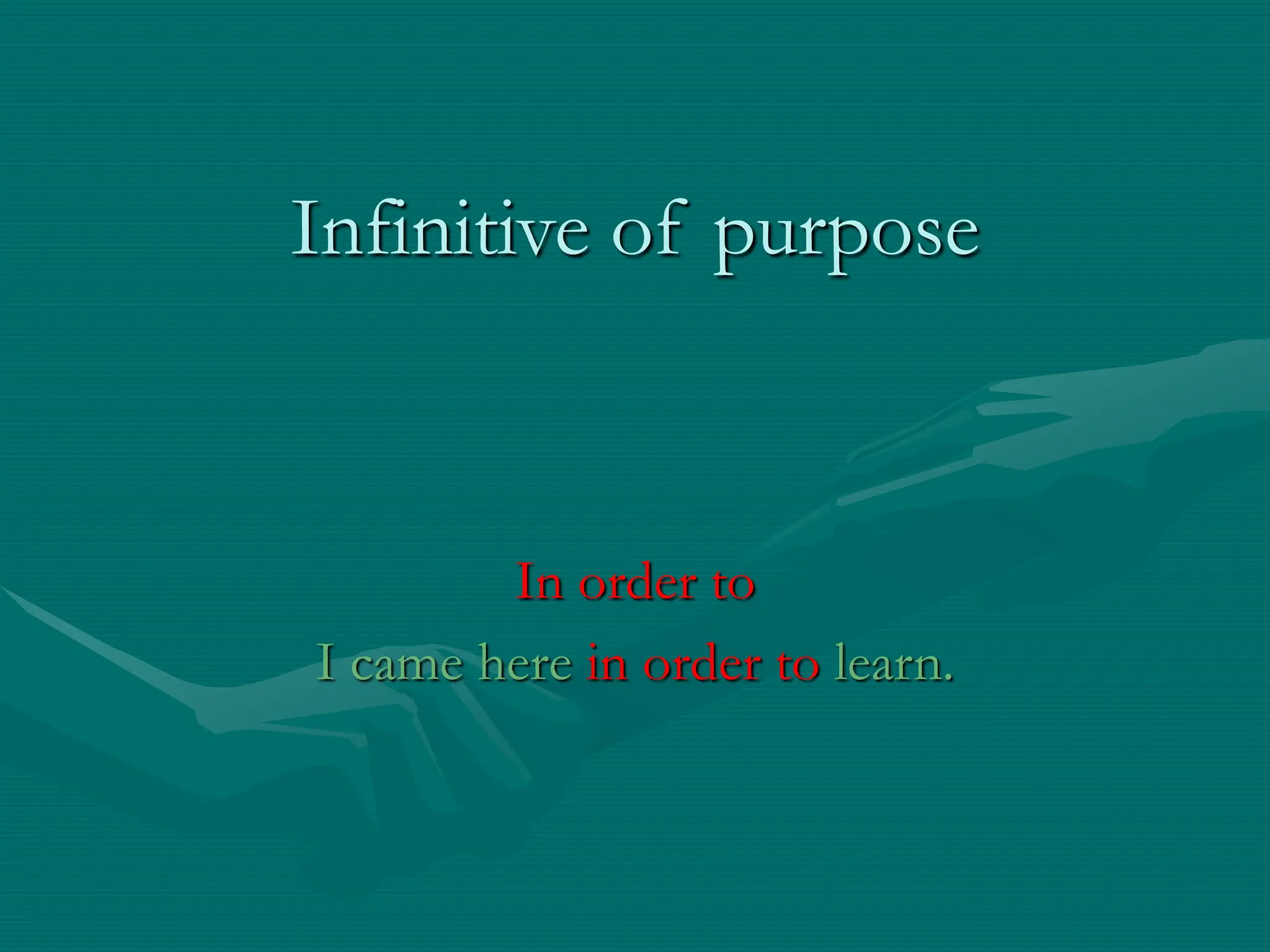
Infinitive of purpose
In order to
I came here in order to learn.
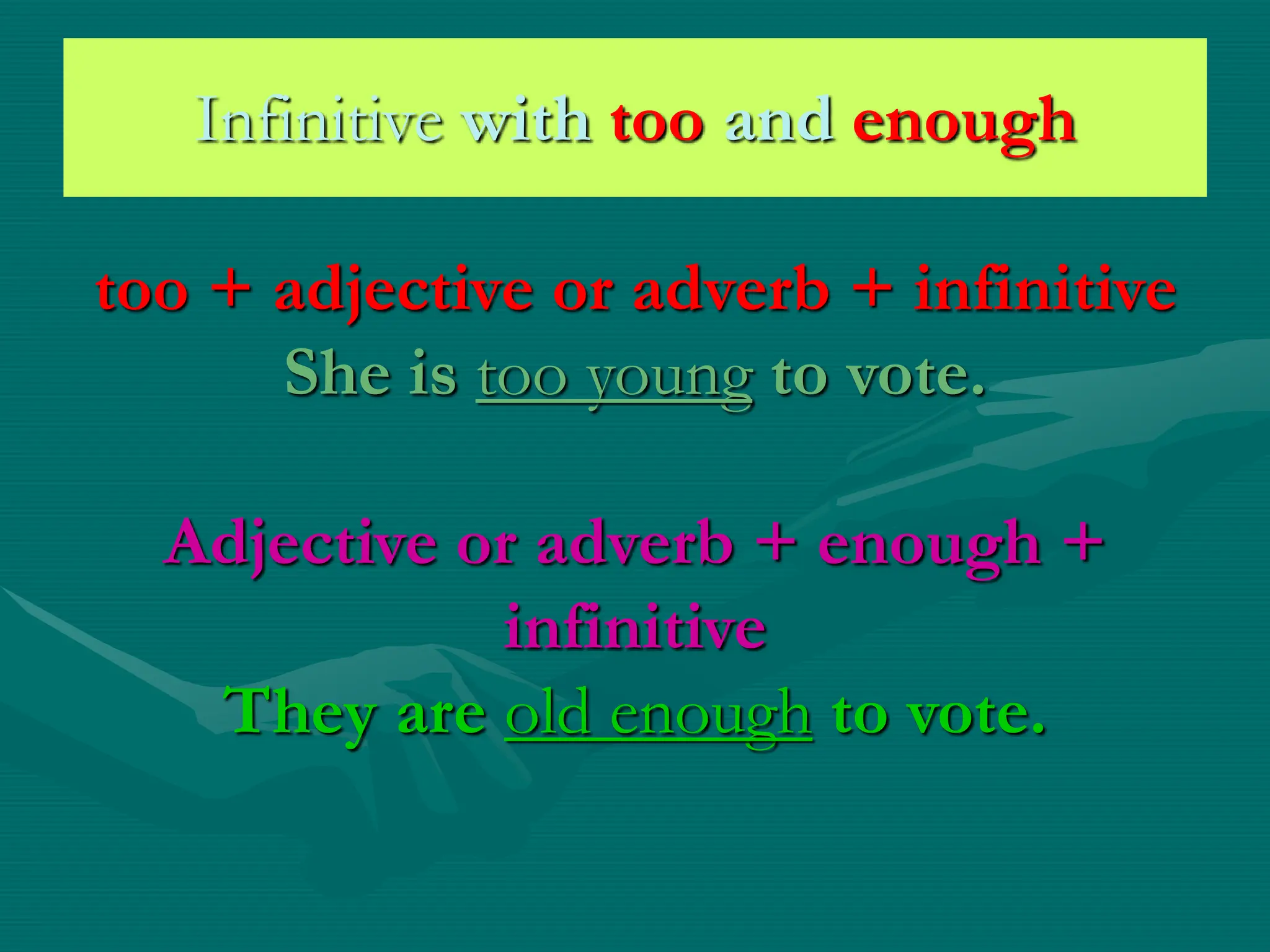
Infinitive with too and enough
too + adjective or adverb + infinitive
She is too young to vote.
Adjective or adverb + enough +
infinitive
They are old enough to vote.
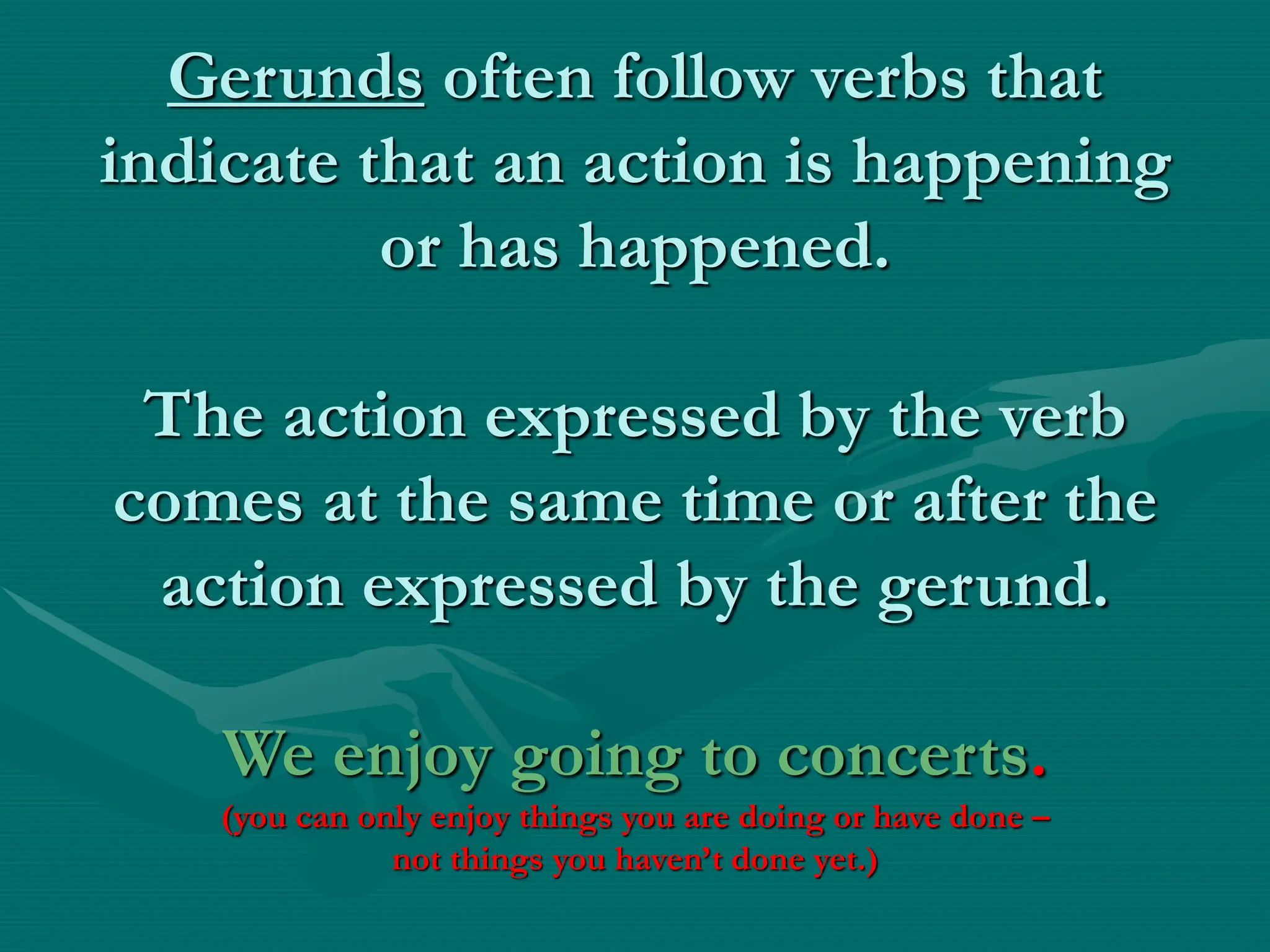
Gerunds often follow verbs that
indicate that an action is happening
or has happened.
The action expressed by the verb
comes at the same time or after the
action expressed by the gerund.
We enjoy going to concerts.
(you can only enjoy things you are doing or have done –
not things you haven’t done yet.)
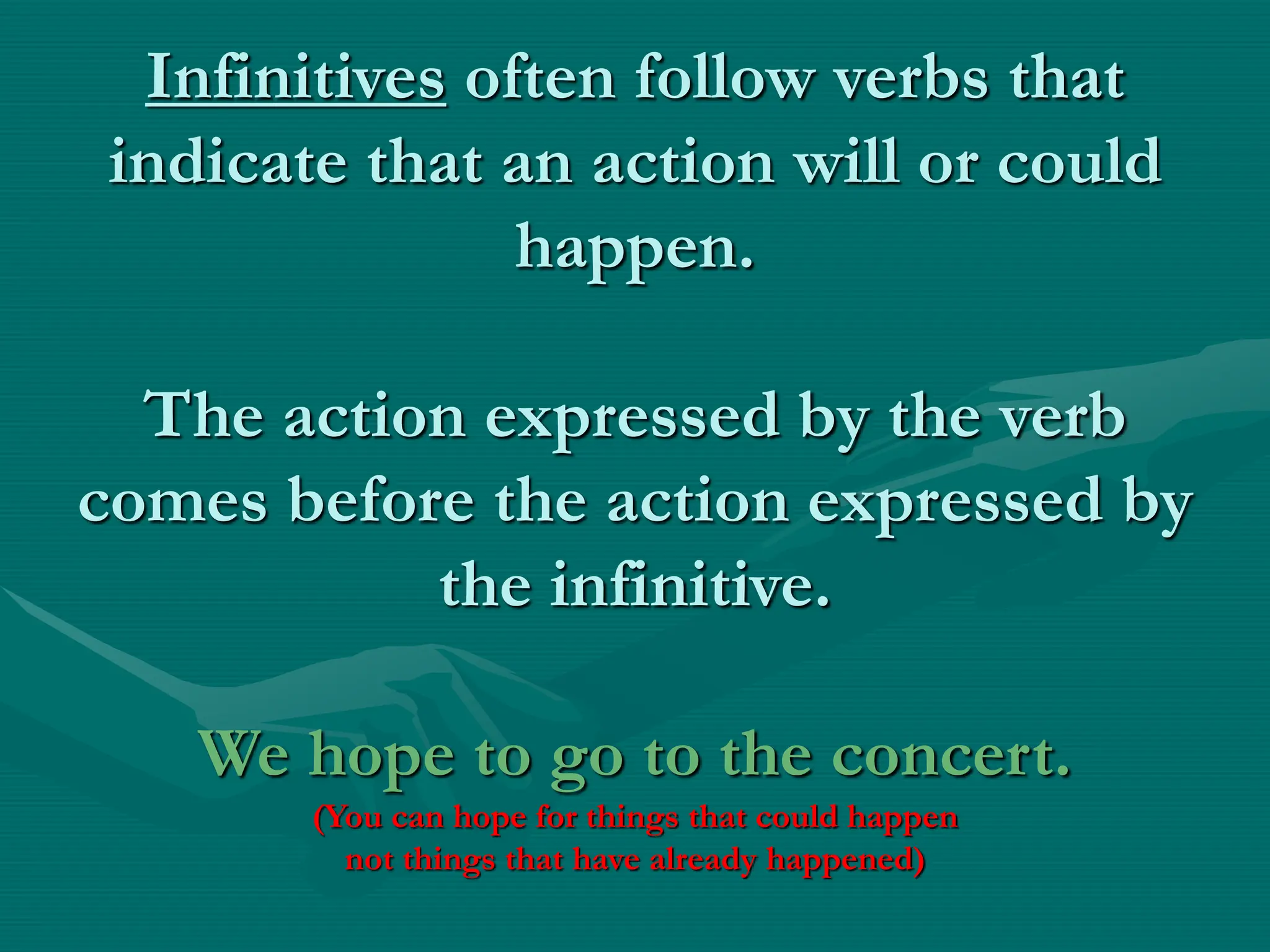
Infinitives often follow verbs that
indicate that an action will or could
happen.
The action expressed by the verb
comes before the action expressed by
the infinitive.
We hope to go to the concert.
(You can hope for things that could happen
not things that have already happened)
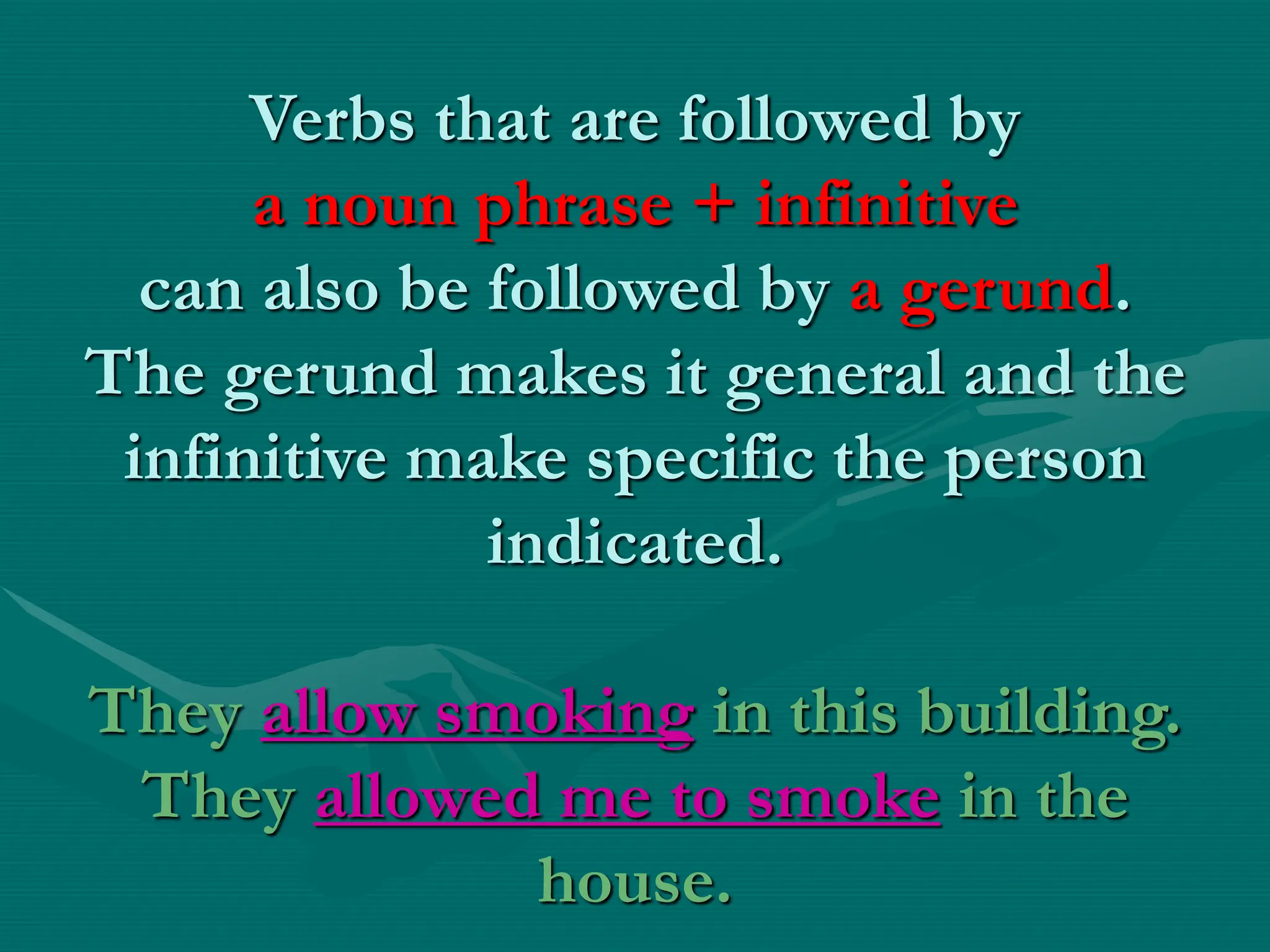
Verbs that are followed by
a noun phrase + infinitive
can also be followed by a gerund.
The gerund makes it general and the
infinitive make specific the person
indicated.
They allow smoking in this building.
They allowed me to smoke in the
house.
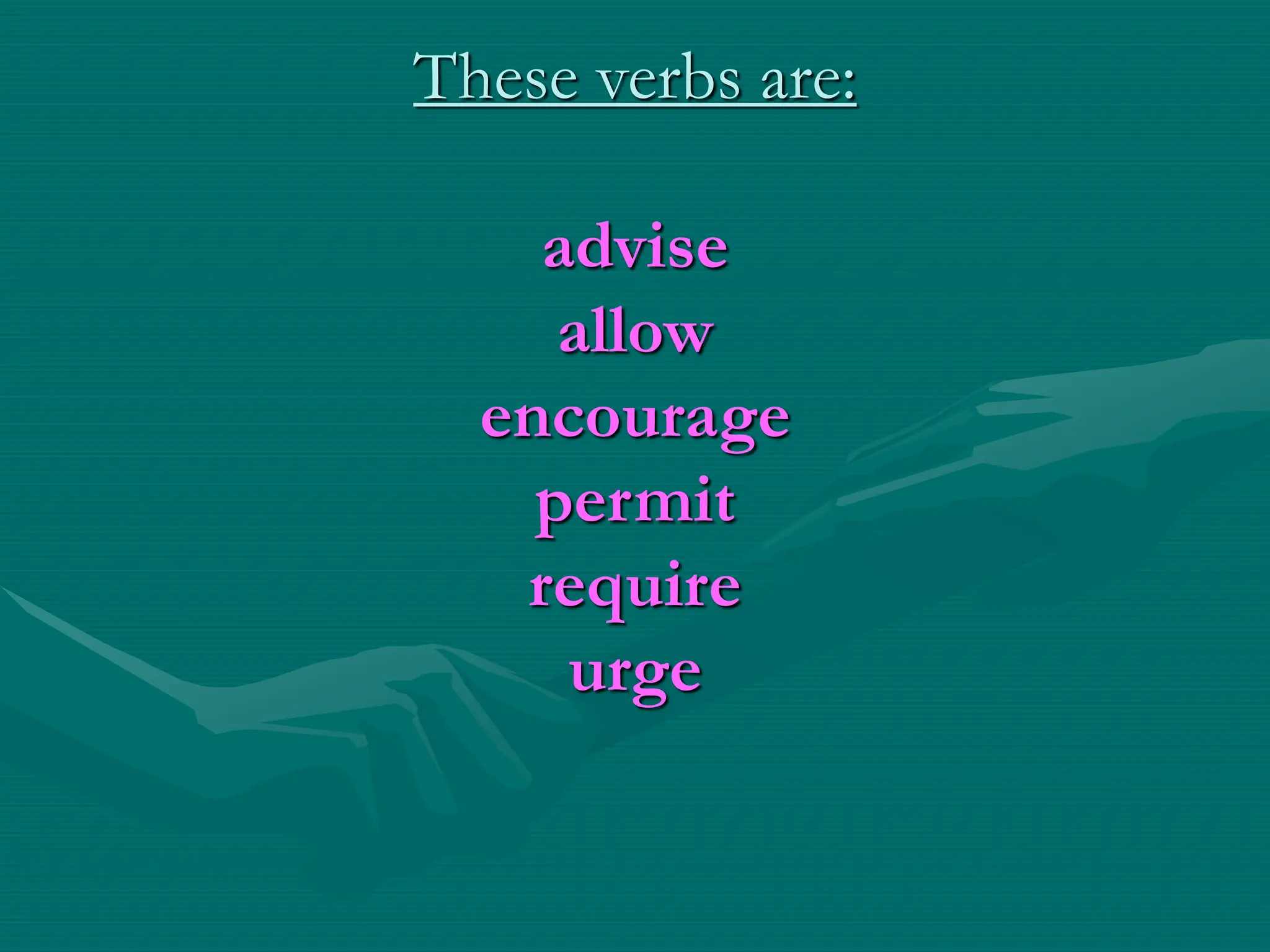
These verbs are:
advise
allow
encourage
permit
require
urge
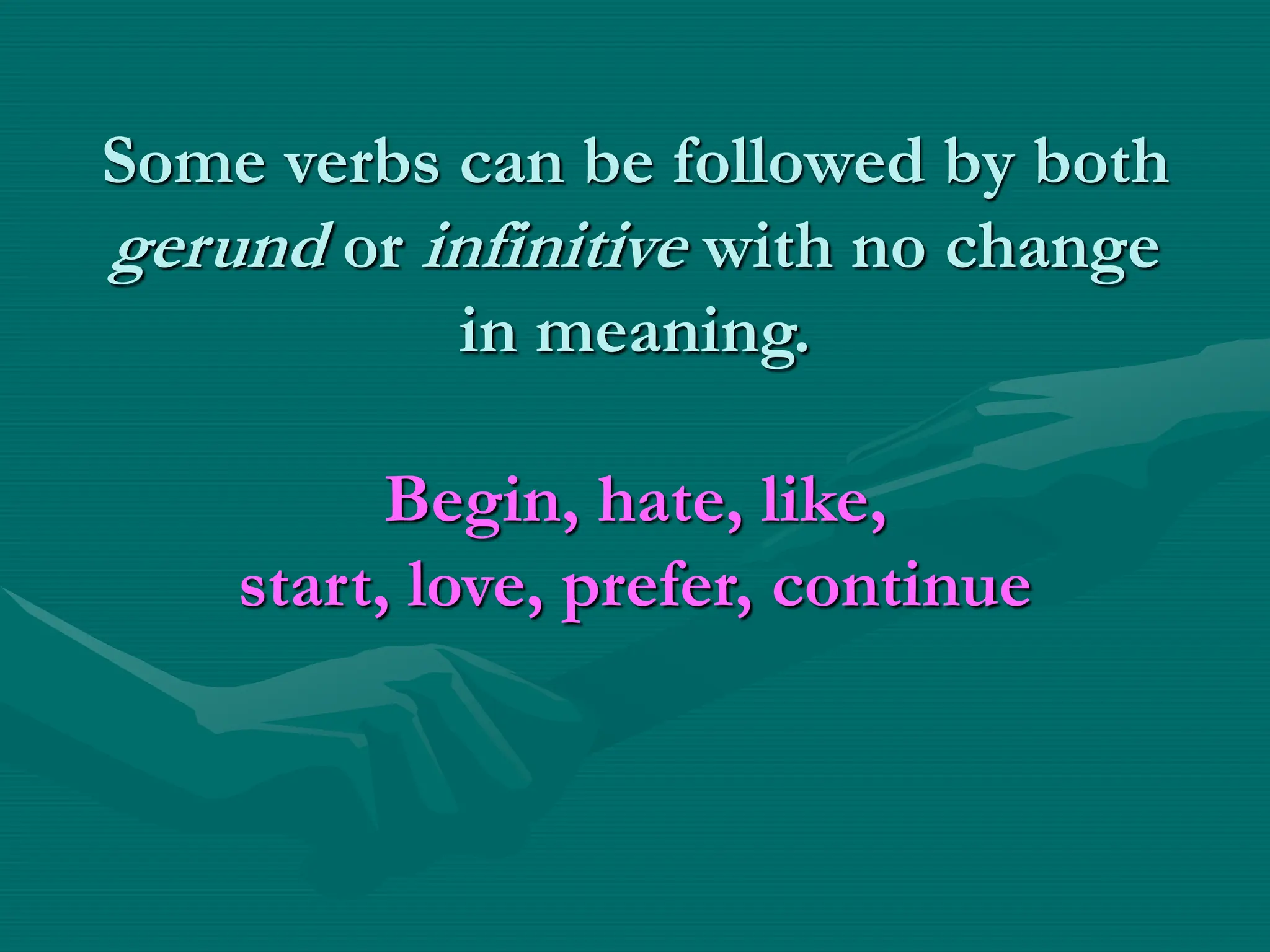
Some verbs can be followed by both
gerund or infinitive with no change
in meaning.
Begin, hate, like,
start, love, prefer, continue
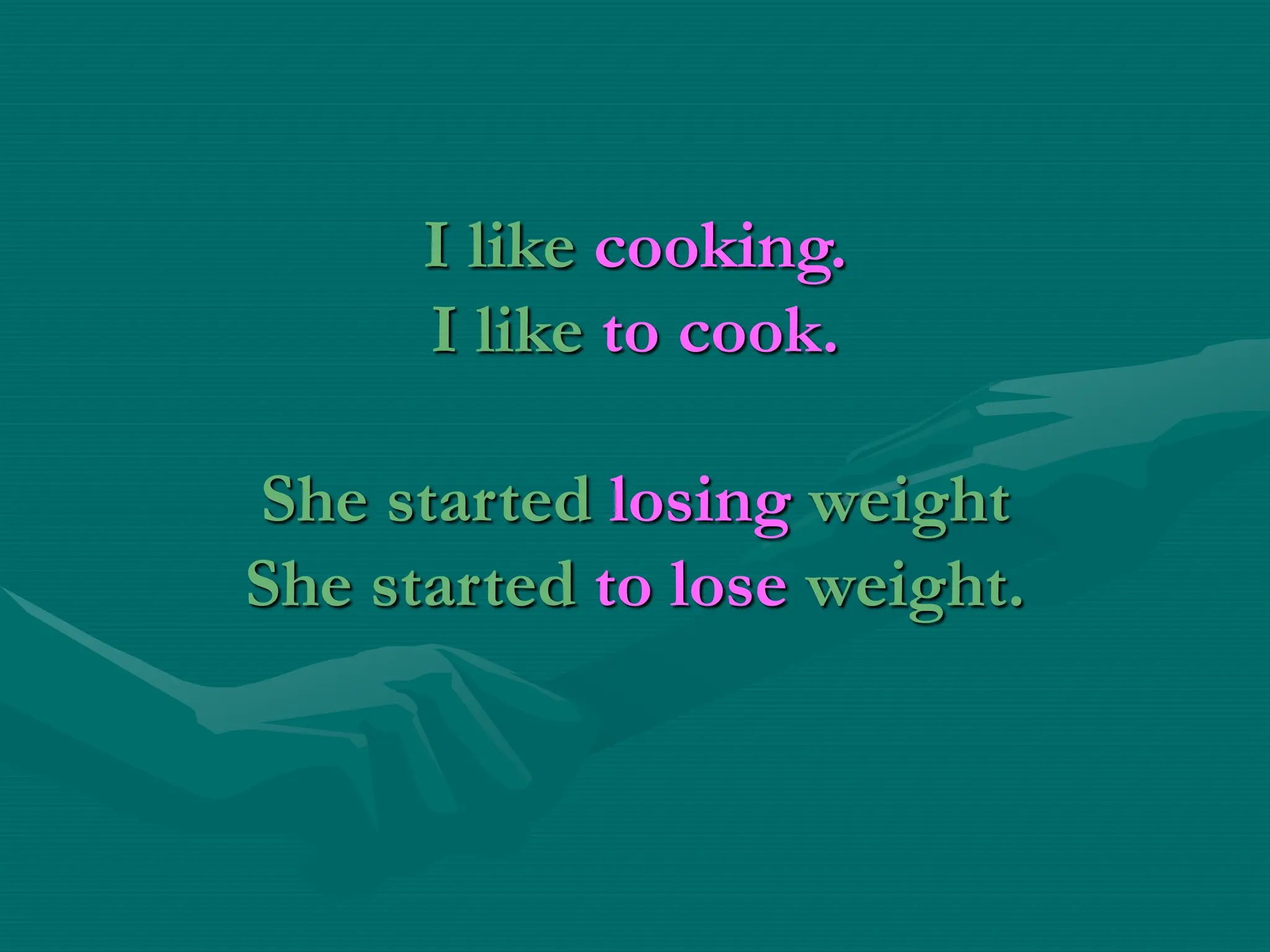
I like cooking.
I like to cook.
She started losing weight
She started to lose weight.
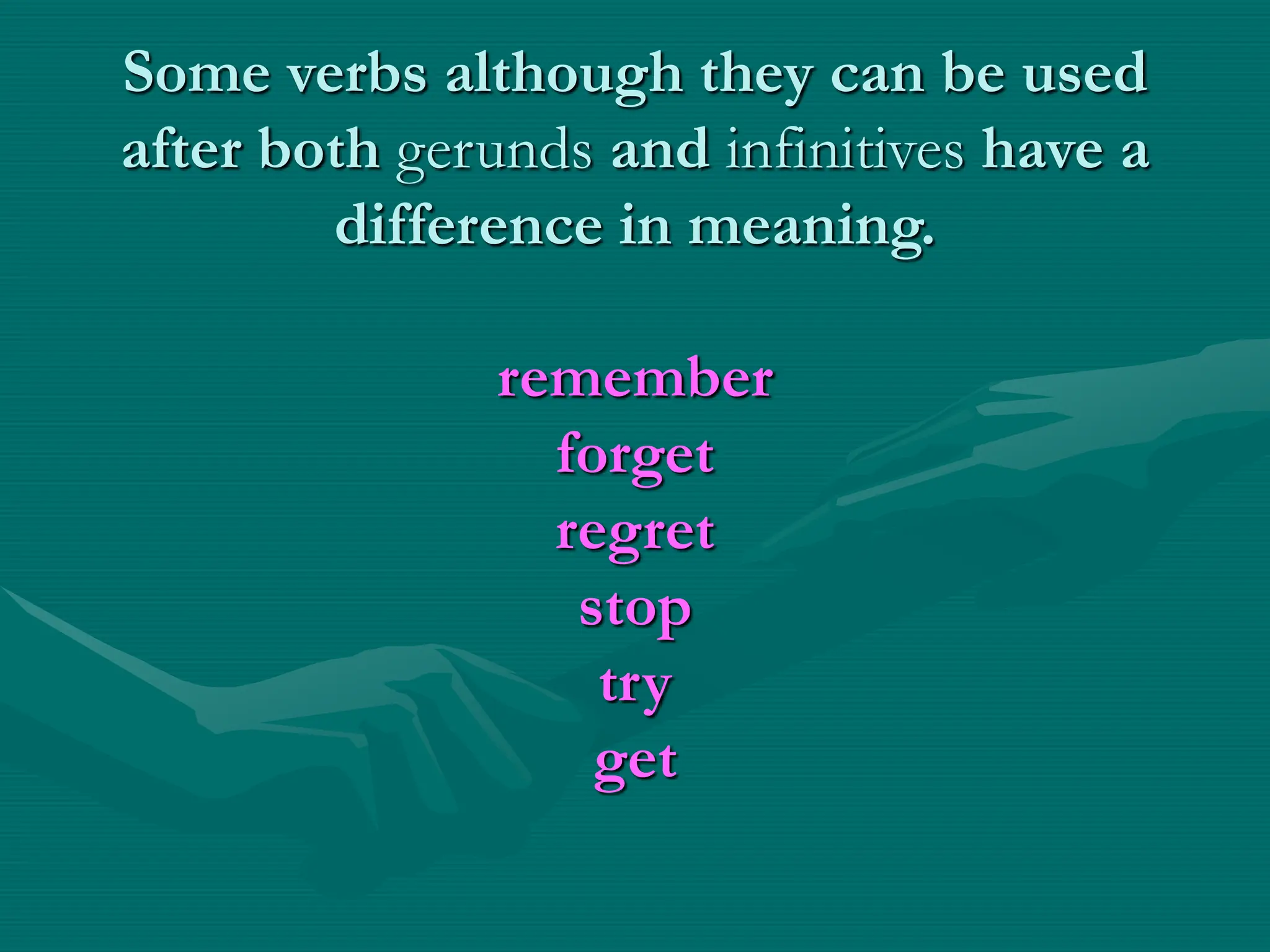
Some verbs although they can be used
after both gerunds and infinitives have a
difference in meaning.
remember
forget
regret
stop
try
get
She stopped smoking.
She stopped to smoke.
They forgot buying bread.
They forgot to buy bread.
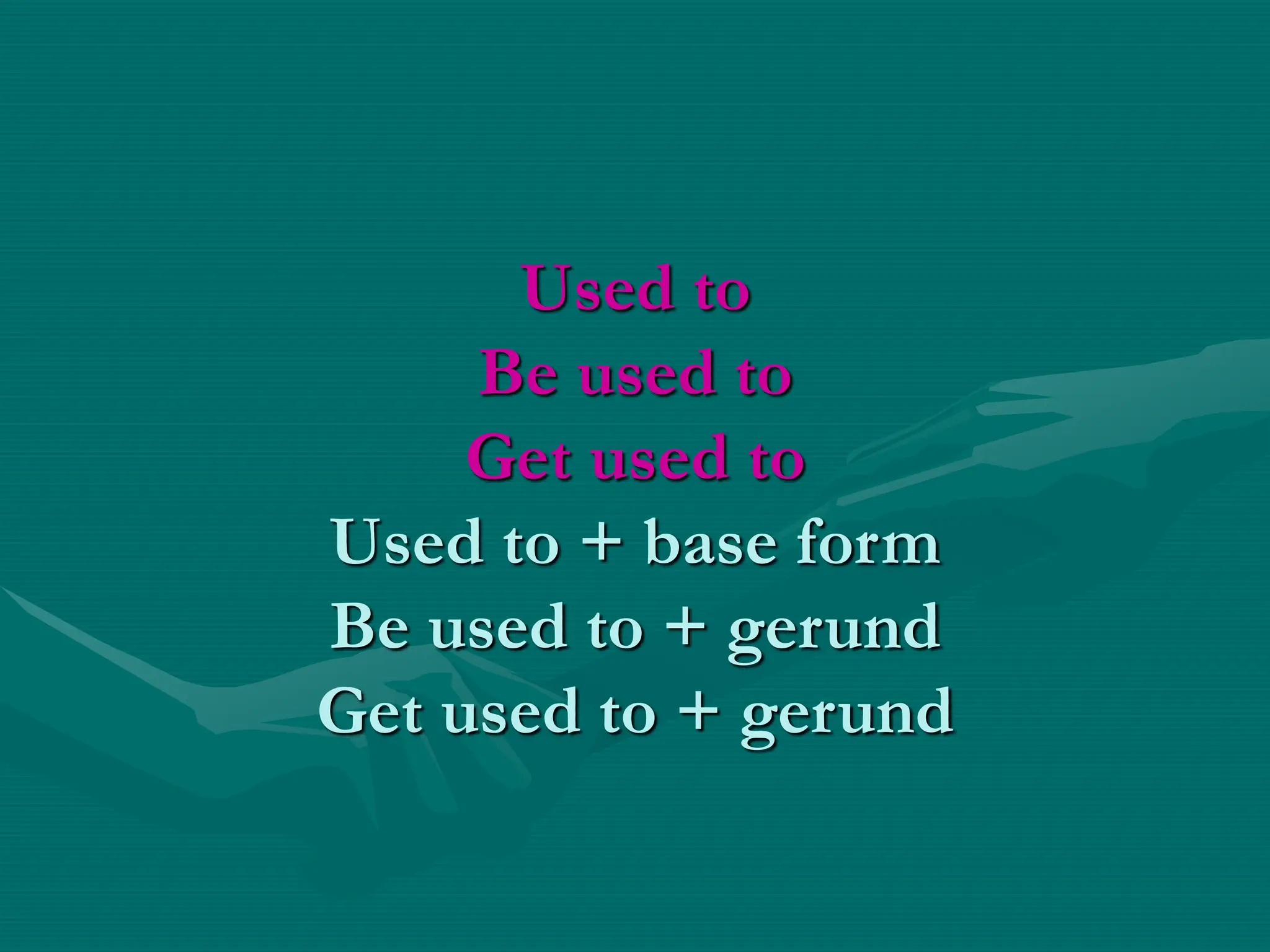
Used to
Be used to
Get used to
Used to + base form
Be used to + gerund
Get used to + gerund
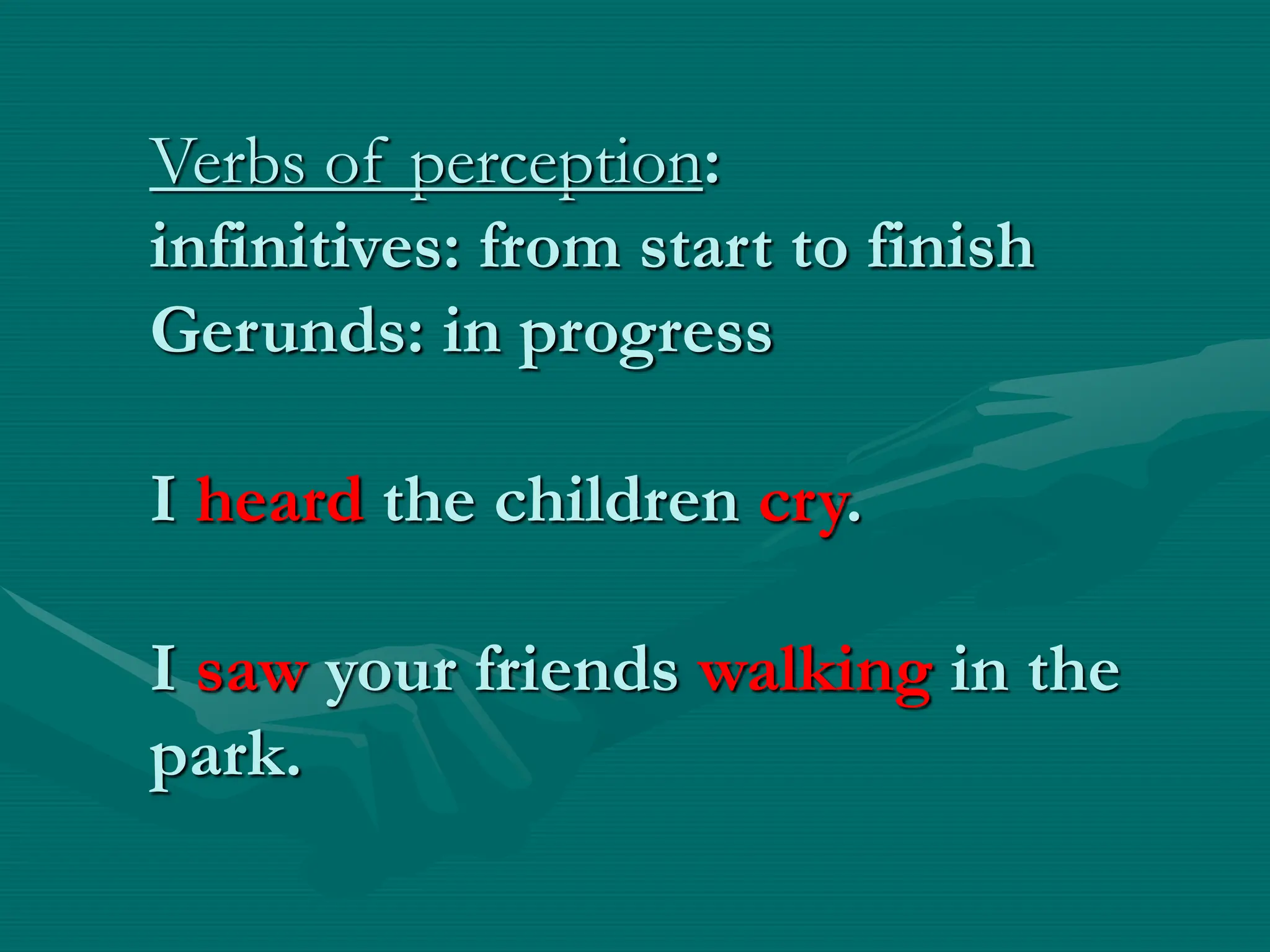
Verbs of perception:
infinitives: from start to finish
Gerunds: in progress
I heard the children cry.
I saw your friends walking in the
park.
Infinitive forms are not used after the
following verbs of perception:
feel
see
hear
smell
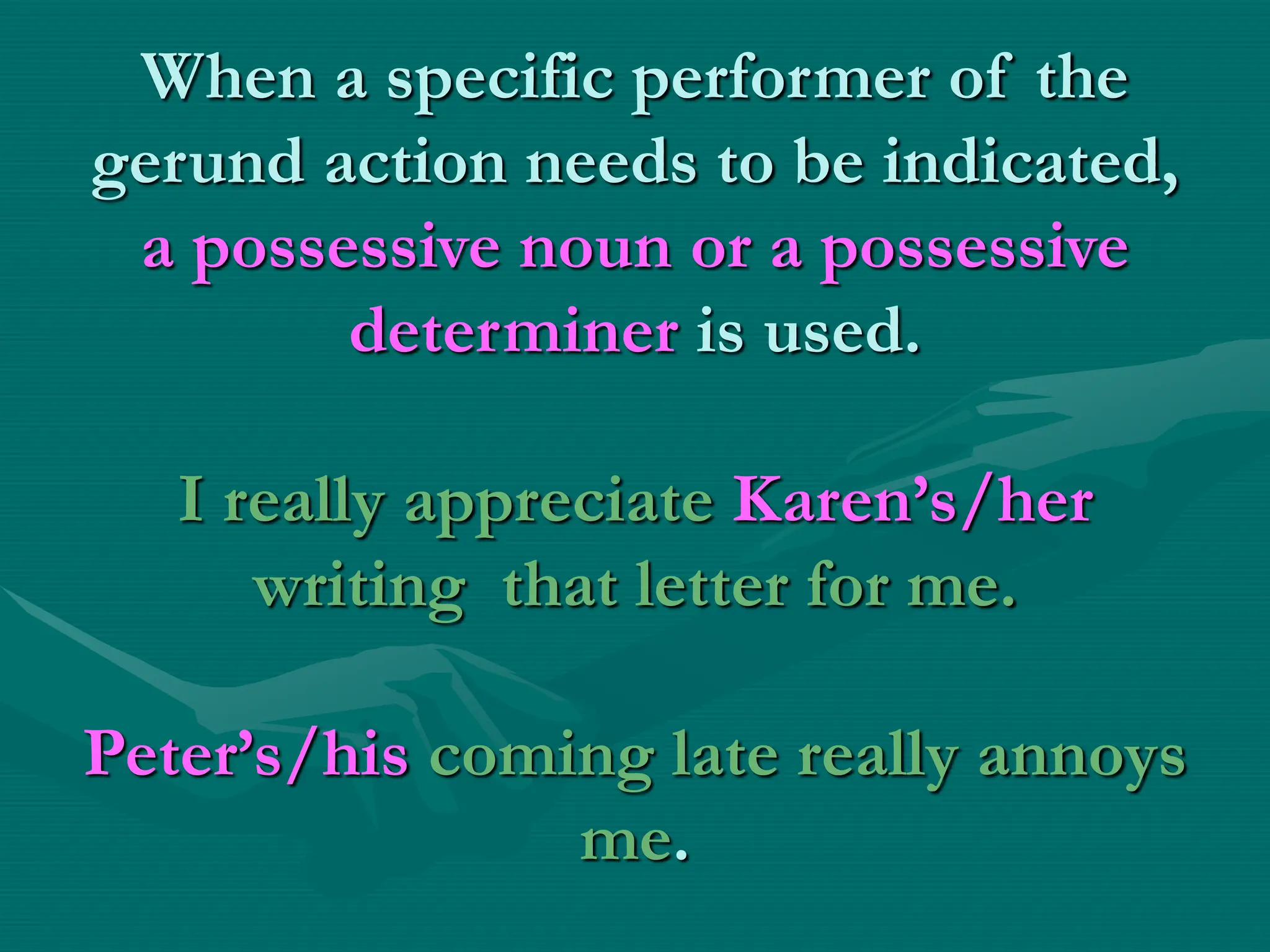
When a specific performer of the
gerund action needs to be indicated,
a possessive noun or a possessive
determiner is used.
I really appreciate Karen’s/her
writing that letter for me.
Peter’s/his coming late really annoys
me.
Your neglecting your teeth will cause
an earlier return to the dentist.
Their denying the allegation was
understandable.
I didn’t like the dog’s barking all
night.
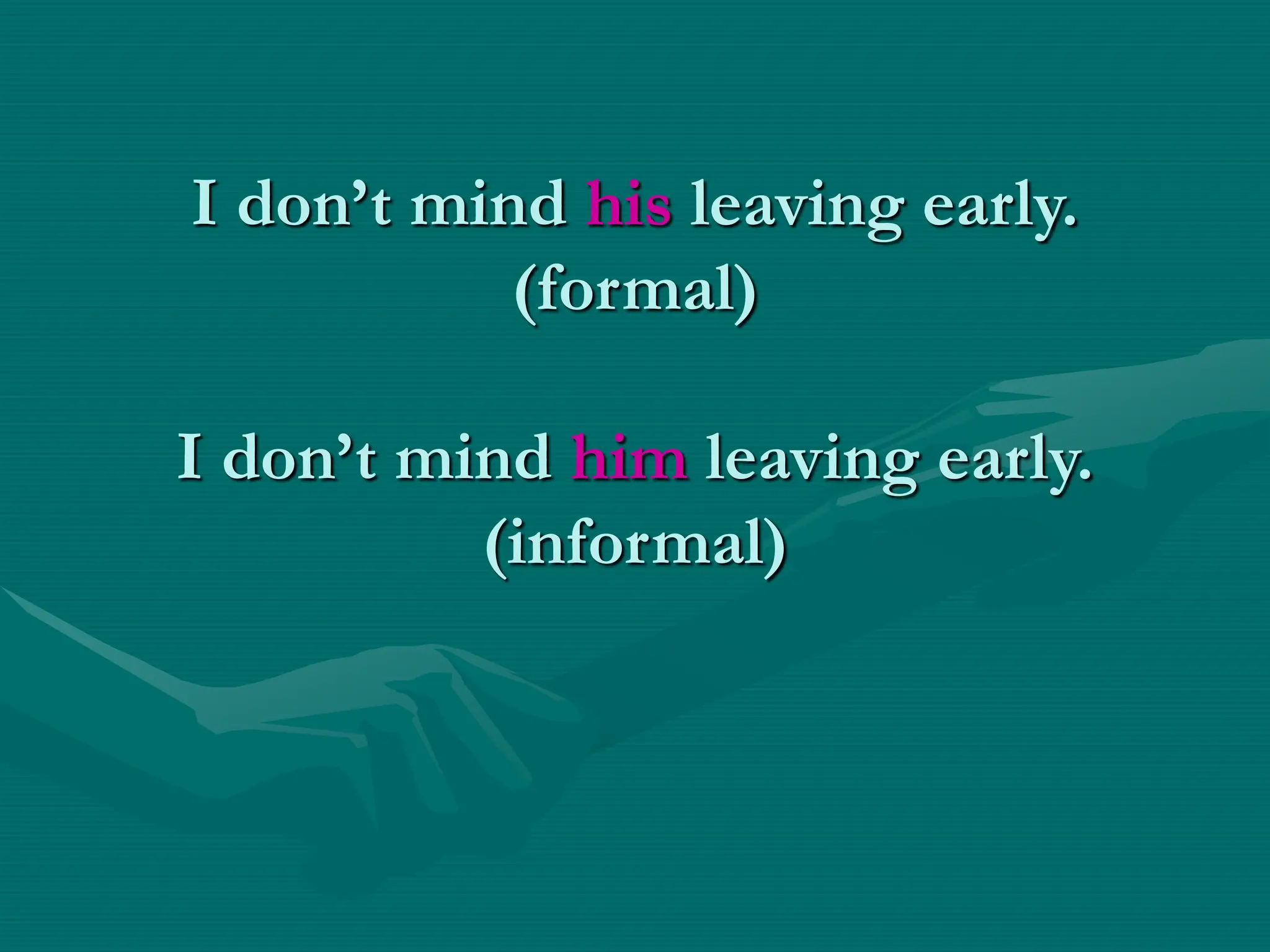
I don’t mind his leaving early.
(formal)
I don’t mind him leaving early.
(informal)
When an infinitive functions as a
subject or a subject complement, any
stated subject of the infinitive should
be preceded by for. If a pronoun
follows for, it must be in object form.
When the subject of a gerund is
stated, it takes the possessive form.
For people to see is a wonderful gift.
Her desire was for them to take a trip
around the world
They hoped for her to be able to
attend the concert.
Infinitives can occur in the
progressive but gerunds cannot.
To be doing
It is used to indicate an activity in
progress or ongoing
She had hoped to be working
Both gerunds and infinitives can
occur in the perfect form
having done
to have done
It is used to indicate that the activity
is in the past
We appreciate having heard her sing.
We’re fortunate to have heard her
sing
A gerund can be used in the passive
form
I dislike being told a lie.
Have
make
let
are causative verbs. They cause
someone to do something.
They are always followed by a noun
phrase + base form of verb.
Do not use an infinitive after these
verbs.
She made me fall.
She made her daughter go to the
party.
She let him take the camera.
She had me prepare breakfast
yesterday.
After causative verbs:
get
convince
persuade
use the infinitive
She got me to work.
She convinced me to work.
Sense-perception verbs:
hear, listen to
feel, smell, see
watch, observe, notice
are followed by either a noun phrase
+ base or –ing form with only a
slight difference in meaning.
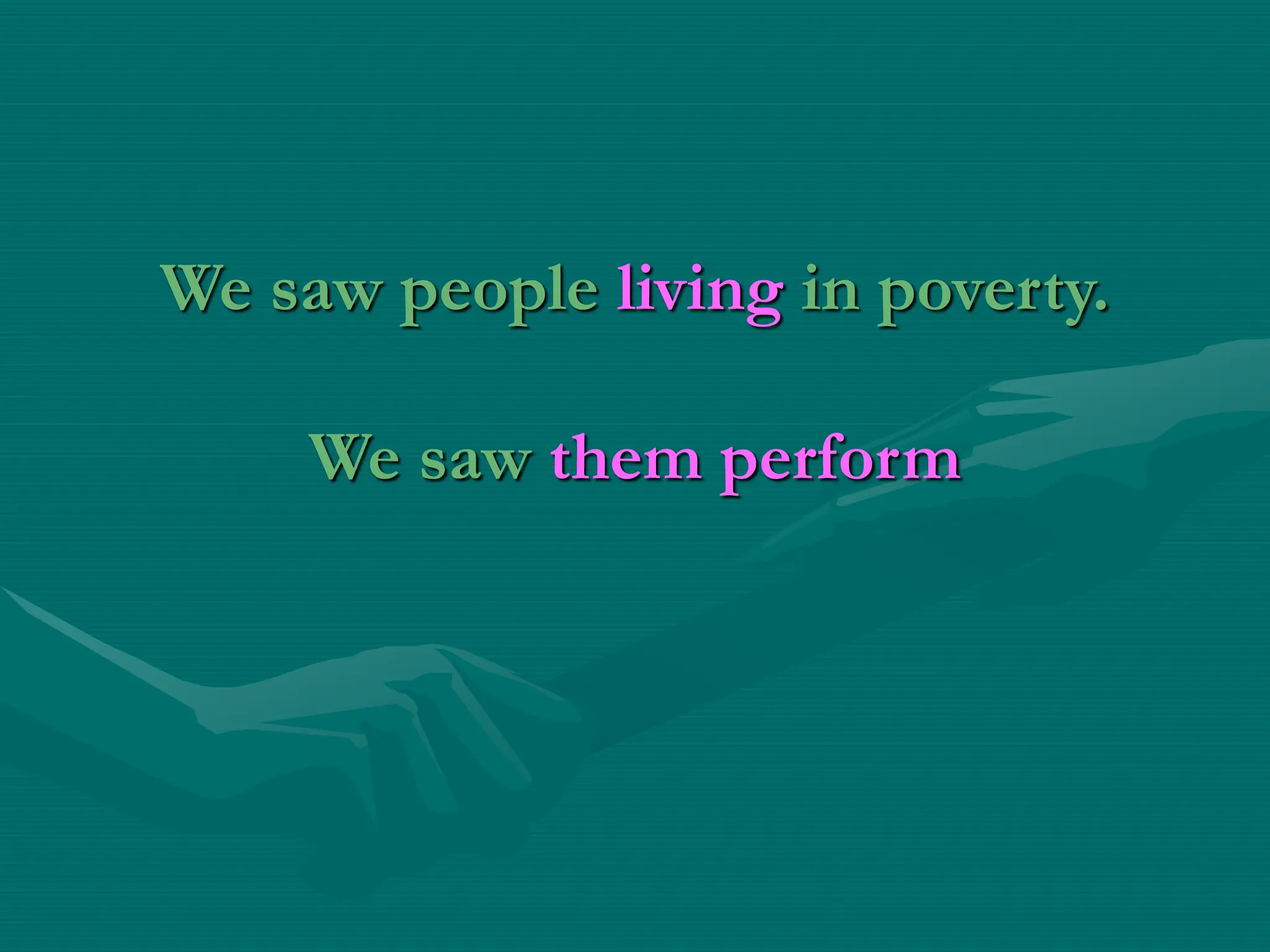
We saw people living in poverty.
We saw them perform
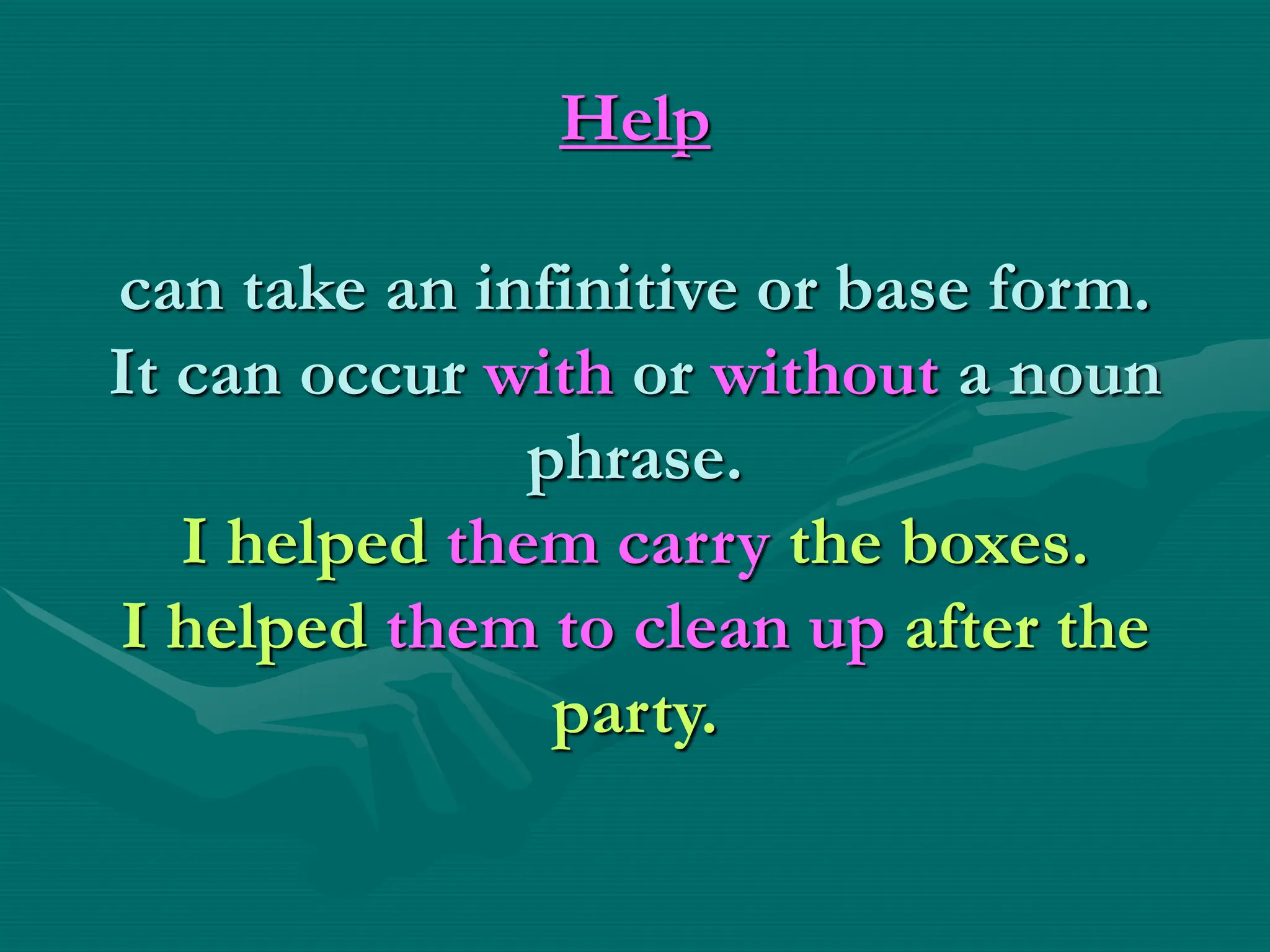
Help
can take an infinitive or base form.
It can occur with or without a noun
phrase.
I helped them carry the boxes.
I helped them to clean up after the
party.
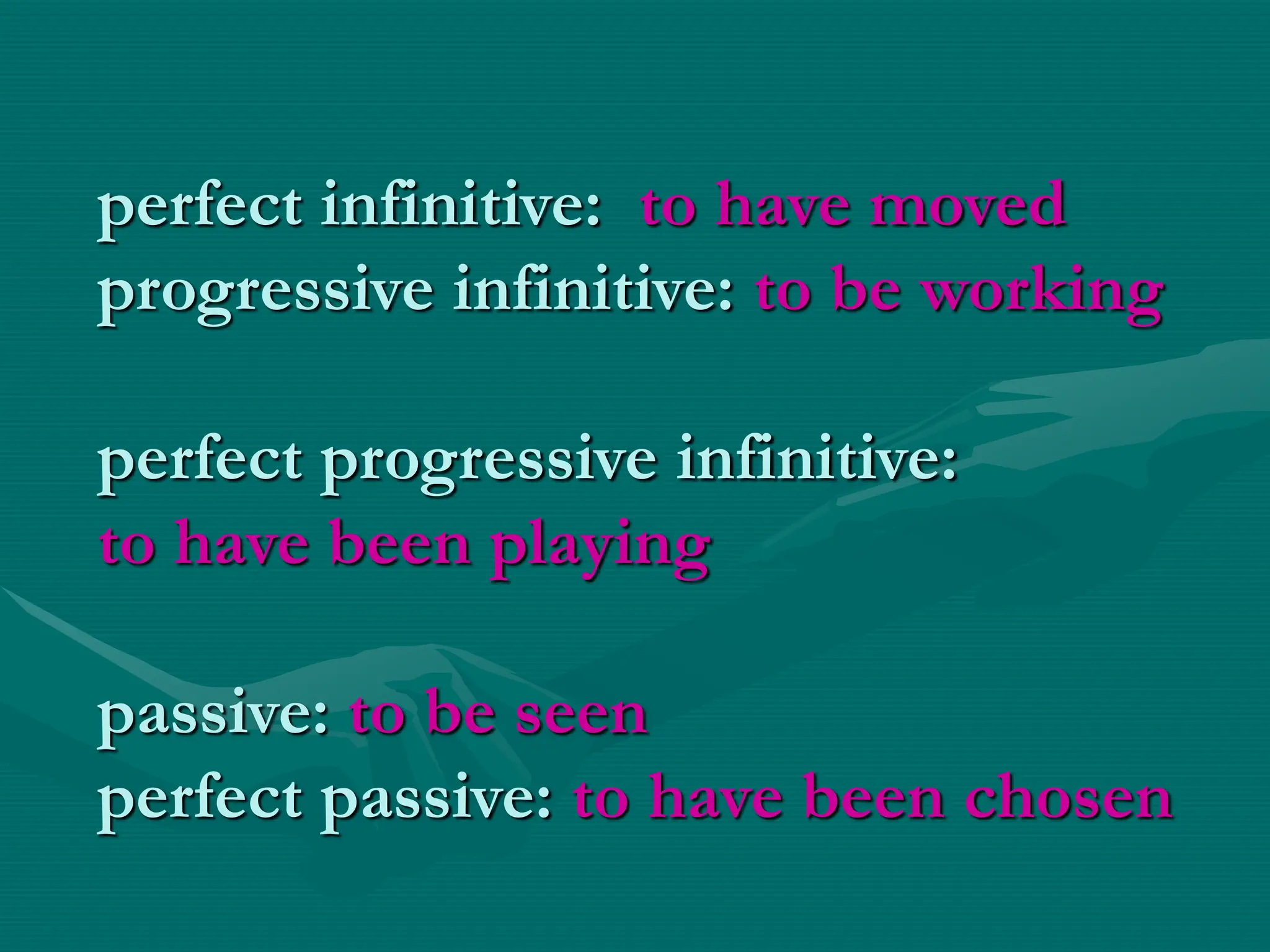
perfect infinitive: to have moved
progressive infinitive: to be working
perfect progressive infinitive:
to have been playing
passive: to be seen
perfect passive: to have been chosen
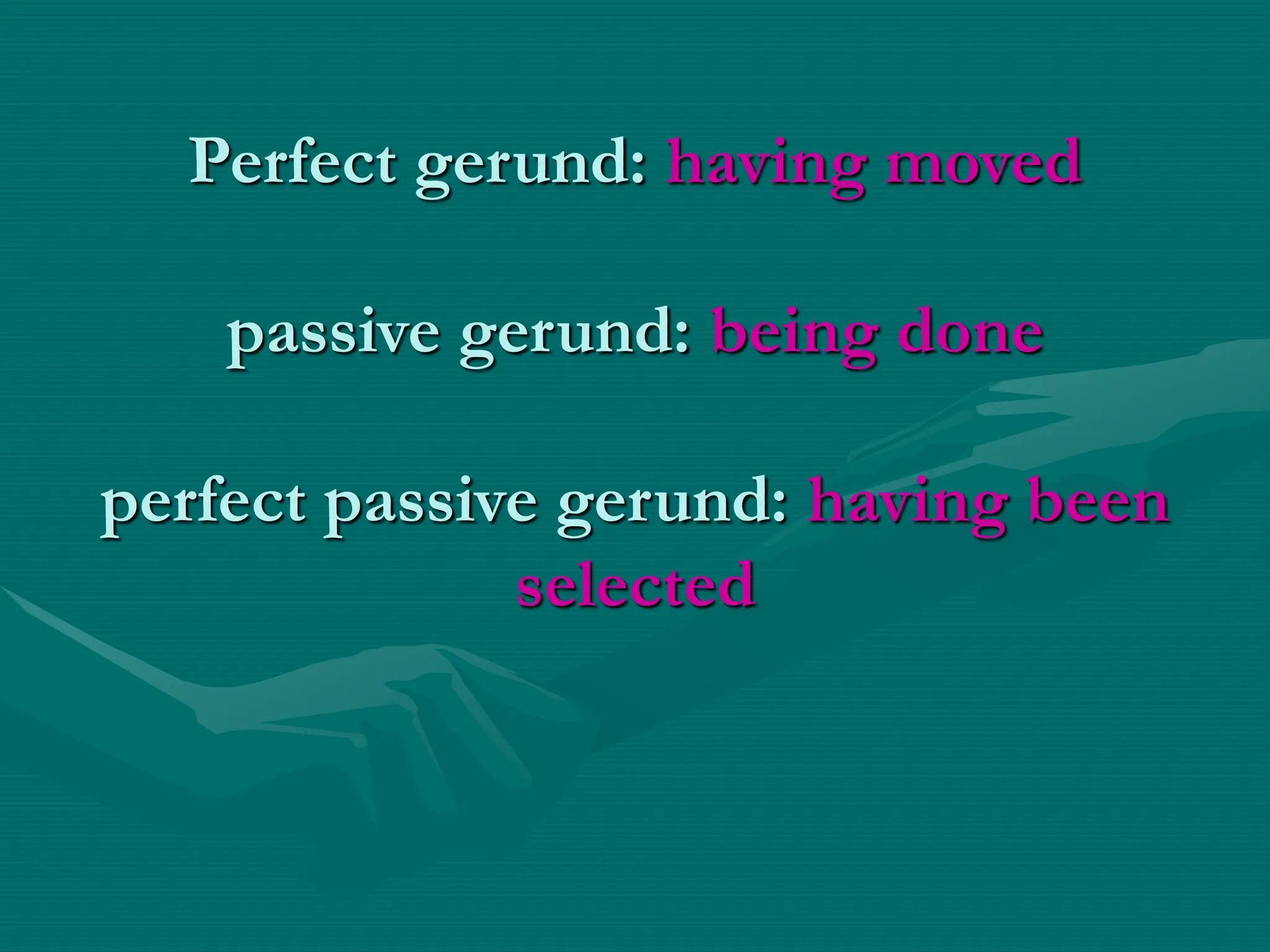
Perfect gerund: having moved
passive gerund: being done
perfect passive gerund: having been
selected
The End!

gerundsandinfinitives-110419121547-phpapp02.ppt

  • 1.
  • 2.
    Gerunds and infinitives canfunction as: NOUNS (subjects, objects, subject complements) As subjects, they take a singular verb. Only Gerunds can be object of the preposition.
  • 3.
    To form gerunds,use the base form + ing (don’t’ forget the rules for spelling of ing form of verbs) I enjoy learning English To form negative gerunds, use not + gerund Not speaking English well is my biggest problem in this country.
  • 4.
    Gerunds used assubject of the sentence. Dancing is fun.
  • 5.
    Gerunds used asobjects He enjoys working with children.
  • 6.
    Verbs that takeonly Gerunds • Appreciate • Avoid • Delay • Deny • Discuss • Dislike • Enjoy • Excuse • Finish • understand • Keep • Mention • Mind • Miss • Postpone • Quit • Recall • Recommend • Resent • suggest
  • 7.
    Gerunds used asobject of the preposition I am thinking about taking the children to Mexico.
  • 8.
    Common preposition combinations followedby gerunds • Be excited about, complain about, talk about, think about, worry about • Apologize for, blame for, famous for • Believe in, interested in, succeed in • Take care of, instead of, be accused of • Insist on, count on, concentrate on • Keep from, prevent from, profit from • In addition to, look forward to, be used to
  • 9.
    By + gerund Youget good grades by studying hard. go + gerund Recreational activities: camping, dancing, sightseeing, swimming, skiing, fishing, jogging, I will go fishing with you tomorrow.
  • 10.
    Some expressions are usedwith gerunds Be busy, can’t help, have fun, it’s no use, it’s not worth
  • 11.
    To form infinitivesuse to + base form of the verb I want to dance To form negative infinitives use Not + infinitive He decided not to go to the party.
  • 12.
    Infinitives in thesubject position To live in the United States is my dream It is my dream to live in the United States.
  • 13.
    Verbs that takeinfinitives Verb + infinitives – agree, appear, decide hope, intend, learn, offer, plan, seem, tend, wait, can afford Verb + Noun phrase + infinitive – cause, convince, force, invite, order, persuade, remind, tell, trust, warn, advise, encourage Verbs that come directly after the infinitive or have a noun phrase – ask, beg, choose, expect, need, want, would like, promise
  • 14.
    Adjectives followed by infinitives Afraid,amazed, anxious, ashamed, careful, delighted, eager, fortunate, glad, happy, lucky, pleased, ready, sad, sorry,
  • 15.
    Infinitive of purpose Inorder to I came here in order to learn.
  • 16.
    Infinitive with tooand enough too + adjective or adverb + infinitive She is too young to vote. Adjective or adverb + enough + infinitive They are old enough to vote.
  • 17.
    Gerunds often followverbs that indicate that an action is happening or has happened. The action expressed by the verb comes at the same time or after the action expressed by the gerund. We enjoy going to concerts. (you can only enjoy things you are doing or have done – not things you haven’t done yet.)
  • 18.
    Infinitives often followverbs that indicate that an action will or could happen. The action expressed by the verb comes before the action expressed by the infinitive. We hope to go to the concert. (You can hope for things that could happen not things that have already happened)
  • 19.
    Verbs that arefollowed by a noun phrase + infinitive can also be followed by a gerund. The gerund makes it general and the infinitive make specific the person indicated. They allow smoking in this building. They allowed me to smoke in the house.
  • 20.
  • 21.
    Some verbs canbe followed by both gerund or infinitive with no change in meaning. Begin, hate, like, start, love, prefer, continue
  • 22.
    I like cooking. Ilike to cook. She started losing weight She started to lose weight.
  • 23.
    Some verbs althoughthey can be used after both gerunds and infinitives have a difference in meaning. remember forget regret stop try get
  • 24.
    She stopped smoking. Shestopped to smoke. They forgot buying bread. They forgot to buy bread.
  • 25.
    Used to Be usedto Get used to Used to + base form Be used to + gerund Get used to + gerund
  • 26.
    Verbs of perception: infinitives:from start to finish Gerunds: in progress I heard the children cry. I saw your friends walking in the park.
  • 27.
    Infinitive forms arenot used after the following verbs of perception: feel see hear smell
  • 28.
    When a specificperformer of the gerund action needs to be indicated, a possessive noun or a possessive determiner is used. I really appreciate Karen’s/her writing that letter for me. Peter’s/his coming late really annoys me.
  • 29.
    Your neglecting yourteeth will cause an earlier return to the dentist. Their denying the allegation was understandable. I didn’t like the dog’s barking all night.
  • 30.
    I don’t mindhis leaving early. (formal) I don’t mind him leaving early. (informal)
  • 31.
    When an infinitivefunctions as a subject or a subject complement, any stated subject of the infinitive should be preceded by for. If a pronoun follows for, it must be in object form. When the subject of a gerund is stated, it takes the possessive form.
  • 32.
    For people tosee is a wonderful gift. Her desire was for them to take a trip around the world They hoped for her to be able to attend the concert.
  • 33.
    Infinitives can occurin the progressive but gerunds cannot. To be doing It is used to indicate an activity in progress or ongoing She had hoped to be working
  • 34.
    Both gerunds andinfinitives can occur in the perfect form having done to have done It is used to indicate that the activity is in the past We appreciate having heard her sing. We’re fortunate to have heard her sing
  • 35.
    A gerund canbe used in the passive form I dislike being told a lie.
  • 36.
    Have make let are causative verbs.They cause someone to do something. They are always followed by a noun phrase + base form of verb. Do not use an infinitive after these verbs. She made me fall.
  • 37.
    She made herdaughter go to the party. She let him take the camera. She had me prepare breakfast yesterday.
  • 38.
    After causative verbs: get convince persuade usethe infinitive She got me to work. She convinced me to work.
  • 39.
    Sense-perception verbs: hear, listento feel, smell, see watch, observe, notice are followed by either a noun phrase + base or –ing form with only a slight difference in meaning.
  • 40.
    We saw peopleliving in poverty. We saw them perform
  • 41.
    Help can take aninfinitive or base form. It can occur with or without a noun phrase. I helped them carry the boxes. I helped them to clean up after the party.
  • 42.
    perfect infinitive: tohave moved progressive infinitive: to be working perfect progressive infinitive: to have been playing passive: to be seen perfect passive: to have been chosen
  • 43.
    Perfect gerund: havingmoved passive gerund: being done perfect passive gerund: having been selected
  • 44.