INJECTABLE CONTRACEPTIVES www.freelivedoctor.com
Introduction Injectable contraceptives contain hormonal drugs  that  provide women with  safe ,  highly effective , and  reversible   contraceptive protection .  www.freelivedoctor.com
Two types of injectable  contraceptives :  (1)  Progestogen-only  formulations  that contain a progestogen hormone and are effective for 2 or 3 months; and,  (2)  Combined  formulations  that contain both a progestogen and an estrogen and are effective for 1 month  www.freelivedoctor.com
Progestogen -only formulations  Consist of  DMPA  (depot med-roxyprogesterone acetate) and  NET-EN  (norethisterone enanthate). DMPA is the injectable formulation most widely used worldwide . DMPA  is injected every 3 months. NET-EN  is injected every 2 months.  www.freelivedoctor.com
Combined formulations   The most extensively studied formulations are known by their brand names,  Mesigyna ; Monthly  injectable. Mesigyna  contains the  same progestogen as NET-EN .& contains an added estrogen.  www.freelivedoctor.com
Combined formulations Administered by a  deep intramuscular injection  into the muscle of the arm or buttock and are  effective immediately , provided they are taken at specified times  www.freelivedoctor.com
All injectable contraceptives are  slowly absorbed  into the bloodstream from the injection site, with the body maintaining a sufficient level of hormone to provide contraception for 1 to 3 months, depending on the type of injectable used www.freelivedoctor.com
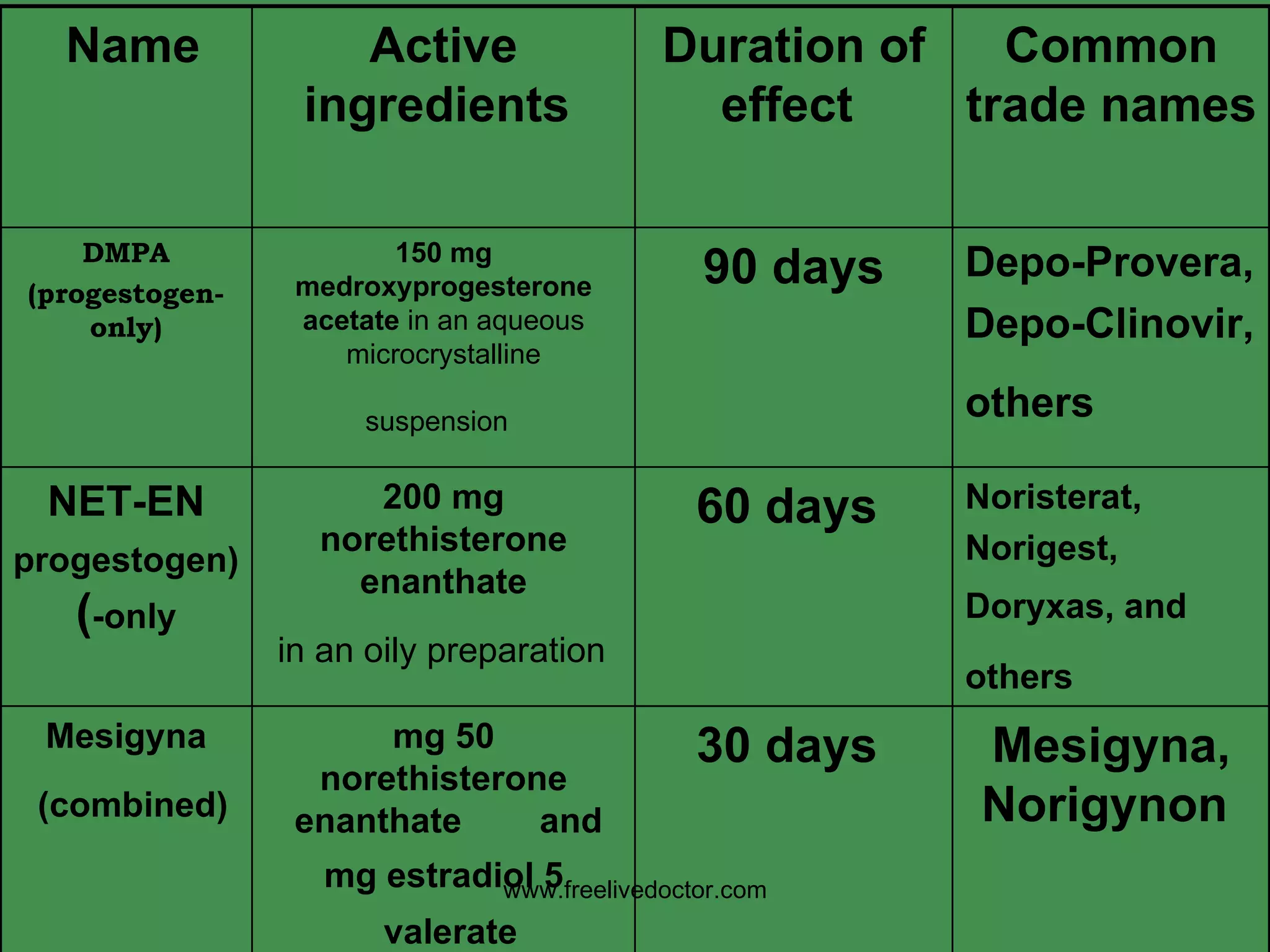
www.freelivedoctor.com Common trade names   Duration of effect   Active ingredients   Name   Depo-Provera,  Depo-Clinovir,  others   90 days 150 mg medroxyprogesterone acetate  in an aqueous microcrystalline suspension   DMPA (progestogen-only) Noristerat,  Norigest,  Doryxas, and others   60 days   200 mg norethisterone enanthate in an oily preparation   NET-EN (progestogen-only ) Mesigyna, Norigynon   30 days   50 mg norethisterone enanthate  and  5 mg estradiol valerate   Mesigyna (combined)
PROGESTOGEN  ONLY  INJECTABLES www.freelivedoctor.com
Mode of Action The immediate action of progestagen-only injectables (POIs) is to  thicken cervical mucus , which then presents an obstacle to sperm penetration.  Also,  ovulation is impaired .  There are additional changes in the endometrium that make it unfavourable to implantation; however, the first two effects make fertilisation highly unlikely. www.freelivedoctor.com
Efficacy The reported  failure rates  of POIs are low, and come within the narrow range of  0.1% to 0.6%. www.freelivedoctor.com
Beneficial Effects Prevention of pregnancy A single injection of a POI can provide  highly effective  protection against pregnancy for two or more months, depending on the formulation.  Delivery is simple , independent of coitus, and ensures periodic contact with medical or other trained health personnel. This is a  suitable method for women in whom oestrogens present health risks  – eg, those with a history of thromboembolic disorders - and those who have had side effects with the use of oestrogens. www.freelivedoctor.com
Non-contraceptive health benefits Clear benefits Sickle cell disease:  In a two-year trial, women with sickle cell disease using DMPA had significantly fewer crises than women given a placebo. Anaemia:  POIs can increase haemoglobin concentration, mainly by reducing menstrual blood loss. www.freelivedoctor.com
Non-contraceptive health benefits Possible benefits 1. Endometrial cancer: In a World Health Organization (WHO) study, women who had ever used DMPA had one-fifth the risk of developing endometrial malignancy observed in women who had not used DMPA.  The results, although not statistically significant, support the hypothesis that use of DMPA might protect against this form of cancer. 2. Other: The use of POIs possibly protects against pelvic inflammatory disease (PID), seizures in women with epilepsy, uterine myoma, and endometriosis. www.freelivedoctor.com
PROGESTOGEN  ONLY  INJECTABLES SIDE   EFFECTS www.freelivedoctor.com
Menstrual   irregularities DMPA   and NET-EN are associated with disruptions of the menstrual cycle including amenorrhoea, prolonged menses, spotting between periods, and heavy bleeding. Less than one-third of women receiving DMPA report having normal menstrual cycles during the first year of use. www.freelivedoctor.com
Menstrual irregularities Amenorrhoea   is the  most common side-effect  and its occurrence increases with duration of use from  about 50 %  of DMPA users  by the end of one year  to  80% by the end of 5 years.  Women using  NET-EN  are less likely to experience amenorrhoea. www.freelivedoctor.com
Menstrual  irregularities Heavy bleeding  is uncommon (occurs in 1-2% of users), and prolonged bleeding is seldom heavy enough to be a threat to health. Any woman who reports  prolonged or heavy bleeding  may need to be  evaluated for anemia .  Anaemia treatments  include  nutritional advice  & an appropriate dosage of  oral iron tablets .  www.freelivedoctor.com
Menstrual irregularities Treatments for heavy bleeding  include non-aspirin anti-inflammatory drugs such as ibuprofen, short-term use of combined oral contraceptives or estrogen, or early administration of the next injection (not sooner than 4 weeks after the previous injection). If these measures are not effective or the woman’s health is threatened, POIs should be discontinued.  www.freelivedoctor.com
Other Side-Effects After menstrual changes,  weight gain, headache, and dizziness  are the next most common side-effects reported.  Most users of POIs  put on weight  and this is a common reason for discontinuation.  The average  DMPA  user  gains 1.5–2.0 kg in the first year  and some users continue to gain weight thereafter at about the same rate.  In clinical trials, between  3% and 19% of users of injectables have reported headache or dizziness . Few women discontinue for these reasons. www.freelivedoctor.com
Possible Carcinogenicity Clinical studies have found  no association between DMPA use and cervical, ovarian, or liver cancers , And have  confirmed a substantial protective effect against endometrial cancer.  Studies have found no overall increase in risk of breast cancer.  Although some studies have indicated a small increased risk of breast cancer in some younger women following initial exposure, the studies show  no trend toward increased risk among more long-term users. www.freelivedoctor.com
Bone density Findings to date suggest  a relatively small and reversible effect , with  no serious health risk for women of any age . At present, medical experts recommend  no restriction on use of injectables by adolescents over age 16. Changes in  calcium   uptake by bone and decreases in urinary calcium excretion have been documented and there is a  suggestion of a relation between long term use of DMPA and low bone mass. www.freelivedoctor.com
Effect   on fetal exposure There are  no known adverse effects of fetal exposure to injectables.  Studies of  teenage children  who were exposed to  DMPA  in utero   show  no significant differences in health, growth, or sexual  development compared to other children. Progestogen-only injectables can be used by breastfeeding women at 6 weeks postpartum without adverse effects on nursing infants.   www.freelivedoctor.com
Effect on Metabolism The  only metabolic effect  of undoubted clinical importance is  weight gain .  - Minor alterations  of  lipid metabolism ,  fluid/nitrogen balance ,  glucose tolerance ,  steroid metabolism , and  immune function  have been recorded but seem to be  of no clinical significance. - Fewer data   have  been published on the metabolic effects of  NET-EN,  but its effect on most biochemical functions appears to be similar to that of DMPA. www.freelivedoctor.com
Cardiovascular Effect Data are insufficient to indicate whether there is any relation between DMPA use and cardiovascular complications.  Results of a WHO study suggest  that there is  little or no increased risk of cardiovascular disease associated with the use of progestagen-only injectables,  although further investigation is needed into a  possible increased risk of stroke among women with high blood pressure. www.freelivedoctor.com
RETURN OF FERTILITY Fertility is not impaired  after discontinuation of DMPA or NET-EN although  its return is delayed .  The average time between the last DMPA injection and conception is  about nine months , including the three months during which the injection is effective. More than 80%  of women become pregnant  within one year  of discontinuing DMPA and  90% within two years . The few data on  NET-EN  suggest that fertility returns more quickly with this agent. www.freelivedoctor.com
www.freelivedoctor.com
World Health Organization   (WHO)  developed eligibility criteria for the use of various contraceptive methods .  Category 1 :  A condition for which there is no restriction for the use of the contraceptive method. Category 2 :  A condition where the advantages of using the method generally outweigh the theoretical or proven risks. Category 3 :  A condition where the theoretical or proven risks usually outweigh the advantages of using the method. Category 4 :  A condition which represents an unacceptable health risk if the contraceptive method is used. www.freelivedoctor.com
Contra-indications   (category 4): POIs should not be used in the presence of: Confirmed or suspected pregnancy Malignant disease of the breast www.freelivedoctor.com
Conditions requiring careful consideration (category 3): POIs should generally not be used in the presence of: Diabetes with vascular disease or of >20 years’ duration Cerebrovascular or coronary artery disease Acute liver disease  4.benign or malignant liver tumours Severe hypertension/ (BP>180/110 mm Hg) Hypertension with vascular disease Focal migraine .  severe cirrhosis   www.freelivedoctor.com
Other   Conditions (category 2) -  Women with  mild to moderate hypertension, diabetes (without vascular complications), hyperlipidaemias, or mild (compensated) cirrhosis  can generally use POIs. -  Careful  screening  and appropriate  monitoring  will allow the benefits of using POIs to outweigh any potential risks. www.freelivedoctor.com
COMBINED INJECTABLE CONTRACEPTIVES www.freelivedoctor.com
Mode of Action Combined injectable contraceptives (CICs) exert their contraceptive effect  mainly by suppressing ovulation .  In addition,  thickening of the cervical mucus  (mainly due to the progestagen) presents an obstacle to sperm penetration.  The  receptivity of endometrium  to the blastocyst is also reduced. www.freelivedoctor.com
Efficacy In clinical trials,  Cyclofem /Cycloprovera  and  Mesigyna/Norigynon  have both proved  highly effective  contraceptives  With 12-month failure rates of  0.2%  or less for  Cyclofem  and  0.4%  for  Mesigyna . www.freelivedoctor.com
Beneficial Effects A single injection of a CIC can provide  highly effective  protection against pregnancy  for one month . Delivery is simple  and independent of coitus, and in general CICs are associated with better cycle control than POIs. www.freelivedoctor.com
Side-Effects In clinical trials, side-effects of CICs included  irregular bleeding, amenorrhoea, heavy bleeding, prolonged bleeding, headaches, dizziness, and body weight changes. However, these side-effects are much less common than with the use of POIs. www.freelivedoctor.com
Return   of Fertility The  return of fertility  following CIC use  is noticeably shorter than that observed for POIs. More than 50%  of women become  pregnant within six months of discontinuing CICs and 80% within one year. www.freelivedoctor.com
Eligibility Criteria Until sufficient clinical data become available, the eligibility criteria for the use of combined injectable contraceptives are  based on data from combined oral contraceptives www.freelivedoctor.com
www.freelivedoctor.com
Adolescents Injectable contraceptives have  important advantages  in adolescents; however, in those  under 16 years  of age there are concerns regarding the  hypo-oestrogenic effects  of POIs, which may affect the post-menarche increase of bone mineral density. www.freelivedoctor.com
Women Over 35 POIs and CICs can be  used by most healthy women over 35 .  Any  increase in risk of cardiovascular disease  will be  minimal  for these women if they do not smoke and have no other risk factors, such as hypertension or diabetes. www.freelivedoctor.com
Postpartum  (in Breast feeding Women) If a woman wishes to start injectable contraception during breastfeeding a POI should be recommended .  DMPA and NET-EN  have  no apparent negative influence on milk production or the duration of lactation ; and  infants  whose mothers have received DMPA while breastfeeding seem to develop normally, both physically and mentally. www.freelivedoctor.com
Postpartum  (in Breast feeding Women) The question of possible consequences of the transfer of the injectable steroid to the breastfed infant has yet to be resolved .  The  amounts  of steroid transmitted in the milk and  absorbed  by the infant are known to be  small.   www.freelivedoctor.com
Postpartum  (in Breast feeding Women) Short-term follow-up  studies of children breastfed by mothers using progestagen-only contraceptives have given reassuring results, but longer-term studies are yet to be evaluated. It is recommended that breastfeeding women should not start POIs before the sixth week postpartum . www.freelivedoctor.com
Postpartum  (in Breastfeeding Women) There are no data on the effects of CIC formulations on the quantity and quality of breast milk or the duration of lactation. Until such data become available, CICs should generally be withheld until six months after delivery or until the infant is weaned, whichever is the earlier www.freelivedoctor.com
Postpartum  (in Non-Breast feeding Women) To avoid increasing the risk of  thromboembolic  complications in the postpartum period,  CICs should not be used during the first three weeks after delivery. After 21 days, blood coagulation and fibrinolysis are essentially back to normal. POIs can be started at any time after delivery . www.freelivedoctor.com
Drug Interaction Drugs that  induce liver enzymes  may  lessen the efficacy  of hormonal contraceptives.  Such drugs which are commonly used in long-term treatments include the antibiotics  rifampicin and griseofulvin  and the anticonvulsants  phenytoin ,  carbamazepine , and  barbiturates.   www.freelivedoctor.com
Prevention of STD/HIV Transmission   Strict aseptic techniques  should be maintained when giving the injections to avoid the risk of transmitting any infection including HIV. Injectable contraceptives  do not protect against STD/HIV  infection. Therefore, when there is a risk of sexual transmission of infection,  condoms should always  be used in addition to injectable contraceptives. www.freelivedoctor.com
Elective Surgery It is advisable to stop using CICs  about four weeks before elective surgery  that will involve  prolonged immobilisation , and to restart them  two weeks  after the woman has returned to mobility.  Alternative effective contraception, including POIs, should be advised during this time. In emergency procedures, the surgeon may consider  prophylactic anticoagulant measures www.freelivedoctor.com
Sickle Cell Disease Either POIs or CICs can be used by women with sickle cell disease but POIs are a more suitable choice.  In addition to their contraceptive effect, there is  some evidence of benefit on the disease itself. www.freelivedoctor.com
Counselling Clients considering the use of injectable contraception should be clearly informed about the  advantages and disadvantages of the agents, their side-effects, their cost, and the alternative contraceptive options.  Where once-a-month injectables are available, clients should be told about the differences between these injectables and POIs. Women who  desire a rapid return to fertility  on discontinuation of their contraceptive should be advised to use CICs where available or another method. www.freelivedoctor.com
some misconceptions about injectables   www.freelivedoctor.com
Do injectable contraceptives cause infertility ?   No.  Although a woman's return to fertility can be delayed after injectables are discontinued, injectables do not damage fertility.  www.freelivedoctor.com
Do injectable contraceptives increase cancer risks  ?   No.  Overall increase in cancer risk has not been demonstrated in long-term, multicountry studies of injectable users.  www.freelivedoctor.com
When amenorrhea occurs, does menstrual blood build up in the body, leading to disease  ?   No.  Amenorrhea is not a  health risk.  It does not cause  blood to build up in the body.  www.freelivedoctor.com
Can injectable contraceptives transmit disease  ?   No. Injectable contraceptives are sterile preparations that are free from disease- causing agents. Contaminated needles and syringes used to administer injectables can transmit disease, however .   www.freelivedoctor.com
special injection techniques  www.freelivedoctor.com
Injectable contraceptives are administered using deep intramuscular injection techniques. The injection site should not be massaged afterwards, since this may accelerate absorption of the drug.  www.freelivedoctor.com
Because  DMPA  is an aqueous suspension, a DMPA vial must be  shaken vigorously  before it is loaded into the syringe, to resuspend any active ingredient in the bottom of the vial. The syringe should then be checked to ensure that it contains the correct dosage.  www.freelivedoctor.com
NET-EN  is an  oil-based solution  that needs special care to ensure that all the solution is both loaded and injected without leakage. Warming the vial to body temperature  makes it easier to draw into the syringe. Since  Mesigyna  is an  oil-based solution similar to NET-EN , the same attention to leakage applies.  www.freelivedoctor.com
When can the initial injection be given  ? www.freelivedoctor.com
Progestogen -Only Injectables DMPA and NET-EN : During the first 7 days of the menstrual cycle.  Injectables will be immediately effective. Immediately after  abortion. At other times in a menstrual cycle as long as the possibility of pregnancy is ruled out.  At 6 weeks postpartum .  www.freelivedoctor.com
Combined Injectables     Mesigyna  During the first 5 days of the menstrual cycle.  Injectables will be immediately effective. Immediately after abortion. At other times in a menstrual cycle as long as the possibility of pregnancy is ruled out. At 6 months postpartum .   www.freelivedoctor.com
Margin for  the follow-up  re-injection  www.freelivedoctor.com
Progestogen-Only Injectables   DMPA and NET-EN: up to 2 weeks (14 days) early or late Combined Injectables     Mesigyna: Up to 3 days early or late   www.freelivedoctor.com
Breast feeding   Progestogen-Only Injectables   DMPA and NET-EN: Suitable for women who are breastfeeding at 6 weeks postpartum. Combined Injectables     Mesigyna: Not suitable for women who are fully breast feeding until 6 months postpartum.   www.freelivedoctor.com
Thank you www.freelivedoctor.com

Injectable contraceptives

  • 1.
  • 2.
    Introduction Injectable contraceptivescontain hormonal drugs that provide women with safe , highly effective , and reversible contraceptive protection . www.freelivedoctor.com
  • 3.
    Two types ofinjectable contraceptives : (1) Progestogen-only formulations that contain a progestogen hormone and are effective for 2 or 3 months; and, (2) Combined formulations that contain both a progestogen and an estrogen and are effective for 1 month www.freelivedoctor.com
  • 4.
    Progestogen -only formulations Consist of DMPA (depot med-roxyprogesterone acetate) and NET-EN (norethisterone enanthate). DMPA is the injectable formulation most widely used worldwide . DMPA is injected every 3 months. NET-EN is injected every 2 months. www.freelivedoctor.com
  • 5.
    Combined formulations The most extensively studied formulations are known by their brand names, Mesigyna ; Monthly injectable. Mesigyna contains the same progestogen as NET-EN .& contains an added estrogen. www.freelivedoctor.com
  • 6.
    Combined formulations Administeredby a deep intramuscular injection into the muscle of the arm or buttock and are effective immediately , provided they are taken at specified times www.freelivedoctor.com
  • 7.
    All injectable contraceptivesare slowly absorbed into the bloodstream from the injection site, with the body maintaining a sufficient level of hormone to provide contraception for 1 to 3 months, depending on the type of injectable used www.freelivedoctor.com
  • 8.
    www.freelivedoctor.com Common tradenames Duration of effect Active ingredients Name Depo-Provera, Depo-Clinovir, others 90 days 150 mg medroxyprogesterone acetate in an aqueous microcrystalline suspension DMPA (progestogen-only) Noristerat, Norigest, Doryxas, and others 60 days 200 mg norethisterone enanthate in an oily preparation NET-EN (progestogen-only ) Mesigyna, Norigynon 30 days 50 mg norethisterone enanthate and 5 mg estradiol valerate Mesigyna (combined)
  • 9.
    PROGESTOGEN ONLY INJECTABLES www.freelivedoctor.com
  • 10.
    Mode of ActionThe immediate action of progestagen-only injectables (POIs) is to thicken cervical mucus , which then presents an obstacle to sperm penetration. Also, ovulation is impaired . There are additional changes in the endometrium that make it unfavourable to implantation; however, the first two effects make fertilisation highly unlikely. www.freelivedoctor.com
  • 11.
    Efficacy The reported failure rates of POIs are low, and come within the narrow range of 0.1% to 0.6%. www.freelivedoctor.com
  • 12.
    Beneficial Effects Preventionof pregnancy A single injection of a POI can provide highly effective protection against pregnancy for two or more months, depending on the formulation. Delivery is simple , independent of coitus, and ensures periodic contact with medical or other trained health personnel. This is a suitable method for women in whom oestrogens present health risks – eg, those with a history of thromboembolic disorders - and those who have had side effects with the use of oestrogens. www.freelivedoctor.com
  • 13.
    Non-contraceptive health benefitsClear benefits Sickle cell disease: In a two-year trial, women with sickle cell disease using DMPA had significantly fewer crises than women given a placebo. Anaemia: POIs can increase haemoglobin concentration, mainly by reducing menstrual blood loss. www.freelivedoctor.com
  • 14.
    Non-contraceptive health benefitsPossible benefits 1. Endometrial cancer: In a World Health Organization (WHO) study, women who had ever used DMPA had one-fifth the risk of developing endometrial malignancy observed in women who had not used DMPA. The results, although not statistically significant, support the hypothesis that use of DMPA might protect against this form of cancer. 2. Other: The use of POIs possibly protects against pelvic inflammatory disease (PID), seizures in women with epilepsy, uterine myoma, and endometriosis. www.freelivedoctor.com
  • 15.
    PROGESTOGEN ONLY INJECTABLES SIDE EFFECTS www.freelivedoctor.com
  • 16.
    Menstrual irregularities DMPA and NET-EN are associated with disruptions of the menstrual cycle including amenorrhoea, prolonged menses, spotting between periods, and heavy bleeding. Less than one-third of women receiving DMPA report having normal menstrual cycles during the first year of use. www.freelivedoctor.com
  • 17.
    Menstrual irregularities Amenorrhoea is the most common side-effect and its occurrence increases with duration of use from about 50 % of DMPA users by the end of one year to 80% by the end of 5 years. Women using NET-EN are less likely to experience amenorrhoea. www.freelivedoctor.com
  • 18.
    Menstrual irregularitiesHeavy bleeding is uncommon (occurs in 1-2% of users), and prolonged bleeding is seldom heavy enough to be a threat to health. Any woman who reports prolonged or heavy bleeding may need to be evaluated for anemia . Anaemia treatments include nutritional advice & an appropriate dosage of oral iron tablets . www.freelivedoctor.com
  • 19.
    Menstrual irregularities Treatmentsfor heavy bleeding include non-aspirin anti-inflammatory drugs such as ibuprofen, short-term use of combined oral contraceptives or estrogen, or early administration of the next injection (not sooner than 4 weeks after the previous injection). If these measures are not effective or the woman’s health is threatened, POIs should be discontinued. www.freelivedoctor.com
  • 20.
    Other Side-Effects Aftermenstrual changes, weight gain, headache, and dizziness are the next most common side-effects reported. Most users of POIs put on weight and this is a common reason for discontinuation. The average DMPA user gains 1.5–2.0 kg in the first year and some users continue to gain weight thereafter at about the same rate. In clinical trials, between 3% and 19% of users of injectables have reported headache or dizziness . Few women discontinue for these reasons. www.freelivedoctor.com
  • 21.
    Possible Carcinogenicity Clinicalstudies have found no association between DMPA use and cervical, ovarian, or liver cancers , And have confirmed a substantial protective effect against endometrial cancer. Studies have found no overall increase in risk of breast cancer. Although some studies have indicated a small increased risk of breast cancer in some younger women following initial exposure, the studies show no trend toward increased risk among more long-term users. www.freelivedoctor.com
  • 22.
    Bone density Findingsto date suggest a relatively small and reversible effect , with no serious health risk for women of any age . At present, medical experts recommend no restriction on use of injectables by adolescents over age 16. Changes in calcium uptake by bone and decreases in urinary calcium excretion have been documented and there is a suggestion of a relation between long term use of DMPA and low bone mass. www.freelivedoctor.com
  • 23.
    Effect on fetal exposure There are no known adverse effects of fetal exposure to injectables. Studies of teenage children who were exposed to DMPA in utero show no significant differences in health, growth, or sexual development compared to other children. Progestogen-only injectables can be used by breastfeeding women at 6 weeks postpartum without adverse effects on nursing infants. www.freelivedoctor.com
  • 24.
    Effect on MetabolismThe only metabolic effect of undoubted clinical importance is weight gain . - Minor alterations of lipid metabolism , fluid/nitrogen balance , glucose tolerance , steroid metabolism , and immune function have been recorded but seem to be of no clinical significance. - Fewer data have been published on the metabolic effects of NET-EN, but its effect on most biochemical functions appears to be similar to that of DMPA. www.freelivedoctor.com
  • 25.
    Cardiovascular Effect Dataare insufficient to indicate whether there is any relation between DMPA use and cardiovascular complications. Results of a WHO study suggest that there is little or no increased risk of cardiovascular disease associated with the use of progestagen-only injectables, although further investigation is needed into a possible increased risk of stroke among women with high blood pressure. www.freelivedoctor.com
  • 26.
    RETURN OF FERTILITYFertility is not impaired after discontinuation of DMPA or NET-EN although its return is delayed . The average time between the last DMPA injection and conception is about nine months , including the three months during which the injection is effective. More than 80% of women become pregnant within one year of discontinuing DMPA and 90% within two years . The few data on NET-EN suggest that fertility returns more quickly with this agent. www.freelivedoctor.com
  • 27.
  • 28.
    World Health Organization (WHO) developed eligibility criteria for the use of various contraceptive methods . Category 1 : A condition for which there is no restriction for the use of the contraceptive method. Category 2 : A condition where the advantages of using the method generally outweigh the theoretical or proven risks. Category 3 : A condition where the theoretical or proven risks usually outweigh the advantages of using the method. Category 4 : A condition which represents an unacceptable health risk if the contraceptive method is used. www.freelivedoctor.com
  • 29.
    Contra-indications (category 4): POIs should not be used in the presence of: Confirmed or suspected pregnancy Malignant disease of the breast www.freelivedoctor.com
  • 30.
    Conditions requiring carefulconsideration (category 3): POIs should generally not be used in the presence of: Diabetes with vascular disease or of >20 years’ duration Cerebrovascular or coronary artery disease Acute liver disease 4.benign or malignant liver tumours Severe hypertension/ (BP>180/110 mm Hg) Hypertension with vascular disease Focal migraine . severe cirrhosis www.freelivedoctor.com
  • 31.
    Other Conditions (category 2) - Women with mild to moderate hypertension, diabetes (without vascular complications), hyperlipidaemias, or mild (compensated) cirrhosis can generally use POIs. - Careful screening and appropriate monitoring will allow the benefits of using POIs to outweigh any potential risks. www.freelivedoctor.com
  • 32.
    COMBINED INJECTABLE CONTRACEPTIVESwww.freelivedoctor.com
  • 33.
    Mode of ActionCombined injectable contraceptives (CICs) exert their contraceptive effect mainly by suppressing ovulation . In addition, thickening of the cervical mucus (mainly due to the progestagen) presents an obstacle to sperm penetration. The receptivity of endometrium to the blastocyst is also reduced. www.freelivedoctor.com
  • 34.
    Efficacy In clinicaltrials, Cyclofem /Cycloprovera and Mesigyna/Norigynon have both proved highly effective contraceptives With 12-month failure rates of 0.2% or less for Cyclofem and 0.4% for Mesigyna . www.freelivedoctor.com
  • 35.
    Beneficial Effects Asingle injection of a CIC can provide highly effective protection against pregnancy for one month . Delivery is simple and independent of coitus, and in general CICs are associated with better cycle control than POIs. www.freelivedoctor.com
  • 36.
    Side-Effects In clinicaltrials, side-effects of CICs included irregular bleeding, amenorrhoea, heavy bleeding, prolonged bleeding, headaches, dizziness, and body weight changes. However, these side-effects are much less common than with the use of POIs. www.freelivedoctor.com
  • 37.
    Return of Fertility The return of fertility following CIC use is noticeably shorter than that observed for POIs. More than 50% of women become pregnant within six months of discontinuing CICs and 80% within one year. www.freelivedoctor.com
  • 38.
    Eligibility Criteria Untilsufficient clinical data become available, the eligibility criteria for the use of combined injectable contraceptives are based on data from combined oral contraceptives www.freelivedoctor.com
  • 39.
  • 40.
    Adolescents Injectable contraceptiveshave important advantages in adolescents; however, in those under 16 years of age there are concerns regarding the hypo-oestrogenic effects of POIs, which may affect the post-menarche increase of bone mineral density. www.freelivedoctor.com
  • 41.
    Women Over 35POIs and CICs can be used by most healthy women over 35 . Any increase in risk of cardiovascular disease will be minimal for these women if they do not smoke and have no other risk factors, such as hypertension or diabetes. www.freelivedoctor.com
  • 42.
    Postpartum (inBreast feeding Women) If a woman wishes to start injectable contraception during breastfeeding a POI should be recommended . DMPA and NET-EN have no apparent negative influence on milk production or the duration of lactation ; and infants whose mothers have received DMPA while breastfeeding seem to develop normally, both physically and mentally. www.freelivedoctor.com
  • 43.
    Postpartum (inBreast feeding Women) The question of possible consequences of the transfer of the injectable steroid to the breastfed infant has yet to be resolved . The amounts of steroid transmitted in the milk and absorbed by the infant are known to be small. www.freelivedoctor.com
  • 44.
    Postpartum (inBreast feeding Women) Short-term follow-up studies of children breastfed by mothers using progestagen-only contraceptives have given reassuring results, but longer-term studies are yet to be evaluated. It is recommended that breastfeeding women should not start POIs before the sixth week postpartum . www.freelivedoctor.com
  • 45.
    Postpartum (inBreastfeeding Women) There are no data on the effects of CIC formulations on the quantity and quality of breast milk or the duration of lactation. Until such data become available, CICs should generally be withheld until six months after delivery or until the infant is weaned, whichever is the earlier www.freelivedoctor.com
  • 46.
    Postpartum (inNon-Breast feeding Women) To avoid increasing the risk of thromboembolic complications in the postpartum period, CICs should not be used during the first three weeks after delivery. After 21 days, blood coagulation and fibrinolysis are essentially back to normal. POIs can be started at any time after delivery . www.freelivedoctor.com
  • 47.
    Drug Interaction Drugsthat induce liver enzymes may lessen the efficacy of hormonal contraceptives. Such drugs which are commonly used in long-term treatments include the antibiotics rifampicin and griseofulvin and the anticonvulsants phenytoin , carbamazepine , and barbiturates. www.freelivedoctor.com
  • 48.
    Prevention of STD/HIVTransmission Strict aseptic techniques should be maintained when giving the injections to avoid the risk of transmitting any infection including HIV. Injectable contraceptives do not protect against STD/HIV infection. Therefore, when there is a risk of sexual transmission of infection, condoms should always be used in addition to injectable contraceptives. www.freelivedoctor.com
  • 49.
    Elective Surgery Itis advisable to stop using CICs about four weeks before elective surgery that will involve prolonged immobilisation , and to restart them two weeks after the woman has returned to mobility. Alternative effective contraception, including POIs, should be advised during this time. In emergency procedures, the surgeon may consider prophylactic anticoagulant measures www.freelivedoctor.com
  • 50.
    Sickle Cell DiseaseEither POIs or CICs can be used by women with sickle cell disease but POIs are a more suitable choice. In addition to their contraceptive effect, there is some evidence of benefit on the disease itself. www.freelivedoctor.com
  • 51.
    Counselling Clients consideringthe use of injectable contraception should be clearly informed about the advantages and disadvantages of the agents, their side-effects, their cost, and the alternative contraceptive options. Where once-a-month injectables are available, clients should be told about the differences between these injectables and POIs. Women who desire a rapid return to fertility on discontinuation of their contraceptive should be advised to use CICs where available or another method. www.freelivedoctor.com
  • 52.
    some misconceptions aboutinjectables www.freelivedoctor.com
  • 53.
    Do injectable contraceptivescause infertility ? No. Although a woman's return to fertility can be delayed after injectables are discontinued, injectables do not damage fertility. www.freelivedoctor.com
  • 54.
    Do injectable contraceptivesincrease cancer risks ? No. Overall increase in cancer risk has not been demonstrated in long-term, multicountry studies of injectable users. www.freelivedoctor.com
  • 55.
    When amenorrhea occurs,does menstrual blood build up in the body, leading to disease ? No. Amenorrhea is not a  health risk. It does not cause  blood to build up in the body. www.freelivedoctor.com
  • 56.
    Can injectable contraceptivestransmit disease ? No. Injectable contraceptives are sterile preparations that are free from disease- causing agents. Contaminated needles and syringes used to administer injectables can transmit disease, however . www.freelivedoctor.com
  • 57.
    special injection techniques www.freelivedoctor.com
  • 58.
    Injectable contraceptives areadministered using deep intramuscular injection techniques. The injection site should not be massaged afterwards, since this may accelerate absorption of the drug. www.freelivedoctor.com
  • 59.
    Because DMPA is an aqueous suspension, a DMPA vial must be shaken vigorously before it is loaded into the syringe, to resuspend any active ingredient in the bottom of the vial. The syringe should then be checked to ensure that it contains the correct dosage. www.freelivedoctor.com
  • 60.
    NET-EN isan oil-based solution that needs special care to ensure that all the solution is both loaded and injected without leakage. Warming the vial to body temperature makes it easier to draw into the syringe. Since Mesigyna is an oil-based solution similar to NET-EN , the same attention to leakage applies. www.freelivedoctor.com
  • 61.
    When can theinitial injection be given ? www.freelivedoctor.com
  • 62.
    Progestogen -Only InjectablesDMPA and NET-EN : During the first 7 days of the menstrual cycle. Injectables will be immediately effective. Immediately after abortion. At other times in a menstrual cycle as long as the possibility of pregnancy is ruled out. At 6 weeks postpartum . www.freelivedoctor.com
  • 63.
    Combined Injectables Mesigyna During the first 5 days of the menstrual cycle. Injectables will be immediately effective. Immediately after abortion. At other times in a menstrual cycle as long as the possibility of pregnancy is ruled out. At 6 months postpartum . www.freelivedoctor.com
  • 64.
    Margin for the follow-up re-injection www.freelivedoctor.com
  • 65.
    Progestogen-Only Injectables DMPA and NET-EN: up to 2 weeks (14 days) early or late Combined Injectables Mesigyna: Up to 3 days early or late www.freelivedoctor.com
  • 66.
    Breast feeding Progestogen-Only Injectables DMPA and NET-EN: Suitable for women who are breastfeeding at 6 weeks postpartum. Combined Injectables Mesigyna: Not suitable for women who are fully breast feeding until 6 months postpartum. www.freelivedoctor.com
  • 67.