SCADA stands for Supervisory Control and Data Acquisition.
It generally refers to an industrial control system: a
computer system monitoring and controlling a process. The
process can be industrial, infrastructure or facility based
as described below:
• Industrial processes include those of manufacturing,
production, power generation, fabrication, and
refining, and may run in continuous, batch, repetitive,
or discrete modes.
• Infrastructure processes may be public or private, and
include water treatment and distribution, wastewater
collection and treatment, oil and gas pipelines,
electrical power transmission and distribution, civil
defense siren systems, and large communication
systems.
• Facility processes occur both in public facilities and
private ones, including buildings, airports, ships, and
space stations. They monitor and control HVAC,
access, and energy consumption.
Common system Components
A SCADA System usually consists of the following
subsystems:
• A Human-Machine Interface or HMI: is the
apparatus which presents process data to a human
operator, and through this, the human operator
monitors and controls the process.
• A supervisory (computer) system: gathering
(acquiring) data on the process and sending commands
(control) to the process.
• Remote Terminal Units (RTUs) : connecting to
sensors in the process, converting sensor signals to
digital data and sending digital data to the supervisory
system.
• Programmable Logic Controller (PLCs):used as
field devices because they are more economical,
versatile, flexible, and configurable than special-
purpose RTUs.
• Communication infrastructure: connecting the
supervisory system to the Remote Terminal Units
supervision vs. Control
There is, in several industries, considerable confusion over
the differences between SCADA systems and Distributed
control systems (DCS). Generally speaking, a SCADA system
usually refers to a system that coordinates, but does not
control processes in real time. The discussion on real-time
control is muddied somewhat by newer telecommunications
technology, enabling reliable, low latency, high speed
communications over wide areas. Most differences between
SCADA and DCS are culturally determined and can usually
be ignored. As communication infrastructures with higher
capacity become available, the difference between SCADA
and DCS will fade.
systems ConCepts
The term SCADA usually refers to centralized systems
which monitor and control entire sites, or complexes of
systems spread out over large areas (anything between an
industrial plant and a country). Most control actions are
performed automatically by remote terminal units ("RTUs")
or by programmable logic controllers ("PLCs"). Host
control functions are usually restricted to basic
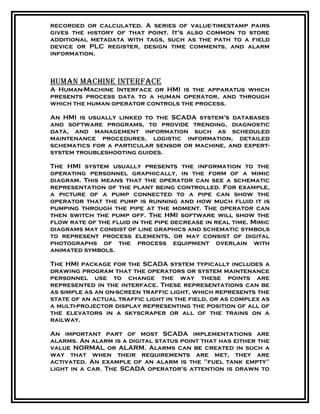
overriding or supervisory level intervention. For example, a
PLC may control the flow of cooling water through part of
an industrial process, but the SCADA system may allow
operators to change the set points for the flow,and enable
alarm conditions, such as loss of flow and high
temperature, to be displayed and recorded. The feedback
control loop passes through the RTU or PLC, while the
SCADA system monitors the overall performance of the
loop.
Data acquisition begins at the RTU or PLC level and includes
meter readings and equipment status reports that are
communicated to SCADA as required. Data is then compiled
and formatted in such a way that a control room operator
using the HMI can make supervisory decisions to adjust or
override normal RTU (PLC) controls. Data may also be fed to
a Historian, often built on a commodity Database
Management System, to allow trending and other analytical
auditing.
SCADA systems typically implement a distributed database,
commonly referred to as a tag database, which contains
data elements called tags or points. A point represents a
single input or output value monitored or controlled by the
system. Points can be either "hard" or "soft". A hard point
represents an actual input or output within the system,
while a soft point results from logic and math operations
applied to other points. (Most implementations conceptually
remove the distinction by making every property a "soft"
point expression, which may, in the simplest case, equal a
single hard point.) Points are normally stored as value-
timestamp pairs: a value and the timestamp when it was
recorded or calculated. A series of value-timestamp pairs
gives the history of that point. It's also common to store
additional metadata with tags, such as the path to a field
device or PLC register, design time comments, and alarm
information.
Human maCHine interfaCe
A Human-Machine Interface or HMI is the apparatus which
presents process data to a human operator, and through
which the human operator controls the process.
An HMI is usually linked to the SCADA system's databases
and software programs, to provide trending, diagnostic
data, and management information such as scheduled
maintenance procedures, logistic information, detailed
schematics for a particular sensor or machine, and expert-
system troubleshooting guides.
The HMI system usually presents the information to the
operating personnel graphically, in the form of a mimic
diagram. This means that the operator can see a schematic
representation of the plant being controlled. For example,
a picture of a pump connected to a pipe can show the
operator that the pump is running and how much fluid it is
pumping through the pipe at the moment. The operator can
then switch the pump off. The HMI software will show the
flow rate of the fluid in the pipe decrease in real time. Mimic
diagrams may consist of line graphics and schematic symbols
to represent process elements, or may consist of digital
photographs of the process equipment overlain with
animated symbols.
The HMI package for the SCADA system typically includes a
drawing program that the operators or system maintenance
personnel use to change the way these points are
represented in the interface. These representations can be
as simple as an on-screen traffic light, which represents the
state of an actual traffic light in the field, or as complex as
a multi-projector display representing the position of all of
the elevators in a skyscraper or all of the trains on a
railway.
An important part of most SCADA implementations are
alarms. An alarm is a digital status point that has either the
value NORMAL or ALARM. Alarms can be created in such a
way that when their requirements are met, they are
activated. An example of an alarm is the "fuel tank empty"
light in a car. The SCADA operator's attention is drawn to
the part of the system requiring attention by the alarm.
Emails and text messages are often sent along with an alarm
activation alerting managers along with the SCADA
operator.
Hardware solutions
SCADA solutions often have Distributed Control System
(DCS) components. Use of "smart" RTUs or PLCs, which are
capable of autonomously executing simple logic processes
without involving the master computer, is increasing. A
functional block programming language, IEC 61131-3
(Ladder Logic), is frequently used to create programs which
run on these RTUs and PLCs. Unlike a procedural language
such as the C programming language or FORTRAN, IEC
61131-3 has minimal training requirements by virtue of
resembling historic physical control arrays. This allows
SCADA system engineers to perform both the design and
implementation of a program to be executed on an RTU or
PLC. A Programmable automation controller (PAC) is a
compact controller that combines the features and
capabilities of a PC-based control system with that of a
typical PLC. PACs are deployed in SCADA systems to provide
RTU and PLC functions. In many electrical substation SCADA
applications, "distributed RTUs" use information processors
or station computers to communicate with protective relays,
PACS, and other devices for I/O, and communicate with the
SCADA master in lieu of a traditional RTU.
Since about 1998, virtually all major PLC manufacturers
have offered integrated HMI/SCADA systems, many of them
using open and non-proprietary communications protocols.
Numerous specialized third-party HMI/SCADA packages,
offering built-in compatibility with most major PLCs, have
also entered the market, allowing mechanical engineers,
electrical engineers and technicians to configure HMIs
themselves, without the need for a custom-made program
written by a software developer.
remote terminal unit (rtu)
The RTU connects to physical equipment. Typically, an RTU
converts the electrical signals from the equipment to
digital values such as the open/closed status from a switch
or a valve, or measurements such as pressure, flow, voltage
or current. By converting and sending these electrical
signals out to equipment the RTU can control equipment,
such as opening or closing a switch or a valve, or setting the
speed of a pump.
supervisory station
The term "Supervisory Station" refers to the servers and
software responsible for communicating with the field
equipment (RTUs, PLCs, etc), and then to the HMI software
running on workstations in the control room, or elsewhere.
In smaller SCADA systems, the master station may be
composed of a single PC. In larger SCADA systems, the
master station may include multiple servers, distributed
software applications, and disaster recovery sites. To
increase the integrity of the system the multiple servers
will often be configured in a dual-redundant or hot-standby
formation providing continuous control and monitoring in
the event of a server failure.
Initially, more "open" platforms such as Linux were not as
widely used due to the highly dynamic development
environment and because a SCADA customer that was able
to afford the field hardware and devices to be controlled
could usually also purchase UNIX or OpenVMS licenses.
Today, all major operating systems are used for both master
station servers and HMI workstations.
operational pHilosopHy
For some installations, the costs that would result from
the control system failing are extremely high. Possibly even
lives could be lost. Hardware for some SCADA systems is
ruggedized to withstand temperature, vibration, and voltage
extremes, but in most critical installations reliability is
enhanced by having redundant hardware and
communications channels, up to the point of having multiple
fully equipped control centres. A failing part can be quickly
identified and its functionality automatically taken over by
backup hardware. A failed part can often be replaced
without interrupting the process. The reliability of such
systems can be calculated statistically and is stated as the
mean time to failure, which is a variant of mean time between
failures. The calculated mean time to failure of such high
reliability systems can be on the order of centuries.
CommuniCation infrastruCture and metHods
SCADA systems have traditionally used combinations of
radio and direct serial or modem connections to meet
communication requirements, although Ethernet and IP over
SONET / SDH is also frequently used at large sites such as
railways and power stations. The remote management or
monitoring function of a SCADA system is often referred to
as telemetry.
This has also come under threat with some customers
wanting SCADA data to travel over their pre-established
corporate networks or to share the network with other
applications. The legacy of the early low-bandwidth
protocols remains, though. SCADA protocols are designed
to be very compact and many are designed to send
information to the master station only when the master
station polls the RTU. Typical legacy SCADA protocols
include Modbus RTU, RP-570, Profibus and Conitel. These
communication protocols are all SCADA-vendor specific but
are widely adopted and used. Standard protocols are IEC
60870-5-101 or 104, IEC 61850 and DNP3. These
communication protocols are standardized and recognized
by all major SCADA vendors. Many of these protocols now
contain extensions to operate over TCP/IP. It is good
security engineering practice to avoid connecting SCADA
systems to the Internet so the attack surface is reduced.
RTUs and other automatic controller devices were being
developed before the advent of industry wide standards for
interoperability. The result is that developers and their
management created a multitude of control protocols.
Among the larger vendors, there was also the incentive to
create their own protocol to "lock in" their customer base.
A list of automation protocols is being compiled here.
Recently, OLE for Process Control (OPC) has become a
widely accepted solution for intercommunicating different
hardware and software, allowing communication even
between devices originally not intended to be part of an
industrial network.
DESIGN MODULES
1] adC interfaCe
Analog to digital converters sense a voltage and
convert it into its corresponding digital
representation, based on the percentage of the full
range of the input. For an 8-bit A/D, there are 256
discrete representations of the input voltage. In other
words, it takes the input voltage range and divides it
into 256 equal parts. If, for instance, your input range
was 0 to 2.56 volts, the smallest increment the A/D can
measure is 2.56/256 or 10 mV. Since most micro
controllers operate with 8 bits, using an 8 bit A/D
works out well.
2] rfreCeiver
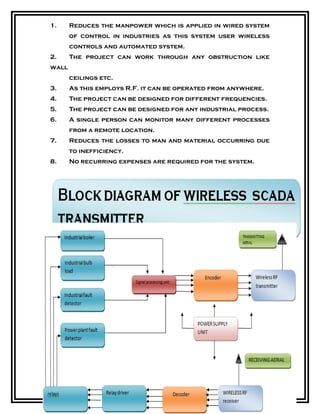
The RF RECEIVER modulates the digital data an
RECEVER FROM TX.
3] rftransmitter
The RF transmitter modulates the digital data and
send to the PC. It’s transmission frequency
315MHZ.
Technical specification
915 MHz (70 cms pan-Euro pean ISM allocation)
75E antenna connection
RF output power programmable in 10 steps between
l.mWand 10 mW
Range 250 m line of sight (LOS) or 30 m in buildings
Data speed on host link: 2.4 to 38.4 kbits/s, adjustable
in
five steps
Fixed 19.2 kbits/s data speed on RF link
Two hardware handshaking signals
RSSI (received signal strength) analogue output
Supply voltage 3.3 V to 5.5 V
a dot-matrix liquid crystal display are internally
provided on one chip, a minimal system can be interfaced
with this controller/driver. A single HD44780U can
display up to one 8-character line or two 8-character
lines.
Analog inputs
Voltage range - 0 - 5V
Resolution - 8 / 10 bits
Conversion time - 100uS
Total access time - 21uS + 10 I/O clock periods
Input resistance - typically >100M
Advantages
1. Reduces the manpower which is applied in wired system
of control in industries as this system user wireless
controls and automated system.
2. The project can work through any obstruction like
wall
ceilings etc.
3. As this employs R.F. it can be operated from anywhere.
4. The project can be designed for different frequencies.
5. The project can be designed for any industrial process.
6. A single person can monitor many different processes
from a remote location.
7. Reduces the losses to man and material occurring due
to inefficiency.
8. No recurring expenses are required for the system.
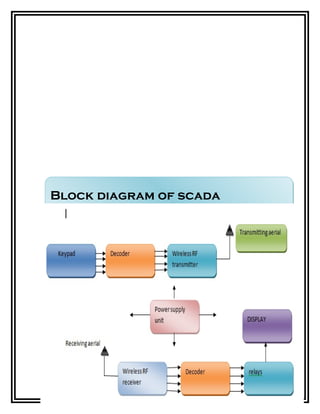
Block diagram of scada
receiver
FUTURE SCOPE
1. Live Audio view of the process can be achieved.
2. In future it can be improved by using different
upcoming Technology.
3. With modification in the circuit the system can
be used for 3-φ phase system.
APPLICATION
 Fire detection automation
 Gas detection automation
 Liquid process automation
 Water heater automation
 Labor detection automation
 Siren control automation
 Automatic electric control automation
 Heavy weight detection automation
 Automatic motor control automation
RefeReNCe bOOk
Principles of electronics - v.k.mehtha
Digital principles and application - malvino and
leach
Digital fundamental - Floyd
Op-amp - gayakwad
Electronics for you - magazine
Programmable logic controller - john w.webb and
Ronald a reis
Websites:
www.8052.com
www.Roboticengg.com
www.Hobby electronics.com
www.wikipedia.com
www.google.com
www.toshiba.com
www.Hobbykits4u.net
www.technologyuk.com

03 scada.synopsis

  • 1.
    SCADA stands forSupervisory Control and Data Acquisition. It generally refers to an industrial control system: a computer system monitoring and controlling a process. The process can be industrial, infrastructure or facility based as described below: • Industrial processes include those of manufacturing, production, power generation, fabrication, and refining, and may run in continuous, batch, repetitive, or discrete modes. • Infrastructure processes may be public or private, and include water treatment and distribution, wastewater collection and treatment, oil and gas pipelines, electrical power transmission and distribution, civil defense siren systems, and large communication systems. • Facility processes occur both in public facilities and private ones, including buildings, airports, ships, and space stations. They monitor and control HVAC, access, and energy consumption. Common system Components A SCADA System usually consists of the following subsystems: • A Human-Machine Interface or HMI: is the apparatus which presents process data to a human operator, and through this, the human operator monitors and controls the process. • A supervisory (computer) system: gathering (acquiring) data on the process and sending commands (control) to the process.
  • 2.
    • Remote TerminalUnits (RTUs) : connecting to sensors in the process, converting sensor signals to digital data and sending digital data to the supervisory system. • Programmable Logic Controller (PLCs):used as field devices because they are more economical, versatile, flexible, and configurable than special- purpose RTUs. • Communication infrastructure: connecting the supervisory system to the Remote Terminal Units supervision vs. Control There is, in several industries, considerable confusion over the differences between SCADA systems and Distributed control systems (DCS). Generally speaking, a SCADA system usually refers to a system that coordinates, but does not control processes in real time. The discussion on real-time control is muddied somewhat by newer telecommunications technology, enabling reliable, low latency, high speed communications over wide areas. Most differences between SCADA and DCS are culturally determined and can usually be ignored. As communication infrastructures with higher capacity become available, the difference between SCADA and DCS will fade. systems ConCepts The term SCADA usually refers to centralized systems which monitor and control entire sites, or complexes of systems spread out over large areas (anything between an industrial plant and a country). Most control actions are performed automatically by remote terminal units ("RTUs") or by programmable logic controllers ("PLCs"). Host control functions are usually restricted to basic overriding or supervisory level intervention. For example, a PLC may control the flow of cooling water through part of an industrial process, but the SCADA system may allow operators to change the set points for the flow,and enable alarm conditions, such as loss of flow and high temperature, to be displayed and recorded. The feedback control loop passes through the RTU or PLC, while the SCADA system monitors the overall performance of the loop.
  • 3.
    Data acquisition beginsat the RTU or PLC level and includes meter readings and equipment status reports that are communicated to SCADA as required. Data is then compiled and formatted in such a way that a control room operator using the HMI can make supervisory decisions to adjust or override normal RTU (PLC) controls. Data may also be fed to a Historian, often built on a commodity Database Management System, to allow trending and other analytical auditing. SCADA systems typically implement a distributed database, commonly referred to as a tag database, which contains data elements called tags or points. A point represents a single input or output value monitored or controlled by the system. Points can be either "hard" or "soft". A hard point represents an actual input or output within the system, while a soft point results from logic and math operations applied to other points. (Most implementations conceptually remove the distinction by making every property a "soft" point expression, which may, in the simplest case, equal a single hard point.) Points are normally stored as value- timestamp pairs: a value and the timestamp when it was
  • 4.
    recorded or calculated.A series of value-timestamp pairs gives the history of that point. It's also common to store additional metadata with tags, such as the path to a field device or PLC register, design time comments, and alarm information. Human maCHine interfaCe A Human-Machine Interface or HMI is the apparatus which presents process data to a human operator, and through which the human operator controls the process. An HMI is usually linked to the SCADA system's databases and software programs, to provide trending, diagnostic data, and management information such as scheduled maintenance procedures, logistic information, detailed schematics for a particular sensor or machine, and expert- system troubleshooting guides. The HMI system usually presents the information to the operating personnel graphically, in the form of a mimic diagram. This means that the operator can see a schematic representation of the plant being controlled. For example, a picture of a pump connected to a pipe can show the operator that the pump is running and how much fluid it is pumping through the pipe at the moment. The operator can then switch the pump off. The HMI software will show the flow rate of the fluid in the pipe decrease in real time. Mimic diagrams may consist of line graphics and schematic symbols to represent process elements, or may consist of digital photographs of the process equipment overlain with animated symbols. The HMI package for the SCADA system typically includes a drawing program that the operators or system maintenance personnel use to change the way these points are represented in the interface. These representations can be as simple as an on-screen traffic light, which represents the state of an actual traffic light in the field, or as complex as a multi-projector display representing the position of all of the elevators in a skyscraper or all of the trains on a railway. An important part of most SCADA implementations are alarms. An alarm is a digital status point that has either the value NORMAL or ALARM. Alarms can be created in such a way that when their requirements are met, they are activated. An example of an alarm is the "fuel tank empty" light in a car. The SCADA operator's attention is drawn to
  • 5.
    the part ofthe system requiring attention by the alarm. Emails and text messages are often sent along with an alarm activation alerting managers along with the SCADA operator. Hardware solutions SCADA solutions often have Distributed Control System (DCS) components. Use of "smart" RTUs or PLCs, which are capable of autonomously executing simple logic processes without involving the master computer, is increasing. A functional block programming language, IEC 61131-3 (Ladder Logic), is frequently used to create programs which run on these RTUs and PLCs. Unlike a procedural language such as the C programming language or FORTRAN, IEC 61131-3 has minimal training requirements by virtue of resembling historic physical control arrays. This allows SCADA system engineers to perform both the design and implementation of a program to be executed on an RTU or PLC. A Programmable automation controller (PAC) is a compact controller that combines the features and capabilities of a PC-based control system with that of a typical PLC. PACs are deployed in SCADA systems to provide RTU and PLC functions. In many electrical substation SCADA applications, "distributed RTUs" use information processors or station computers to communicate with protective relays, PACS, and other devices for I/O, and communicate with the SCADA master in lieu of a traditional RTU. Since about 1998, virtually all major PLC manufacturers have offered integrated HMI/SCADA systems, many of them using open and non-proprietary communications protocols. Numerous specialized third-party HMI/SCADA packages, offering built-in compatibility with most major PLCs, have also entered the market, allowing mechanical engineers, electrical engineers and technicians to configure HMIs themselves, without the need for a custom-made program written by a software developer. remote terminal unit (rtu) The RTU connects to physical equipment. Typically, an RTU converts the electrical signals from the equipment to digital values such as the open/closed status from a switch or a valve, or measurements such as pressure, flow, voltage or current. By converting and sending these electrical signals out to equipment the RTU can control equipment, such as opening or closing a switch or a valve, or setting the speed of a pump.
  • 6.
    supervisory station The term"Supervisory Station" refers to the servers and software responsible for communicating with the field equipment (RTUs, PLCs, etc), and then to the HMI software running on workstations in the control room, or elsewhere. In smaller SCADA systems, the master station may be composed of a single PC. In larger SCADA systems, the master station may include multiple servers, distributed software applications, and disaster recovery sites. To increase the integrity of the system the multiple servers will often be configured in a dual-redundant or hot-standby formation providing continuous control and monitoring in the event of a server failure. Initially, more "open" platforms such as Linux were not as widely used due to the highly dynamic development environment and because a SCADA customer that was able to afford the field hardware and devices to be controlled could usually also purchase UNIX or OpenVMS licenses. Today, all major operating systems are used for both master station servers and HMI workstations. operational pHilosopHy For some installations, the costs that would result from the control system failing are extremely high. Possibly even lives could be lost. Hardware for some SCADA systems is ruggedized to withstand temperature, vibration, and voltage extremes, but in most critical installations reliability is enhanced by having redundant hardware and communications channels, up to the point of having multiple fully equipped control centres. A failing part can be quickly identified and its functionality automatically taken over by backup hardware. A failed part can often be replaced without interrupting the process. The reliability of such systems can be calculated statistically and is stated as the mean time to failure, which is a variant of mean time between failures. The calculated mean time to failure of such high reliability systems can be on the order of centuries. CommuniCation infrastruCture and metHods SCADA systems have traditionally used combinations of radio and direct serial or modem connections to meet communication requirements, although Ethernet and IP over SONET / SDH is also frequently used at large sites such as railways and power stations. The remote management or monitoring function of a SCADA system is often referred to as telemetry.
  • 7.
    This has alsocome under threat with some customers wanting SCADA data to travel over their pre-established corporate networks or to share the network with other applications. The legacy of the early low-bandwidth protocols remains, though. SCADA protocols are designed to be very compact and many are designed to send information to the master station only when the master station polls the RTU. Typical legacy SCADA protocols include Modbus RTU, RP-570, Profibus and Conitel. These communication protocols are all SCADA-vendor specific but are widely adopted and used. Standard protocols are IEC 60870-5-101 or 104, IEC 61850 and DNP3. These communication protocols are standardized and recognized by all major SCADA vendors. Many of these protocols now contain extensions to operate over TCP/IP. It is good security engineering practice to avoid connecting SCADA systems to the Internet so the attack surface is reduced. RTUs and other automatic controller devices were being developed before the advent of industry wide standards for interoperability. The result is that developers and their management created a multitude of control protocols. Among the larger vendors, there was also the incentive to create their own protocol to "lock in" their customer base. A list of automation protocols is being compiled here. Recently, OLE for Process Control (OPC) has become a widely accepted solution for intercommunicating different hardware and software, allowing communication even between devices originally not intended to be part of an industrial network. DESIGN MODULES 1] adC interfaCe Analog to digital converters sense a voltage and convert it into its corresponding digital representation, based on the percentage of the full range of the input. For an 8-bit A/D, there are 256 discrete representations of the input voltage. In other words, it takes the input voltage range and divides it into 256 equal parts. If, for instance, your input range was 0 to 2.56 volts, the smallest increment the A/D can measure is 2.56/256 or 10 mV. Since most micro controllers operate with 8 bits, using an 8 bit A/D works out well. 2] rfreCeiver
  • 8.
    The RF RECEIVERmodulates the digital data an RECEVER FROM TX. 3] rftransmitter The RF transmitter modulates the digital data and send to the PC. It’s transmission frequency 315MHZ. Technical specification 915 MHz (70 cms pan-Euro pean ISM allocation) 75E antenna connection RF output power programmable in 10 steps between l.mWand 10 mW Range 250 m line of sight (LOS) or 30 m in buildings Data speed on host link: 2.4 to 38.4 kbits/s, adjustable in five steps Fixed 19.2 kbits/s data speed on RF link Two hardware handshaking signals RSSI (received signal strength) analogue output Supply voltage 3.3 V to 5.5 V a dot-matrix liquid crystal display are internally provided on one chip, a minimal system can be interfaced with this controller/driver. A single HD44780U can display up to one 8-character line or two 8-character lines. Analog inputs Voltage range - 0 - 5V Resolution - 8 / 10 bits Conversion time - 100uS Total access time - 21uS + 10 I/O clock periods Input resistance - typically >100M Advantages
  • 9.
    1. Reduces themanpower which is applied in wired system of control in industries as this system user wireless controls and automated system. 2. The project can work through any obstruction like wall ceilings etc. 3. As this employs R.F. it can be operated from anywhere. 4. The project can be designed for different frequencies. 5. The project can be designed for any industrial process. 6. A single person can monitor many different processes from a remote location. 7. Reduces the losses to man and material occurring due to inefficiency. 8. No recurring expenses are required for the system.
  • 10.
    Block diagram ofscada receiver
  • 11.
    FUTURE SCOPE 1. LiveAudio view of the process can be achieved. 2. In future it can be improved by using different upcoming Technology. 3. With modification in the circuit the system can be used for 3-φ phase system.
  • 12.
    APPLICATION  Fire detectionautomation  Gas detection automation  Liquid process automation  Water heater automation  Labor detection automation  Siren control automation  Automatic electric control automation  Heavy weight detection automation  Automatic motor control automation RefeReNCe bOOk Principles of electronics - v.k.mehtha Digital principles and application - malvino and leach Digital fundamental - Floyd Op-amp - gayakwad Electronics for you - magazine Programmable logic controller - john w.webb and Ronald a reis
  • 13.