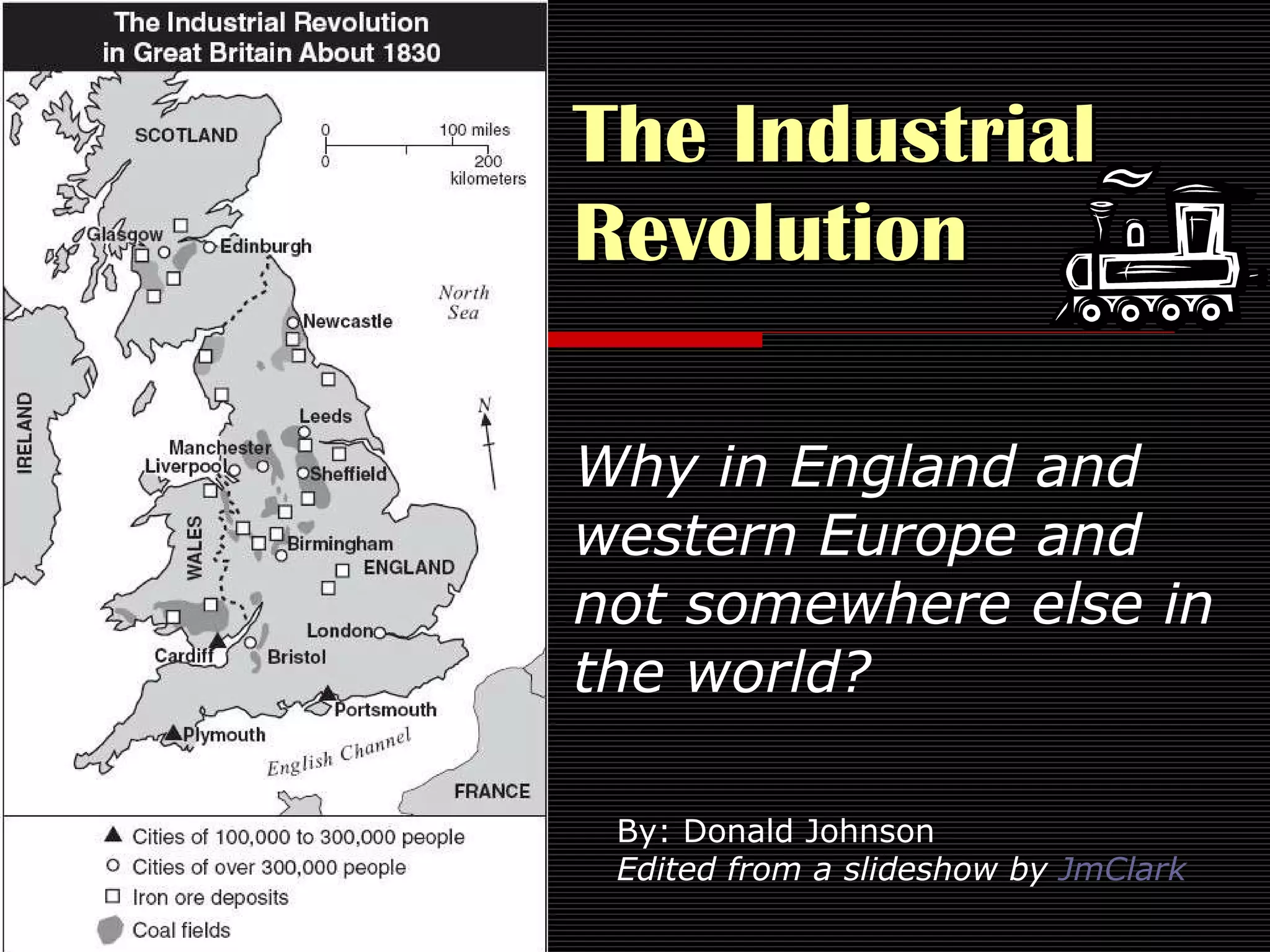
The Industrial Revolution   Why in England and western Europe and not somewhere else in the world? By: Donald Johnson Edited from a slideshow by  JmClark
The Industrial Revolution Today, most historians agree that the Industrial Revolution was a turning point in the history of the world. It changed the      Western world from    a rural and agrarian    society to an urban    and industrial society.
Advent of change Starting around 1750 Great Britain was to set the pace in Europe for the next century or so, thanks to its lucrative agrarian industry, wealthy landowners and an astonishing number of creative inventors.
Cottage Industry Before the Industrial Revolution, textiles were produced under the  putting-out system , in which merchant clothiers had their work done in the homes of artisans or farming families.
Cotton was spun and woven into cloth by hand in England until textile machinery, developed in the late 1700s, revolutionized its manufacture.
Spinning  Jenny First on the scene were spinning machines. These were followed by mechanical looms and before long textile factories were shooting up all over the place.
Water power The first textile mills, needing waterpower to drive their machinery, were built on fast-moving streams in rural England.
An English Mill Town Period art showing the transformation of the countryside during the Industrial Revolution in Great Britain
Cotton mill A cotton mill,  c. 1850 .  By the mid-19th century,  cotton manufacture was an  entirely factory-based  operation, notably in  the Lancashire towns  of Manchester and  Oldham as shown  in this photograph at  right.
Child Labor When the industrial evolution first came to Britain and the U.S., there was a high demand for labor. Families quickly migrated from the rural farm areas to the newly industrialized cities to find work.
Work conditions Once they got there, things  did not look as bright as  they did. To survive in even the lowest level of poverty, families had to have every able member of the family go to work. This led to the high rise in child labor in factories. Children were not treated well, overworked, and underpaid for a long time before anyone tried to change things for them.
Labor The way people worked changed, as did they way they lived - not always for the better.
Industrial Revolution Britain changed more during this era than at any other time. People moved from the  countryside  to the new  towns and  cities.
Superpower Britain became the world's biggest superpower with the huge increase in industrial production, and imperial expansion.
Ironbridge Gorge The world’s first castiron bridge, spanning the Severn at Coalbrookdale, was built in 1779 using iron from furnaces owned by Darby. Considered the birthplace of the Industrial Revolution, it had all the necessary ingredients for industrialization: coal, clay, ironstone, and limestone exposed at the surface.
Soana layout A map from 1761 illustrates in very fine detail, a group of buildings settled on the right bank of the Soana torrent. By the mid-1700s, the blood-red skies above the gorge meant power and success to the pioneering industrialists.
 
Iron If textiles fueled the Industrial Revolution, iron was the scaffolding on which it was constructed. Without iron, there could have been no meaningful industrialization.
Iron It was needed everywhere, from the framework of spinning mules to the boilers and cylinders of steam engines.
James Watts’ steam  engine
Double acting stationary engine The huge ironworks would never have come into existence without the steam engine, the third great trigger of the age.
Population Growth   Population  begins to grow  especially in  England. What are some possible explanations for this growth? Is the population more urban or rural?
Population growth resulted from: agricultural revolution expansion of trade openness to innovation
Agricultural  Revolution Acceptance of potato   2-3 more times  more food per acre than the crops it replaced  Turnips, Legumes, and Clover Easy on soil  Feed animals  (milk available)
Population Growth  Agricultural Revolution  leads to: More dependable food supplies Ends cyclical famine  Better nutrition leads to longer lifespan  More positive outlook on life
Population Growth   Dependable food supplies + good job opportunities = Younger average age of marriage  Earlier marriage increases the birthrate per couple  Early 19 th  century 40% of England under the age of 15  Migration from countryside to cities
Changes in Trade   Bettering Transportation Cottage Industries  Sweet Tooth for Europe Sugar Cane from plantations most profitable item in international trade
Developing infrastructure The development of the railway stimulated the economy  by providing cheap and efficient transport which lowered the carriage cost of goods.
Outcomes  Greater income disparity England becomes the major power in Europe through its successful trade  Capitalism beats out mercantilism as the way to run a country
T  e  m  x  i  t  l  l  l i l e   In this modern textile mill many machines whir busily in an initial stage of processing fiber into fabric.
Links http://www.puhsd.k12.ca.us/chana/staffpages/eichman/Adult_School/us/fall/industrialization/1/industrial_revolution.htm http://www.saburchill.com/history/chapters/IR/036.html http://www.learningcurve.gov.uk/victorianbritain/pdf/industrial.pdf http:// www.historywiz.com/galleries/milltown.htm http://www.nettlesworth.durham.sch.uk/time/victorian/vindust.html http://www.iwto.org/WhyWool/WoolHistory.htm http://www.nps.gov/archive/lowe/loweweb/lowell_history/england.htm

The industrial revolution

  • 1.
    The Industrial Revolution Why in England and western Europe and not somewhere else in the world? By: Donald Johnson Edited from a slideshow by JmClark
  • 2.
    The Industrial RevolutionToday, most historians agree that the Industrial Revolution was a turning point in the history of the world. It changed the Western world from a rural and agrarian society to an urban and industrial society.
  • 3.
    Advent of changeStarting around 1750 Great Britain was to set the pace in Europe for the next century or so, thanks to its lucrative agrarian industry, wealthy landowners and an astonishing number of creative inventors.
  • 4.
    Cottage Industry Beforethe Industrial Revolution, textiles were produced under the putting-out system , in which merchant clothiers had their work done in the homes of artisans or farming families.
  • 5.
    Cotton was spunand woven into cloth by hand in England until textile machinery, developed in the late 1700s, revolutionized its manufacture.
  • 6.
    Spinning JennyFirst on the scene were spinning machines. These were followed by mechanical looms and before long textile factories were shooting up all over the place.
  • 7.
    Water power Thefirst textile mills, needing waterpower to drive their machinery, were built on fast-moving streams in rural England.
  • 8.
    An English MillTown Period art showing the transformation of the countryside during the Industrial Revolution in Great Britain
  • 9.
    Cotton mill Acotton mill, c. 1850 . By the mid-19th century, cotton manufacture was an entirely factory-based operation, notably in the Lancashire towns of Manchester and Oldham as shown in this photograph at right.
  • 10.
    Child Labor Whenthe industrial evolution first came to Britain and the U.S., there was a high demand for labor. Families quickly migrated from the rural farm areas to the newly industrialized cities to find work.
  • 11.
    Work conditions Oncethey got there, things did not look as bright as they did. To survive in even the lowest level of poverty, families had to have every able member of the family go to work. This led to the high rise in child labor in factories. Children were not treated well, overworked, and underpaid for a long time before anyone tried to change things for them.
  • 12.
    Labor The waypeople worked changed, as did they way they lived - not always for the better.
  • 13.
    Industrial Revolution Britainchanged more during this era than at any other time. People moved from the countryside to the new towns and cities.
  • 14.
    Superpower Britain becamethe world's biggest superpower with the huge increase in industrial production, and imperial expansion.
  • 15.
    Ironbridge Gorge Theworld’s first castiron bridge, spanning the Severn at Coalbrookdale, was built in 1779 using iron from furnaces owned by Darby. Considered the birthplace of the Industrial Revolution, it had all the necessary ingredients for industrialization: coal, clay, ironstone, and limestone exposed at the surface.
  • 16.
    Soana layout Amap from 1761 illustrates in very fine detail, a group of buildings settled on the right bank of the Soana torrent. By the mid-1700s, the blood-red skies above the gorge meant power and success to the pioneering industrialists.
  • 17.
  • 18.
    Iron If textilesfueled the Industrial Revolution, iron was the scaffolding on which it was constructed. Without iron, there could have been no meaningful industrialization.
  • 19.
    Iron It wasneeded everywhere, from the framework of spinning mules to the boilers and cylinders of steam engines.
  • 20.
  • 21.
    Double acting stationaryengine The huge ironworks would never have come into existence without the steam engine, the third great trigger of the age.
  • 22.
    Population Growth Population begins to grow especially in England. What are some possible explanations for this growth? Is the population more urban or rural?
  • 23.
    Population growth resultedfrom: agricultural revolution expansion of trade openness to innovation
  • 24.
    Agricultural RevolutionAcceptance of potato 2-3 more times more food per acre than the crops it replaced Turnips, Legumes, and Clover Easy on soil Feed animals (milk available)
  • 25.
    Population Growth Agricultural Revolution leads to: More dependable food supplies Ends cyclical famine Better nutrition leads to longer lifespan More positive outlook on life
  • 26.
    Population Growth Dependable food supplies + good job opportunities = Younger average age of marriage Earlier marriage increases the birthrate per couple Early 19 th century 40% of England under the age of 15 Migration from countryside to cities
  • 27.
    Changes in Trade Bettering Transportation Cottage Industries Sweet Tooth for Europe Sugar Cane from plantations most profitable item in international trade
  • 28.
    Developing infrastructure Thedevelopment of the railway stimulated the economy by providing cheap and efficient transport which lowered the carriage cost of goods.
  • 29.
    Outcomes Greaterincome disparity England becomes the major power in Europe through its successful trade Capitalism beats out mercantilism as the way to run a country
  • 30.
    T e m x i t l l l i l e In this modern textile mill many machines whir busily in an initial stage of processing fiber into fabric.
  • 31.
    Links http://www.puhsd.k12.ca.us/chana/staffpages/eichman/Adult_School/us/fall/industrialization/1/industrial_revolution.htm http://www.saburchill.com/history/chapters/IR/036.htmlhttp://www.learningcurve.gov.uk/victorianbritain/pdf/industrial.pdf http:// www.historywiz.com/galleries/milltown.htm http://www.nettlesworth.durham.sch.uk/time/victorian/vindust.html http://www.iwto.org/WhyWool/WoolHistory.htm http://www.nps.gov/archive/lowe/loweweb/lowell_history/england.htm

Editor's Notes

  • #4 The Industrial Revolution did not arrive overnight but slowly spread all over the continent.
  • #5 Production was limited by reliance on the spinning wheel and the hand loom; increases in output required more hand workers at each stage.
  • #16 the Severn River, a vital transport link to major cities; and the ingenuity of men such as Abraham Darby.
  • #17 But the water was so polluted that it wasn’t fit to drink, life expectancy was low, and many of the children never made it out of infancy. Darby himself died at 39.
  • #19 , from the railway lines that criss-crossed the country to the metal skeletons of a thousand cotton mills and eventually, the iron ships that carried Britain's manufactured goods around the globe.
  • #22 The first working steam engines pumped pit water from the mines of Cornwall in 1776.
  • #31 The process is almost entirely coordinated and controlled by computer, with a small staff of managers, inspectors, and technicians to ensure quality and efficiency.